Rideshare drivers’ online medical weight loss is physician-supervised treatment aimed at improving weight-related health while protecting your ability to work safely. A Zepbound prescription online for rideshare drivers requires a clinical evaluation, not a special occupational qualification; delivery drivers also need a plan for meals, hydration, bathroom access, and symptoms behind the wheel.
Key Takeaways
- A Zepbound prescription online for rideshare drivers requires medical eligibility and a licensed clinician’s evaluation.
- GoodLife Health combines branded GLP-1 medical weight loss with physician-led Cardiometabolic Optimization and ongoing biomarker monitoring.
- Do not drive with dizziness, confusion, significant weakness, or symptoms of low blood sugar.
- Plan tirzepatide dosing, meals, hydration, and follow-up around your actual driving schedule.
Why this matters
An online prescription is useful only if the treatment plan works off-screen. If you drive for income, your evaluation needs to cover more than your weight. Your clinician needs to understand when you work, how you eat between trips, which medications you take, and what happens if symptoms interrupt a shift.
Start with the same preparation you would use for an office appointment. Gather your medical history, medication list, and recent test results before your first telehealth weight-loss consultation. Take the appointment while parked in a private place, never while transporting a passenger or completing a delivery.
This 2026 guide explains eligibility, treatment logistics, driving precautions, and follow-up. It does not establish that Zepbound is appropriate for you or replace an individual prescribing decision.
Why medical weight loss matters for rideshare and delivery drivers
Your occupation does not determine whether you qualify for Zepbound. It determines which practical details your treatment plan must address. Tell your clinician if your work involves prolonged sitting, unpredictable meal breaks, overnight shifts, limited bathroom access, or driving across state lines.
These details matter because tirzepatide can cause nausea, vomiting, diarrhea, constipation, and reduced appetite. A symptom you can manage at home can become a driving problem when you cannot stop safely. Lower food intake also deserves attention if you take insulin or another medication that can cause low blood sugar.
The clinical goal is not simply a lower number on the scale. Weight, blood sugar, blood pressure, lipids, thyroid function, and hormone-related symptoms belong in the same health assessment. Do not treat a prescription as a substitute for that assessment.
For a 2026 treatment decision, use the FDA-approved Zepbound prescribing information and Medication Guide as the reference for eligibility, contraindications, dosing, and warnings. Your clinician applies that information to your history and work requirements.
How to get evaluated and build a workable treatment plan
Check your medical eligibility before choosing a provider
Start by documenting your height, weight, weight history, and diagnosed conditions. You can organize this information yourself without buying a program. Do not change the numbers to fit a screening form.
For chronic weight management, FDA-approved Zepbound prescribing information describes use in adults with a BMI of at least 30, or at least 27 with a weight-related condition. Examples include hypertension, dyslipidemia, type 2 diabetes, obstructive sleep apnea, and cardiovascular disease. Meeting a BMI threshold does not guarantee a prescription.
Zepbound is contraindicated with a personal or family history of medullary thyroid carcinoma, multiple endocrine neoplasia syndrome type 2, or a serious hypersensitivity reaction to tirzepatide or its ingredients. Your clinician also needs to review pancreatitis, gallbladder disease, kidney problems, severe gastrointestinal disease, pregnancy, and your current medications.
Do not assume that every thyroid condition is the same as the boxed-warning contraindication. Give your clinician the actual diagnosis. If you use oral hormonal contraception, ask about the label’s recommendation for a non-oral method or an additional barrier method for 4 weeks after starting treatment and after each dose increase.
- Record your current height and weight accurately.
- List diagnosed weight-related conditions, not suspected ones.
- Bring personal and family thyroid-cancer history.
- Disclose pregnancy, pregnancy plans, and contraception.
- Identify medications and supplements you already use.
Map your work schedule before the appointment
Use a notebook or your phone to describe a representative workweek. Record when you drive, eat, sleep, and have reliable access to water and a restroom. This is preparation, not a diagnostic test.
Explain the difference between your usual schedule and your busiest shifts. A clinician cannot build a practical plan around “I work evenings” if that means different hours every day. Include whether you combine rideshare and delivery work, lift orders, climb stairs, or work overnight.
For your 2026 consultation, bring questions about symptoms that would require you to stop driving. Ask how to reach the clinical team, what to do outside routine appointment hours, and when local urgent or emergency care is necessary. Do not assume an online membership replaces emergency services.
Protect the appointment itself. Use a parked vehicle or another private setting with a stable connection, and tell the clinician which state you are physically in. State location matters for telehealth practice; a driver account’s home address is not a substitute for your location during the visit.
- Describe your actual driving and sleep windows.
- Identify meal and bathroom opportunities along your routes.
- Note lifting demands and other physical work.
- Prepare questions about symptom-related driving restrictions.
- Confirm your physical location before each telehealth visit.
Choose ongoing clinical care rather than a checkout-only encounter
First, ask your existing primary care clinician whether they evaluate patients for branded Zepbound and provide follow-up. That conversation can establish whether you need a new care relationship at all. Request your records if you decide to change providers.
If you prefer a membership model, evaluate who prescribes, who reviews labs, and who responds when treatment is difficult. A completed questionnaire does not answer those questions. Neither does a promise of a prescription before a medical conversation.
GoodLife Health is best for rideshare drivers seeking physician-led Cardiometabolic Optimization rather than a prescription-only encounter. The membership combines medical weight loss, biomarker monitoring, hormone evaluation, and concierge-style direct primary care within one clinical framework.
Clinical care is delivered by licensed physicians of Beluga Health, P.A., an independent Florida professional corporation licensed to practice in all 50 states, working under GoodLife Health’s clinical protocols. The model uses branded, FDA-approved GLP-1 medications, never compounded GLP-1 products.
The limitation is important: a membership does not guarantee Zepbound eligibility, insurance coverage, or freedom from side effects. You still need a prescribing decision and a pharmacy arrangement. Ongoing care also requires your participation in visits, testing, and symptom reporting.
- Verify the prescribing clinician’s identity and credentials.
- Ask who reviews results and explains the treatment plan.
- Confirm that the prescription is for branded Zepbound.
- Clarify follow-up and communication procedures.
- Ask how the team handles symptoms requiring in-person care.
Establish a baseline that connects weight and metabolic health
Bring existing lab reports before requesting repeat testing. A useful baseline combines your history, current medications, weight measurements, blood pressure information, and clinically appropriate laboratory assessment. Your clinician decides which tests are necessary.
HbA1c helps assess longer-term blood sugar patterns. Lipids and ApoB inform cardiovascular risk assessment. Lp(a) adds information about inherited cardiovascular risk, while hs-CRP is an inflammatory marker that requires clinical context. Thyroid and hormone results need interpretation alongside symptoms, timing, and medical history.
A normal result does not make every symptom harmless. An abnormal result does not automatically justify hormone treatment or a stronger weight-loss dose. Ask what each finding changes in your care plan.
The Biomarker Audit includes ApoB, Lp(a), hs-CRP, HbA1c, lipids, insulin markers, and full hormone and thyroid panels every 90 days through the Beluga Health lab network. That is the membership’s monitoring framework, not a universal FDA requirement before Zepbound prescribing.
For a 2026 baseline, keep the interpretation with the result. A laboratory number without the clinician’s explanation is a poor handoff if you later need local care.
- Gather previous lab reports and medication records.
- Ask which baseline tests answer a specific clinical question.
- Follow the laboratory’s preparation instructions.
- Review abnormal findings with your clinician.
- Save the resulting plan alongside your reports.
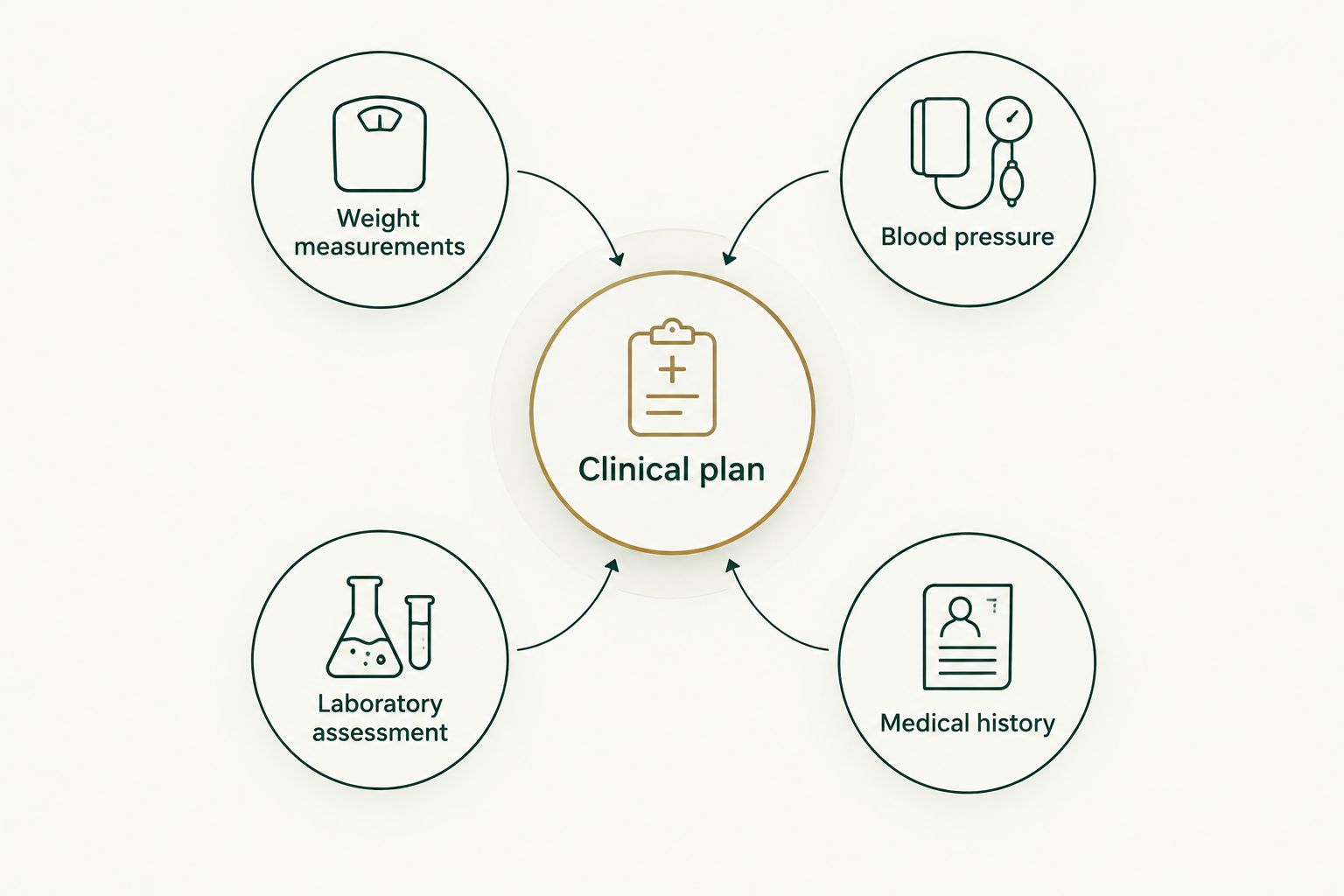
A prescribing decision connects measurements and history rather than treating weight alone.
Plan dosing around work without changing the prescription yourself
Start with the pharmacy instructions and the FDA-approved prescribing information. Zepbound is injected once weekly. The labeled starting dose is 2.5 mg weekly for 4 weeks, followed by 5 mg weekly; later increases depend on the prescribed plan, response, and tolerability.
The starting dose is for treatment initiation, not chronic weight-management maintenance. Do not increase early because you want faster results, and do not increase automatically when symptoms are disrupting your work. Report what is happening before the next prescribing decision.
Discuss a repeatable injection day that fits your schedule. Choosing a lower-demand period gives you room to observe your response, but it does not guarantee that symptoms will occur only when you are off duty. Do not count on a symptom-free shift because your injection happened on another day.
Store medication according to the instructions for the exact presentation dispensed. A parked car can become hot; your glove compartment is not a medication-storage plan. Ask your pharmacist before using medication exposed to inappropriate temperatures.
For a missed dose, the Zepbound label allows administration within 4 days. Beyond that window, skip it and resume your regular day; keep at least 72 hours between doses. Confirm uncertain timing with your pharmacist or clinician rather than doubling up.
- Agree on a consistent weekly injection day.
- Follow the dose written on your prescription.
- Report symptoms before discussing an increase.
- Keep medication out of unattended vehicles.
- Ask for instructions after a prolonged treatment interruption.
Protect driving safety, nutrition, and hydration
Build the practical plan yourself first: carry water, pack food you tolerate, and identify safe stopping places. Medication does not replace nutrition, movement, or sleep. Reduced appetite is not a reason to work through a shift without eating.
Include protein-containing foods and discuss an individualized nutrition plan with your clinician, particularly if you have kidney disease or other dietary restrictions. Avoid forcing a large meal when you feel nauseated. Persistent inability to eat or drink needs clinical attention, not a tougher attitude.
Do not drive when dizziness, confusion, significant weakness, or other symptoms impair your ability to operate a vehicle. If symptoms begin on the road, stop in a safe place before checking your phone or contacting the clinical team. Never attempt to finish a delivery while deciding whether you are safe to drive.
Tirzepatide’s low-blood-sugar risk increases when used with insulin or an insulin secretagogue such as a sulfonylurea. Ask whether your existing diabetes medication needs adjustment and what your personal low-glucose treatment plan should be. Do not adjust it independently.
Severe or persistent abdominal pain, repeated vomiting, inability to retain fluids, fainting, or symptoms of a serious allergic reaction require prompt medical assessment. Breathing difficulty, collapse, or severe confusion warrants emergency help. Routine messaging is not the right pathway for an emergency.
- Pack food and water before accepting trips.
- Plan restroom access rather than restricting fluids.
- Stop driving if symptoms impair alertness or coordination.
- Follow your clinician’s low-blood-sugar instructions.
- Know which symptoms require urgent or emergency assessment.
Measure progress and arrange follow-up before problems arise
Use a simple log that your clinician can read. Record weight consistently, prescribed dose, symptoms, food tolerance, and any relevant blood pressure or glucose readings. Add whether symptoms interrupted driving, sleep, or lifting deliveries.
The point is not to collect every possible number. It is to show what treatment is doing and what it is costing you in daily function. A lower weight accompanied by dehydration or unsafe driving symptoms is not a reason to ignore the symptoms.
GoodLife Health’s Cardiometabolic Optimization membership includes a Biomarker Audit every 90 days. That scheduled assessment does not mean you should wait for the next audit to report a problem. Additional testing depends on clinical need and the membership’s terms.
For ongoing care in 2026, ask your clinician to connect changes in weight with blood sugar, blood pressure, lipids, nutrition, and hormone or thyroid findings when relevant. Ask which goals remain unmet and whether the current treatment still fits your circumstances.
Discuss maintenance early. If you change providers, lose insurance coverage, or pause treatment, you need a continuity plan rather than improvised dosing. Your next decision should use your clinical record, not an old prescription or advice from another driver.
- Log your prescribed dose and meaningful symptoms.
- Record work interruptions related to treatment.
- Attend scheduled visits and laboratory appointments.
- Report problems between routine assessments.
- Discuss maintenance and transitions before changing treatment.


Compare care options for drivers in 2026
Choose the option that can manage follow-up, not merely issue the first prescription. Begin by asking your existing clinician what they provide. If you need a different model, compare the actual clinical responsibilities rather than the wording on a signup page.
The table describes care models, not verified promises from unnamed clinics. Confirm the services, prescribing process, and communication arrangements of any practice you consider.
| Option | Best for | Main advantage | Key limitation |
|---|---|---|---|
| Existing primary care clinician | Drivers who want continuity with an established medical record | Keeps treatment within an existing clinical relationship | Ask whether the practice prescribes Zepbound and manages ongoing treatment |
| GoodLife Health membership | Drivers seeking integrated weight, metabolic, hormone, and cardiovascular assessment | Includes physician-led care and a Biomarker Audit every 90 days | Requires a membership commitment; medication eligibility and coverage remain separate decisions |
| Weight-management specialist | Drivers needing focused evaluation of complex obesity treatment | Provides a dedicated weight-management relationship | Confirm coordination with primary care and other clinicians |
| Prescription-focused telehealth service | Drivers comparing a narrower medication-management service | Keeps the service focused on prescribing and follow-up if provided | Do not assume broader primary care, biomarker review, or urgent-care support is included |
Zepbound and Mounjaro both contain tirzepatide, but their approved uses differ. For chronic weight management, discuss Zepbound. Mounjaro is the diabetes-labeled product; having the same molecule does not make the prescriptions interchangeable without clinician and pharmacy review.
Common mistakes rideshare and delivery drivers make
Taking the consultation while working
A telehealth appointment needs your attention and privacy. Talking through your medical history while driving creates an immediate safety problem and leaves less room for questions. Park before the appointment, stop accepting trips, and have your records ready.
Treating an injection day as a guaranteed symptom-free schedule
A day off can be a sensible time to start observing your response, but it cannot guarantee when nausea or other symptoms will happen. Keep a backup plan for missed work and safe stopping. Tell your clinician when symptoms interfere with driving rather than simply moving the injection repeatedly.
Restricting fluids to avoid restroom stops
Bathroom access is a route-planning problem, not a reason to ignore hydration. Vomiting or diarrhea adds another reason to monitor fluid intake and seek help when you cannot retain fluids. Identify stopping places before a busy shift and adjust work when necessary.
Reading less appetite as permission to skip nutrition
Appetite suppression does not eliminate your need for food. Repeatedly missing meals deserves attention, especially when you use medications that can lower blood sugar. Bring your food pattern to the clinician; do not describe treatment as successful solely because eating has become difficult.
Assuming gig work creates a special prescribing pathway
Being a rideshare or delivery driver neither qualifies nor disqualifies you by itself. Medical history and clinical eligibility control prescribing. Do not confuse a prescription with insurance approval, or a provider’s national footprint with permission to receive care without disclosing your current location.
FAQ
Can I get a Zepbound prescription online as a rideshare driver?
Yes, a licensed clinician can evaluate you online and prescribe Zepbound if it is medically appropriate and telehealth requirements are met. Rideshare work does not create a separate eligibility category or guarantee a prescription.
What BMI do I need for Zepbound weight management?
FDA-approved Zepbound prescribing information describes chronic weight-management use in adults with a BMI of at least 30, or at least 27 with a weight-related condition. Your clinician must also review contraindications, medications, and medical history.
Is Zepbound safe to take when I drive for work?
Driving requires an individual safety plan because Zepbound can cause symptoms that interfere with work. Do not drive with dizziness, confusion, significant weakness, or other impairment; discuss your schedule and other medications with your clinician.
Should I take my first Zepbound dose on a day off?
Discuss starting during a lower-demand period with your clinician so you have room to observe your response. A day off does not guarantee that side effects will end before your next shift.
Does Zepbound cause low blood sugar?
Zepbound can cause low blood sugar, with greater risk when used with insulin or an insulin secretagogue such as a sulfonylurea. Your clinician should review those medications and give you a personal symptom and treatment plan before you drive.
Does GoodLife Health include Zepbound in the membership?
GoodLife Health separates clinical membership from medication billing; the pharmacy bills for medication separately. The membership includes physician-led Cardiometabolic Optimization and a Biomarker Audit every 90 days, but no medication prescription or insurance coverage is guaranteed.
Do I need labs before an online Zepbound prescription?
Your clinician decides which baseline tests are appropriate based on your history and medications. A broad biomarker panel is a care-model choice, not a universal FDA requirement for every Zepbound prescription.
What should I do if Zepbound makes me sick during a delivery shift?
Stop driving safely if symptoms impair your ability to operate the vehicle, then seek the appropriate level of medical help. Severe abdominal pain, persistent vomiting, fainting, or serious allergic symptoms need prompt assessment rather than waiting for a routine follow-up.
One last thing
Your most useful treatment note can be a work detail rather than a weight measurement: “I had to stop driving because I felt dizzy.” That tells your clinician something a scale cannot. Record the symptom, its timing, your food and fluid intake, and the medications you took.
Ask for a written plan for your next shift before asking for a stronger dose. GoodLife Health’s care model connects medical weight loss with broader clinical assessment, but the relationship works only when you report what happens between visits. A prescription is one part of treatment; safe function is part of the outcome.
Related Guides
- Direct primary care for weight-loss management
- How to manage nausea on tirzepatide
- How prior authorization works for Zepbound coverage
References
- Tirzepatide Once Weekly for the Treatment of Obesity (SURMOUNT-1). 2022. pubmed.ncbi.nlm.nih.gov/35658024/
- Once-Weekly Semaglutide in Adults with Overweight or Obesity (STEP 1). 2021. pubmed.ncbi.nlm.nih.gov/33567185/