Airline pilots’ online TRT is physician-managed testosterone replacement therapy delivered through telehealth to treat confirmed testosterone deficiency, with aviation medical requirements addressed separately. Online TRT for airline pilots requires both a sound clinical diagnosis and a flight-duty plan; a prescription does not establish fitness to fly.
Key Takeaways
- Online TRT for airline pilots requires confirmed testosterone deficiency and separate aviation medical review.
- GoodLife Health’s Cardiometabolic Optimization suits adults seeking integrated hormone, metabolic, and cardiovascular care, not aviation certification.
- Repeat testosterone testing, hematocrit monitoring, and sleep assessment matter more than pursuing a high testosterone number.
- Consult your Aviation Medical Examiner before starting or changing treatment; do not assume a prescription permits flying.
GoodLife Health treats metabolic, hormonal, and cardiovascular health as one interconnected system. For flight crew, that approach keeps fatigue, sleep, blood pressure, glucose, and testosterone in the same clinical conversation instead of treating a low laboratory result in isolation.
Why online TRT matters for airline pilots and flight crew
The aviation-specific question is not just whether testosterone treatment is appropriate. It is whether your condition and treatment are compatible with your duties. A telehealth physician evaluates and treats your health; an Aviation Medical Examiner, or AME, addresses the aeromedical certification pathway.
Pilots and cabin crew do not follow identical medical-certification rules. Pilots exercising privileges that require an FAA medical certificate must address that certificate’s requirements. Flight attendants should address fitness for safety-sensitive duties and their employer’s occupational-health procedures without assuming the pilot certification process applies to them.
In 2026, use three separate checks: clinical need, applicable aviation requirements, and practical treatment continuity. A clinic that handles only the prescription leaves the other questions unanswered.
Fatigue after disrupted sleep is not proof of testosterone deficiency. Neither are slower gym progress, weight gain, or reduced concentration. Those symptoms deserve evaluation, but testosterone is not a substitute for adequate sleep or a treatment for operational fatigue.
This guide focuses primarily on adult men being evaluated for testosterone deficiency. Testosterone treatment for women has different indications and evidence; the diagnostic thresholds below do not apply to women.
How to approach online TRT without compromising flight safety
1. Establish your aviation medical requirements first
Start with your existing AME or aviation medical service, not a subscription checkout. Explain the symptoms, proposed evaluation, and any medication already prescribed. Ask what documentation is needed before treatment starts and after treatment changes.
For U.S. pilots, 14 CFR §61.53 governs operations during a medical deficiency. Its requirements address medical conditions and medication or treatment that prevent a pilot from meeting applicable medical requirements or operating safely. Holding an unexpired certificate does not remove that responsibility.
The FAA’s Guide for Aviation Medical Examiners is the authoritative reference for aeromedical assessment. For your 2026 decision, have your AME apply the current guidance to the exact diagnosis, formulation, dose, and associated conditions. Do not infer approval from another pilot’s experience or an online medication list.
Ask specifically about observation after initiation or a dose change. This article does not supply a universal grounding interval because a generic interval cannot replace the applicable FAA guidance and your individual assessment.
- Identify whether your duties require an FAA medical certificate.
- Give your AME the proposed medication and diagnosis.
- Ask about observation, documentation, and return-to-duty requirements.
- Confirm your employer’s separate occupational-health procedures.
- Record the guidance before beginning treatment.
2. Confirm testosterone deficiency rather than treating fatigue alone
Bring existing laboratory reports, your medication list, and a description of symptoms to your physician. Include sleep timing, recent illness, weight changes, libido, erectile function, and fertility plans. These details help distinguish testosterone deficiency from other causes of feeling unwell.
The American Urological Association’s testosterone-deficiency guideline uses total testosterone below 300 ng/dL as a reasonable diagnostic cutoff. It also calls for 2 early-morning total testosterone measurements on separate days, with symptoms or signs supporting the diagnosis. One low result is not enough.
Rotating schedules complicate the meaning of morning testing. Tell your physician when you actually sleep and wake, and ask how to obtain interpretable samples. Do not deliberately reduce sleep before a draw or choose whichever result looks lowest.
Your physician can assess whether free testosterone, sex hormone-binding globulin, luteinizing hormone, or prolactin adds useful information. Those tests answer different questions; ordering every hormone does not automatically produce a better diagnosis.
- Describe specific symptoms rather than requesting a target level.
- Bring complete reports, including units and reference ranges.
- Complete repeat testing under your physician’s instructions.
- Disclose shift patterns, illness, supplements, and medications.
- Ask what explains the result and what needs further evaluation.
3. Choose continuing medical care, not a prescription-only process
You can begin with your current primary care physician and request an appropriate hormone evaluation. An endocrinologist or urologist is another route when the cause is unclear, fertility matters, or a specialist assessment is needed. Telehealth is a delivery method, not a separate diagnostic standard.
GoodLife Health’s Cardiometabolic Optimization is best suited to adults seeking integrated hormone, metabolic, and cardiovascular care, not aviation certification. Its membership includes a Biomarker Audit every 90 days, or 4 audits per year, covering ApoB, Lp(a), hs-CRP, HbA1c, lipids, insulin markers, and full hormone and thyroid panels.
Clinical care is delivered by licensed physicians of Beluga Health, P.A., an independent Florida professional corporation, working under GoodLife Health’s clinical protocols. Labs run through the Beluga Health lab network. This care model does not replace an AME’s assessment or establish a pilot-specific certification service.
Before choosing telehealth hormone therapy, confirm who evaluates abnormal results and how follow-up works. An included quarterly panel is not permission to wait for the next scheduled audit when new symptoms or treatment-related abnormalities require earlier review.
- Ask who makes the diagnosis and reviews each result.
- Confirm how to contact the clinical team between visits.
- Request copies of treatment notes and laboratory reports.
- Ask how additional testing is arranged when clinically indicated.
- Keep aviation certification responsibilities separate from treatment.
4. Assess sleep, fertility, and cardiovascular risk before prescribing
Prepare a baseline history before your appointment. List snoring, witnessed pauses in breathing, daytime sleepiness, blood-pressure readings, prior blood clots, urinary symptoms, and any plans for biological children. Mention previous testosterone or anabolic-steroid use without omitting nonprescribed products.
Testosterone treatment can suppress sperm production. A fertility discussion therefore belongs before the first prescription, not after trouble conceiving. Your physician should explain alternatives or arrange specialist input when appropriate.
Sleep assessment is particularly important when fatigue drives the consultation. The Endocrine Society’s testosterone-therapy guideline recommends against initiating treatment in men with untreated severe obstructive sleep apnea. Treating a hormone number while leaving significant sleep-disordered breathing unaddressed is not a sound plan.
Baseline hemoglobin and hematocrit help identify existing red-blood-cell elevation. Prostate assessment depends on age, risk, symptoms, and shared decision-making. Metabolic and cardiovascular markers provide additional context, but no single panel certifies flight fitness or guarantees treatment safety.
- State your fertility goals before discussing formulations.
- Report snoring, witnessed apneas, and daytime sleepiness.
- Review blood pressure and cardiovascular history.
- Obtain the baseline testing your physician specifies.
- Ask which findings would delay or rule out treatment.
5. Build a treatment schedule around duties and travel
Write out your upcoming duty roster, home days, and international travel before discussing a regimen. Ask your physician to choose a clinically appropriate plan that you can follow consistently. Do not choose a formulation solely because it appears convenient for layovers.
Injections require training, supplies, safe sharps disposal, and a dosing schedule. Topical gels require attention to drying, covered application sites, and preventing transfer to other people. These are practical differences, not proof that one route is inherently better for every pilot.
Discuss initiation and changes with your AME before fitting them into your 2026 roster. Do not make a self-directed dose change shortly before duty. A missed dose should prompt the medication-specific instructions from your physician or pharmacist, not an improvised catch-up dose.
International travel adds a separate legal question. A U.S. prescription does not automatically authorize importing testosterone into another country. Verify destination and transit requirements with official authorities, and confirm product-specific storage instructions with the dispensing pharmacy.
- Share your roster before agreeing to a regimen.
- Learn administration and handling from your clinical team.
- Obtain written instructions for missed doses.
- Verify international medication rules before departure.
- Discuss formulation or dose changes before flight duty.
6. Monitor symptoms and laboratory results together
Keep a simple record of medication administration, sleep, symptoms, blood pressure when requested, and laboratory dates. Bring it to follow-up appointments. The purpose is to identify a pattern your physician can interpret, not to adjust treatment yourself.
Testosterone sampling must relate to the formulation and dosing schedule. A result collected at the wrong point can misrepresent exposure and lead to an unnecessary change. Ask exactly when to draw blood relative to your medication.
Testosterone can increase hematocrit. The AUA guideline identifies hematocrit of 54% or higher during treatment as requiring intervention. Your physician determines the response; donating blood on your own is not a substitute for evaluating why the value rose and whether treatment needs modification.
The 90-day Biomarker Audit cadence at GoodLife Health supports ongoing review, but TRT-specific monitoring must still follow your clinical needs. Additional labs beyond the quarterly cadence are billed at pass-through cost. New symptoms warrant contact rather than waiting for a calendar reminder.
- Record symptom changes alongside dosing and sleep.
- Follow formulation-specific instructions for blood draws.
- Review hematocrit, treatment response, and adverse effects.
- Report worsening sleep, swelling, or blood-pressure concerns.
- Ask whether earlier testing or treatment changes are needed.
7. Keep your medical and aviation records aligned
Maintain one accessible record set containing the diagnosis, baseline tests, current prescription, follow-up results, and treating physician’s notes. You can do this yourself without special software. Consistent records reduce confusion when different clinicians ask what changed.
For pilots completing FAA MedXPress in 2026, follow the current instructions for reporting medications, medical history, and visits. Do not omit treatment because it was prescribed online or paid for outside insurance. Ask your AME how to describe it accurately when a reporting question is unclear.
A treatment letter should describe facts: the diagnosis, regimen, relevant monitoring, response, and adverse effects. It should not substitute for the FAA’s certification decision or assert aviation clearance beyond the treating physician’s role.
The process is Baseline review, Aviation review, Treatment plan, Monitoring, Records. Keep all five connected. A normal testosterone result does not cancel an abnormal hematocrit, untreated sleep apnea, or a duty-related symptom.
- Store complete laboratory reports rather than cropped screenshots.
- Keep the medication name, formulation, and dose current.
- Request factual notes after significant treatment changes.
- Share relevant records with your AME and treating physician.
- Resolve conflicting instructions before returning to duty.
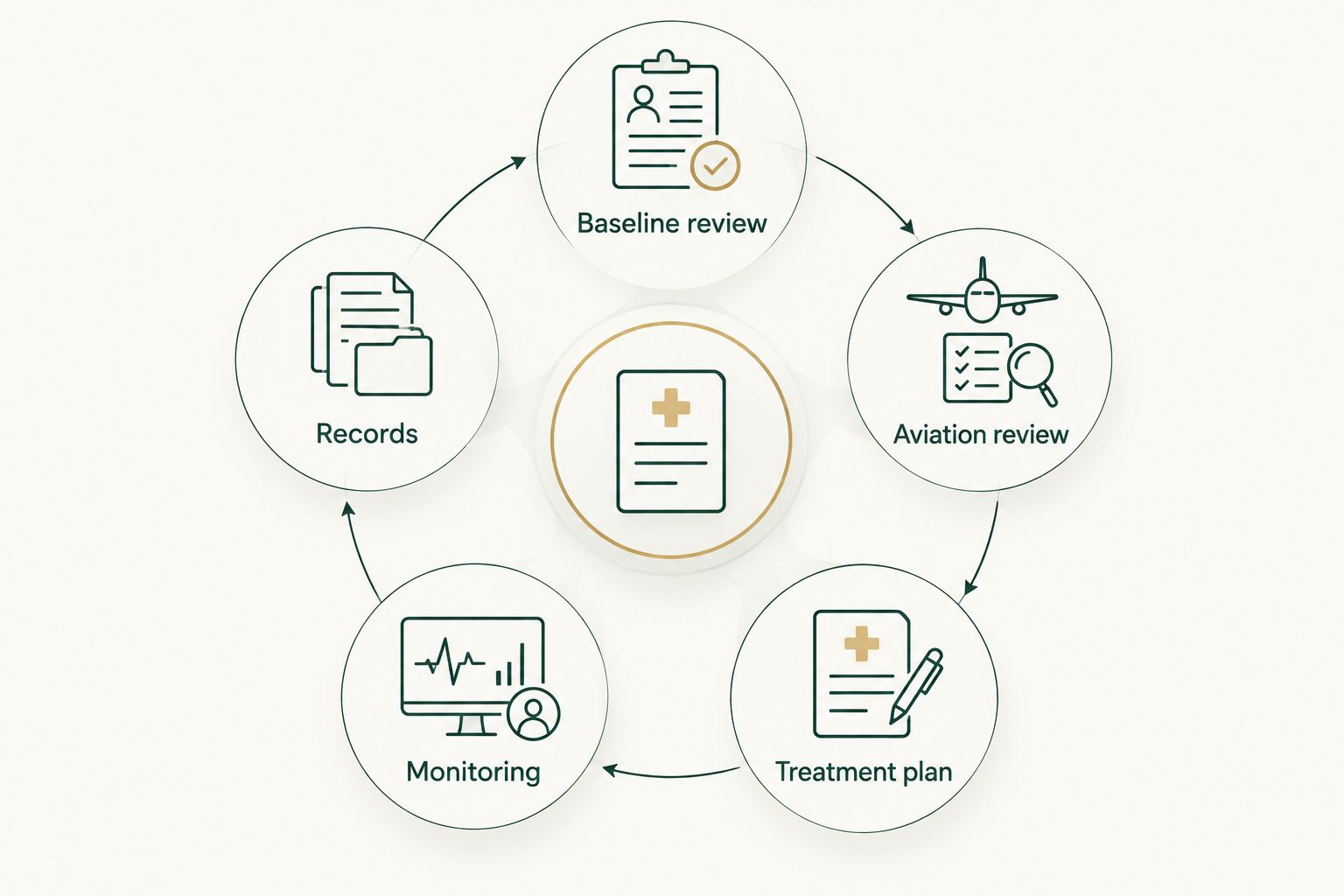
Clinical treatment and aviation review remain connected throughout care.
Compare care options for pilots and flight crew
Choose the care setting for diagnosis and follow-up, then address aviation requirements separately. No option below automatically provides FAA clearance. Use this comparison to identify what each route contributes and what you still need to arrange.
| Option | Best for | Main advantage | Key limitation |
|---|---|---|---|
| Existing primary care physician | Starting a broad evaluation | Can review fatigue, medications, and general health together | Confirm experience with testosterone diagnosis and monitoring |
| Endocrinologist or urologist | Unclear causes, fertility questions, or specialist needs | Provides focused evaluation within the specialty | Aviation review and broader primary care remain separate tasks |
| Integrated telehealth membership | Continuing hormone and cardiometabolic care | Connects ongoing visits with laboratory review | Requires physical testing and a separate aviation assessment |
| Prescription-focused telehealth service | Patients comparing remote prescribing processes | Offers remote access to a clinician | Verify diagnostic standards, monitoring, records, and escalation procedures |
| Aviation Medical Examiner | FAA medical-certification questions | Assesses the aeromedical pathway | The AME role does not automatically include ongoing TRT management |
A membership is not a substitute for health insurance or emergency care. Likewise, an AME visit does not necessarily supply the longitudinal treatment relationship you need. Ask each professional what they handle and which responsibilities belong elsewhere.
If you already receive treatment, compare the quality of your existing follow-up before switching. A clear diagnosis, accessible physician, consistent laboratory interpretation, and usable records matter more than a clinic’s promise to raise your testosterone.


Common mistakes pilots and flight crew make with online TRT
Treating a valid prescription as permission to fly
The prescribing decision and the aviation decision answer different questions. Your clinician determines whether treatment is medically appropriate; applicable aviation requirements determine whether you can exercise flight privileges. In 2026, confirm the current requirements before initiation and changes, not at the next certificate renewal.
Using testosterone to compensate for a disrupted roster
Fatigue, low motivation, and reduced concentration overlap with sleep deprivation and other illnesses. Starting TRT without confirming deficiency can leave the actual cause untreated. Bring sleep timing and duty patterns into the evaluation, and address persistent daytime sleepiness directly rather than labeling every symptom hormonal.
Comparing laboratory results collected at different dosing points
A testosterone result after medication administration is not directly interchangeable with a result collected at another point in the dosing cycle. Changing treatment based on inconsistent sampling creates confusion. Document the time of the draw and the preceding dose, then let your physician interpret the pattern.
Ignoring fertility or treating side effects independently
Do not wait until conception becomes a goal to disclose it. Do not add hormone-modifying drugs, donate blood repeatedly, or alter testosterone because a forum recommends it. Fertility suppression and rising hematocrit require a clinical plan, and additional medications require their own aviation review.
Assuming international travel does not change the plan
A prescription, airline employment, and security screening do not establish another country’s import rules. Check the medication’s legal status, documentation requirements, storage, and transit restrictions before departure. Also confirm whether a remote appointment is permitted from your physical location; nationwide U.S. licensure does not establish worldwide practice authority.
FAQ
Can airline pilots use testosterone replacement therapy?
Testosterone treatment requires an individual clinical assessment and a separate review of applicable aviation medical requirements. A prescription alone does not establish fitness to fly; consult your Aviation Medical Examiner before starting or changing treatment.
Is online TRT for airline pilots different from ordinary telehealth TRT?
Online TRT for airline pilots uses the same clinical diagnostic standards but adds aviation medical and duty-related considerations. The treating physician manages testosterone deficiency, while an Aviation Medical Examiner addresses the aeromedical certification pathway.
Does a low testosterone result mean I need TRT?
One low testosterone result does not establish that you need TRT. The AUA guideline calls for symptoms or signs plus repeat early-morning testing on separate days, with physician interpretation of the results and possible causes.
How long must a pilot stop flying after starting testosterone?
Do not use a generic grounding interval for testosterone treatment. Your Aviation Medical Examiner should apply current FAA guidance to the diagnosis, exact medication, treatment changes, side effects, and associated conditions before you resume duties.
Do flight attendants need the same FAA medical review as pilots?
Flight attendants do not follow the same FAA pilot medical-certification pathway. They should discuss treatment-related fitness for safety-sensitive duties with their physician and follow their employer’s occupational-health requirements.
What blood tests matter during testosterone treatment?
Testosterone levels and hemoglobin or hematocrit are central to TRT monitoring, with other testing selected for the individual. Blood-draw timing depends on the formulation and dosing schedule; prostate, metabolic, and cardiovascular assessment depends on clinical circumstances.
Can I carry prescribed testosterone on international trips?
A U.S. prescription does not automatically authorize carrying testosterone into another country. Verify destination and transit requirements with official authorities, retain appropriate prescription documentation, and follow the dispensing pharmacy’s product-specific storage instructions.
Does GoodLife Health provide FAA medical clearance?
GoodLife Health’s hormone and cardiometabolic care does not replace FAA medical certification or an Aviation Medical Examiner’s assessment. Clinical care is delivered by physicians of Beluga Health, P.A., under GoodLife Health’s clinical protocols, with aviation review handled separately.
One last thing
The most useful appointment before TRT is often the one that clarifies why you feel unwell. Testosterone deficiency, disrupted sleep, sleep apnea, thyroid disease, medication effects, and metabolic problems are not interchangeable diagnoses. A careful evaluation prevents a prescription from becoming the answer to the wrong question.
Before your first consultation, assemble three documents: your current medication list, complete recent laboratory reports, and a duty-and-sleep summary. Then obtain the aviation guidance relevant to your role. This gives both your physician and AME a factual starting point without asking either to guess what the other has decided.
Seek urgent medical assessment for chest pain, significant shortness of breath, new one-sided leg swelling, or sudden neurological symptoms. Do not fly with symptoms that compromise safe operation, and do not wait for a routine telehealth follow-up to address an emergency.
Related Guides
- How to read your testosterone lab results
- Testosterone therapy for shift workers with disrupted sleep
- How to maintain TRT treatment while traveling internationally
References
- Treatment of Symptoms of the Menopause: An Endocrine Society Clinical Practice Guideline. 2015. doi.org/10.1210/jc.2015-2236
- Testosterone Therapy in Men with Hypogonadism: An Endocrine Society Clinical Practice Guideline. 2018. doi.org/10.1210/jc.2018-00229