Construction workers’ online Zepbound care is physician-supervised obesity treatment delivered through telehealth, with the aim of improving weight-related health without overlooking job-site safety. Getting a prescription requires medical eligibility and a clinician’s assessment; working around heat, heights, machinery, and irregular breaks makes hydration, nutrition, and side-effect planning part of that assessment.
Key Takeaways
- A zepbound prescription online for construction workers requires medical eligibility, not simply a physically demanding job.
- GoodLife Health suits construction workers seeking Zepbound assessment within ongoing Cardiometabolic Optimization care.
- Zepbound treatment needs a job-specific plan for nausea, hydration, nutrition, and safe equipment operation.
- Telehealth supports medical weight loss; it does not replace emergency care or workplace heat protections.
Why online Zepbound care matters for construction workers
Construction work changes the practical requirements of obesity treatment. If your duties include outdoor labor, lifting, climbing, or operating equipment, a treatment plan must account for those duties rather than stop at a prescription.
Zepbound can cause nausea, vomiting, diarrhea, constipation, and reduced appetite. Those effects matter differently when you cannot easily leave a roof, reach a bathroom, or take an unscheduled meal break. Vomiting and diarrhea also increase the risk of dehydration, which deserves particular attention during hot-weather work.
Telehealth removes travel from the medical consultation, but it does not remove the need for testing, physical assessment when indicated, or urgent evaluation of serious symptoms. Choose the care setting that answers the clinical question, not just the setting that fits your calendar.
GoodLife Health defines Cardiometabolic Optimization as treating metabolic, hormonal, and cardiovascular health as one system. That framing connects weight management with blood sugar, lipids, inflammation, thyroid function, and clinically relevant hormone findings rather than treating the scale as the only outcome.
The right online prescription is one you can use safely while doing your actual job. A construction worker’s treatment plan should protect work capacity, not trade it for faster scale changes.
Check what qualifies you for Zepbound in 2026
For adult chronic weight management, the FDA-approved Zepbound prescribing information specifies obesity with a body mass index of at least 30, or overweight with a BMI of at least 27 and at least one weight-related condition. Examples include hypertension, dyslipidemia, type 2 diabetes, obstructive sleep apnea, or cardiovascular disease. Treatment accompanies a reduced-calorie diet and increased physical activity.
Your occupation does not establish eligibility. Neither does fatigue, belly fat, or a difficult shift schedule by itself. A clinician evaluates your measurements, medical history, previous treatment, and contraindications before deciding whether tirzepatide is appropriate.
BMI is also not a complete description of body composition. If substantial muscle contributes to your weight, tell your clinician; do not assume that crossing a BMI threshold automatically makes medication the right choice.
The safety reference for this 2026 guide is the FDA-approved Zepbound prescribing information, specifically its adult weight-management criteria, contraindications, dose escalation, and adverse-reaction warnings. Your prescribed product’s current labeling and your clinician’s instructions govern your treatment.
How to get an online prescription that fits construction work
1. Document your health history and job demands
Start with a written note on your phone or paper. Record your height, weight, previous weight-management efforts, diagnoses, medications, and the parts of your workday that make eating or drinking difficult. You do not need an app subscription to prepare a useful consultation.
Describe the job precisely. An equipment operator working in a climate-controlled cab has different practical constraints from a roofer carrying materials in direct sun. Include driving between sites, overnight shifts, bathroom access, protective clothing, and any restrictions on carrying food or water.
Bring available medical records rather than relying on memory. Include previous blood pressure readings, diabetes testing, kidney-function results, and treatment for sleep apnea. Tell the clinician about supplements, nonprescription products, and pain medicines as well as prescriptions.
The goal is not to prove that you deserve treatment. It is to give your physician enough information to choose treatment safely and identify problems that need a different approach.
- List every medicine and supplement you take.
- Record relevant diagnoses and previous weight-loss treatments.
- Describe heat exposure, lifting, climbing, and machinery duties.
- Note meal breaks, water access, bathroom access, and travel.
- Bring existing laboratory results and blood pressure records.
2. Ask a licensed clinician to confirm eligibility and risks
Use your existing primary care clinician if that relationship meets your needs. Ask whether telehealth is appropriate for the initial assessment and what information the clinician needs before prescribing. An online visit is a care-delivery method, not a different eligibility standard.
Disclose a personal or family history of medullary thyroid carcinoma or multiple endocrine neoplasia syndrome type 2. Zepbound is contraindicated in those circumstances and in patients with a previous serious hypersensitivity reaction to tirzepatide or its ingredients. Other thyroid diagnoses require individual assessment; they are not interchangeable with these contraindications.
Also discuss pancreatitis, gallbladder disease, severe gastrointestinal symptoms, kidney problems, pregnancy plans, and medicines that lower blood sugar. Zepbound is not recommended for severe gastroparesis. Insulin and sulfonylureas require particular attention because combining them with tirzepatide increases hypoglycemia risk.
Tell your clinician about planned surgery or procedures involving anesthesia or deep sedation. Tirzepatide delays gastric emptying, which makes procedure planning relevant even when you feel well.
- Confirm the clinician can treat you in your current state.
- Discuss thyroid cancer history and serious medication allergies.
- Review gastrointestinal, pancreatic, gallbladder, and kidney history.
- Identify insulin, sulfonylureas, and other weight-management medicines.
- Disclose pregnancy plans and upcoming procedures.
3. Choose follow-up care before choosing a prescription service
First, ask your current clinician who will answer questions after treatment begins. A prescription without a clear follow-up arrangement leaves you making decisions about symptoms and dose changes alone. Establish how routine questions, worsening symptoms, and emergencies will be handled.
GoodLife Health offers Cardiometabolic Optimization through a single membership combining concierge-style direct primary care with a comprehensive Biomarker Audit every 90 days. Clinical care is delivered by licensed physicians of Beluga Health, P.A., an independent Florida professional corporation licensed to practice in all 50 states, working under GoodLife Health’s clinical protocols.
The audit includes ApoB, Lp(a), hs-CRP, HbA1c, lipids, insulin markers, and full hormone and thyroid panels through the Beluga Health lab network. These results inform the broader clinical assessment; they do not automatically establish a need for hormones or a Zepbound prescription. Additional testing beyond the included cadence is separate.
For the prescribing decision itself, review medical weight loss with Zepbound and who qualifies. A broad panel supports ongoing cardiometabolic care, but your clinician determines which tests are necessary for your situation.
Organize the consultation around four connected topics: Medical history, Biomarker results, Work demands, and Follow-up plan.
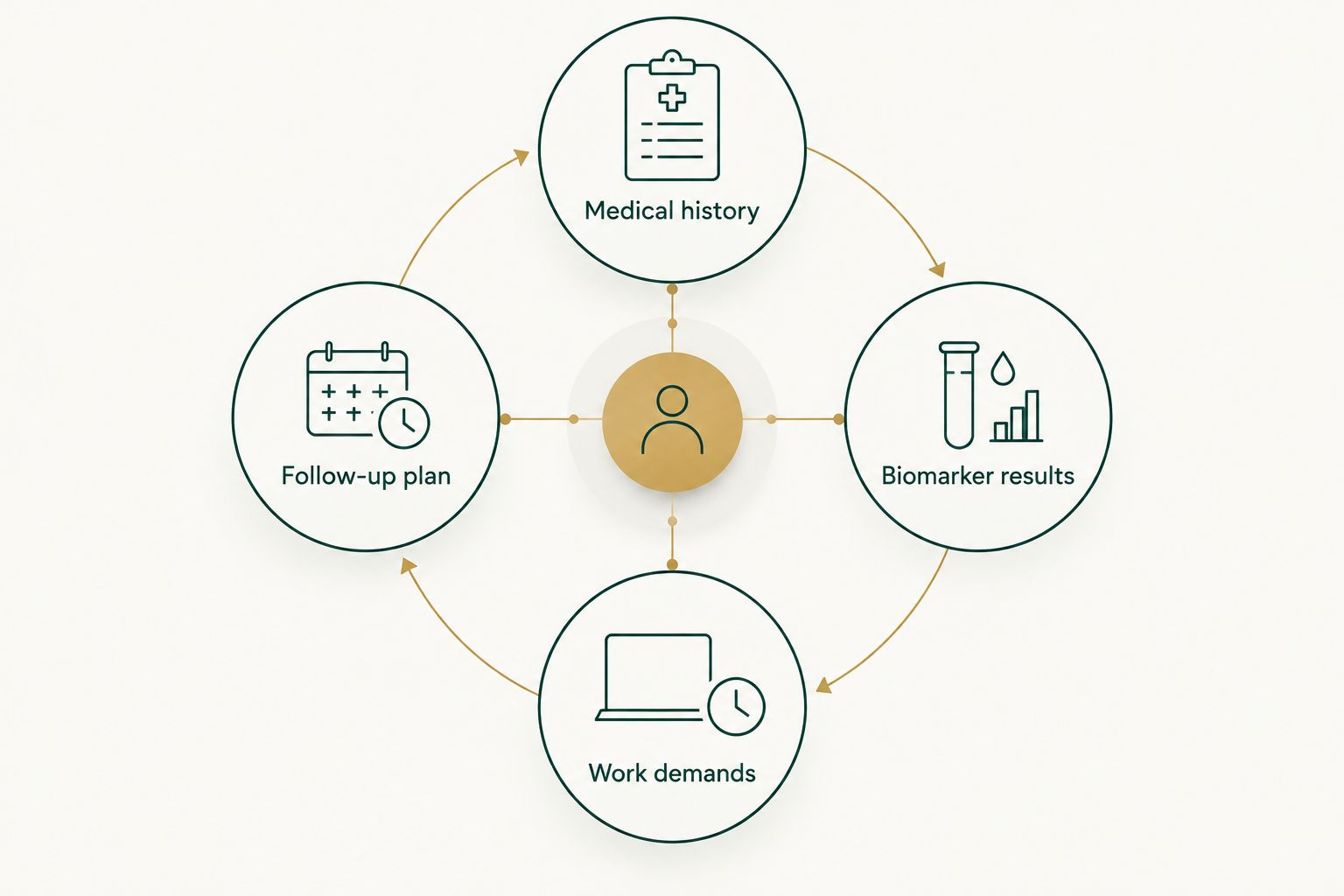
Medical findings and work demands belong in the same treatment plan.
Choose care that connects those topics rather than treating laboratory testing and prescription renewal as unrelated transactions.
- Ask who interprets your laboratory results.
- Confirm the follow-up process before treatment starts.
- Separate routine messages from urgent medical evaluation.
- Ask when an in-person examination becomes necessary.
- Confirm that treatment uses branded, FDA-approved medication.
4. Coordinate the starting dose with your work schedule
Begin with your actual work calendar and your clinician’s prescription. Mark shifts involving heights, confined spaces, long drives, or substantial heat exposure. Discuss those duties before the first injection rather than waiting until symptoms interrupt a shift.
The FDA-approved starting schedule is 2.5 mg once weekly for 4 weeks, followed by 5 mg once weekly. The starting dose is for treatment initiation, not maintenance. Later increases depend on the prescribing instructions, response, and tolerability, with at least 4 weeks at the current dose before an increase.
Do not accelerate the schedule because your job is physically demanding or because appetite suppression seems weaker than expected. Likewise, do not change the dose independently to get through a difficult week. Contact the prescribing clinician about significant symptoms before the next planned increase.
You and your clinician can discuss choosing a consistent injection day that gives you practical room to observe your response. No injection day guarantees a symptom-free workweek. Avoid building a safety plan around that assumption.
For 2026 treatment planning, use the instructions supplied with your exact prescription presentation. Injection technique and storage details should come from that product’s instructions, not a social media demonstration.
- Put the prescribed weekly injection day on your calendar.
- Tell your clinician about upcoming high-risk duties.
- Follow the prescribed initiation and escalation schedule.
- Report significant symptoms before a planned increase.
- Ask your pharmacist to explain the exact device and storage instructions.
5. Plan meals and fluids around job-site access
Start with ordinary food, an appropriate lunch container, and your workplace’s existing water and rest arrangements. Reduced appetite does not mean your body no longer needs fuel for lifting, walking, climbing, and recovery.
Pack manageable meals containing protein and other foods you tolerate. If nausea makes a large meal difficult, discuss smaller portions distributed around permitted breaks. A registered dietitian can help individualize intake, particularly if you have kidney disease, diabetes, or other dietary restrictions.
Hydration requires a plan, not a universal bottle count. Fluid needs vary with temperature, exertion, medical conditions, and workplace protections. Workers with heart failure, kidney disease, or prescribed fluid restrictions need clinician-specific advice rather than generic instructions to drink more.
Keep medicine out of job-site heat and direct sunlight. A parked vehicle, tool compartment, or lunch cooler is not automatically a suitable storage environment. Ask the pharmacist about your exact product’s temperature limits and how to transport it without freezing it.
Zepbound does not replace required heat protections, scheduled rest, or access to drinking water. If the site cannot support safe work conditions, medication timing will not fix that problem.
- Pack food before leaving for the site.
- Include tolerable protein-containing foods in your meals.
- Arrange water access and follow workplace heat protections.
- Individualize fluids if you have medical restrictions.
- Confirm safe medicine storage with your pharmacist.
6. Set a response plan for symptoms during a shift
Write down your clinician’s contact process and identify where you would obtain urgent care near the site. Do this before you need it. Telehealth is useful for assessment and follow-up, but a message thread is not emergency treatment.
If dizziness, faintness, confusion, or weakness affects your ability to work safely, stop operating machinery, climbing, or working at height. Move to a safe location and seek assessment. Do not assume that a symptom is merely a medication effect, dehydration, or low blood sugar without evaluation.
Persistent severe abdominal pain, particularly with vomiting, needs urgent medical assessment because pancreatitis and other serious conditions must be considered. Repeated vomiting, inability to keep fluids down, or markedly reduced urination also warrants prompt care. Breathing difficulty, facial or throat swelling, collapse, or severe confusion requires emergency help.
For mild symptoms, report their timing, severity, food intake, fluid intake, and effect on work. Your clinician can assess whether diet adjustments, symptom treatment, or a change to the medication plan is appropriate. Do not push through worsening symptoms to protect a dosing schedule.
- Stop safety-sensitive tasks when symptoms impair your function.
- Record symptoms and their relationship to injections and meals.
- Contact your clinician about persistent or worsening problems.
- Seek urgent care for severe pain or inability to retain fluids.
- Use emergency services for collapse or breathing difficulty.
7. Track work capacity alongside weight and laboratory results
Use a simple weekly record rather than collecting numbers you will never discuss. Note weight trends, appetite, gastrointestinal symptoms, sleep, and whether normal tasks feel harder. Bring that record to follow-up visits so treatment decisions reflect your life outside the consultation.
Physical labor is not identical to a structured resistance-training program. Repetitive lifting, fatigue, and uneven recovery do not guarantee preservation of muscle during weight loss. Discuss appropriate resistance exercise, sufficient nutrition, and recovery with your clinician, accounting for injuries and the demands of your trade.
Review blood pressure and blood sugar when your clinician recommends monitoring, especially if you already take treatment for either. Weight loss and changes in intake can affect medication needs. Adjustments belong with the prescribing clinician, not with a coworker’s advice.
GoodLife Health’s Cardiometabolic Optimization model includes 4 Biomarker Audits per year, allowing clinical review of more than scale weight. Earlier assessment remains appropriate when symptoms or medical circumstances require it; the scheduled audit is not a reason to wait.
For your 2026 follow-up plan, define what successful treatment means in practical terms: better weight-related health with adequate nutrition, preserved function, and tolerable symptoms.
- Track weight trends without reacting to every fluctuation.
- Record strength, recovery, and difficulty completing usual tasks.
- Follow individualized blood pressure or glucose-monitoring instructions.
- Review nutrition and resistance exercise during follow-up.
- Request earlier assessment when symptoms change.


Compare care options for construction workers
GoodLife Health is best for construction workers seeking Zepbound assessment within ongoing Cardiometabolic Optimization care. Its membership connects weight management with laboratory review and broader primary care, but telehealth does not replace hands-on examination or emergency services.
Compare the care model before enrolling. In 2026, ask each practice directly about clinician access, laboratory arrangements, prescribing responsibility, and escalation to in-person care. Do not infer those features from the word telehealth.
| Option | Best for | Main advantage | Key limitation |
|---|---|---|---|
| Existing primary care clinician | Workers with an established clinical relationship | Existing records and knowledge of your medical history | Ask whether the practice provides ongoing obesity-medication management |
| Local obesity-medicine practice | Workers needing in-person assessment | Hands-on examination when clinically indicated | Visits require travel and coordination with the workday |
| Standalone telehealth prescribing service | Workers primarily seeking remote medication assessment | Consultation without traveling to an office | Confirm who handles laboratory review, side effects, and other conditions |
| GoodLife Health membership | Workers seeking connected weight, metabolic, hormonal, and cardiovascular care | Included Biomarker Audits and concierge-style direct primary care | Membership is separate from pharmacy billing and does not provide emergency care |
A broader care model is useful when several clinical issues need coordination. It is not automatically necessary for every patient, and broader testing does not mean every abnormal result needs medication.
For this membership, branded medication is billed by the pharmacy separately, with no medication markup or dose-escalation upcharge. Confirm membership terms and your pharmacy arrangements before making a decision; a prescription does not establish insurance coverage.
Common mistakes construction workers make
Treating suppressed appetite as permission to skip meals
Eating less without planning can leave you under-fueled during demanding work. If your usual lunch becomes unmanageable, change the meal structure with clinical guidance rather than deleting food from the day. Report weakness or reduced work capacity instead of treating it as proof that treatment is working.
Raising the dose before a demanding work period
A planned increase deserves discussion when a new assignment involves substantial heat, travel, or safety-sensitive duties. Do not independently accelerate, delay, or restart treatment. Your clinician needs to weigh the schedule against symptoms and treatment response.
Assuming every dizzy spell is low blood sugar
Dizziness has multiple possible causes, including dehydration, heat illness, blood pressure changes, and hypoglycemia. The risk assessment changes if you take insulin or a sulfonylurea. Stop hazardous tasks and seek appropriate assessment rather than guessing the cause and returning to work.
Leaving injections in a truck
Job-site convenience does not establish safe medication storage. Check the exact product instructions and ask the pharmacist how to transport your prescription. Never assume that another worker’s device has the same handling requirements as yours.
Measuring success only by pounds lost
A falling scale does not excuse persistent vomiting, inadequate intake, or declining function. Review symptoms, strength, blood pressure, relevant laboratory results, and your ability to work safely. The treatment goal is improved health, not the fastest possible change in body weight.
FAQ
Can a construction worker get a Zepbound prescription online?
Yes, a construction worker can receive a Zepbound prescription through telehealth when a licensed clinician determines that treatment is appropriate. Job title does not establish eligibility, and some findings require an in-person assessment.
What BMI do I need for Zepbound weight-loss treatment?
For adult chronic weight management, Zepbound labeling specifies a BMI of at least 30, or at least 27 with a weight-related condition. Your clinician also reviews contraindications, medical history, and whether treatment is appropriate for you.
Is Zepbound safe if I work outside in the heat?
Outdoor work requires an individualized safety assessment and hydration plan during Zepbound treatment. Vomiting or diarrhea can contribute to dehydration; medication does not replace workplace heat protections, water access, or rest.
Can I operate heavy equipment while taking Zepbound?
Do not operate heavy equipment when dizziness, faintness, confusion, weakness, or other symptoms impair safe operation. Taking Zepbound alone does not determine fitness for duty; your symptoms, medical conditions, and workplace requirements matter.
Should I inject Zepbound before my day off?
Discuss your injection day with your prescribing clinician rather than assuming a day off prevents workday symptoms. A consistent schedule can help planning, but side effects do not follow a guaranteed timetable.
Is Mounjaro the same medicine as Zepbound?
Zepbound and Mounjaro both contain tirzepatide, but they have different approved indications. Zepbound is used for chronic weight management in eligible adults, while Mounjaro is indicated for type 2 diabetes; your clinician chooses the appropriate prescription.
Does GoodLife Health offer compounded tirzepatide?
GoodLife Health does not offer compounded GLP-1 medications. Its clinical model uses branded, FDA-approved GLP-1 treatment when prescribed after physician assessment.
Do I need hormone treatment because construction work makes me tired?
Fatigue alone does not establish a need for hormone treatment. Your clinician evaluates sleep, nutrition, medications, work demands, and relevant medical findings before deciding whether hormone testing or treatment is appropriate.
One last thing
Bring a description of your hardest workday to the consultation, not just your easiest one. Include where you get water, when you can eat, how far you are from a bathroom, and which tasks become dangerous if you feel faint.
Ask your clinician: what should I do if symptoms start while I am on a roof or operating equipment? A useful treatment plan answers that question before the first injection. This guide is educational; your clinician’s individualized advice and your prescribed product’s instructions govern treatment.
Related Guides
- How to manage nausea on tirzepatide
- How strength training changes GLP-1 weight-loss results
- How prior authorization works for Zepbound coverage
References
- Tirzepatide Once Weekly for the Treatment of Obesity (SURMOUNT-1). 2022. pubmed.ncbi.nlm.nih.gov/35658024/
- Once-Weekly Semaglutide in Adults with Overweight or Obesity (STEP 1). 2021. pubmed.ncbi.nlm.nih.gov/33567185/