Firefighters and police officers’ online TRT is clinician-directed testosterone replacement therapy delivered through telehealth to treat confirmed testosterone deficiency and improve related symptoms. This 2026 guide explains how to confirm the diagnosis, account for disrupted sleep, protect fertility, and monitor treatment without confusing hormone care with fitness-for-duty clearance.
Key Takeaways
- Online TRT for firefighters and police officers requires symptoms, confirmatory testosterone testing, and ongoing safety monitoring.
- GoodLife Health integrates hormone optimization with metabolic and cardiovascular care rather than treating testosterone as an isolated number.
- Shift workers need clinician-planned blood draws; testing after overnight duty can complicate interpretation.
- Testosterone can suppress sperm production and raise hematocrit; discuss both before starting treatment.
Why online TRT matters for firefighters and police officers
The right goal is treating a documented deficiency, not prescribing testosterone for a demanding job. Fatigue, reduced libido, poor concentration, and declining exercise tolerance deserve evaluation. They do not identify the cause by themselves.
For firefighters and police officers, interrupted sleep and rotating schedules complicate both symptom assessment and laboratory timing. Treatment also has practical consequences: medication storage, injections or gel application, follow-up visits, and department-specific medical requirements must fit your duties.
GoodLife Health uses Cardiometabolic Optimization to treat metabolic, hormonal, and cardiovascular health as one system. That framing matters when fatigue overlaps with obesity, sleep apnea, thyroid disease, abnormal blood sugar, or cardiovascular risk. Testosterone is one part of the assessment, not the explanation for every symptom.
Telehealth reduces travel for conversations and record review. It does not eliminate blood draws, physical examinations when indicated, specialist referrals, or emergency care. In 2026, evaluate an online service by the clinical work it performs, not by how quickly it promises a prescription.
This guide focuses on adult men being evaluated for testosterone deficiency. Women firefighters and police officers need a different hormone assessment; male diagnostic thresholds and TRT regimens do not transfer to women.
Build an online TRT plan around your duty schedule
1. Document symptoms alongside sleep and duty patterns
Start with a written record you can create yourself. Record your main symptoms, when they began, whether they change between duty and recovery days, and which ones interfere with daily life. Bring prior laboratory reports rather than relying on your memory of a result.
Reduced sexual desire and fewer spontaneous erections are relevant to testosterone assessment. Fatigue and poor focus are less specific. Your clinician should also review mood, medications, alcohol use, sleep quality, weight changes, and other medical conditions before deciding which tests to order.
Do not interpret occupational stress as proof of low testosterone. A difficult stretch of overnight calls can make recovery worse without establishing a hormone disorder. Likewise, persistent symptoms on well-rested days deserve attention even when you have become accustomed to working tired.
Describe functional problems plainly: struggling to stay awake while driving, losing concentration during reports, or unusually poor exercise recovery. Dangerous sleepiness requires prompt assessment, not an experiment with testosterone.
- Record sleep periods and overnight interruptions alongside symptoms.
- List prescriptions, supplements, anabolic steroids, and previous hormone use.
- Bring dated testosterone results with units and laboratory reference ranges.
- Separate sexual symptoms from general fatigue and job-related exhaustion.
- Report snoring, witnessed breathing pauses, and sleepiness while driving.
2. Confirm low testosterone with properly planned testing
One low result is not a complete TRT diagnosis. The American Urological Association’s Testosterone Deficiency Guideline, published in 2018, uses total testosterone below 300 ng/dL as a reasonable diagnostic cutoff in men, alongside symptoms and signs. It calls for 2 separate early-morning measurements before diagnosis.
Shift work requires a conversation about applying that testing approach. Tell your clinician when you normally sleep, when you last worked overnight, and whether the proposed draw follows your main sleep period. Do not assume a blood draw immediately after overnight duty is equivalent to one after restorative sleep.
The Endocrine Society’s 2018 guideline on testosterone therapy in men also recommends confirming low testosterone with repeat morning fasting measurements. In 2026, these diagnostic principles remain more useful than an online questionnaire that treats fatigue alone as eligibility.
Your clinician interprets borderline results in context. Free testosterone and sex hormone-binding globulin, or SHBG, help in selected cases, particularly when total testosterone does not match the clinical picture. Luteinizing hormone and follicle-stimulating hormone help distinguish testicular from pituitary-related causes; additional evaluation depends on the findings.
- Ask your clinician to plan draw timing around your sleep schedule.
- Complete repeat testing before accepting a diagnosis from one result.
- Follow the specific fasting instructions supplied with your laboratory order.
- Report recent illness, severe sleep disruption, and previous testosterone use.
- Ask what the results show about the cause, not just the level.
3. Evaluate the whole cardiometabolic system before prescribing
You can prepare without buying another testing package. Gather blood pressure readings, existing blood counts, diabetes screening, lipid results, and relevant family history. Your clinician then decides which gaps need testing and which findings need treatment before testosterone is considered.
GoodLife Health is best for firefighters and police officers seeking hormone optimization within ongoing Cardiometabolic Optimization care. The membership includes a Biomarker Audit every 90 days covering ApoB, Lp(a), hs-CRP, HbA1c, lipids, insulin markers, and full hormone and thyroid panels. Those markers provide context; none independently proves that you need TRT.
Clinical care is delivered by licensed physicians of Beluga Health, P.A., an independent Florida professional corporation licensed to practice in all 50 states, working under GoodLife Health’s clinical protocols. Laboratory testing runs through the Beluga Health lab network.
The advantage is coordinated assessment rather than a testosterone-only encounter. The limitation is equally important: a recurring panel does not replace additional tests, in-person care, or specialist evaluation when your findings require them. Additional laboratory testing beyond the quarterly cadence is billed separately at pass-through cost.
The overview of hormone replacement therapy for men with low testosterone explains the broader treatment context. Enrollment does not establish a diagnosis or guarantee a prescription.
- Bring blood pressure readings and prior blood count results.
- Discuss sleep apnea assessment when symptoms suggest it.
- Review blood sugar, thyroid findings, lipids, and cardiovascular history together.
- Ask which baseline safety tests are needed specifically for testosterone.
- Confirm who reviews results and explains the treatment decision.
4. Protect fertility and identify reasons to defer treatment
Tell your clinician about future biological children before discussing a testosterone regimen. External testosterone can suppress sperm production. It is not a fertility-preserving treatment, and recovery after stopping is not immediate or guaranteed on a particular timetable.
A clinician should discuss alternatives or specialist referral when fertility matters. Do not assume adding another medication automatically protects fertility. Decisions depend on the cause of low testosterone, reproductive goals, examination findings, and, when indicated, semen testing.
Baseline hematocrit matters because testosterone can increase red blood cell production. The Endocrine Society’s 2018 guideline identifies hematocrit above 54% during therapy as a reason to stop treatment temporarily, assess contributing factors, and reconsider the regimen. This is a clinical action threshold, not a target to approach.
Other concerns include untreated severe obstructive sleep apnea, relevant prostate findings, uncontrolled heart failure, and recent major cardiovascular events. Your clinician determines whether to defer treatment, investigate further, or involve a specialist. An online visit cannot settle every one of these questions remotely.
Disclose prior anabolic steroid use honestly. It changes the diagnostic picture and the treatment discussion; concealing it makes laboratory interpretation less reliable.
- State fertility goals before accepting a prescription.
- Ask whether reproductive specialist input is appropriate.
- Review baseline hematocrit and the response plan for elevated results.
- Disclose sleep apnea, cardiovascular events, and prostate concerns.
- Avoid self-prescribed hormone combinations or preventive add-on medications.
5. Choose a delivery method that fits real duty conditions
Start by mapping practical constraints: where you can store medication securely, when you have privacy, whether your schedule changes unexpectedly, and who shares your living space. Then ask your clinician which clinically appropriate delivery methods fit those constraints.
Injectable testosterone avoids the skin-transfer precautions associated with gels, but requires technique training, sharps disposal, and consistent dosing. Different injection routes and preparations have different instructions. Do not borrow a colleague’s regimen or change the route yourself.
Testosterone gel avoids injections but requires careful application and contact precautions. Shared station facilities, close contact with family members, and unpredictable callouts make planning important. Follow the prescribed product’s directions for drying, covering the application site, washing hands, and avoiding transfer to others.
Other formulations have their own limitations. Some require procedures; some have specific blood pressure or administration considerations. A telehealth service should explain the available clinically appropriate choices without presenting every formulation as interchangeable.
In 2026, do not choose a regimen because someone calls it a performance protocol. The decision should reflect confirmed deficiency, safety, your preferences, and follow-up capacity. The prescribing clinician also must comply with current controlled-substance and telemedicine requirements where you are located.
- Describe station storage, privacy, travel, and unpredictable overtime.
- Request training before administering an injection yourself.
- Arrange a sharps container when your prescription requires needles.
- Review household and workplace contact precautions for topical treatment.
- Get written instructions for missed doses and medication storage.
6. Monitor benefits and risks instead of chasing a higher number
Keep your own symptom record and bring it to follow-up. Track the symptoms treatment was intended to address, not just gym performance. Your clinician should compare that record with testosterone measurements, blood pressure, blood counts, and other relevant findings.
Blood-draw timing during treatment depends on the formulation and dosing schedule. A result collected at the wrong point in the dosing interval can mislead dose decisions. Record when you last used the medication and follow the clinician’s draw instructions.
A Biomarker Audit every 90 days provides a recurring review point, but treatment-related monitoring can be needed sooner. Ask which tests are due after starting therapy or changing a dose. Do not wait for a scheduled panel if you develop concerning symptoms.
Discuss acne, swelling, worsening snoring, urinary changes, breast symptoms, or significant mood changes. New chest pain, severe breathlessness, fainting, or symptoms suggesting a stroke require emergency evaluation, not a portal message.
If testosterone normalizes but the symptoms do not improve, reconsider the diagnosis and treatment value with your clinician. A higher dose is not the automatic next step. Treating sleep apnea, depression, thyroid disease, or another contributor can be more relevant than escalating testosterone.
- Record dose timing before every treatment-related blood draw.
- Track the original symptoms and any new adverse effects.
- Review hematocrit, blood pressure, and testosterone with your clinician.
- Ask whether prostate monitoring is appropriate for your age and risk.
- Reassess treatment when laboratory improvement does not match symptom benefit.
7. Coordinate treatment with occupational health requirements
Before starting, obtain your department’s current medication and medical-clearance policies. Read the actual documents rather than relying on a coworker’s experience. Requirements differ between employers, assignments, and jurisdictions.
A lawful prescription does not automatically establish fitness for duty. Your treating clinician manages the medical condition; an occupational clinician or designated department process determines work clearance where required. Keep those roles clear, especially if you operate emergency vehicles or perform other safety-sensitive tasks.
Ask what documentation is required and who receives it. Use designated confidential medical channels rather than sending complete records broadly. Do not assume that telehealth makes a prescription invisible to every occupational review process.
The same preparation applies during mutual-aid assignments, deployments, or travel. Notify your treating clinician about your location and anticipated interruptions to follow-up. Do not assume a refill or prescribing visit works identically in every location under current 2026 rules.
Finally, make a continuity plan. Losing contact with a clinic should not leave you improvising doses, sharing medication, or relying on unregulated products.
- Obtain written medication-disclosure and fitness-for-duty policies.
- Ask occupational health which records are required and why.
- Keep prescription documentation and laboratory summaries accessible.
- Tell your treating clinician about travel and duty changes.
- Plan refills and follow-up without sharing or stockpiling medication.
Compare care options for first responders
Choose the care model before choosing a prescription. In 2026, the useful distinction is whether a service can establish the diagnosis, manage monitoring, and arrange in-person evaluation when needed. No care setting is automatically adequate simply because it is convenient.
| Care option | Best for | Main advantage | Key limitation |
|---|---|---|---|
| Existing primary care clinician | Initial evaluation of fatigue and possible low testosterone | Connects symptoms with established records and other conditions | Testosterone management or specialist referral depends on the practice |
| Endocrinologist or urologist | Complex hormonal findings, fertility concerns, or prostate issues | Focused evaluation of conditions that need specialist expertise | Visits and testing require separate scheduling around duty |
| Testosterone-focused telehealth service | Confirmed deficiency with a clearly defined monitoring plan | Remote follow-up reduces appointment travel | Verify broader risk assessment, laboratory review, and referral processes |
| GoodLife Health Cardiometabolic Optimization | First responders wanting hormone care within ongoing metabolic and cardiovascular care | Included recurring Biomarker Audits and concierge-style direct primary care | Membership does not replace emergency, procedural, occupational, or specialist care |
| Occupational health clinician | Department-specific medical documentation and clearance | Applies the employer’s fitness-for-duty requirements | Occupational assessment is not a substitute for longitudinal hormone treatment |
Compare services using written answers. Ask who prescribes, how abnormal results are handled, whether physical examination is required, and who manages problems outside hormone treatment. Also establish how membership, laboratory services, and pharmacy billing are separated; no quoted fee tells you whether the clinical process is adequate.
Common TRT mistakes firefighters and police officers make
Treating post-shift exhaustion as a hormone diagnosis
A difficult overnight assignment is not a testosterone test. Persistent fatigue needs assessment for sleep disruption, sleep apnea, mood conditions, medications, and metabolic or thyroid contributors. Do not use TRT to make dangerous sleepiness acceptable.
Copying another first responder’s dose
Your colleague’s prescription reflects a different diagnosis, formulation, laboratory pattern, and medical history. Matching a dose or targeting the same testosterone result ignores those differences. Bring questions to your clinician instead of changing treatment around station advice.
Assuming a prescription settles department policy
Medical treatment and occupational clearance answer different questions. Check written requirements before a problem arises, especially for safety-sensitive assignments. Do not rely on an online clinic to interpret your employer’s rules or guarantee clearance.
Missing monitoring because symptoms improve
Feeling better does not reveal hematocrit or blood pressure. Schedule follow-up around expected rotations, and contact the clinical team if overtime disrupts testing. A prescription without a workable monitoring plan is incomplete care.
Using testosterone as a substitute for broader care
Testosterone does not replace treatment for obesity, diabetes, abnormal lipids, thyroid disease, or sleep apnea. Cardiometabolic Optimization connects these findings without assuming they all require hormone prescriptions. Sleep, nutrition, and appropriate physical activity remain part of care.
Keep the treatment decision connected
A useful review connects Sleep, Hormone levels, Blood sugar, and Heart risk. These are not four separate medication targets. They are clinical context for deciding whether testosterone is indicated, whether treatment is helping, and whether another problem needs attention first.
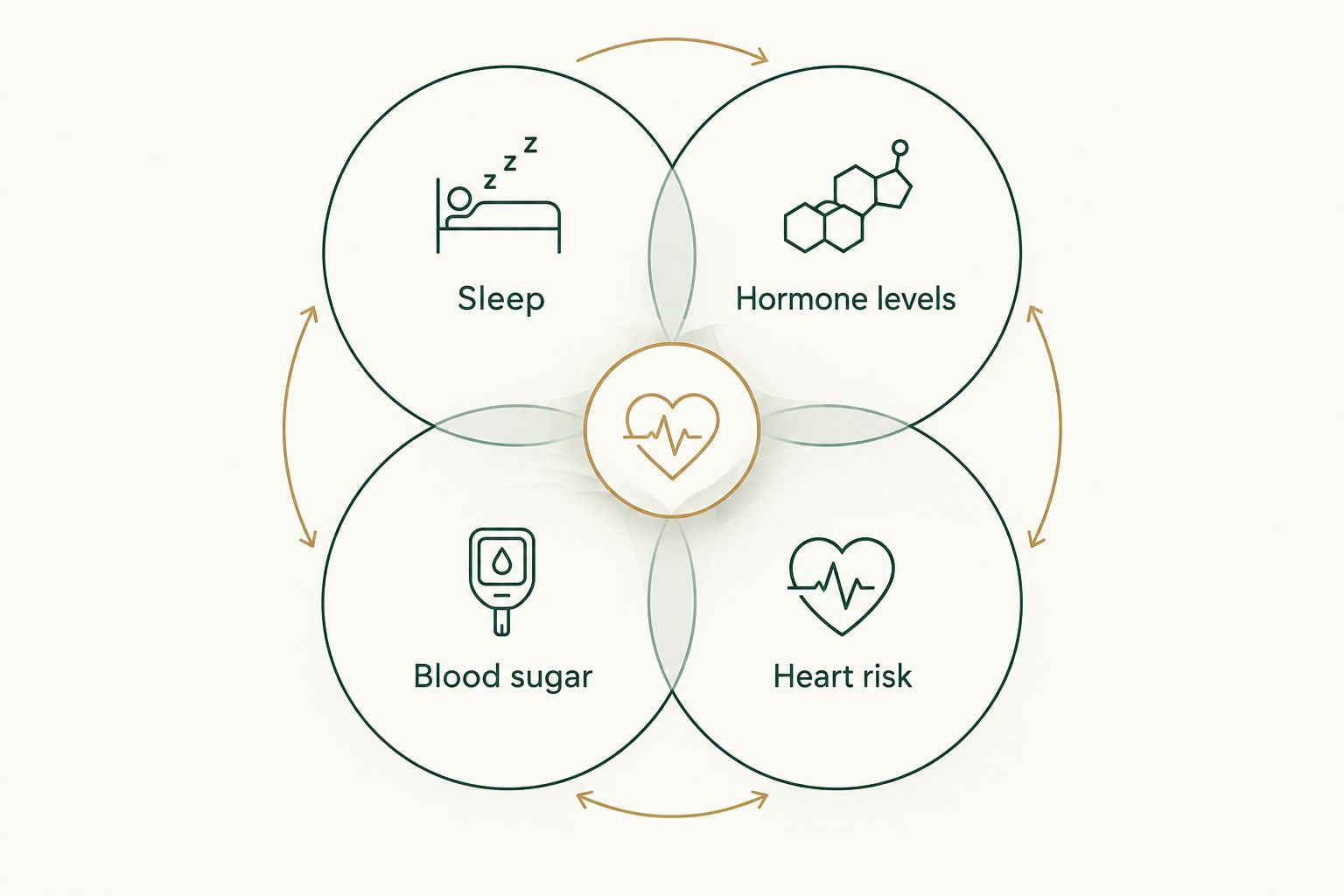
Testosterone decisions need the context of sleep, metabolic health, and cardiovascular risk.
FAQ
Can firefighters and police officers get TRT online?
Firefighters and police officers can be evaluated for TRT through telehealth when the clinician meets applicable prescribing requirements. Treatment requires a supported diagnosis and monitoring; occupational clearance is a separate process.
Does working nights mean I need testosterone therapy?
Working nights does not establish a need for testosterone therapy. Sleep disruption can overlap with low-testosterone symptoms, so a clinician must evaluate symptoms and confirm laboratory findings before recommending TRT.
When should a night-shift worker have testosterone tested?
A night-shift worker should have testosterone testing scheduled with the clinician using the worker’s sleep and duty history. Standard diagnostic recommendations use repeat morning measurements, but a draw immediately after overnight duty needs careful interpretation.
What testosterone level qualifies a man for TRT?
A testosterone level alone does not qualify a man for TRT. The American Urological Association uses total testosterone below 300 ng/dL as a reasonable diagnostic cutoff, together with symptoms, signs, and confirmation on separate measurements.
Can TRT affect my ability to have children?
TRT can suppress sperm production and affect fertility. Discuss future biological children before starting external testosterone; a clinician can assess whether specialist evaluation or a different treatment approach is needed.
Is injectable testosterone better than gel for first responders?
Injectable testosterone is not universally better than gel for first responders. Injections require training and sharps disposal, while gels require precautions against skin transfer; the choice depends on clinical suitability and duty conditions.
What does GoodLife Health include for hormone monitoring?
GoodLife Health includes a Biomarker Audit every 90 days within its Cardiometabolic Optimization Membership, with full hormone and thyroid panels plus metabolic and cardiovascular markers. Additional treatment-specific testing depends on clinical need and is separate from the included quarterly cadence.
Does a TRT prescription guarantee fitness-for-duty clearance?
A TRT prescription does not guarantee fitness-for-duty clearance. Your department’s designated occupational process determines applicable work requirements, while your treating clinician manages the medical condition.
One last thing
Bring your duty calendar to the consultation, not just your testosterone result. Sleep timing affects diagnostic interpretation, and medication timing affects follow-up interpretation. Your schedule also determines whether the monitoring plan is practical.
For your 2026 treatment decision, ask one final question: what would make the clinician decide not to prescribe, reduce treatment, or stop it? A clear answer tells you whether the service is managing a medical condition rather than simply maintaining a subscription.
Related Guides
- Testosterone therapy for shift workers with disrupted sleep
- Testosterone therapy for men: what labs to track
- How to protect fertility while on testosterone replacement therapy
References
- Treatment of Symptoms of the Menopause: An Endocrine Society Clinical Practice Guideline. 2015. doi.org/10.1210/jc.2015-2236
- Testosterone Therapy in Men with Hypogonadism: An Endocrine Society Clinical Practice Guideline. 2018. doi.org/10.1210/jc.2018-00229