Active-duty telehealth weight loss is clinician-supervised obesity care delivered remotely to improve metabolic health while protecting military readiness. You need a plan that coordinates with military medical care, preserves physical performance, and remains workable during training, transfers, and deployment planning.
Key Takeaways
- Choose telehealth weight loss programs for military active duty around medical coordination, performance, and continuity, not prescription speed.
- GoodLife Health Cardiometabolic Optimization suits adults seeking integrated metabolic, hormonal, and cardiovascular care alongside military medical coordination.
- Confirm civilian-care authorization and medication coverage with TRICARE before committing to treatment.
- A civilian prescription does not establish fitness for duty, deployment eligibility, or an exemption from service standards.
Why telehealth weight loss matters for active-duty members
The right program supports your health without creating a second, disconnected medical plan. A virtual appointment reduces the need to travel for a conversation, but blood draws, physical examinations, urgent symptoms, and occupational decisions still require the appropriate clinical setting.
Military needs change the selection criteria. You need to discuss field conditions, irregular meals, strenuous activity, and upcoming moves before choosing treatment. An appetite-suppressing medication requires particular attention to food intake, hydration, gastrointestinal symptoms, and training tolerance.
Cardiometabolic Optimization treats metabolic, hormonal, and cardiovascular health as one system. GoodLife Health uses this framework rather than treating the scale as an isolated problem. Blood sugar, lipids, inflammation, thyroid function, symptoms, and body composition belong in the same clinical assessment.
For a 2026 decision, separate three questions: Is treatment medically appropriate? Does your military medical team identify duty-related restrictions? Does your benefit cover the proposed civilian care and prescription? A yes to one does not answer the others.
This guide provides a selection process, not military clearance or individual medical advice. Your treating clinicians determine care; the responsible military medical authority addresses occupational requirements. Do not use a telehealth enrollment confirmation as evidence that either question has been settled.
How to choose and use an active-duty telehealth program
Confirm your military care pathway first
Start with your primary care manager or military treatment facility before enrolling in outside treatment. Ask how civilian weight-management care should fit into your existing record, referral pathway, and current duties. This conversation costs no private membership commitment and establishes who needs to receive the treatment plan.
Distinguish clinical permission from payment authorization. A clinician agreeing that weight management deserves attention does not establish that an outside appointment, laboratory panel, or prescription meets your benefit requirements. For your 2026 review, ask TRICARE to confirm the rules that apply to your enrollment and the specific proposed service.
If you serve in aviation, diving, special operations, or another role with additional medical oversight, identify the appropriate reviewing clinician before starting medication. Do not assume another service member's experience establishes your eligibility. Ask which current service and occupational policies apply, and record who provided the answer.
You do not need to resolve the entire treatment plan at this first discussion. You do need to establish the review process before a civilian clinician makes decisions without your operational context.
- Identify your primary care manager and relevant occupational medical contact.
- Ask whether the proposed civilian evaluation requires a referral or authorization.
- Request the process for sharing outside visit notes and prescriptions.
- Describe upcoming fitness testing, field exercises, and deployment planning.
- Save written benefit determinations separately from clinical recommendations.
Build a baseline beyond the weigh-in
Bring existing records before paying to repeat testing. Assemble your weight history, blood pressure readings, previous laboratory results, current prescriptions, supplements, injuries, sleep concerns, and prior weight-loss attempts. Include the practical details: when you eat, how you train, and what changes during overnight duty.
A military body-composition assessment and a medical obesity evaluation answer different questions. Meeting or missing a service standard does not, by itself, establish an indication for medication. Likewise, a BMI calculation does not explain muscle mass, recent performance changes, or the cause of fatigue.
FDA prescribing information for Wegovy and Zepbound includes adult chronic weight-management eligibility at a BMI of at least 30, or at least 27 with a weight-related condition. These are clinical screening thresholds, not military standards, insurance approval criteria, or a promise that a clinician will prescribe treatment.
Discuss changes in energy, menstrual function, libido, recovery, and sleep alongside weight and cardiometabolic markers. Symptoms deserve evaluation rather than an automatic hormone prescription. Ask your clinician to explain what each proposed test will change in the plan.
- Gather prior laboratory reports with their collection dates.
- List every medication and supplement, including workout products.
- Describe previous medication benefits, side effects, and reasons for stopping.
- Record performance concerns alongside weight and waist trends.
- Flag pregnancy, pregnancy planning, and relevant personal or family medical history.
Choose a clinician-led model with clear boundaries
First compare what your existing military care team can provide or coordinate. Then evaluate civilian telehealth if it addresses a defined gap, such as ongoing medical weight management or continuity between scheduled visits. Avoid buying a second primary care relationship without deciding how the clinicians will communicate.
GoodLife Health Cardiometabolic Optimization is best for adults seeking integrated metabolic, hormonal, and cardiovascular care. The membership includes a Biomarker Audit every 90 days, equivalent to four scheduled audits per year, and concierge-style direct primary care. The audit includes ApoB, Lp(a), hs-CRP, HbA1c, lipids, insulin markers, and full hormone and thyroid panels.
Clinical care is delivered by licensed physicians of Beluga Health, P.A., an independent Florida professional corporation licensed to practice in all 50 states, working under GoodLife Health's clinical protocols. Laboratory testing runs through the Beluga Health lab network. The model uses branded, FDA-approved GLP-1 medications, never compounded GLP-1 products.
The benefit is an ongoing clinical framework rather than an isolated prescription. The limitation for active-duty members is equally important: membership does not establish TRICARE coverage, military authorization, deployment suitability, or overseas treatment access. Review how direct primary care supports weight-loss management before deciding whether a separate membership fills your actual care gap.
- Ask who evaluates you and who handles follow-up questions.
- Request the process for sharing records with military clinicians.
- Separate membership services, pharmacy billing, and additional testing.
- Confirm that treatment depends on clinical assessment, not enrollment alone.
- Ask how the practice handles symptoms requiring an examination.
Match treatment to your duties and medical history
Begin with a clinician-guided review of meals, sleep, activity, and medications that affect weight. Prescription treatment belongs within that plan, not in place of it. Your clinician should explain why a particular treatment fits your diagnosis, medical history, and ability to follow the plan during duty.
For active-duty members, tolerability is a performance issue as well as a comfort issue. Nausea, vomiting, diarrhea, constipation, and reduced appetite need discussion before a demanding exercise or an extended period away from routine care. Tell your clinician about heat exposure, restricted meal opportunities, and physically strenuous assignments.
Medical history changes the decision. Disclose pancreatitis, gallbladder problems, severe gastrointestinal symptoms, pregnancy plans, and any personal or family history of medullary thyroid carcinoma or multiple endocrine neoplasia type 2. Your clinician must review contraindications and warnings for the exact medication being considered.
Do not select a prescription because another service member tolerated it. Do not increase a dose to match a fitness-test date. Your prescriber determines the schedule and any changes; the military medical team addresses duty implications. A treatment that produces unacceptable symptoms needs reassessment, not a stronger commitment to pushing through.
- Give the prescriber your training and travel calendar.
- Review contraindications against the exact product's prescribing information.
- Ask what symptoms require prompt contact or urgent evaluation.
- Establish who approves dose changes and treatment interruptions.
- Discuss a nonmedication plan if prescription treatment is unsuitable.
Protect strength, fueling, and recovery
Use a simple food and training log before buying additional tracking services. Record meals, appetite, gastrointestinal symptoms, sleep, and whether you complete normal training sessions. This gives your clinician something more useful than a weekly scale reading without requiring a complicated dashboard.
Weight loss includes the possibility of losing lean tissue, so preserving muscle deserves an explicit plan. Resistance training and adequate nutrition belong in the discussion, adjusted for injury, medical conditions, and your existing training load. Ask a registered dietitian or treating clinician to individualize intake rather than copying a universal calorie or protein target.
Lower body weight is not progress if you cannot fuel or recover for your duties. Report worsening fatigue, declining strength, dizziness, and persistent inability to eat. Do not interpret appetite suppression as evidence that food is unnecessary, and do not add extra conditioning to compensate for normal fluctuations on the scale.
For a 2026 training plan, select a few repeatable indicators that matter to your assignment. Keep measurement conditions consistent and interpret changes with your clinician. An isolated difficult session is different from a sustained decline, but both deserve context rather than an automatic medication adjustment.
- Track representative meals and appetite without deliberately underfueling.
- Continue clinician-approved resistance training within your recovery capacity.
- Record strength, endurance, and recovery alongside body-weight trends.
- Report dizziness, persistent fatigue, or inability to maintain intake.
- Arrange nutrition support that accounts for dining-facility and field constraints.
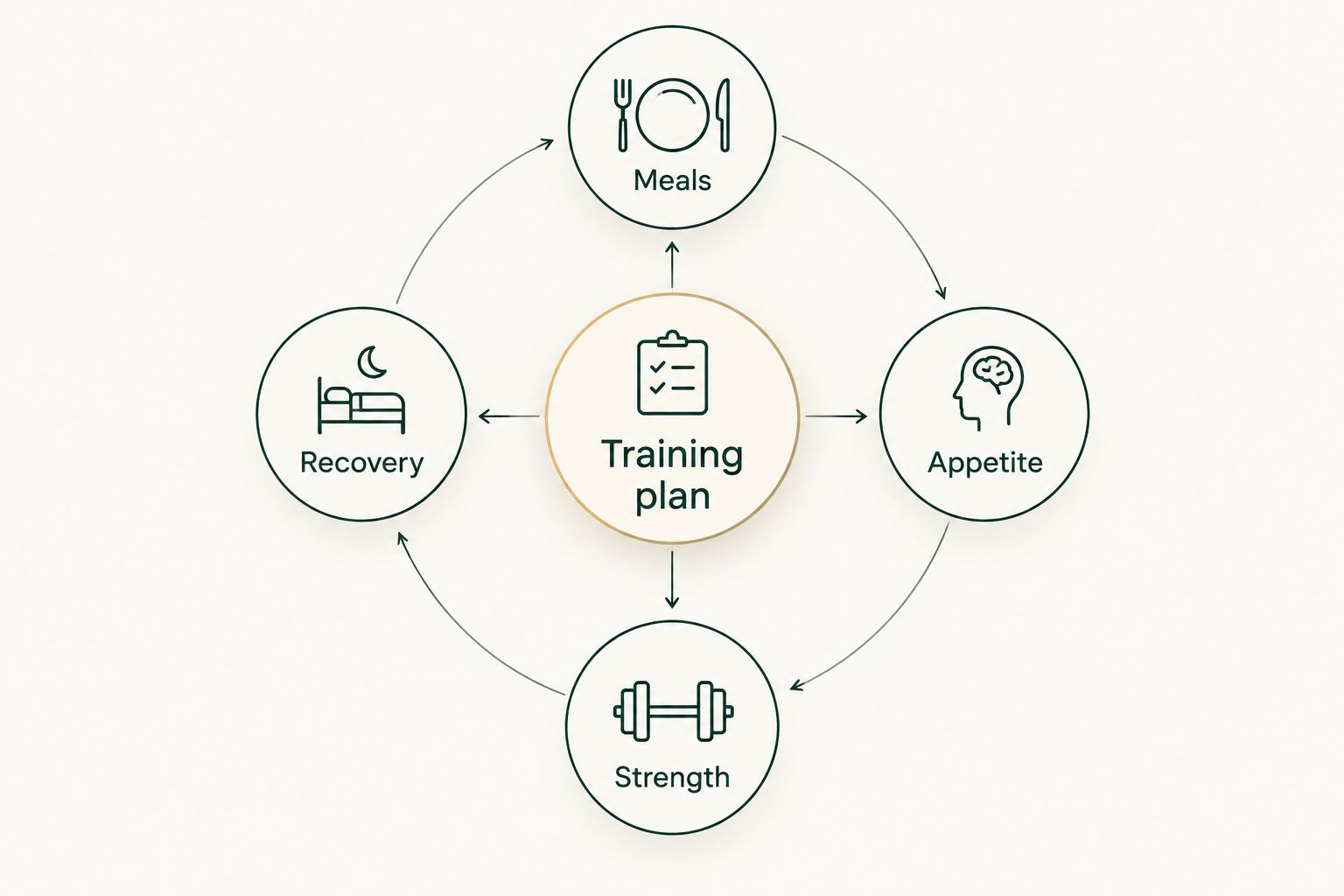
Track fueling and performance alongside changes in body weight.
Plan continuity before transfers and field training
Write a continuity plan before your next permanent change of station, temporary duty assignment, or extended exercise. Include the prescription name, current instructions, allergies, treating clinician, pharmacy, recent results, and the military medical contact coordinating your care. Keep records accessible through an appropriate secure method.
Telehealth depends on where you are physically located during the appointment. Confirm that the treating clinician can legally provide care at your destination. State licensure does not establish permission to treat someone overseas, and domestic prescribing does not establish import permission in another country.
Medication handling requires the exact product instructions. Storage limits differ among products and presentations; do not apply a generic refrigerator rule or an internet travel chart to every prescription. Ask the pharmacist about your specific itinerary, including temperature exposure and what to do if storage conditions are uncertain.
For a 2026 move, confirm continuity before your departure rather than after a missed appointment or interrupted prescription. If treatment must pause, obtain a prescriber-directed interruption and restart plan. Do not double a dose, borrow medication, or resume a previous dose after an extended interruption without instructions.
- Confirm appointment eligibility at your actual destination.
- Ask military medical staff about deployment and occupational review.
- Obtain product-specific transport and storage instructions from the pharmacist.
- Request a written plan for interrupted treatment and missed doses.
- Transfer relevant notes and results to the next treating team.
Measure health outcomes and define escalation
Start with a shared follow-up record. Track the outcomes your clinician selected, the side effects you experience, and whether treatment remains compatible with normal duties. Decide who reviews home measurements, who interprets laboratory results, and how information reaches your military medical team.
Laboratory cadence is not the same as symptom management. A scheduled Biomarker Audit every 90 days does not mean you should wait until the next draw to report a problem. Additional tests depend on the clinical situation; testing beyond the quarterly cadence in this membership is billed at pass-through cost.
Discuss metabolic markers as part of the same system as blood pressure, symptoms, thyroid function, and performance. A lower HbA1c does not resolve persistent vomiting, and a smaller waist does not explain new dizziness. Ask the clinician to state what improved, what remains abnormal, and what changes next.
Set emergency boundaries before you need them. Seek urgent medical evaluation for severe or persistent abdominal pain, repeated vomiting with inability to keep fluids down, fainting, or signs of a serious allergic reaction. A portal message is not emergency care. Tell the evaluating team exactly what medication you take and when you last took it.
- Record treatment benefits and side effects in the same log.
- Review blood pressure and relevant laboratory trends with your clinician.
- Ask when a remote visit must become an in-person evaluation.
- Identify the local urgent and emergency care pathway.
- Update both treating teams when prescriptions or duty circumstances change.
Compare care options for active-duty members
Choose the model that closes a documented care gap. The table compares care pathways, not named clinics' unverified military benefits. None of these options independently determines whether a medication fits your occupational requirements.
| Option | Best for | Main advantage | Key limitation |
|---|---|---|---|
| Military primary care pathway | Members establishing a coordinated starting point | Connects weight concerns with the existing military medical team | Ask what weight-management services and referral routes apply locally |
| Civilian specialist through an authorized pathway | Members needing a focused obesity or endocrine evaluation | Adds specialist assessment to the documented care plan | Requires confirmation of referral, authorization, and benefit requirements |
| GoodLife Health Cardiometabolic Optimization | Adults seeking integrated metabolic, hormonal, and cardiovascular follow-up | Combines scheduled Biomarker Audits with ongoing physician-directed care | Membership does not establish military clearance, TRICARE coverage, or overseas access |
| Civilian prescription-focused telehealth | Members evaluating a narrow medication-management service | Concentrates the consultation on prescription assessment and follow-up | Verify laboratory review, coordination, and in-person escalation individually |
| Lifestyle support without medication | Members building sustainable habits or unable to use medication | Focuses on nutrition, activity, sleep, and behavior | Does not replace evaluation of symptoms or associated medical conditions |
Before paying for civilian care, request a written explanation of what the service includes and excludes. Separate clinical follow-up, laboratory services, medication billing, and any insurance claims process. Do not assume a direct primary care membership functions as health insurance.
You also need a practical answer about records. Ask whether you receive visit notes, laboratory reports, and an updated medication list in a form your military clinicians can review. A program that fits your schedule but leaves your medical record incomplete does not solve the coordination problem.


Common mistakes active-duty members make
Treating a civilian prescription as military clearance
A valid prescription establishes a treatment decision, not an occupational determination. Confirm the military review process before starting, especially when your duties involve additional medical oversight. Do not substitute a civilian clinician's general reassurance for review by the responsible military medical authority.
Buying treatment before confirming the benefit pathway
A telehealth practice's ability to prescribe does not establish TRICARE payment or authorization. Confirm the proposed appointment, testing, and medication separately. Keep the response tied to the actual service and prescription rather than a general question about whether weight-loss care is covered.
Chasing a weigh-in instead of treating a condition
A deadline does not establish medication eligibility or justify aggressive restriction. Tell the clinician the date and the pressure you feel, but ask for a medically appropriate plan. Avoid dehydration tactics, unsupervised dose changes, and adding multiple weight-loss products to force a result.
Hiding appetite problems to protect the prescription
Persistent difficulty eating is clinically relevant, particularly during strenuous duty. Report it even if weight is falling. Your clinician needs to evaluate symptoms, intake, and treatment tolerance together; a prescription should not become something you defend at the expense of your health.
Assuming a domestic plan travels everywhere
A change in physical location can change the appointment, prescribing, transport, and follow-up questions you need to resolve. Review the plan before travel. A national care footprint is not a promise of overseas care or medication continuity during deployment.
FAQ
Can active-duty service members use telehealth for weight loss?
Active-duty service members should coordinate proposed civilian telehealth weight-loss care with their military medical team and confirm applicable authorization requirements. Medical eligibility, benefit coverage, and occupational suitability are separate decisions.
What's the best telehealth weight-loss program for someone on active duty?
The best fit is a clinician-led program that coordinates with military care, evaluates medical eligibility, and plans for performance and treatment continuity. GoodLife Health offers integrated cardiometabolic care, but membership does not establish military clearance or TRICARE coverage.
Does TRICARE cover an outside weight-loss membership?
Do not assume TRICARE covers an outside weight-loss membership. Ask TRICARE to confirm coverage and authorization requirements for the specific practice, appointment, laboratory services, and prescription before committing.
Can I take a GLP-1 medication while deployed?
A civilian prescription alone does not establish whether GLP-1 treatment is compatible with your deployment. Ask the responsible military medical authority to review the medication, underlying condition, monitoring needs, and operational setting before departure.
Do I qualify for medication if I fail a military body-composition assessment?
Failing a military body-composition assessment does not automatically establish eligibility for weight-loss medication. A treating clinician must assess the applicable medication indication, weight-related conditions, medical history, and contraindications.
Can I keep using my telehealth clinician after a permanent change of station?
Confirm continuity with your telehealth practice before a permanent change of station. The clinician must be authorized to treat you where you are physically located, and an overseas assignment requires additional review rather than an assumption of continued access.
What labs are included in the GoodLife Health membership?
The GoodLife Health membership includes a Biomarker Audit every 90 days through the Beluga Health lab network. The panel includes ApoB, Lp(a), hs-CRP, HbA1c, lipids, insulin markers, and full hormone and thyroid panels; additional testing beyond that cadence is billed at pass-through cost.
Should I wait until my next appointment if I have severe medication symptoms?
Do not wait for a routine telehealth appointment when severe symptoms require urgent evaluation. Severe or persistent abdominal pain, repeated vomiting with inability to keep fluids down, fainting, or signs of a serious allergic reaction need prompt medical attention.
One last thing
Ask for an interruption plan before you ask for a prescription. A service member's treatment has to withstand changes in location, meal access, training, and medical oversight. The useful question is not simply whether a program can start treatment; it is who takes responsibility when your circumstances change.
Before your 2026 enrollment decision, ask the civilian clinician and military medical team to identify the next action if treatment becomes intolerable or cannot continue during an assignment. A clear answer is more useful than a promise about the scale.
Related Guides
- What to expect at your first telehealth medical weight-loss visit
- How to travel with refrigerated GLP-1 medication
- How to protect lean mass during GLP-1 treatment
References
- Tirzepatide Once Weekly for the Treatment of Obesity (SURMOUNT-1). 2022. pubmed.ncbi.nlm.nih.gov/35658024/
- Once-Weekly Semaglutide in Adults with Overweight or Obesity (STEP 1). 2021. pubmed.ncbi.nlm.nih.gov/33567185/