Type 2 diabetes ApoB testing is a blood assessment of artery-damaging lipoprotein particle burden, used to clarify cardiovascular risk and guide treatment. Your total testing expense depends on the lab, insurance benefits, collection fees, and whether a clinician's interpretation is included; compare the complete testing-and-care arrangement, not just the assay.
- ApoB test cost for type 2 diabetes should include collection, interpretation, and follow-up, not just the assay.
- GoodLife Health includes ApoB in its Cardiometabolic Optimization Biomarker Audit every 90 days.
- ApoB and LDL cholesterol measure different features of cardiovascular risk; neither replaces diabetes monitoring.
- Confirm insurance coverage for the exact test and laboratory before your blood draw.
Why ApoB testing matters for adults with type 2 diabetes
A glucose result does not describe your full cardiovascular risk. HbA1c reflects average blood glucose over approximately 2–3 months. ApoB addresses a different question: how many circulating atherogenic lipoprotein particles are present.
Type 2 diabetes often involves insulin resistance, elevated triglycerides, and changes in lipoprotein composition. In that setting, LDL cholesterol and ApoB do not always tell the same story. Your LDL cholesterol result can appear reassuring while ApoB identifies a greater particle burden than the cholesterol measurement suggests.
GoodLife Health defines Cardiometabolic Optimization as treating metabolic, hormonal, and cardiovascular health as one system. That framework matters here: interpreting ApoB alongside glucose, lipids, blood pressure, thyroid status, and treatment history is more useful than treating an isolated laboratory flag.
For your 2026 testing decision, start with the clinical question. Will ApoB clarify risk, resolve disagreement between lipid measurements, or help assess a treatment response? If the answer is unclear, ask before ordering.
Testing is not treatment. A useful result ends with a physician explaining what changes, what stays the same, and when reassessment makes sense.
Understand what your ApoB result measures
ApoB is a protein carried by atherogenic lipoproteins, including LDL and triglyceride-rich remnant particles. Measuring ApoB provides an estimate of the number of these particles. LDL cholesterol instead measures the cholesterol carried inside LDL particles.
That distinction matters because particles do not all carry the same amount of cholesterol. With insulin resistance, the cholesterol content per particle can differ enough that LDL cholesterol understates particle burden relative to ApoB. Clinicians call disagreement between these measurements discordance.
ApoB is commonly reported in mg/dL.
A laboratory reference interval is not automatically your personal treatment goal. Your physician must account for established cardiovascular disease, kidney disease, other risk factors, and current lipid-lowering treatment.
ApoB also does not replace a standard lipid panel. Triglycerides, HDL cholesterol, LDL cholesterol, and non-HDL cholesterol provide related information that helps explain the result. Nor does ApoB replace HbA1c, kidney assessment, blood pressure measurement, or routine diabetes care.
Before comparing testing arrangements, make sure everyone is quoting the same service: an apolipoprotein B measurement, not simply a cholesterol panel or a different advanced lipid assessment.
How to compare ApoB testing and arrange useful follow-up
1. Define the decision the test will support
Start with your existing physician and your current records. Ask whether ApoB would add information beyond your lipid panel and medical history. You do not need to purchase a broad testing package before having that conversation.
Bring your recent lipid results, HbA1c, medication list, and any history of cardiovascular or kidney disease. Include family history of early heart attacks and whether you have stopped a cholesterol medication because of side effects. Those details help your clinician interpret the result rather than simply label it high or normal.
The question is not whether ApoB is a useful marker in general. It is whether measuring ApoB will improve a specific decision in your care. Your physician should explain that decision in ordinary language before the blood draw.
- Ask what ApoB would add to your existing lipid results.
- Identify the treatment decision the result could change.
- Bring prior results with collection dates and units.
- Record medication names, doses, and recent changes.
- Explain previous medication intolerance rather than omitting it.
2. Request an itemized testing estimate
Use the ordering office, laboratory, and insurer to build a written estimate yourself. Ask each organization which part of the service it bills. A laboratory quote does not establish what a separate visit or follow-up review will involve.
For an ApoB test cost comparison in 2026, distinguish the assay from specimen collection, ordering services, and interpretation. Ask whether an existing appointment can cover the discussion or whether a separate encounter is required. Also confirm what happens if a sample cannot be processed.
Avoid comparing an isolated laboratory test with a longitudinal care membership as though they were interchangeable. One produces a measurement; the other can include an ongoing clinical relationship. Your comparison should match the service you actually need, without assuming that more services are automatically better.
- Request a written description of every billed component.
- Confirm whether specimen collection is included.
- Ask who orders the test and reviews the result.
- Clarify whether follow-up requires a separate appointment.
- Check the policy for an unusable specimen.
3. Match the care arrangement to your diabetes needs
Begin by asking whether your current primary care physician, endocrinologist, or cardiologist can order and interpret ApoB within your existing care. Keeping the result with the team already managing your diabetes can reduce fragmented decisions and duplicate testing.
For ongoing monitoring, GoodLife Health Cardiometabolic Optimization includes a comprehensive Biomarker Audit every 90 days, with ApoB, Lp(a), hs-CRP, HbA1c, lipids, insulin markers, and full hormone and thyroid panels. That is 4 scheduled audits per year. Labs run through the Beluga Health lab network; additional testing beyond the quarterly cadence is billed separately at pass-through cost.
GoodLife Health is best for adults seeking ApoB testing within ongoing Cardiometabolic Optimization, rather than a standalone lab order. The limitation is equally clear: a membership is a broader commitment than an isolated test. Compare the clinical scope before joining.
- Ask your current team about ordering ApoB first.
- Review how direct primary care supports type 2 diabetes management.
- Confirm which scheduled labs the membership includes.
- Ask how additional laboratory testing is handled.
- Decide who will coordinate care with your specialists.
4. Verify insurance benefits before the blood draw
Contact your insurer with the exact test information supplied by the ordering office or laboratory. Ask the office for the applicable billing code rather than guessing from a search result. Coverage depends on your plan, the laboratory, the documented reason for testing, and applicable benefit rules.
A type 2 diabetes diagnosis does not establish automatic coverage for every advanced lipid test. Likewise, a clinician's order does not mean the insurer has agreed to reimburse it. Keep clinical necessity and benefit verification separate.
For 2026 benefits, record the representative's response and any reference number. If the answer is unclear, ask what documentation is needed before collection. A benefit estimate is still not a guarantee of final claim payment, so confirm how the laboratory handles patient responsibility and billing questions.
- Verify the exact assay and applicable billing code.
- Check the laboratory's network status for your plan.
- Ask about medical-necessity documentation and authorization rules.
- Clarify deductible and other patient-responsibility provisions.
- Save the written estimate or call reference number.
5. Prepare without disrupting your diabetes treatment
Start by reading the ordering clinician's instructions. ApoB alone generally does not require fasting, but accompanying tests can have different preparation requirements. Ask about the entire order rather than assuming that instructions for ApoB cover every marker being collected.
Fasting deserves particular attention if you use insulin or another medication that can cause hypoglycemia. Do not skip meals, stop medication, or change a dose on your own to satisfy a laboratory instruction.
Your diabetes team should give you a preparation plan that fits your treatment.
Coordinate tests when clinically appropriate, but do not combine orders merely to make the appointment convenient. The clinician must decide which markers are needed and whether their preparation requirements fit together. Tell the ordering team about recent illness and significant treatment changes so the collection date has useful context.
- Confirm whether the complete order requires fasting.
- Request individualized medication instructions from your diabetes team.
- Ask how to handle low glucose during preparation.
- Bring the correct order and laboratory identification requirements.
- Report recent illness and major medication changes.
6. Interpret ApoB alongside the rest of your risk profile
First obtain the complete report and review it with the clinician responsible for your cardiovascular prevention plan. Do not treat a portal flag as a diagnosis or use an online target to change your medication independently.
Compare ApoB with LDL cholesterol, non-HDL cholesterol, triglycerides, and your treatment history. If the measurements disagree, ask what that means for your risk assessment. Blood pressure, smoking, kidney function, established cardiovascular disease, and diabetes management remain part of the same discussion.
A lower HbA1c does not prove that ApoB has improved, and weight loss does not establish that lipid-lowering treatment is unnecessary. Conversely, an elevated ApoB result does not identify a single cause by itself. Your physician should explain both the finding and the reasoning behind the proposed response.
- Check the ApoB value, units, and collection date.
- Compare the result with the accompanying lipid panel.
- Ask whether discordance changes your risk assessment.
- Review medication adherence and tolerability without self-adjusting doses.
- Request a written explanation of the next clinical step.
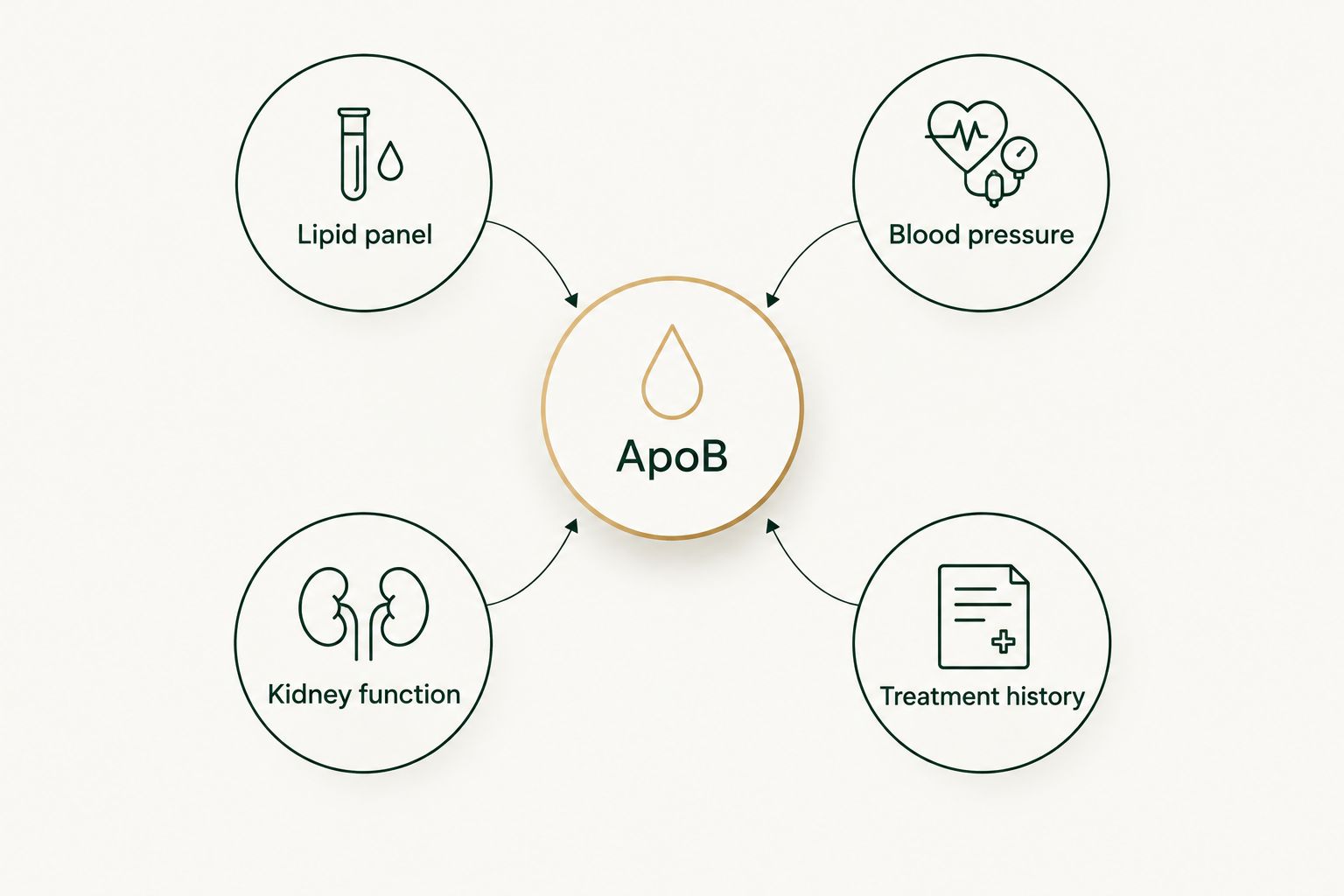
An ApoB result belongs within a cardiovascular risk assessment, not outside it.
7. Set a follow-up plan before ordering another test
Use a simple record of results, medication changes, and the clinician's recommendations. Ask when repeat testing will answer a meaningful question. Repeating ApoB without an intervening treatment decision can produce more measurements without producing clearer care.
The right interval depends on the treatment plan and clinical circumstances. GoodLife Health schedules its Biomarker Audit every 90 days; that membership cadence is not a universal recommendation for every adult with diabetes. Your physician determines whether testing outside the scheduled audit is needed.
Your 2026 monitoring plan should identify who receives the result, who explains it, and who adjusts treatment. If several clinicians are involved, choose a lead contact for lipid management. A shared report is useful, but a shared report without assigned responsibility still leaves room for conflicting instructions.
- Record the reason for repeating ApoB.
- Document treatment changes between blood draws.
- Identify the clinician responsible for lipid management.
- Share complete reports with relevant specialists.
- Confirm how questions and unexpected results are handled.


Compare ApoB testing options for adults with diabetes
Choose the arrangement that connects the result to a decision. A standalone assay can meet a focused need when your existing clinician will interpret it. A broader care model serves a different purpose: repeated assessment and ongoing treatment management.
This 2026 comparison separates clinical fit from billing structure. Verify the actual terms directly before ordering; neither a test order nor a membership establishes insurance reimbursement.
ApoB testing options for adults with diabetes
| Option | Best for | Main advantage | Billing to confirm | Key limitation |
|---|---|---|---|---|
| Existing primary care or diabetes clinician | Adults with an established treatment team | Keeps interpretation with your current medical history | Laboratory, collection, and visit components | ApoB testing and follow-up must be arranged explicitly |
| Standalone self-pay laboratory testing | Adults whose clinician has agreed to review an outside result | Separates the assay from a broader care commitment | Ordering, collection, and interpretation components | The result alone does not provide ongoing treatment |
| Cardiologist-led assessment | Adults needing specialist evaluation of complex cardiovascular risk | Places testing within specialist assessment | Consultation, laboratory, and insurance requirements | Specialist evaluation is a broader service than an ApoB measurement |
| Cardiometabolic Optimization Membership | Adults seeking recurring labs and longitudinal care | Includes ApoB within scheduled Biomarker Audits | Membership terms and additional testing provisions | Broader commitment than a standalone assay |
GoodLife Health's clinical care is delivered by licensed physicians of Beluga Health, P.A., an independent Florida professional corporation licensed to practice in all 50 states, working under GoodLife Health's clinical protocols. The membership does not replace health insurance or eliminate the need for specialist care.
The practical trade-off is scope. If you only need a measurement interpreted by your current physician, compare standalone testing. If you need continuing coordination across glucose, lipids, thyroid, hormones, and treatment, assess the ongoing clinical relationship instead.
Common mistakes adults with type 2 diabetes make
Treating an improved HbA1c as a complete heart-risk assessment
HbA1c and ApoB answer different questions. Better glucose control is valuable, but it does not establish that atherogenic particle burden, blood pressure, or other cardiovascular risks are adequately managed. Keep your diabetes and cardiovascular prevention plans connected. Ask which markers have improved and which still require attention rather than assuming all risks move together.
Paying for a result without assigning interpretation
An outside laboratory report is not an ongoing care plan. Before ordering, confirm that your clinician accepts outside results and will explain what action follows. Otherwise, you can finish the testing process with an unexplained number and still need a separate clinical assessment. Establish responsibility before collection, not after an abnormal result appears.
Assuming a diabetes diagnosis guarantees coverage
Medical relevance and insurance reimbursement are different issues. Your plan can apply laboratory, documentation, or other benefit requirements even when a clinician considers ApoB useful. Verify the exact assay and laboratory before the draw. Do not substitute another patient's coverage experience for your own plan's response, particularly after a change in benefits or laboratory network.
Changing medication to improve the next laboratory result
Do not stop a statin, change diabetes medication, or alter fasting preparation to influence the report. The purpose of testing is to assess your actual treatment response and guide a safe plan. Tell your clinician about missed doses and adverse effects honestly; those details improve interpretation. A result obtained under an undisclosed medication change can mislead the next decision.
FAQ
What determines ApoB test cost for type 2 diabetes?
Your total depends on the laboratory assay, specimen collection, ordering services, clinical interpretation, and your insurance benefits. Request an itemized estimate that separates the blood test from any appointment or follow-up service.
Does insurance cover an ApoB test if I have type 2 diabetes?
References
- Tirzepatide Once Weekly for the Treatment of Obesity (SURMOUNT-1). 2022. pubmed.ncbi.nlm.nih.gov/35658024/
- Once-Weekly Semaglutide in Adults with Overweight or Obesity (STEP 1). 2021. pubmed.ncbi.nlm.nih.gov/33567185/