Corporate wellness programs' hormone panel testing is clinician-directed laboratory evaluation with the aim of connecting employees to appropriate care for symptoms and suspected endocrine conditions. A sound 2026 program makes testing voluntary, keeps individual results outside employer reporting, and evaluates hormones alongside metabolic and cardiovascular health rather than treating a laboratory number as a diagnosis.
Key Takeaways
- Hormone panel testing for corporate wellness programs should fund clinical evaluation, not automatic screening of every employee.
- GoodLife Health Cardiometabolic Optimization suits adults seeking hormone testing within ongoing metabolic and cardiovascular care.
- Employers should receive participation reporting, not individual hormone results, diagnoses, or prescription details.
- A hormone panel needs symptom context, appropriate collection timing, physician interpretation, and a documented follow-up plan.
- A corporate wellness program has two different responsibilities: provide useful access to care and avoid turning private medical information into a workplace management tool.
- Start with an employee's concern, not a panel catalog.
- The strongest procurement question is not how many hormones the panel measures.
Why hormone panel testing matters for corporate wellness programs
A corporate wellness program has two different responsibilities: provide useful access to care and avoid turning private medical information into a workplace management tool. The employer funds access; the clinician decides what testing and treatment are appropriate. That boundary belongs in the program design before enrollment opens.
Fatigue, disrupted sleep, menstrual changes, low libido, and unexplained weight changes warrant clinical attention, but they do not establish hormone deficiency. Medication effects, sleep disorders, anemia, mental health conditions, and other illnesses belong in the evaluation. Ordering the same hormone panel for everyone skips that reasoning.
GoodLife Health defines Cardiometabolic Optimization as treating metabolic, hormonal, and cardiovascular health as one system. That framing matters because an employee's thyroid symptoms, blood sugar, weight trajectory, lipids, and treatment risks should inform the same care plan.
For your 2026 benefits brief, distinguish access from outcomes. Offering appointments and laboratory evaluation is a deliverable; reduced absenteeism or improved productivity is an outcome that requires evidence. Do not promise either from a testing launch alone.
The practical objective is narrower and more defensible: employees understand their results, receive appropriate next steps, and know who owns follow-up.
Build the program around clinical decisions
Start with an employee's concern, not a panel catalog. A useful pathway connects confidential intake, a clinician's assessment, appropriate testing, interpretation, and continuing care.
You can organize that pathway through existing primary care and benefits administration without purchasing a separate testing platform. A membership model is another option when you want a continuing clinical relationship. Neither approach justifies employer access to identifiable medical findings, and neither makes every available test necessary for every participant.
1. Define the clinical purpose before selecting tests
Write a short program brief using your existing benefits documents and a discussion with your clinical adviser. Specify what employees can access, how they request care, and where the employer's involvement ends. Avoid describing hormone testing as an energy upgrade or a performance intervention.
Separate symptom evaluation from population screening. An employee seeking help for hot flashes needs a different conversation from an employee with no symptoms who wants a broad laboratory panel. A benefits team can explain the pathway, but it cannot determine which hormones either employee needs measured.
Also define success without claiming a medical effect you have not measured. Appointment completion, documented result review, and access barriers are operational measures. A laboratory change is a clinical finding, not proof that the benefit caused better workplace performance.
Your 2026 scope should state whether the program funds consultations, testing, continuing care, or some combination. Employees should not discover after a blood draw that interpretation falls outside the arrangement.
Close the brief with these decisions:
- Purpose: provide confidential evaluation of symptoms and clinically relevant concerns.
- Eligibility: explain who can use the benefit without requiring disclosure to a manager.
- Scope: distinguish consultation, laboratory testing, result review, and continuing care.
- Accountability: identify the clinician responsible for acting on findings.
- Measurement: track access and completed care steps before making outcome claims.
2. Protect voluntary participation and medical privacy
Begin with a written data-flow map. Show where enrollment information, clinical histories, laboratory results, billing records, and employer reports travel. You do not need a new dashboard to identify whether sensitive information reaches the wrong recipient.
Design participation as a choice rather than a workplace expectation. Managers should not nominate employees for testing because of weight, mood, age, or perceived energy. Employees should be able to decline without explaining a medical decision to their supervisor.
Medical privacy requirements depend on the entities involved and the benefit's structure. Do not assume that calling a program HIPAA-compliant settles every employer responsibility. Ask benefits counsel to review the arrangement, including applicable disability, genetic-information, health-plan, and state privacy requirements.
Small-group reports deserve particular attention. Removing names does not make a report private if a department contains one identifiable participant. Set reporting boundaries before collecting data, not after someone requests a breakdown of menopause or testosterone findings.
Put these controls in writing:
- Keep individual results, diagnoses, symptoms, and prescriptions within the clinical care pathway.
- Limit employer reporting to agreed operational information with appropriate privacy safeguards.
- Prevent managers from accessing participation details that reveal medical concerns.
- Explain consent, record access, data retention, and withdrawal in plain language.
- Have qualified counsel review incentives and information-sharing arrangements before launch.
3. Select a care pathway with a named clinical owner
Start by assessing existing access. Employees can bring symptoms and previous laboratory results to their primary care clinician, who can decide whether additional testing or specialist referral is appropriate. A separate employer-sponsored hormone panel is not a prerequisite for evaluation.
If that pathway does not provide the continuity you want, compare clinical memberships rather than panel size alone. Ask who orders tests, who interprets them, who responds to concerning findings, and how care continues after the first review. A result portal is not a substitute for those responsibilities.
GoodLife Health Cardiometabolic Optimization is best for adults seeking hormone testing within ongoing metabolic and cardiovascular care. Clinical care is delivered by licensed physicians of Beluga Health, P.A., an independent Florida professional corporation licensed to practice in all 50 states, working under GoodLife Health's clinical protocols.
That describes an individual care model, not a confirmed employer contract or reporting service. Verify any proposed employer arrangement separately. For employees whose symptoms involve thyroid disease, the guide to direct primary care for thyroid disorder management explains the relevant care context.
Evaluate the pathway against these criteria:
- Identify the clinical entity and the physician responsible for care.
- Require a conversation before treatment decisions, not prescribing from a questionnaire alone.
- Confirm how employees obtain interpretation and follow-up.
- Establish referral and urgent-result procedures.
- Verify employer contracting and reporting separately from individual membership features.
4. Match the laboratory plan to the employee's history
The manual starting point is a clinical history: symptoms, medications, supplements, prior diagnoses, previous results, reproductive context, and sleep schedule. Employees can gather existing records before the visit. That often answers questions a new panel cannot resolve by itself.
A hormone panel is not one standardized test. Depending on the clinical question, evaluation can involve thyroid markers, testosterone, estradiol, progesterone, or other targeted tests. More analytes do not automatically produce a better answer, and normal results do not invalidate persistent symptoms.
Interpret hormones within the wider cardiometabolic picture. HbA1c informs assessment of longer-term blood sugar; lipids and ApoB inform cardiovascular risk assessment; hs-CRP is an inflammation marker with nonspecific causes. These markers answer different questions and should not become interchangeable wellness scores.
Perimenopause illustrates the need for context. Hormone levels fluctuate, so a single estradiol or follicle-stimulating hormone result does not reliably summarize the whole transition. Likewise, a random cortisol value is not a validated measure of workplace burnout.
Ask the clinical team to document:
- The symptom or clinical question each ordered test addresses.
- Relevant medications, supplements, diagnoses, and previous laboratory findings.
- Whether reproductive stage or menstrual timing affects interpretation.
- How thyroid, glucose, lipids, and other relevant findings inform the same assessment.
- Which findings need confirmation, referral, or no additional testing.
5. Standardize collection and interpretation without standardizing treatment
Use the laboratory's instructions and the ordering clinician's guidance as your starting point. Provide employees with clear preparation information, but leave medication changes and individualized collection decisions to the clinical team. Benefits staff should never tell employees to stop prescribed therapy before testing.
Collection context matters. Testosterone assessment commonly requires appropriately timed samples and confirmation of a low result in someone with compatible symptoms. Shift work complicates conventional morning collection, so the clinician should consider the employee's sleep pattern rather than applying an office-worker schedule automatically.
A reference range is not a treatment instruction. The clinician must connect the finding to symptoms, collection conditions, relevant illnesses, and medication use. An unexpected result can require confirmation before it supports a diagnosis.
For your 2026 operating procedure, make the result review an explicit appointment or documented clinical interaction. Employees need an explanation of what matters, what does not, and what happens next. Sending a colored laboratory report alone does not complete the evaluation.
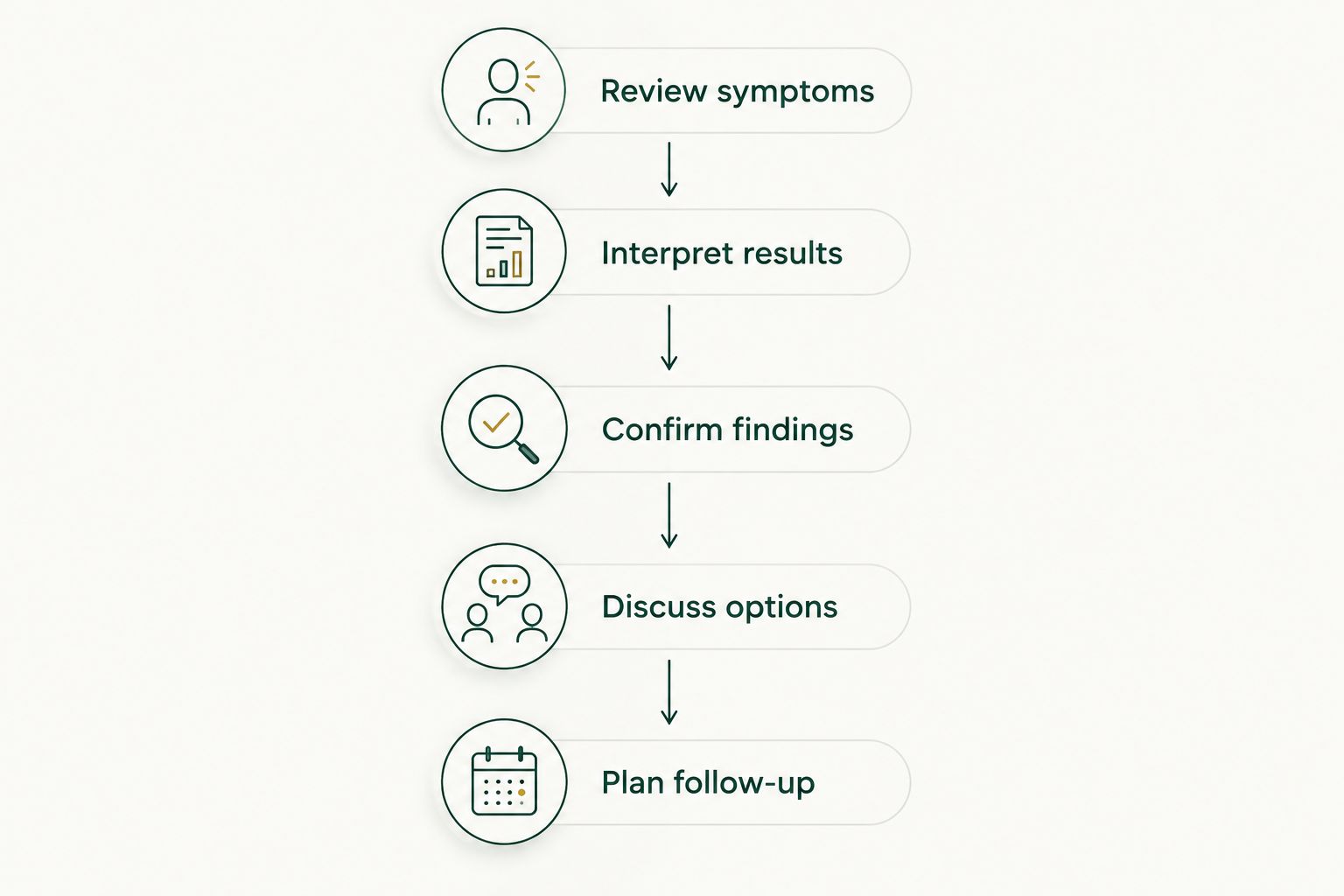
A laboratory result informs a clinical decision; it does not make the decision.
Use this review sequence:
- Review symptoms: connect the employee's concern with history and collection conditions.
- Interpret results: explain relevant findings without treating every flag as disease.
- Confirm findings: repeat or extend testing when clinically indicated.
- Discuss options: include observation, lifestyle support, medication, and referral where appropriate.
- Plan follow-up: document the next action and its clinical owner.
6. Fund continuing care rather than a one-time result
First, check whether an employee's existing clinician can provide follow-up. A targeted evaluation with continuing primary care can be more useful than an expansive panel without anyone responsible for reviewing it. The program should support the next clinical decision, not merely the blood draw.
If you choose a membership pathway, inspect what it includes and what remains separate. GoodLife Health includes a Biomarker Audit every 90 days, or 4 audits per year, covering ApoB, Lp(a), hs-CRP, HbA1c, lipids, insulin markers, and full hormone and thyroid panels. Labs run through the Beluga Health lab network.
The membership begins with a commitment of 2 months, then continues month to month with cancellation permitted after that initial commitment. A recurring membership is a limitation for someone seeking only a one-time consultation. Its scheduled audit also does not mean every marker needs the same clinical retesting interval.
Additional labs beyond the quarterly cadence are billed separately at pass-through cost. Medications are billed by the pharmacy at pharmacy cost, without medication markup or dose-escalation fees. Do not assume an employer subsidy, insurance reimbursement, or a corporate purchasing arrangement without written confirmation.
Before funding a pathway, confirm:
- What consultation, interpretation, and continuing access the arrangement includes.
- Which laboratory services fall inside or outside the included cadence.
- How prescriptions and pharmacy billing remain separate from clinical membership.
- How employees continue care if their employment or benefits change.
- How clinically indicated follow-up occurs between scheduled audits.
7. Measure completed care while keeping clinical findings private
Start with a simple operational report rather than a hormone dashboard. Count enrollment, completed consultations, completed result reviews, and unresolved access problems. Define each measure so a completed blood draw cannot be mistaken for completed care.
Keep clinical monitoring with the treating team. Employees and physicians can review symptoms, treatment tolerance, blood pressure, and relevant laboratory trends. Employers should not receive individual testosterone changes, reproductive histories, or lists of employees receiving hormone therapy.
Separate program evaluation from causal claims. If participants report better access, that supports an access finding. It does not establish reduced healthcare spending, improved productivity, or fewer sick days. Those claims need a defined evaluation method and evidence that addresses other explanations.
Your 2026 renewal decision should examine whether the pathway works as promised. Employees who receive an abnormal result but cannot reach a clinician expose a care gap, even if testing participation looks strong. Employees who decline testing should remain outside any performance assessment.
Use these review questions:
- Did employees receive the consultation and interpretation described at enrollment?
- Were clinically relevant findings assigned a documented next step?
- Did collection locations, schedules, or technology create access barriers?
- Did employer reporting stay within the agreed privacy boundaries?
- Are proposed outcome claims supported by an appropriate evaluation rather than participation counts?
Compare care options for your 2026 program
Choose the option that completes the care pathway, not the one with the longest test menu. Existing primary care, targeted testing, and membership-based care serve different purposes. Employer funding changes who pays for access; it does not change who makes clinical decisions.
| Option | Best for | Main advantage | Key limitation |
|---|---|---|---|
| Existing primary care with targeted testing | Employees with an established clinician | Uses medical history and an existing care relationship | Access and follow-up depend on the individual practice and benefit arrangement |
| Standalone hormone testing with separately arranged review | A defined clinical question with an identified reviewer | Separates specimen collection from the choice of clinician | The test purchase alone does not establish diagnosis or provide continuing care |
| GoodLife Health Cardiometabolic Optimization Membership | Adults seeking integrated hormone, metabolic, and cardiovascular care | Includes a recurring Biomarker Audit and concierge-style direct primary care | Requires an initial membership commitment; employer contracting must be verified separately |
| Endocrinology or other specialist evaluation | Complex findings or conditions needing specialist expertise | Adds condition-specific evaluation beyond a general testing program | Does not replace the broader primary care relationship |
Use the table as a selection framework, not a referral rule. A person can need primary care and specialist care together. A membership can also coexist with insurance; it is not a substitute for coverage of hospital care, emergency services, or other insured services.
Before selecting an option, ask for written service boundaries. The important comparison is what happens after an unexpected result: who explains it, who confirms it, and who arranges further care.

Common mistakes corporate wellness programs make
Treating everyone as a candidate for hormone therapy
Testing eligibility is not treatment eligibility. Testosterone therapy requires a clinical indication and can suppress sperm production; menopausal hormone therapy requires individualized assessment of symptoms, medical history, and risks. Do not advertise a prescription as the expected reward for participation.
Correct the design: fund assessment and appropriate care, including the decision not to prescribe. A clinically useful visit can end with reassurance, a different diagnostic pathway, or a specialist referral rather than hormone treatment.
Using hormone results as workplace performance data
A hormone level does not establish motivation, competence, resilience, or suitability for promotion. Even aggregate reports can reveal private information when teams are small or employees are identifiable through other details.
Correct the design: keep employer measurement focused on access and service delivery. Do not connect laboratory findings, diagnoses, or participation decisions to individual performance reviews or manager coaching.
Buying panels without funding interpretation
A report with reference ranges leaves unanswered questions about symptoms, timing, confirmation, and clinical significance. Employees should not have to seek a second service simply to learn whether a flagged finding matters.
Correct the design: specify result review and follow-up ownership before purchasing testing. Ask the provider to explain how unexpected findings move from a report into a documented care decision.
Assuming a scheduled audit replaces individualized monitoring
A quarterly panel is a program feature, not a universal clinical rule. Treatment changes, unexpected findings, and new symptoms can require a different schedule, while some markers do not need frequent repetition.
Correct the design: distinguish included testing from clinically indicated monitoring. Make employees aware of additional services and keep repeat-test decisions with their clinician.
FAQ
What's the best approach to hormone panel testing for corporate wellness programs?
The best approach is voluntary, clinician-directed evaluation with confidential result review and an identified follow-up owner. Employers should fund access without selecting treatment, receiving individual results, or assuming every employee needs the same panel.
Should every employee get a full hormone panel?
No, a full hormone panel is not automatically appropriate for every employee. A clinician should select testing based on symptoms, history, medications, reproductive context, and the question the evaluation needs to answer.
Can our employer see individual hormone test results?
An employer-facing wellness report should not include individual hormone results, diagnoses, or prescription details. The program should define clinical data boundaries and obtain qualified legal review of the benefit structure and information-sharing arrangements.
Which hormones belong in a corporate wellness panel?
There is no universal corporate wellness hormone panel. Depending on the clinical question, a clinician can consider thyroid markers, testosterone, estradiol, progesterone, or other targeted tests while assessing relevant metabolic and cardiovascular factors.
Can a cortisol test tell us which employees have burnout?
A random cortisol test is not a validated way to identify workplace burnout. Cortisol testing addresses specific clinical questions and requires appropriate test selection and interpretation; employee stress should not be reduced to a hormone score.
Does GoodLife Health provide continuing care after hormone testing?
GoodLife Health Cardiometabolic Optimization combines a Biomarker Audit every 90 days with concierge-style direct primary care. Licensed physicians of Beluga Health, P.A. deliver clinical care under GoodLife Health's clinical protocols; any employer contracting or reporting arrangement must be verified separately.
How much should an employer budget for hormone testing?
An employer should budget for the full care pathway rather than the laboratory panel alone. Request written terms covering consultation, collection, interpretation, follow-up, additional testing, and any separately billed services before deciding what the benefit funds.
Can employees use a clinical membership alongside health insurance?
A clinical membership can operate alongside health insurance, but it does not replace insurance coverage. Confirm the membership's service boundaries and keep coverage for services such as hospital care, emergency treatment, and specialist services as applicable.
One last thing
The strongest procurement question is not how many hormones the panel measures. It is what happens when a result is abnormal but the employee feels well, or when results look normal but symptoms persist. Ask the clinical provider to explain both pathways before signing an agreement.
Those scenarios reveal whether the service offers medical judgment or simply delivers laboratory data. A useful answer includes interpretation, appropriate confirmation, consideration of other causes, and a clear follow-up owner. It should not default to prescribing or dismissing the employee's concern.
For a 2026 corporate wellness program, put that standard in the service requirements. Purchase a responsible clinical relationship, not an employer-owned hormone database. Keep participation voluntary, protect individual information, and measure whether employees actually receive the care the program describes.
Related Guides
- How to pitch concierge medicine as an employer benefit
- How to prepare for your first hormone consultation
- How to read your hormone lab results
References
- Treatment of Symptoms of the Menopause: An Endocrine Society Clinical Practice Guideline. 2015. doi.org/10.1210/jc.2015-2236
- Testosterone Therapy in Men with Hypogonadism: An Endocrine Society Clinical Practice Guideline. 2018. doi.org/10.1210/jc.2018-00229