Instead of repeatedly calling a clinic and pharmacy about an unclear GLP-1 prescription, use a documented workflow that confirms the medication, prescribing clinician, dispensing pharmacy, delivery instructions, and follow-up plan before treatment begins. If you are searching for a specialty pharmacy for compounded GLP-1, start with this distinction: compounded drugs are not FDA-approved, and GoodLife Health uses branded, FDA-approved GLP-1 medications only, never compounded GLP-1 products.
- A specialty pharmacy for compounded GLP-1 does not make the compounded medication FDA-approved.
- GoodLife Health is best for patients seeking branded GLP-1 care within physician-guided Cardiometabolic Optimization.
- Confirm prescription identity, pharmacy credentials, delivery instructions, and follow-up before using any medication.
- Never transfer syringe-unit instructions from a compounded vial to a different formulation.
Why this matters
A pharmacy shipment is the end of a dispensing process, not evidence that treatment is appropriate. The prescribing decision, medication identity, dispensing instructions, and clinical monitoring must agree before you take a dose.
A pharmacy shipment is the end of a dispensing process, not evidence that treatment is appropriate.
The phrase specialty pharmacy describes a pharmacy service model. It does not establish whether a particular product is FDA-approved, whether a compounded prescription meets applicable legal requirements, or whether the pharmacy can dispense into your state. Those are separate checks.
GoodLife Health is best for patients seeking branded GLP-1 care within physician-guided Cardiometabolic Optimization. That means treating metabolic, hormonal, and cardiovascular health as one system rather than treating a shipment as the entire service.
This 2026 workflow is a patient coordination guide, not instructions for sourcing or preparing compounded medication. It explains how to identify an unclear prescription, stop an unsafe handoff, and establish a clinician-directed route to branded treatment when appropriate.
For the broader clinical relationship, see how direct primary care supports weight-loss management. Medication delivery belongs inside that relationship, alongside nutrition, physical activity, symptom review, and lab interpretation.
Before you start
- Gather your records and access. Have your medication list, allergies, relevant diagnoses, recent laboratory reports, prescribing clinician's contact information, and pharmacy contact information. If insurance is involved, keep the plan's prescription-benefit details accessible and use the clinic's designated secure channel for medical records.
- Establish clinical responsibility. Identify who evaluates eligibility, issues prescriptions, reviews symptoms, and decides whether treatment changes. At GoodLife Health, clinical care is delivered by licensed physicians of Beluga Health, P.A., an independent Florida professional corporation licensed to practice in all 50 states, working under GoodLife Health's clinical protocols.
- Resolve the concentration gotcha first. Instructions written in syringe units for one compounded vial do not establish the dose for another formulation. Bring the original label and last-dose history to your clinician; do not calculate a replacement dose yourself or assume a branded product continues the same instructions.
You do not need a particular app to complete these checks. Use written confirmations and the actual prescription label rather than assumed portal buttons or shipment notifications.
Prescription identity and pharmacy verification
Establish what is being prescribed
- Request the exact medication identity. Ask your clinician to specify the product, active ingredient, dosage form, strength, route, and prescribed schedule. Record whether the prescription is for an FDA-approved branded product or a compounded preparation.
- Separate specialty services from approval status. Ask the pharmacy what it is dispensing, not simply whether it calls itself a specialty pharmacy. A service label cannot substitute for the identity of the medication.
- Verify the dispensing pharmacy independently. Check its license through the relevant state board of pharmacy and confirm authority to dispense into your state. Use the pharmacy's verified contact information when resolving an unfamiliar message or payment request.
- Escalate a compounded prescription to the prescriber. Ask why an FDA-approved product does not meet the clinical need and have the prescriber and pharmacist explain the applicable requirements. Do not treat a marketing statement as a legal determination.
Expected result: You can identify the prescribed product and the pharmacy responsible for dispensing it. If either remains unclear, stop before authorizing fulfillment or taking medication.
Understand the two product categories
The distinction below applies in 2026 regardless of whether a prescription moves through a neighborhood pharmacy, mail delivery, or a specialty-pharmacy service. It is a comparison of regulatory categories, not a recommendation to obtain compounded treatment.
FDA-approved branded GLP-1 vs compounded GLP-1 preparation
A regulatory comparison, not a recommendation to obtain compounded treatment
| Check | FDA-approved branded GLP-1 | Compounded GLP-1 preparation |
|---|---|---|
| Regulatory status | FDA reviews the approved product for safety, effectiveness, and quality | The compounded preparation is not FDA-approved |
| Instructions | Use the dispensed product's labeling and prescription directions | Directions depend on the particular preparation and concentration |
| Clinical role | Best for patients whose clinician determines an approved product fits their indication and history | Requires a specific clinical and legal assessment; not a routine substitute |
| Practical benefit | Product-specific prescribing information supports verification | Compounding can address certain patient-specific needs under applicable requirements |
| Limitation | Approval does not mean the product suits every patient or is risk-free | No FDA premarket review of the compounded preparation's safety, effectiveness, or quality |
| Program boundary | Branded treatment is the only GLP-1 route used by this membership | Compounded GLP-1 products are not prescribed or facilitated by this membership |
Do not confuse a valid pharmacy license with FDA approval of every preparation it dispenses. Both questions matter, but they answer different things.


Clinical assessment and prescription handoff
Establish the treatment plan
- Complete the clinical conversation before the prescription. Discuss your treatment goals, previous medication experience, current prescriptions, pregnancy plans, relevant gastrointestinal history, and other conditions. Your clinician determines what additional evaluation is needed.
- Review contraindications and precautions. Ask your clinician to check the selected product's prescribing information against your medical and family history. Do not use a general online eligibility checklist as clearance to start treatment.
- Agree on laboratory evaluation. Review blood sugar, lipids, cardiovascular risk, thyroid function, and hormone-related symptoms as connected clinical questions. A lab panel informs the assessment; it does not automatically establish that medication is appropriate.
- Document responsibility for the handoff. Confirm who sends the prescription, who receives pharmacy questions, and who provides teaching. Ask how you should report a discrepancy between the clinical plan and the dispensed label.
Review blood sugar, lipids, cardiovascular risk, thyroid function, and hormone-related symptoms as connected clinical questions. A lab panel informs the assessment; it does not automatically establish that medication is appropriate.
Expected result: You have a clinician-approved plan, not just an order confirmation. You know what evaluation precedes treatment and who resolves prescription questions.
Keep monitoring connected to the prescription
GoodLife Health's Cardiometabolic Optimization Membership includes a Biomarker Audit every 90 days, or 4 audits per year. The included assessment covers ApoB, Lp(a), hs-CRP, HbA1c, lipids, insulin markers, and full hormone and thyroid panels through the Beluga Health lab network.
The benefit is a recurring opportunity to interpret weight, glycemic health, hormones, and cardiovascular risk together. The boundary is equally important: this cadence does not replace earlier assessment when symptoms or medication changes require it. Additional laboratory testing beyond the included cadence is billed separately at pass-through cost.
For your own 2026 record, keep the collection date, result, clinician interpretation, and agreed action together. An abnormal result without an interpretation is an unfinished clinical task; an improving scale reading does not resolve every cardiometabolic question.
Dispensing confirmation and delivery acceptance
Confirm the prescription before dispatch
- Ask the pharmacy to reconcile the order. Confirm that the product, strength, dosage form, and directions match the current prescription. If insurance paperwork is required, ask whether the outstanding task belongs to the insurer, prescriber, or pharmacy.
- Confirm the destination and recipient. Check the delivery address and contact details directly with the dispensing pharmacy. Discuss any circumstance that prevents you from receiving or storing the medication according to its instructions.
- Request product-specific handling instructions. Ask the pharmacist how the dispensed product must be transported and stored, what packaging to inspect, and what to do if its condition is questionable. Do not apply an injectable product's rules to an oral formulation.
- Separate dispatch from permission to start. A tracking message confirms a logistics event. It does not replace medication teaching or resolve an unanswered clinical question.
Expected result: The pharmacy and clinical plan identify the same medication, and you know how to receive it. Any unresolved mismatch remains a stop point rather than becoming your responsibility to interpret.
Inspect the delivery before use
On arrival, compare the patient name, medication name, strength, dosage form, and directions with the confirmed prescription. Check the packaging for damage and read the enclosed storage instructions before putting the medication away.
Do not use a product with an unresolved identity or handling concern. Keep the packaging, document what you observe, and contact the dispensing pharmacist. If temperature exposure is uncertain, provide the delivery details rather than deciding usability from the feel of a cooling pack.
Do not assume a universal shipping interval, storage temperature, or out-of-refrigeration allowance. These depend on the exact product and presentation. The pharmacist should resolve the question using the relevant manufacturer information.
Treatment teaching and follow-up configuration
Close the loop before the first dose
- Confirm administration teaching. Ask your clinician or pharmacist to explain the actual dispensed product's instructions. If you are uncertain about a device, route, or dose, resolve the uncertainty before using it.
- Record your medication history. Keep the date of the last dose, the prescribed dose, and any symptoms in your secure treatment record. For a transition, include the previous label rather than relying on memory.
- Agree on symptom escalation. Ask which symptoms require a routine message, prompt clinical assessment, or emergency care. Severe or persistent abdominal pain, repeated vomiting, inability to keep fluids down, or signs of a serious allergic reaction warrant urgent medical attention.
- Set the review plan. Confirm when your clinician wants an update and what information to provide. Dose changes require clinical direction; they should not follow automatically from a calendar reminder or delivery cycle.
Expected result: You know how to use the dispensed medication, when to seek help, and how your clinician will review treatment. Delivery is complete only when these clinical responsibilities are clear.
The sequence is Prescription review, Pharmacy verification, Delivery check, Clinical follow-up. Each stage answers a different question, and none replaces the stage before it.
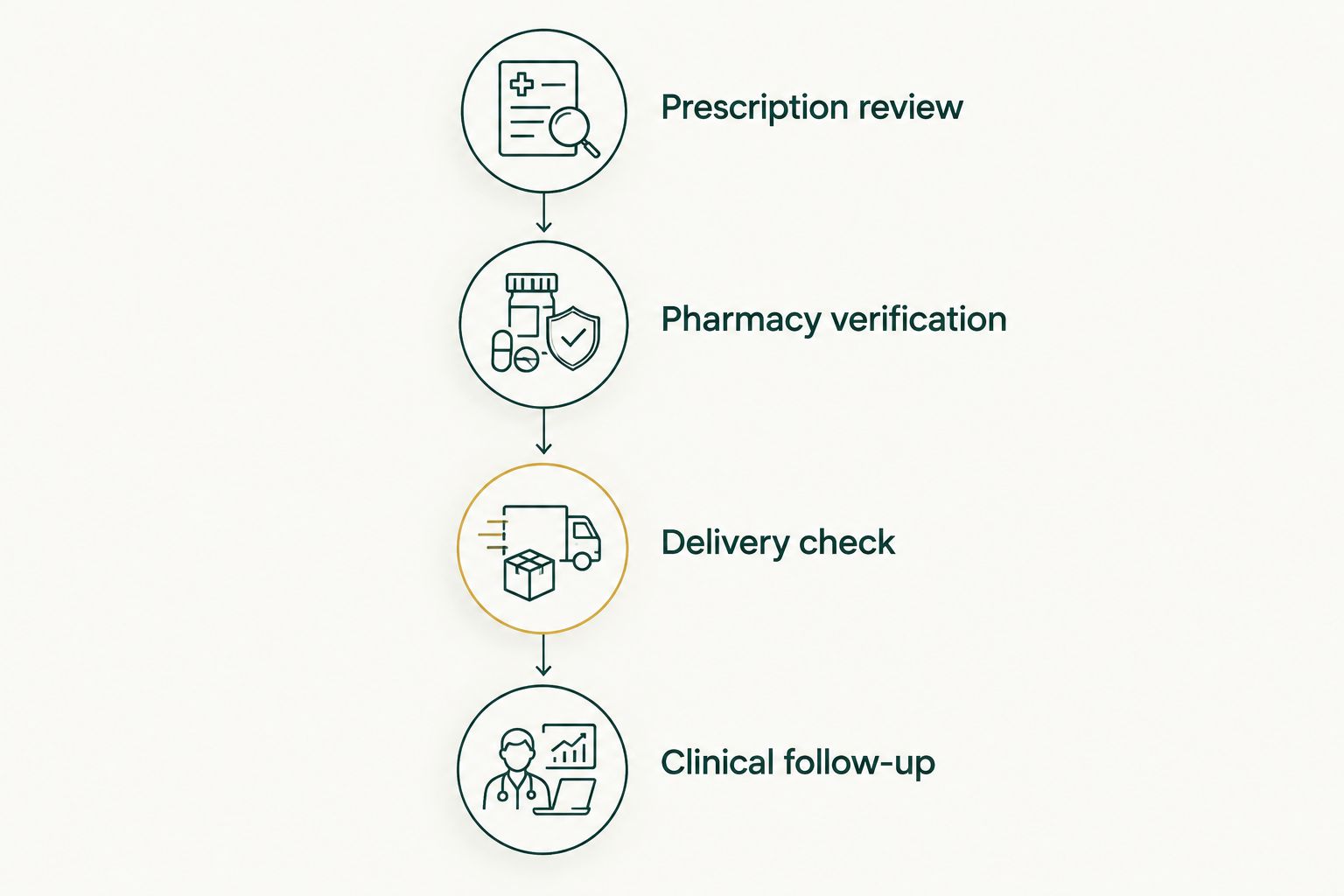
A delivered package does not replace prescription verification or clinical follow-up.
For a 2026 treatment record, distinguish medication administration from administrative events. A prescription sent, a pharmacy acknowledgment, and a delivered package are useful milestones, but none means you took a dose or tolerated it.
Second workflow: when a prescription changes or care transfers
A refill, dose change, or transfer requires a shorter version of the same checks. It is not permission to reuse every instruction from the previous shipment.
Best for continuing patients: Use a change-triggered review whenever the prescriber, pharmacy, product, strength, formulation, or administration directions change. The benefit is catching discrepancies at the point they enter the process; the limitation is that paperwork alone cannot establish the right clinical dose.
- Identify the change. Write down what is different and why the clinician changed it. Distinguish a new prescription from an administrative refill request.
- Transfer the actual record. Provide the previous label, last-dose date, treatment interruptions, and side effects through the receiving clinic's secure channel.
- Request explicit restart or transition instructions. Never convert a compounded vial's syringe-unit directions into a branded dose. Your clinician determines the new plan, including whether a treatment gap changes it.
- Recheck the dispensed product. Repeat the label and handling checks when the new medication arrives, even if the packaging looks familiar.
Expected result: The receiving clinician has enough information to assess the transition, and you have written instructions for the new prescription. Do not overlap treatments or resume a previous dose without direction.
Troubleshooting: stop the handoff, then resolve the cause
The pharmacy has no record of the prescription
Ask the clinic to confirm the destination pharmacy and whether the prescription was transmitted successfully. Then ask the pharmacy to search using the correct patient details. Avoid asking multiple pharmacies to fill parallel prescriptions while the original order remains unresolved.
The useful outcome is an acknowledged prescription at the intended pharmacy, not another message saying it was sent. Record which party owns the next action.
The label does not match the treatment plan
Do not take a dose while the product, strength, route, or directions are disputed. Send the label details through the clinic's secure channel and ask the dispensing pharmacist and prescriber to reconcile them.
This includes instructions that mention syringe units when you expected a different formulation. Do not solve the mismatch with an online conversion chart.
The package is damaged or handling is uncertain
Retain the carton and dispensing information, document the concern, and contact the pharmacist before use. Follow the product's storage instructions while awaiting guidance rather than inventing a correction, such as freezing medication that should not be frozen.
A delivery photograph establishes where a package was left. It does not establish that the medicine remains suitable for use.
A treatment gap makes the next dose unclear
Tell your clinician when you last took medication, what you took, and why treatment stopped. Ask for a restart plan rather than automatically returning to the last prescribed dose.
Do not double a dose to compensate for a missed administration. Missed-dose instructions are product-specific, and a longer interruption requires clinical review.
Symptoms appear before the next planned review
Report the symptoms, their timing, your last dose, and whether you can eat and drink. Do not wait for the next Biomarker Audit to raise a medication concern.
Seek urgent assessment for severe symptoms rather than relying on an asynchronous message. A scheduled laboratory review is not an emergency-care service.
Customize your workflow around clinical needs
Best for patients managing several connected concerns: Keep one medication list and one clinician-reviewed account of symptoms, laboratory findings, and treatment decisions. This reduces contradictory instructions without pretending that every condition needs the same intervention.
GoodLife Health connects branded GLP-1 care with Cardiometabolic Optimization rather than offering compounded GLP-1 fulfillment. Its Unbundled Pharmacy Model separates the clinical membership from pharmacy-billed medication, with no medication markup or dose-escalation fee. The limitation is clear: a membership does not guarantee a prescription, insurance approval, or a particular clinical result.
In 2026, choose the record format you can maintain reliably. Keep prescription changes, dose dates, symptoms, laboratory interpretations, nutrition concerns, and activity limitations together. Ask your clinician which observations affect decisions; collecting more data is not the same as receiving better care.
Do not change hormone or thyroid medication simply because weight changes during GLP-1 treatment. Bring those changes into the same clinical review. Nutrition and physical activity remain part of treatment, adapted to your health status and ability.
FAQ
Does a specialty pharmacy for compounded GLP-1 mean the medication is FDA-approved?
No. A specialty-pharmacy designation does not make a compounded GLP-1 preparation FDA-approved. Verify the exact medication and its regulatory category separately from the pharmacy's license.
Does GoodLife Health prescribe compounded semaglutide or tirzepatide?
No. GoodLife Health uses branded, FDA-approved GLP-1 medications only and does not prescribe, recommend, or facilitate compounded GLP-1 products. Your clinician determines whether a branded treatment is appropriate.
How do I check whether a pharmacy can dispense into my state?
Check the pharmacy's licensing information through the relevant state board of pharmacy. Confirm the dispensing entity and its authority to serve your location rather than relying on a specialty-pharmacy label.
Can I use my compounded vial's syringe-unit instructions with a branded medication?
No. Syringe-unit instructions for a compounded vial do not establish the prescribed dose for a branded medication. Give your clinician the original label and last-dose history so the clinician can establish a transition plan.
What should I do if my delivered GLP-1 medication looks damaged?
Do not use medication with an unresolved packaging or handling concern. Retain the packaging and contact the dispensing pharmacist for a product-specific assessment before administration.
Who provides clinical care through GoodLife Health?
Clinical care is delivered by licensed physicians of Beluga Health, P.A., an independent Florida professional corporation licensed to practice in all 50 states. The physicians work under GoodLife Health's clinical protocols.
How often does the membership include a Biomarker Audit?
The Cardiometabolic Optimization Membership includes a Biomarker Audit every 90 days, or 4 audits per year.
References
- Tirzepatide Once Weekly for the Treatment of Obesity (SURMOUNT-1). 2022. pubmed.ncbi.nlm.nih.gov/35658024/
- Once-Weekly Semaglutide in Adults with Overweight or Obesity (STEP 1). 2021. pubmed.ncbi.nlm.nih.gov/33567185/