Instead of manually chasing wellness sign-ups and screening follow-ups, build an employer wellness program with direct primary care around a voluntary handoff to a clinician, a clear membership agreement, and separate administrative and clinical records. This 2026 workflow connects benefit communication to ongoing care without turning HR into a medical intake desk.
- An employer wellness program with direct primary care needs voluntary enrollment, private clinical intake, and clear benefit ownership.
- GoodLife Health combines cardiometabolic optimization, recurring Biomarker Audits, and concierge-style direct primary care.
- Confirm employer payment arrangements before launch; a membership description does not establish an employer benefits contract.
- Keep diagnoses, prescriptions, and individual laboratory results out of employer reporting.
Why this matters
A screening campaign and a clinical relationship do different jobs. A screening identifies something to discuss; an ongoing clinician relationship provides a place to evaluate it, decide whether treatment is appropriate, and revisit the plan.
GoodLife Health defines Cardiometabolic Optimization as treating metabolic, hormonal, and cardiovascular health as one system. Weight, thyroid function, blood sugar, lipids, and inflammation belong in the same clinical discussion, not separate employer challenges.
GoodLife Health direct primary care is best for adults seeking ongoing, physician-guided cardiometabolic care. Its membership includes a Biomarker Audit every 90 days, with 4 audits per year, alongside concierge-style direct primary care.
That clinical model does not establish an employer purchasing arrangement, payroll connection, or benefits-platform integration. Confirm those arrangements directly before describing them to employees. The workflow below is an implementation blueprint, not a claim that a particular employer portal or automated connector exists.
Before you start
- Gather administrative access and approved materials. You need an employer benefits owner, the current eligibility rules, the proposed funding arrangement, employee communication channels, and written confirmation of the provider's enrollment process. Employees need private access to the provider's clinical intake channel.
- Assign clinical and legal ownership. Name the provider contact responsible for intake and care coordination. Have benefits counsel review the arrangement, including applicable privacy, nondiscrimination, tax, plan-design, and insurance questions before the 2026 launch.
- Resolve the hidden dependency: membership is not insurance. Confirm what the membership covers, what remains outside it, and how existing coverage continues. Also confirm which administrative information can be exchanged; do not assume that employer funding creates access to medical records.
Gate the launch on written answers, not a verbal sales discussion. If payment responsibility, eligibility, or data-sharing boundaries remain unresolved, finish those decisions before inviting employees to enroll.
Benefit structure and eligibility
Choose the administrative route
Start with the relationship you can actually support. The routes below are design options to evaluate with the provider and benefits advisers, not confirmed purchasing options from a named vendor.
Proposed administrative routes
Design options to evaluate with provider and benefits advisers
| Proposed route | Best for | Advantage | Limitation to resolve |
|---|---|---|---|
| Employer-sponsored membership | Employers seeking a defined, funded care benefit | Establishes a clear employer role in access | Requires an agreed contract, eligibility process, and payment arrangement |
| Employee-paid membership with employer education | Employers introducing the care model without administering membership payments | Keeps the purchase decision with the employee | Does not itself provide employer-funded access |
| Employer reimbursement arrangement | Employers considering reimbursement under an approved benefits structure | Can connect financial support to documented eligibility | Requires legal and tax review; reimbursement is not automatically tax-favored |
Do not describe these routes as interchangeable. Each creates different administrative work, and none gives a manager authority over an employee's treatment.
Set the eligibility and ownership rules
- Choose a benefits owner. Assign responsibility for eligibility questions, communications, administrative corrections, and escalation. Keep medical questions with the clinical team.
- Document the proposed eligible population. Specify the employment categories and any dependent eligibility under consideration. Obtain approval before using those rules in an enrollment file.
- Confirm the membership agreement. Establish who signs, who pays, when access begins, and what happens when employer support ends. Do not assume employer termination and membership cancellation follow the same process.
- Separate membership from treatment. State that enrollment does not guarantee medication, hormone therapy, a particular diagnosis, or a particular health outcome. A clinician determines appropriate care.
- Approve the employee explanation. Explain the care model, financial responsibilities, commitment terms, insurance boundaries, and private enrollment route in complete sentences.
Expected result: You have an approved benefit description and an accountable owner for each administrative decision. An employee can understand the offer without asking a manager to interpret medical services.
For a 2026 rollout, retain the approved version of the benefit description and its effective date. If the arrangement changes, update the employee explanation before sending another enrollment invitation.


Enrollment handoff and privacy boundaries
Build the minimum administrative record
Use a benefits record to establish eligibility and route questions, not to collect health histories. The record should contain only the administrative information necessary for the approved arrangement.
Suggested checklist labels include Eligibility status, Invitation status, Funding status, and Administrative contact. These are proposed record labels, not claims about fields in a provider's software. Configure equivalent fields only after confirming your actual system and access controls.
Keep symptoms, diagnoses, laboratory values, medication names, and clinical messages outside the employer's enrollment tracker. An employee's decision to ask about care is not permission to circulate medical information.
Configure the handoff
- Confirm the enrollment destination. Obtain the provider's current enrollment instructions and verify the destination through an authorized contact. Do not substitute a general HR form for clinical intake.
- Send a neutral invitation. Explain eligibility and the next administrative action without suggesting that the employee has a health condition. Avoid subject lines that reveal treatment interests.
- Route the employee directly to the provider. Let the employee submit medical history, medication lists, prior results, and consent through the provider's designated process.
- Restrict administrative access. Give each administrator only the information needed for their role. Do not place clinical attachments in shared benefits folders or manager-accessible spreadsheets.
- Test the route before launch. Use clearly marked test information with the provider's permission. Verify that eligibility questions reach benefits staff and medical questions reach the clinical team.
Expected result: The employer can administer eligibility without seeing the employee's clinical intake. The employee knows where to ask a benefits question and where to ask a medical question.
A useful test is to read the invitation as someone sharing an email inbox or device. Remove unnecessary references to weight, hormones, or diagnoses. The invitation should explain access to care without disclosing why an individual wants it.
Clinical intake and ongoing care
Establish the clinical relationship
The employer's handoff ends where clinical decision-making begins. A membership creates access to a care relationship; it does not turn a wellness questionnaire into a prescription.
A membership creates access to a care relationship; it does not turn a wellness questionnaire into a prescription.
For GoodLife Health direct primary care, clinical care is delivered by licensed physicians of Beluga Health, P.A., an independent Florida professional corporation licensed to practice in all 50 states. Those physicians work under GoodLife Health's clinical protocols. They are not described as the employer's clinicians or as employees of the membership brand.
- Complete private intake. Have the employee provide the clinical team with relevant medical history, current medications, allergies, symptoms, prior treatment, and existing specialist relationships.
- Confirm the care scope. Ask the clinician how ongoing primary care, cardiometabolic evaluation, and outside services fit together. Identify needs that require in-person assessment or another clinician.
- Arrange the Biomarker Audit. Follow the clinical team's ordering and preparation instructions. The included panel covers ApoB, Lp(a), hs-CRP, HbA1c, lipids, insulin markers, and full hormone and thyroid panels through the Beluga Health lab network.
- Review the results clinically. Discuss the results alongside symptoms, history, medications, nutrition, activity, and other relevant factors. Do not treat an isolated result as a complete diagnosis.
- Document the next clinical action. Leave the review knowing what the clinician recommends, what needs follow-up, and how to raise a concern between planned reviews.
Expected result: The employee has a clinician-directed plan, not simply a completed screening. Clinical records remain in the care relationship rather than the employer's reporting file.
Maintain the review cycle
The included Biomarker Audit cadence is every 90 days. Additional testing beyond that cadence is billed separately at pass-through cost; the clinician determines when additional evaluation is needed. A quarterly audit is not an instruction to wait for care when symptoms change.
A quarterly audit is not an instruction to wait for care when symptoms change. If medication is appropriate, prescribing follows clinical assessment, and hormone treatment likewise requires an individual evaluation rather than an employer-selected protocol.
If medication is appropriate, prescribing follows clinical assessment. The brand's GLP-1 care uses branded, FDA-approved medications only, never compounded GLP-1 products. Hormone treatment likewise requires an individual evaluation rather than an employer-selected protocol.
Nutrition and physical activity remain part of the clinical discussion. Do not frame medical treatment as a substitute for either, and do not build an employee campaign around promised weight-loss amounts.
The employer's 2026 launch calendar should therefore track administrative readiness, not treatment milestones. Keep clinical timing under the clinician's control.
Reporting permissions and launch checks
Define what success means administratively
Measure whether the handoff works before making claims about health outcomes. An invitation sent, an eligibility correction completed, and an employee's ability to find enrollment instructions are administrative events. They do not establish improved metabolic health or financial savings.
Choose measures that answer an operational question. For example, count eligibility questions to identify confusing wording, or compare invitation delivery records with the approved eligible population to find missed communications. Define each measure before collecting it.
Configure the reporting boundary
- Write a reporting specification. List each proposed administrative measure, its purpose, its source, and who receives it. Remove fields that are unnecessary for that purpose.
- Confirm permissible reporting with the provider. Determine what information the arrangement supports. Do not promise utilization or outcome reports that have not been agreed.
- Review re-identification risks. A small department, distinctive role, or narrow treatment category can make an apparently anonymous report revealing. Have the privacy reviewer set aggregation and suppression rules.
- Approve the escalation route. Route billing and eligibility disputes to benefits administration. Route symptoms, prescription concerns, and laboratory questions to the clinical team.
- Complete a launch rehearsal. Walk through invitation delivery, a rejected eligibility record, a private medical question, and termination of employer support. Confirm an owner for each outcome.
Expected result: The employer has a defined reporting boundary and a tested administrative process. No launch dependency requires a manager to interpret clinical data.
The complete sequence is Benefit rules, Private enrollment, Clinical review, and Ongoing care. Keep Employer reporting separate from the clinical record throughout the sequence.
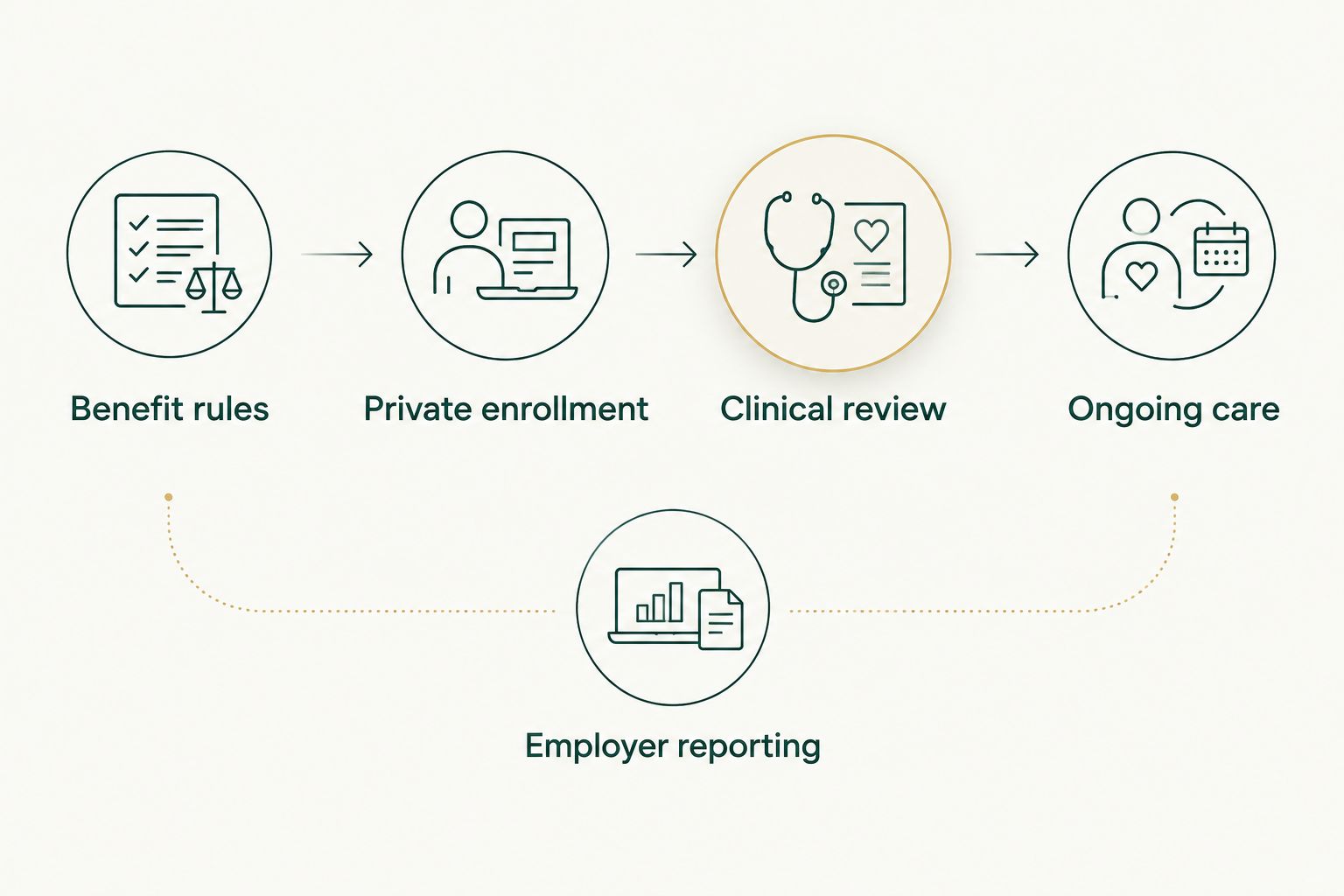
Employer reporting stays separate from the employee's clinical record.
A second workflow: when eligibility changes
An employer wellness program with direct primary care also needs a change process. A new hire, leave, employment termination, or change in employer support is an administrative trigger, not a clinical instruction.
Best for: Benefits teams maintaining an approved arrangement after the initial launch. The advantage is a repeatable process; the limitation is that membership terms, funding rules, and clinical continuity still require separate handling.
- Verify the effective date. Use the approved employment or benefits record. Do not act on an informal manager message alone.
- Apply the agreed eligibility rule. Determine what changes under the actual arrangement, including any required notice. Resolve ambiguous cases with the benefits owner.
- Notify the employee privately. Explain the administrative change, the relevant date, and where to ask about continuing membership or changing payment responsibility.
- Send only the required administrative update. Use the provider's agreed process. Do not attach the employee's health history to explain the employment change.
- Confirm completion. Record the administrative action and its owner. Leave treatment continuity and prescription questions with the employee and clinical team.
Expected result: Employment changes do not silently become care decisions. The employee receives a clear explanation rather than discovering an unresolved membership issue during treatment.
For 2026 benefits renewals, review this change process alongside the original launch materials. A current invitation paired with outdated termination instructions is an incomplete workflow.
Troubleshooting
Employees think the membership replaces insurance
Fix: Revise the benefit explanation before sending more invitations. State that direct primary care membership is not health insurance and explain that services outside the membership require separate arrangements. Do not imply that hospital care, specialist care, imaging, or medications are included unless the actual agreement says so.
HR receives laboratory results or treatment questions
Fix: Stop forwarding the information through the benefits chain. Follow your organization's privacy and incident procedures, restrict further access, and direct the employee to the clinical channel. A benefits administrator should not interpret a result or recommend a medication change.
An invitation arrives, but enrollment cannot proceed
Fix: Check eligibility, the effective date, the approved funding route, and the provider's enrollment instructions. Assign an administrative owner to resolve the mismatch. Do not ask the employee to resubmit medical history to HR as a workaround.
Employees expect a prescription immediately
Fix: Make the clinical sequence explicit: private intake, clinician assessment, appropriate testing, and an individual treatment decision. Membership does not guarantee a GLP-1 prescription or hormone therapy. Employer communications should describe access to evaluation, not access to a predetermined drug.
Leaders ask for individual health outcomes
Fix: Return to the approved reporting specification. Do not build a spreadsheet of named employees' weight changes, HbA1c results, or prescriptions. If broader evaluation is proposed, obtain a separate privacy and legal review before collecting or sharing additional information.
Customize your workflow
Expand access before expanding data collection. Review whether employees on different shifts can receive the same explanation, understand the enrollment route, and ask questions privately. Provide accessible materials and a non-manager contact for administrative help.
Evaluate the provider relationship using the guide to assessing a direct primary care practice before joining. Focus on care scope, clinician responsibility, laboratory review, communication processes, and coordination with existing clinicians.
GoodLife Health offers integrated cardiometabolic care, not a substitute for an employer benefits agreement. Its recurring Biomarker Audits are a defined strength for adults seeking ongoing monitoring. The boundary is equally important: pharmacy-billed medications, additional testing, insurance coverage, and employer administration require their own explanations.
The Unbundled Pharmacy Model separates the clinical membership from pharmacy billing. Medication is billed by the pharmacy at pharmacy cost, with zero markup and no molecule or dose upcharge. Explain that distinction without implying that employer funding automatically covers prescriptions.
FAQ
How do I connect an employer wellness program with direct primary care?
Connect an employer wellness program with direct primary care through approved eligibility rules, voluntary enrollment, private clinical intake, and a written reporting boundary. Confirm the provider's actual employer arrangement before promising funded access or automated administration.
Does direct primary care replace employee health insurance?
Direct primary care membership does not replace health insurance. Employees need separate arrangements for services outside the membership, and the benefits explanation should identify those boundaries clearly.
Can my employer see my laboratory results if it supports membership?
Employer support should not be treated as permission to access individual laboratory results. Keep clinical information within the care relationship and have privacy counsel review any proposed employer reporting.
Does GoodLife Health have a confirmed employer enrollment integration?
This workflow does not establish a GoodLife Health employer enrollment integration. Confirm contracts, payment arrangements, enrollment instructions, and supported administrative exchanges directly before implementation.
Who delivers clinical care through the membership?
Clinical care is delivered by licensed physicians of Beluga Health, P.A., an independent Florida professional corporation licensed to practice in all 50 states. The physicians work under the membership brand's clinical protocols, not under an employer's treatment instructions.
How often are Biomarker Audits included?
The membership includes a Biomarker Audit every 90 days, with 4 audits per year. Additional testing beyond that cadence is billed separately at pass-through cost, and clinical concerns should be raised when they occur.
Does enrollment guarantee weight-loss medication or hormone treatment?
Enrollment does not guarantee weight-loss medication or hormone treatment. A clinician evaluates medical history, symptoms, relevant testing, and treatment suitability before making an individual recommendation.
What happens when an employee leaves the company?
Follow the agreed process for eligibility changes and employer funding, then notify the employee privately. Continuing membership, payment responsibility, and clinical continuity require clear handling rather than assumptions about automatic cancellation.
One last thing
Test the exit before the invitation. Ask who contacts an employee when employer support ends, what that message says, and where clinical continuity questions go. If those answers are unclear, the enrollment workflow is not ready, even if the launch email is finished.
References
- Direct Primary Care: Practice Distribution and Cost Across the Nation (J Am Board Fam Med). 2015. pubmed.ncbi.nlm.nih.gov/26546651/