Call her Dana. She is a composite, assembled from situations patients describe to us, and not a real person. She pays a monthly insurance premium, and part of what it buys is a primary care physician she sees about once a year. Her PCP won't prescribe GLP-1 medication for her, so she signed up with a membership app that would. A third service renews her thyroid prescription: a telehealth company where a clinician she has never spoken to signs off after a short questionnaire. She has three providers, three logins and three bills, and none of the three knows what the other two are doing.
When your PCP won't prescribe GLP-1 and an app will, GoodLife Health can look like one more app for one more prescription. Dana's question is whether this is only for weight loss. This piece answers it by walking through what her first three months with us would look like: what the clinician would check, why, what it would cost, and what it would not do. Before any of that comes an eligibility check, because not everyone is accepted.
- Dana is a composite; her three-provider setup is common, and none of the three sees her whole chart.
- The membership is clinician-led primary care for the cardiometabolic system, labs first; weight is one part of what it reads.
- Month one is her records and a first lab panel; nothing is decided before a clinician has read it.
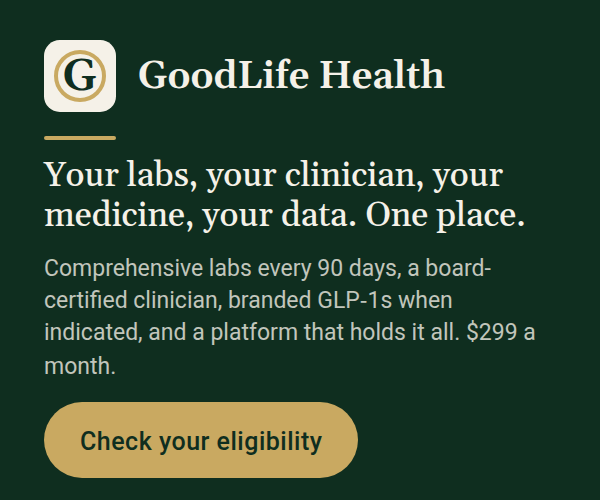
- It costs $299 a month, with $598 charged at sign-up for the first two months; medication is billed by her chosen pharmacy at its own price.
- It pairs with insurance and does not replace it, and it promises no weight loss, coverage or prior authorization.
- Not everyone is accepted, and it is not for someone who only wants the cheapest monthly refill.
Three providers, and nobody holding the whole chart
Each of Dana's providers does what it was set up to do. The trouble lies in what none of them was set up to do.
Her PCP sees her for an annual physical. The standard panel came back with cholesterol the practice called "a little high, let's watch it" and a fasting glucose it called borderline. When she asked about a GLP-1, the answer was no. She was not told much about why, and the next appointment is months away. Her premium, in other words, pays for a relationship that meets once a year and declined the one thing she asked for.
The app filled that gap. She answered an online form, a prescriber approved it, and the medication arrives on schedule. The check-ins ask about her weight, her nausea and whether she wants to move up a dose. The app has never seen her cholesterol result, because nobody sent it and nobody asked. It does not know about her thyroid prescription either, unless she remembered to type it into the intake.
The telehealth signer keeps her thyroid medication going. Every so often she answers the same questionnaire and the renewal goes through. She cannot remember the last time anyone looked at a thyroid level and changed anything because of it. The service is quick, and quick is what she pays it for.
Meanwhile, some things fit into none of the three boxes. She sleeps badly. Hot flashes have started. Her afternoons have less energy in them than they used to. She mentioned all of this once in the app's chat and was told, reasonably, to raise it with her primary care physician, whom she will not see for months.
So Dana has become the coordinator of her own care. She carries the lab printout from one portal to the next, keeps the full medication list in her head, and decides on her own which symptom belongs to which provider. When she comes across a company offering a $299 membership, her first instinct is suspicion, and that instinct is sound. She does not need a fourth provider that sees one more slice of her. If GoodLife Health were a weight-loss app with a higher price, she should keep the app she has.
Weight was the part someone would prescribe for
Look at the three providers again and a pattern shows. Each is organized around a transaction. The PCP's visit is built around an annual exam and billing codes. The app is built around one class of medication. The signer is built around one renewal. Weight became the center of Dana's care because it was the part of her health with a prescription attached and a company willing to write it.
Her body is not organized that way. Cardiometabolic Optimization: The Definitive Guide describes the connections plainly: insulin resistance drives weight gain, visceral fat disrupts hormones, disrupted hormones stall metabolism, and stalled metabolism feeds vascular inflammation. Read through that lens, the borderline glucose, the cholesterol someone is watching, the thyroid dose nobody has revisited, the hot flashes and the weight may be related readings from one system. They may also turn out to be less connected than that. Either way, nobody in her current setup is in a position to find out, because nobody holds all the results.
She is far from unusual. The guide cites an estimate that roughly 38.7% of U.S. adults live with metabolic syndrome, and NHANES data showing that only 12% of U.S. adults are metabolically healthy. Most of that is managed reactively, in silos, or not at all. Dana's three logins are what a silo looks like from the patient's side of the table.
Weight became the center of her care because it was the only part of her health that someone was willing to write a prescription for.
So when Dana asks whether GoodLife Health is only for weight loss, the useful answer describes where it starts. GoodLife Health is clinician-led precision direct primary care for Cardiometabolic Optimization: diagnosis first, then treatment, then the long haul. In practice that means labs before decisions, one clinician reading all of the results together, and the primary-care relationship moving to that clinician. A GLP-1 can be part of the plan when the labs and the clinician say it should be. So can thyroid medication or hormone therapy. None of it is decided before the first panel is read.
That also explains what the membership leaves in place. Dana keeps her insurance. The membership pairs with insurance for catastrophic coverage, and what it replaces is the primary-care relationship: the role her once-a-year PCP and her two online services are currently splitting between them, with gaps.
Her first three months, and what we would check
Month one: the check, the intake, the first panel
Dana starts with the eligibility check. If it suggests she may be a fit, she completes the intake, and this is where her three providers finally end up in one place. She lists the GLP-1 the app sends her and her current dose, the thyroid medication the signer renews, the symptoms nobody has addressed, and whatever records she can share from her PCP, including that cholesterol and glucose result.
Then comes checkout. $598 is charged at sign-up and covers her first two months. After that, a clinician reviews her intake, and this review decides whether she is accepted into care. If the clinician cannot accept her, the $598 is refunded in full. Once she is accepted, the first two months are non-refundable, and any medication billed by a pharmacy follows that pharmacy's own return and refund policy.
If she is accepted, the first cardiometabolic lab panel is ordered. Most of the answer to her question lives here, because the panel looks at far more than weight:
- Blood sugar and insulin: HbA1c and insulin markers, to see what sits behind the glucose her PCP called borderline.
- The cardiovascular side: lipids, ApoB and Lipoprotein(a), so the cholesterol someone was watching is measured in detail.
- Inflammation: hs-CRP.
- Thyroid: TSH, free T3 and free T4, so the clinician can judge whether the dose that keeps getting renewed still fits her.
- Hormones: estradiol, progesterone, total and free testosterone, and DHEA-S, read alongside her sleep, her hot flashes and her energy.
Results are read against optimal ranges rather than population reference ranges, and every result goes to Dana herself. She no longer has to request a printout and carry it anywhere.
Her GLP-1 belongs to the clinician's judgment. If what the app sends her is a branded, FDA-approved medication such as Wegovy or Zepbound and the clinician judges it indicated, it can be prescribed to the pharmacy she chooses. If it is a compounded version, it does not continue here, because GoodLife Health prescribes no compounded GLP-1. The FDA has published its concerns about unapproved GLP-1 drugs used for weight loss, and a clinician's license carries the responsibility for what is prescribed. Saying so makes no claim about how her current medication has served her.
Month two: results, a video visit, one plan
By month two the panel is back, and Dana has a video visit with the clinician who read it. For the first time, one person is looking at her glucose markers, her lipids, her thyroid results, her hormone panel and her medication list together.
What happens next depends on what the panel shows, and a piece like this can only sketch the branches. If the insulin markers point toward insulin resistance, her GLP-1 is being treated as metabolic medicine with something measurable to follow, and the dose is chosen against labs rather than a check-in form. If the thyroid results suggest her dose needs to change, the same clinician makes the change, and the prescription moves with it. If her hormone panel and symptoms point to perimenopause and hormone therapy is indicated, it can be prescribed too, with no change to the membership fee. Bioidentical Hormone Therapy at Pharmacy Cost lists pharmacy prices such as estradiol tablets at about $34 to $35 a month and micronized progesterone at about $37 to $44 a month. And if the panel shows that the weight really is the main story, the clinician says so.
Every medication goes to the pharmacy Dana chooses, at that pharmacy's own price. GoodLife Health sets nothing, sees nothing and takes nothing on medication, and the membership fee stays the same whatever the molecule and whatever the dose. For a sense of the self-pay numbers, the manufacturers published these prices in September 2026: through NovoCare, Wegovy pens at $199 a month for the first two fills (an introductory offer for new patients through December 2026) and $349 a month after, and the Wegovy pill from $149 a month at lower doses; through LillyDirect, Zepbound vials at $299 to $449 a month depending on dose.
Whether her insurance covers any of these medications is between Dana, her plan and her pharmacy. If a prior authorization is needed, that is the pharmacy's process. We do not run it, and we do not promise how it turns out.
Month three: messages, adjustments, the second panel
Month three is where the relationship starts to behave like primary care. Dana messages the care team asynchronously when a side effect shows up or a question occurs to her, and a video visit is available when a conversation needs one. Adjustments happen as information comes in, instead of waiting a year for the next physical.
The labs are quarterly, four cardiometabolic panels a year, so the second panel comes due as her first quarter closes. That second draw is the reason the first one mattered.
One panel is a snapshot; the second, read against the first, shows whether a change in dose or treatment is doing what it was meant to do. What is prescribed follows those results and the clinician's judgment, never a plan decided in advance.
By the end of month three, Dana's GLP-1, her thyroid medication and anything else the clinician has judged indicated sit with one clinician who has read every result. Her app and her telehealth signer are no longer doing jobs that nobody else is doing, and whether she keeps them is her decision. Her insurance stays exactly where it was.
What it costs
The membership is $299 a month, month to month once the first two months are behind her. For a full year, that is $3,588. The fee covers clinicians licensed in all fifty states, four cardiometabolic lab panels a year, every result in her hands, asynchronous messaging with the care team and video visits. The membership fee is generally eligible for HSA or FSA pre-tax dollars. Medication is the only other cost, and it is the pharmacy's number, never ours.
What it does not do
The membership does not promise that Dana will lose a particular amount of weight, or any at all. It does not replace her insurance, and it cannot promise that a medication will be covered or that a prior authorization will succeed. Acceptance is never guaranteed. And the clinician prescribes nothing that her labs and history do not support, including the hormone therapy she may be hoping for.

So, is it only for weight loss?
For Dana, no. Weight is one of the readings the clinician follows, alongside blood sugar, insulin, lipids, inflammation, thyroid and hormones, and a GLP-1 is one possible treatment among several. What she would be paying for is the primary-care relationship her premium was supposed to provide and two online services were patching around: one clinician, quarterly labs, results she can see, and prescriptions that follow those results.
There is an honest caveat. Her first panel could show that the weight is the main story and everything else is in good order. In that case the membership would mostly be GLP-1 care backed by quarterly labs and a clinician who knows her history, and she should weigh that against what she pays the app now. Some patients will find that worth $299 a month. Some will not, and that is a reasonable conclusion to reach.
If she is going to make that call, she should make it from her own results rather than from our description of them. That is what the first three months are for.
Who this is not for
GoodLife Health sits between the $20,000-a-year concierge practice and the $99-a-month compounded app, and says so. If what you want is the cheapest possible monthly GLP-1 with no labs and nobody reading them, the $99 app is built for that, and this membership will feel expensive for what you want from it. If you want to stay on a compounded GLP-1, we do not prescribe one. If you want a guarantee of weight loss, insurance coverage or acceptance, we cannot give one. If you are hoping to cancel your health insurance, this will not stand in for it. And if your current PCP already reads your labs as a whole and prescribes what is indicated, keep that physician, because you already have the relationship this membership is built to provide.
Related Reading
- Cardiometabolic Optimization: The Definitive Guide
- Bioidentical Hormone Therapy at Pharmacy Cost: The Real Numbers
References
- NovoCare Pharmacy — Wegovy self-pay pricing (Novo Nordisk). 2026. www.novocare.com/pharmacy/wegovy.html
- Zepbound Self Pay Journey Program — LillyDirect vial pricing (Eli Lilly). 2026. zepbound.lilly.com/savings
- FDA's Concerns with Unapproved GLP-1 Drugs Used for Weight Loss (U.S. Food and Drug Administration). 2025. www.fda.gov/drugs/postmarket-drug-safety-information-patients-and-providers/fdas-concerns-unapproved-glp-1-drugs-used-weight-loss