Best for integrated cardiometabolic care: GoodLife Health. Best for a local obesity-focused consultation: a physician certified by the American Board of Obesity Medicine; best for complex endocrine disease: an endocrinologist. If you are searching for an obesity doctor near me in 2026, choose the care setting that fits your medical history, not simply the nearest prescriber.
Key Takeaways
- GoodLife Health fits patients seeking GLP-1 treatment within Cardiometabolic Optimization, with physician care and quarterly Biomarker Audits.
- For an obesity doctor near me, verify state licensure, obesity training, follow-up, and the prescribed medication's identity.
- Local obesity specialists, endocrinologists, bariatric programs, and primary care physicians serve different clinical needs.
- Our membership is $299/month; the first charge is $598. Pharmacy-billed medication is separate, with zero markup.
- An obesity consultation should do more than establish whether you qualify for a prescription.
- A physician certified by the American Board of Obesity Medicine has an obesity-focused credential you can verify.
- An endocrinologist evaluates and treats endocrine disorders, including diabetes and thyroid disease.
- A multidisciplinary bariatric program is a useful pathway when you want to discuss whether medication, metabolic surgery, or another structured treatment approach fits your situation.
- Your established primary care physician is a reasonable first conversation when you already have a trusted clinical relationship.
Why this matters
An obesity consultation should do more than establish whether you qualify for a prescription. Your physician needs to understand your weight history, medications, blood pressure, blood sugar, sleep, eating patterns, and relevant hormonal symptoms. Those findings shape treatment and monitoring.
We define Cardiometabolic Optimization as treating metabolic, hormonal, and cardiovascular health as one system. That does not mean everyone needs hormone treatment or the same medication. It means your clinician connects the findings instead of treating a smaller number on the scale as the entire goal.
This guide ranks care pathways by patient fit, not individual physicians by unverified outcomes. A local doctor still needs credential verification, and a national service still needs an individualized clinical assessment. Neither proximity nor an online enrollment form establishes that a prescription is appropriate.
What makes the best obesity medicine specialist?
Use these criteria before comparing appointments or enrolling in a program:
- Relevant credentials. Verify the physician's active state license and claimed board certifications. Obesity medicine certification is distinct from general medical board certification.
- Individual assessment. Expect a review of medical history, prior treatment, current medications, contraindications, and pregnancy plans where relevant.
- Connected monitoring. Ask how the physician follows blood pressure, glucose, nutrition, symptoms, and clinically relevant laboratory results.
- Medication transparency. Know the exact drug, indication, dispensing pharmacy, and whether the product is FDA-approved or compounded.
- Continuity. Establish who reviews results, handles side effects, and decides whether to increase, hold, switch, or stop treatment.
- Financial clarity. Separate physician care, laboratory testing, and medication charges. Ask what changes when the prescription changes.
The strongest GLP-1 program can explain when not to prescribe. A clinician who recommends another treatment after reviewing your history is making a medical decision, not failing to deliver a service.
Obesity care options at a glance
| Ranked care option | Best for | Standout feature | Key limitation |
|---|---|---|---|
| Our Cardiometabolic Optimization Membership | Integrated care | Physician-led treatment connected to quarterly Biomarker Audits and direct primary care | Medication is separate; membership does not replace insurance |
| Local ABOM-certified physician | Local expertise | A verifiable obesity medicine credential | Certification alone does not establish visit format or follow-up arrangements |
| Endocrinologist | Endocrine complexity | Specialist evaluation of diabetes and endocrine disorders | Confirm that the practice provides ongoing obesity treatment |
| Multidisciplinary bariatric program | Surgical evaluation | A setting for discussing medical and surgical treatment pathways | Confirm which disciplines and services the specific program includes |
| Your established primary care physician | Care continuity | Existing knowledge of your history and medications | Confirm GLP-1 prescribing experience and monitoring capacity |
There is no single best option for every patient in 2026. Start with the problem you need the clinical team to solve: integrated ongoing care, local obesity expertise, endocrine complexity, surgical evaluation, or continuity with a physician you already trust.
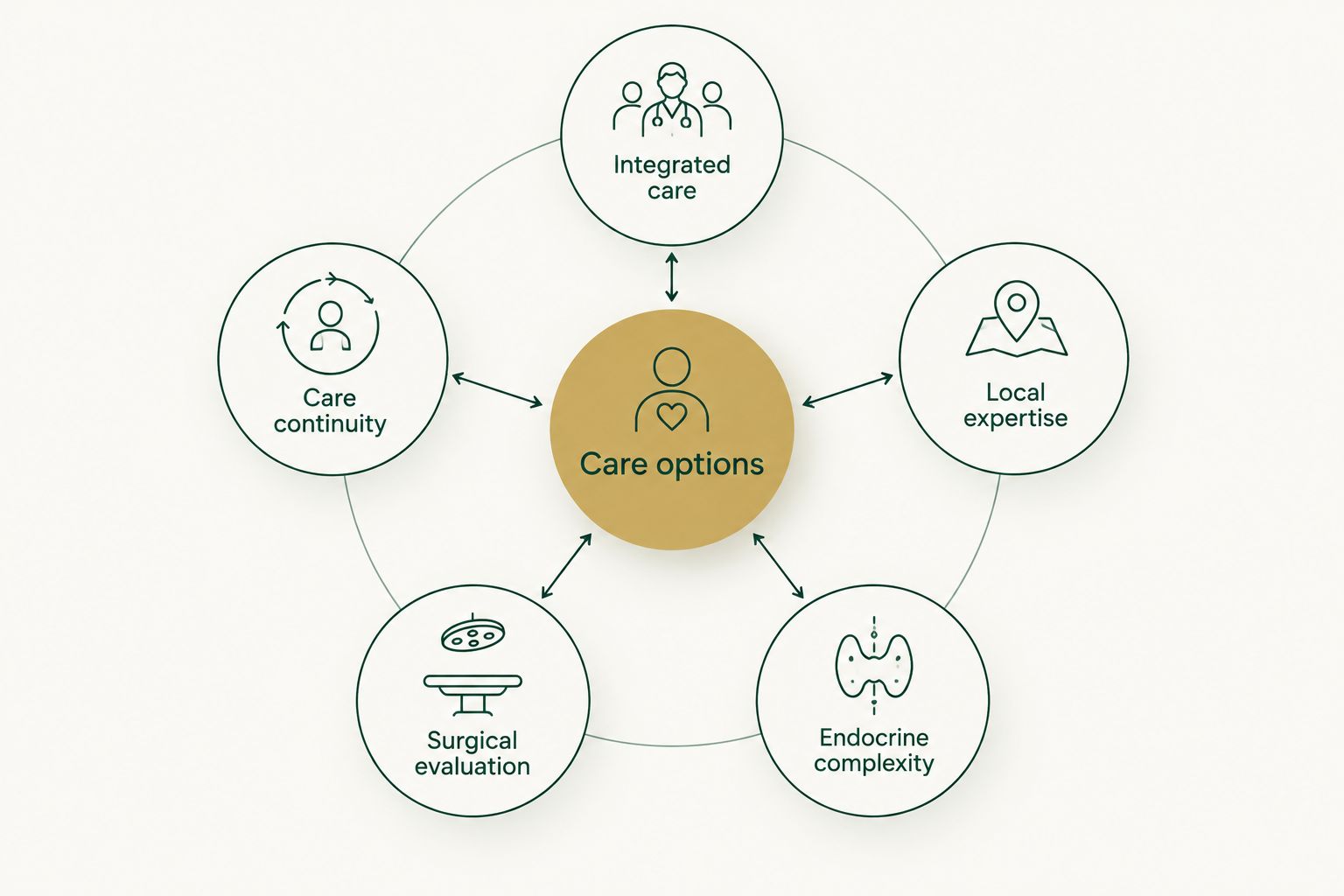
Choose the care pathway around your clinical needs before comparing enrollment details.


1. GoodLife Health: best for integrated cardiometabolic care
GoodLife Health is best for patients seeking GLP-1 treatment within an ongoing Cardiometabolic Optimization membership. We connect medical weight loss, relevant hormone care, cardiovascular risk assessment, and concierge-style direct primary care rather than offering a prescription in isolation.
Clinical care is delivered by licensed physicians of Beluga Health, P.A., an independent Florida professional corporation licensed to practice in all 50 states. The physicians work under GoodLife Health's clinical protocols; they are not our employees. General board certification should not be confused with a claim of obesity medicine subspecialty certification.
Our membership pros:
- One physician-care fee that does not increase with medication dose.
- An included Biomarker Audit every 90 days through the Beluga Health lab network.
- Branded, FDA-approved GLP-1 treatment only, when clinically appropriate; never compounded GLP-1 medication.
- Pharmacy-billed medication at pharmacy cost, with zero markup and no molecule or dose upcharge.
Our membership limitations:
- Medication is billed separately from membership.
- Additional laboratory testing beyond the quarterly cadence is billed at pass-through cost.
- Membership is not health insurance or a replacement for emergency and hospital care.
Membership terms: $299/month, with a two-month starting commitment and a $598 first charge. Membership then continues month-to-month at $299/month, cancel anytime after the initial commitment.
Our approach to direct primary care for weight loss management explains why ongoing medical care belongs alongside prescribing.
Best for: Patients who want connected metabolic, hormonal, and cardiovascular care. Verdict: Hold until a clinical assessment confirms that this care model fits your needs.
2. Local ABOM-certified physician: best for local obesity expertise
A physician certified by the American Board of Obesity Medicine has an obesity-focused credential you can verify. This is a useful starting point when you want a local doctor whose training includes obesity diagnosis and treatment, rather than assuming every weight-loss clinic has equivalent expertise.
Ask whether your consultation will be with that physician, how follow-up works, and whether the practice manages GLP-1 treatment over time. A credential identifies training; it does not tell you the appointment schedule, laboratory approach, or financial terms.
Local obesity specialist pros:
- A verifiable obesity medicine credential.
- A physician whose stated specialty focus matches the reason for your visit.
- An opportunity to ask about medication and nonmedication treatment within the same assessment.
Local obesity specialist limitations:
- Certification alone does not establish ongoing access between visits.
- You must separately confirm insurance participation, medication prescribing, and laboratory arrangements.
For a local search in 2026, check the American Board of Obesity Medicine's physician directory, then verify licensure through your state medical board. Confirm the actual practice address and whether visits are in person, virtual, or both.
Best for: Patients prioritizing a nearby physician with verified obesity medicine training. Verdict: Hold until credentials, visit format, and follow-up arrangements are confirmed.
3. Endocrinologist: best for complex endocrine disease
An endocrinologist evaluates and treats endocrine disorders, including diabetes and thyroid disease. This pathway fits when a diagnosed or suspected endocrine condition needs specialist assessment alongside obesity treatment, particularly when several medications or unresolved laboratory findings complicate decisions.
Weight gain alone does not establish an endocrine disorder. Bring your symptoms, previous results, and medication history rather than requesting hormone treatment as a default weight-loss strategy.
Endocrinology pros:
- Specialist expertise in endocrine disease.
- A setting to review complex diabetes treatment and relevant medication interactions.
- Evaluation of hormonal findings in the context of symptoms and medical history.
Endocrinology limitations:
- Confirm that the specific physician accepts obesity-focused consultations.
- Ask whether ongoing weight-management care remains with the endocrinologist or returns to primary care.
An endocrinologist is especially relevant when the unresolved question is diagnostic: whether an endocrine condition is present and how it changes treatment. If that question is already settled, another physician with appropriate obesity-care experience can still be the right prescriber.
Best for: Patients whose endocrine disease requires specialist evaluation alongside weight management. Verdict: Hold until the practice confirms that its scope matches your clinical question.
4. Bariatric program: best for medical and surgical evaluation
A multidisciplinary bariatric program is a useful pathway when you want to discuss whether medication, metabolic surgery, or another structured treatment approach fits your situation. The purpose is evaluation, not a predetermined recommendation for surgery.
Ask which clinicians actually participate. The word multidisciplinary is not a substitute for knowing whether your care includes an obesity physician, surgeon, dietitian, behavioral health professional, or coordination with your existing doctors.
Bariatric program pros:
- A setting for considering medical and surgical pathways together.
- An opportunity to discuss previous surgery, weight recurrence, or surgical questions.
- A structure in which you can verify access to different clinical disciplines.
Bariatric program limitations:
- Confirm which services belong to the program and which require separate appointments.
- Ask who manages GLP-1 prescribing if you do not pursue surgery.
For your 2026 consultation, bring records of previous weight-management treatment and any prior bariatric operation. Your surgical history matters to nutrition assessment and treatment planning even when your current goal is medication rather than another procedure.
Best for: Patients seeking a discussion of medical versus surgical treatment, including care after bariatric surgery. Verdict: Hold until the program explains the pathway that fits your goals.
5. Established primary care physician: best for care continuity
Your established primary care physician is a reasonable first conversation when you already have a trusted clinical relationship. A qualified primary care physician can prescribe GLP-1 medication within their scope of practice; an endocrinology appointment is not automatically required.
Ask directly about experience managing obesity, dose adjustment, side effects, and maintenance. Familiarity with your history helps, but the practice still needs a clear process for ongoing treatment.
Established primary care pros:
- An existing relationship and medical record.
- A place to review weight alongside blood pressure, glucose, and other ongoing concerns.
- An opportunity to identify when a specialist referral adds value.
Established primary care limitations:
- You must confirm the physician's obesity-treatment experience.
- Ask whether the practice can provide follow-up during dose changes and symptoms between appointments.
Before adding another clinic, ask your current physician what they can manage and what they would refer. This avoids creating separate treatment plans without anyone clearly responsible for reconciling them.
Best for: Patients who value continuity and whose existing physician can provide appropriate obesity care. Verdict: Hold until the practice confirms prescribing and follow-up capacity.
How these care options are ranked
The order reflects the decision each pathway addresses, not a measured difference in weight-loss outcomes. Integrated care comes first for patients seeking connected ongoing management; local obesity expertise, endocrine evaluation, surgical evaluation, and an established relationship each occupy a different use case.
We do not assign an unsupported budget winner. A meaningful financial comparison requires the actual physician-care terms, included testing, pharmacy bill, and insurance benefits for the individual patient. A low enrollment charge does not describe the entire treatment arrangement.
What your first obesity consultation should cover
A good first visit establishes a treatment baseline, not merely a starting dose. Bring a complete medication list, prior treatment history, relevant laboratory results, and the name and dose of any GLP-1 medication you already use.
Your clinician should review:
- Medical history: Diabetes, cardiovascular disease, sleep apnea, gastrointestinal conditions, pancreatitis or gallbladder history, and relevant cancer history.
- Medication history: Prescription drugs, supplements, previous weight-loss medications, treatment response, and adverse effects.
- Daily function: Sleep, food intake, physical activity, pain, work patterns, and practical barriers to care.
- Treatment safety: Pregnancy plans, contraindications, interactions, and instructions for concerning symptoms.
- Follow-up ownership: Who reviews results, responds to symptoms, and manages maintenance or treatment changes.
Be honest about difficulty eating, vomiting, or missed doses. Those details help your physician make safer decisions; they are not evidence that you have failed treatment.
Labs should answer clinical questions
Our included Biomarker Audit every 90 days covers ApoB, Lp(a), hs-CRP, HbA1c, lipids, insulin markers, and full hormone and thyroid panels. Results guide clinical decisions within the membership rather than functioning as a report you must interpret alone.
Other practices use different testing schedules. Ask what each test is intended to clarify, what findings would change care, and when repeat testing is appropriate. A larger panel does not automatically establish better medical judgment.
Hormone results require clinical interpretation. Symptoms, medical history, medication use, and specimen timing matter; an isolated result does not automatically justify hormone replacement or thyroid medication.
Medication identity matters more than a clinic's label
Wegovy and Ozempic contain semaglutide; Zepbound and Mounjaro contain tirzepatide. These names are not interchangeable prescribing instructions. FDA-approved indications, the specific formulation, your diagnosis, and insurance requirements affect the clinical decision.
For cash-pay tirzepatide treatment, our pathway uses Zepbound; Mounjaro fits insurance-covered type 2 diabetes treatment. Your physician determines appropriateness. Neither a preferred brand name nor willingness to pay establishes medical eligibility.
Ask the prescriber to explain the medication's indication, administration instructions, side effects, and reasons to pause or seek care. Nutrition and physical activity remain part of treatment. No clinician can promise a particular amount of weight loss or guarantee that a medication will suit you.
Do not independently restart an old dose, combine GLP-1 medications, or accelerate dose increases. Contact your clinician for individualized instructions after treatment interruptions or troublesome symptoms.
Understand the bill before you enroll
Our financial model separates physician care from the pharmacy transaction. One flat fee for the doctor. Zero markup on the medicine. The $299 monthly membership does not increase when your physician changes the medication or dose.
The $598 first charge covers the initial two-month commitment, not a bundled medication purchase. Quarterly Biomarker Audits are included; medication and additional testing beyond that cadence remain separate as described above.
When comparing any program in 2026, request written answers to these questions:
- What does the physician-care payment include?
- Which tests are included, and which are billed separately?
- Who bills for medication?
- Does the physician-care fee change with the molecule or dose?
- What commitment and cancellation terms apply?
- What happens financially if the clinician decides medication is inappropriate?
Do not assume a membership replaces health insurance. Hospital care, emergency treatment, outside specialists, and other services require their own arrangements.
Which obesity care option should you choose?
Start with your established physician if you want continuity and the practice can provide obesity treatment. Choose a local ABOM-certified physician when verified obesity expertise and local evaluation are your priorities. Choose endocrinology for unresolved endocrine complexity, and a bariatric program when surgical assessment belongs in the discussion.
For patients seeking GLP-1 treatment connected to metabolic, hormonal, and cardiovascular care, our membership is the clearest fit among these pathways. The next step is an assessment, not a promise of a prescription. Clinical eligibility and your preferences determine whether you proceed.
A useful final check is simple: can you name the clinician responsible for follow-up, explain what you are paying for, and describe what happens if treatment causes problems? If not, resolve those questions before enrolling.
FAQ
How do I find the best obesity doctor near me?
Start by verifying state licensure, relevant training, and the practice's ongoing obesity-care process. The American Board of Obesity Medicine physician directory can help identify physicians with obesity medicine certification; confirm credentials and appointment details directly.
Do I need an endocrinologist to get a GLP-1 prescription?
An endocrinologist is not automatically required for a GLP-1 prescription. A qualified primary care or obesity medicine physician can evaluate treatment within their scope, while complex endocrine disease can warrant specialist involvement.
Is GoodLife Health an obesity medicine specialist practice?
GoodLife Health provides a Cardiometabolic Optimization membership that includes physician-led medical weight loss when appropriate. Clinical care is delivered by licensed physicians of Beluga Health, P.A., under our clinical protocols; we do not claim that every treating physician holds ABOM certification.
How much is the membership, and is medication included?
Our Cardiometabolic Optimization Membership is $299/month, beginning with a two-month commitment and a $598 first charge. Medication is billed separately by the pharmacy at pharmacy cost, with zero markup and no molecule or dose upcharge.
What laboratory testing is included?
Our membership includes a Biomarker Audit every 90 days through the Beluga Health lab network. It includes ApoB, Lp(a), hs-CRP, HbA1c, lipids, insulin markers, and full hormone and thyroid panels; additional testing beyond the quarterly cadence is billed at pass-through cost.
Can an online doctor replace an in-person obesity specialist?
An online physician can manage appropriate patients, but virtual care does not replace every physical examination or specialist evaluation. Your clinician should identify when local assessment, urgent care, or another specialist is necessary.
Should I choose Mounjaro or Zepbound for weight loss?
Zepbound and Mounjaro contain tirzepatide, but their prescribing indications differ. Our cash-pay tirzepatide pathway uses Zepbound, while Mounjaro fits insurance-covered type 2 diabetes; your physician determines the appropriate treatment.
What symptoms need urgent attention during GLP-1 treatment?
Severe or persistent abdominal pain, repeated vomiting with inability to keep fluids down, or signs of a serious allergic reaction need prompt medical assessment. Call emergency services for breathing difficulty or other emergency symptoms rather than waiting for a routine clinic response.
One last thing
The most revealing question is not whether a clinic prescribes your preferred drug. Ask: What would make you recommend against this medication for me? A clear answer shows that the conversation includes clinical judgment, alternatives, and your safety, not just enrollment.
Related guides
- How to find a weight-loss doctor who prescribes GLP-1s
- What bloodwork to request at your first weight-loss visit
- How to choose a telehealth weight-loss clinic
References
- Tirzepatide Once Weekly for the Treatment of Obesity (SURMOUNT-1). 2022. pubmed.ncbi.nlm.nih.gov/35658024/
- Once-Weekly Semaglutide in Adults with Overweight or Obesity (STEP 1). 2021. pubmed.ncbi.nlm.nih.gov/33567185/