Instead of sorting telehealth invoices and pharmacy receipts after every refill, set up separate payment and recordkeeping workflows so each eligible expense has a clear paper trail. You can use an HSA card for GLP-1 telehealth expenses that qualify as medical care, but a successful card charge does not establish tax eligibility, and a membership requires its own review.
Key Takeaways
- To use hsa card for glp-1 telehealth payments, confirm medical eligibility before choosing the payment method.
- GoodLife Health bills membership separately from pharmacy medication charges; assess each expense independently.
- An HSA card approval confirms payment processing, not tax eligibility.
- Keep itemized receipts, prescription records, and proof that no other source reimbursed the same expense.
Why this matters
Payment acceptance, HSA eligibility, and insurance coverage are separate decisions. A pharmacy can accept your HSA card even when your insurer does not cover the prescription. Conversely, a telehealth platform accepting the card does not make every service it sells a qualified medical expense.
At GoodLife Health, we organize Cardiometabolic Optimization around metabolic, hormonal, and cardiovascular health as one system. The payment workflow should preserve that connected care while distinguishing the membership, prescription, and any separately billed services.
For 2026, direct primary care has specific federal HSA rules. Those rules do not turn every concierge or bundled health membership into a qualifying arrangement. Review the actual agreement, covered services, and applicable fee limits before using HSA funds for a membership.
Use IRS Publications 502 and 969 for the medical-expense and HSA recordkeeping framework, alongside current IRS guidance on direct primary care arrangements. This guide explains payment organization, not a determination of your individual tax treatment.
Before you start
- Account access: Have access to your HSA account, its payment card, your telehealth billing records, and the dispensing pharmacy's payment records. Check your available HSA balance rather than assuming a recent payroll contribution has posted.
- Clinical and billing documents: Gather the membership agreement, itemized service description, prescription information, pharmacy receipts, and any insurance explanation of benefits. Ask your clinician for supporting documentation when the medical purpose needs clarification.
- The easily missed issue: A medically appropriate GLP-1 prescription does not automatically make the entire membership HSA-qualified. Establish the membership's treatment separately, and confirm that the expense was incurred after your HSA was established.
Do not transfer sensitive health records into an ordinary budgeting app just to make tracking easier. Use secure storage, and share only the documentation needed for the payment or tax question.
Eligibility and expense categories
Establish the medical purpose
- Complete the clinical evaluation. Discuss your diagnosis, treatment goals, medical history, medications, and contraindications with your clinician. Payment eligibility is not a substitute for prescribing eligibility.
- Identify what each charge purchases. Separate physician services, the membership agreement, prescription medication, and additional laboratory charges. Do not assume that everything charged by a healthcare business has identical tax treatment.
- Check the governing rule for each expense. Prescription treatment for a medical condition generally fits the medical-care framework. Weight-loss expenses directed only at appearance or general well-being do not qualify merely because weight loss is involved.
- Resolve the membership question before charging it. Ask a qualified tax professional to assess the actual arrangement under the 2026 rules. Your HSA custodian can explain account procedures, but routine transaction approval is not a tax opinion.
Expected result: You have a documented basis for each expense you intend to pay from the HSA, rather than one blanket assumption about the clinic.
A diagnosis of obesity can support qualifying weight-loss treatment under the IRS medical-expense framework. An insurer's refusal to cover that treatment does not, by itself, make the expense ineligible for HSA payment. Keep the clinical and insurance decisions separate.
Compare the payment routes
Choose between these two payment workflows only after establishing eligibility. Neither route changes which expenses qualify.
| Payment route | Best for | Advantage | Limitation |
|---|---|---|---|
| Direct HSA card payment | Eligible expenses at merchants that accept the card | Pays from the HSA without a later reimbursement transfer | Merchant restrictions, account balance, or recurring-payment settings can interrupt processing |
| Personal payment followed by HSA reimbursement | Eligible expenses when direct card payment is unavailable or you prefer reimbursement | Separates access to care from card-processing problems | Requires personal funds first and careful tracking to prevent duplicate reimbursement |
Use direct HSA card payment when eligibility is clear and processing works. Choose reimbursement when the payment system is the obstacle, not as a workaround for an ineligible expense.

Membership and pharmacy billing
Map the charges before entering a card
- Read the enrollment agreement. Record the initial commitment, subsequent billing cadence, cancellation terms, and what the membership includes. Keep a copy of the agreement you accepted.
- Identify the pharmacy charge separately. Confirm which pharmacy will dispense the prescribed medication and how you will receive its receipt. A clinic invoice does not replace a pharmacy receipt for a separate medication purchase.
- Ask about additional services. Determine whether any testing or other service falls outside the included membership. Request an accurate description of each separately billed service.
- Document the eligibility decision. Save the relevant agreement and advice with your payment records. Do not ask a business to relabel a membership as an office visit simply to make a card transaction easier.
Expected result: You know who will charge you, what each charge covers, and which records belong with each payment.
Our Cardiometabolic Optimization Membership is one flat $299/month, with a two-month commitment and a $598 first charge. After that initial commitment, membership is month-to-month at $299/month, and you can cancel anytime after. There are no tiers, and the membership fee does not rise with the prescription dose.
The membership includes a Biomarker Audit every 90 days, or 4 per year, covering ApoB, Lp(a), hs-CRP, HbA1c, lipids, insulin markers, and full hormone and thyroid panels. Labs run through the Beluga Health lab network. Additional labs beyond the quarterly cadence are billed at pass-through cost.
Medications are billed separately by the pharmacy at pharmacy cost, with zero markup, no molecule upcharge, and no dose upcharge. One flat fee for the doctor. Zero markup on the medicine. Separate billing makes the expenses easier to identify; it does not establish their tax eligibility.
Clinical care is delivered by licensed physicians of Beluga Health, P.A., an independent Florida professional corporation licensed to practice in all 50 states, working under GoodLife Health's clinical protocols. Our GLP-1 treatment uses branded, FDA-approved medication only, never compounded GLP-1 medication.
GoodLife Health Cardiometabolic Optimization is best for patients seeking connected metabolic, hormonal, and cardiovascular care with separately billed medication. The trade-off is a broader membership commitment rather than an isolated prescription transaction, plus separate review of the membership's HSA treatment.
For more context on the clinical relationship, read our guide to direct primary care for weight-loss management.
Configure the payment method
- Confirm acceptance with each biller. Ask the membership billing team and pharmacy separately whether they accept your HSA card. Acceptance by one does not establish acceptance by the other.
- Enter the requested card details. Use the card number, expiration date, security code, and billing address associated with the HSA card. Follow the labels displayed by that specific checkout; clinic, pharmacy, and custodian interfaces differ.
- Review recurring-payment authorization. Confirm which merchant can charge the saved card and what authorization you are granting. Saving a card at the clinic does not necessarily save it at the pharmacy.
- Check the completed transaction. Compare the merchant, amount, and payment status with the invoice. Avoid submitting another payment while the first transaction remains unresolved.
Expected result: Each intended merchant has the appropriate payment method, and each completed charge matches a specific bill.
For your 2026 setup, record the distinction between the initial membership charge and later monthly charges. An initial multi-month commitment needs accurate documentation of the services and period covered. Ask your tax adviser how the agreement's payment structure affects HSA treatment rather than treating the first charge as interchangeable with a later monthly payment.
Do not assume your saved payment method follows a prescription transfer. Confirm payment arrangements whenever the dispensing pharmacy changes, and keep your clinician informed if billing problems threaten continuity of treatment.
Receipts and reconciliation
Build a record for every expense
- Save an itemized receipt. Capture the patient name, provider or pharmacy, service or medication description, relevant date, and amount paid. A bank statement establishes a payment but usually does not explain the medical expense sufficiently by itself.
- Attach supporting records. Keep the prescription information, relevant clinical documentation, and insurance explanation of benefits when applicable. Store only what is necessary, with appropriate privacy protection.
- Record other payments. Identify insurance payments, refunds, assistance, or reimbursements that reduce your personal expense. HSA reimbursement cannot exceed the qualifying amount you actually bear.
- Mark the payment route. Record whether you paid directly with the HSA card, paid personally and later reimbursed yourself, or paid personally and have not reimbursed yourself.
- Reconcile the account. Match the HSA transaction to its receipt and check for refunds, reversals, or duplicate entries. Resolve differences before treating the record as complete.
Expected result: Every HSA distribution has a traceable expense and a clear reimbursement status.
Use a simple four-part sequence: Eligibility review, Separate billing, Payment, and Receipt matching. Repeat the sequence for each new expense; do not assume a previous prescription or membership review automatically covers a changed arrangement.
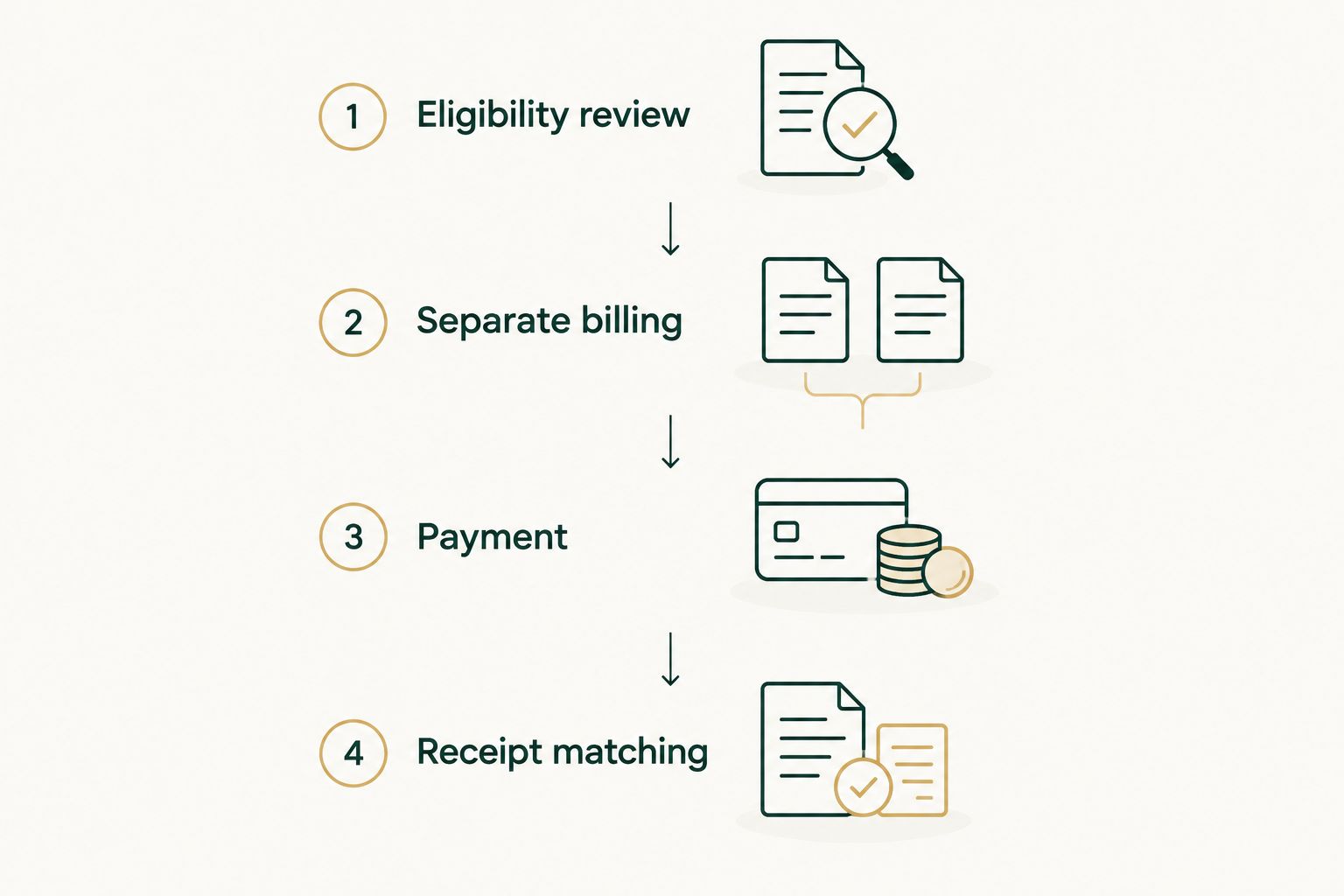
Establish eligibility before payment, then match each transaction to its supporting receipt.
A practical ledger needs the merchant, patient, expense description, service or purchase date, amount paid, payment source, reimbursement status, and receipt location. Add a note for unresolved questions instead of marking an uncertain expense eligible.
Keep supporting records for your 2026 tax reporting and any later inquiry. HSA distributions are reported on Form 8889; receipts generally stay in your records rather than being attached to the return. Follow your tax adviser's retention guidance, especially when reimbursement occurs long after the original expense.
Alternative workflow: pay personally, then reimburse yourself
Personal payment followed by reimbursement is a valid route for a qualified expense; it is not a different eligibility standard. Use this approach when your HSA card fails at an otherwise eligible merchant or when you deliberately choose to reimburse yourself later.
- Pay the clinic or pharmacy with a personal payment method and save the itemized receipt and proof of payment.
- Confirm the expense was incurred after the HSA was established and that no insurer, employer, FSA, or other source reimbursed the same amount.
- Access your HSA custodian's reimbursement process. Enter the expense information requested and follow its instructions for transferring funds to your personal account.
- Record the distribution against the original receipt. Mark the expense reimbursed so you do not submit it again.
- Retain the supporting records even if the custodian does not require you to upload them.
Expected result: The eligible personal expense and subsequent HSA distribution are connected by a complete record.
Federal HSA rules generally do not require reimbursement in the same year as the qualified expense, provided the expense occurred after the HSA was established and the other requirements are met. Delayed reimbursement requires disciplined records. Do not reimburse an expense already claimed as an itemized medical deduction.
When a refill changes, repeat the check for the new purchase. A different prescription, dispensing pharmacy, insurance payment, or refund can change the supporting documents and your actual out-of-pocket expense. Never change your medication or dose to solve a billing problem without your clinician's direction.
Troubleshooting payment and documentation problems
The HSA card declines even though the expense qualifies
Check the available balance, card activation, billing address, and merchant acceptance. Ask the merchant and custodian whether a processing restriction caused the decline rather than repeatedly submitting the charge.
If the expense is qualified and you can pay personally, use the reimbursement workflow. A declined card does not decide tax eligibility.
The card works, but the membership eligibility remains unclear
Pause further HSA payments for the uncertain expense while you obtain advice. Share the agreement, included services, fee structure, and initial commitment with a qualified tax professional.
If you already used HSA funds for a nonqualified expense, ask the custodian and your tax adviser about the appropriate correction or reporting procedure. Do not assume a pharmacy receipt can substantiate a separate membership charge.
Insurance denies the medication
Read the denial to identify whether it concerns coverage, prior authorization, or another requirement. Your clinician and insurer handle the clinical and coverage questions; your HSA records address the expense you ultimately pay.
An insurance denial is not an instruction to misstate the diagnosis or bypass prescribing criteria. Confirm the actual patient responsibility before paying or reimbursing it.
A receipt contains only a total
Ask the biller for an itemized document describing the actual services or prescription. Keep proof of payment alongside it, and request a correction if the patient, date, or amount is wrong.
A letter of medical necessity can support the medical purpose when relevant. It does not automatically convert every membership or general-wellness service into a qualified expense.
A refund arrives after HSA payment
Match the refund to the original transaction and update your ledger. Ask the custodian how to handle the returned amount, particularly if the refund went to a personal card after an HSA reimbursement.
Do not leave a fully reimbursed expense recorded as if you still paid it. Refunds and insurance adjustments belong in the same record as the original purchase.
Customize your workflow
Build your review around actual billing events, not medication doses. Check recurring membership payments, each pharmacy purchase, and any additional lab charge independently. Keep clinical follow-up separate from financial reconciliation so a payment question does not disappear inside a symptom message.
Our Biomarker Audit connects blood sugar, lipid risk, inflammation, thyroid function, and hormones within the same care plan. It informs clinical decisions; it is not a promise that every test or bundled service receives identical tax treatment.
For your 2026 review, reassess the workflow after a membership change, pharmacy transfer, insurance adjustment, or change in HSA contribution eligibility. Spending existing HSA funds and being eligible to contribute new funds are different questions. An arrangement can affect those questions differently.
Before enrolling, ask for the agreement and confirm both the financial commitment and the documentation available. Choose the care relationship for its clinical fit, then establish the correct payment treatment. A convenient checkout should not make either decision for you.
FAQ
Can I use an HSA card for GLP-1 telehealth?
You can use an HSA card for GLP-1 telehealth expenses that qualify as medical care and meet HSA requirements. Review the prescription, clinical services, and membership separately; card acceptance alone does not establish eligibility.
Does my insurance have to cover the GLP-1 prescription?
Insurance coverage is not required for an otherwise qualified medical expense to be paid with HSA funds. Keep documentation of the medical purpose and reimburse only the qualifying amount you actually paid after other payments or adjustments.
Is every telehealth weight-loss membership HSA-eligible in 2026?
No, every telehealth weight-loss membership is not automatically HSA-eligible in 2026. Direct primary care has specific federal requirements, and a bundled membership must be evaluated under the rules that apply to its actual services and agreement.
What should I do if my HSA card is declined at the pharmacy?
Check your available balance, card details, and the pharmacy's acceptance rules. If the prescription expense qualifies, you can pay personally and reimburse yourself from the HSA while retaining the itemized receipt and proof of payment.
Do I need a letter of medical necessity for GLP-1 treatment?
A letter of medical necessity is not a universal requirement for every prescribed GLP-1 expense. Supporting documentation depends on the expense and circumstances; ask your clinician and tax adviser what is appropriate, and retain prescription and payment records.
Can I reimburse myself from my HSA next year?
Federal HSA rules generally allow later reimbursement for a qualified expense incurred after the HSA was established. Keep records showing that the expense was not reimbursed elsewhere or claimed as an itemized medical deduction.
Does GoodLife Health include medication in its membership charge?
GoodLife Health bills the Cardiometabolic Optimization Membership separately from medication. The pharmacy bills medication at pharmacy cost with zero markup, and the membership fee does not increase with the prescription dose.
Can I use both HSA and FSA funds for the same GLP-1 bill?
You cannot reimburse the same expense amount from both an HSA and an FSA. Also check whether your particular FSA affects eligibility to contribute to an HSA; contribution eligibility and spending existing HSA funds are separate questions.
One last thing
The most useful HSA record is not the card approval; it is the matched receipt. Save it when you pay, alongside the expense description and reimbursement status, rather than trying to reconstruct the purchase during tax preparation.
That small habit protects both payment routes. Whether you pay directly or reimburse yourself later, the same record should explain what you purchased, why it qualifies, what you paid, and whether anyone else covered it.
Related Guides
- How to use HSA or FSA funds for concierge medicine
- How membership pricing works for medical weight loss
- How to use telehealth for ongoing GLP-1 management
References
- Tirzepatide Once Weekly for the Treatment of Obesity (SURMOUNT-1). 2022. pubmed.ncbi.nlm.nih.gov/35658024/
- Once-Weekly Semaglutide in Adults with Overweight or Obesity (STEP 1). 2021. pubmed.ncbi.nlm.nih.gov/33567185/