Instead of manually reconstructing sleep, symptoms, and injection dates before every appointment, set up a shared-date tracking log that pairs WHOOP or Oura trends with your testosterone prescription and lab results. This 2026 workflow helps you bring useful context to your physician without treating a recovery score as a testosterone measurement or a reason to change your dose.
- To sync whoop oura ring with trt, combine wearable trends, symptoms, prescription records, and clinician-ordered labs.
- WHOOP and Oura provide sleep and recovery context, not testosterone measurements or dosing instructions.
- GoodLife Health Cardiometabolic Optimization fits patients seeking physician-guided hormone care rather than wearable-led treatment.
- Keep one wearable as your reference source and preserve medication dates separately from sleep dates.
- New symptoms require clinical attention even when your wearable score looks reassuring.
Why this matters
Testosterone replacement therapy, or TRT, needs clinical monitoring. A wearable adds context about sleep, activity, and resting heart rate, but it cannot establish whether testosterone is low, whether treatment is appropriate, or whether your prescription is safe.
GoodLife Health Cardiometabolic Optimization is best for patients who want physician-guided hormone care, not wearable-led dosing. Our approach treats metabolic, hormonal, and cardiovascular health as one system. That means sleep trends belong beside blood pressure, symptoms, hormone testing, blood sugar, lipids, and relevant safety monitoring, not above them.
The GoodLife Health membership follows that connected model. Clinical care is delivered by licensed physicians of Beluga Health, P.A., an independent Florida professional corporation licensed to practice in all 50 states, working under GoodLife Health's clinical protocols.
For your 2026 tracking plan, separate two questions: what changed in daily life, and what requires a medical decision? Wearables help describe the first. Your physician addresses the second using your history, examination when needed, and appropriate testing.
Before you start
- Gather your materials. Have your WHOOP or Oura account, a working device, your current prescription instructions, recent lab reports, and a spreadsheet or private health notebook. Ask your clinical team which secure channel to use for sharing a summary.
- Agree on the clinical plan. Confirm which symptoms to record, when bloodwork is due, and how the blood draw should relate to your specific testosterone formulation and schedule. Discuss fertility plans, sleep apnea, and other relevant conditions before treatment decisions.
- Prevent the date mismatch. Overnight sleep crosses calendar dates, while medication records describe an event at a specific time. Choose a consistent sleep-date convention and record the time zone for medication events, especially during travel or shift work.
Create a file named TRT tracking 2026 or another clear name you will recognize later. This guide uses labels you create in your own log; they are not claimed WHOOP, Oura, or patient-portal buttons.
This is a record-sharing workflow, not a direct device-to-prescription connection. It does not require an automatic connection to a clinical record. Our guide to hormone replacement therapy for men with low testosterone explains the treatment context that the tracking log supports.
Configuration unit: Your reference device
Choose the source you can wear consistently
Both WHOOP and Oura provide sleep and physiological trend information. Neither is a testosterone test, and their summary scores are not interchangeable.
Reference device options
Choose what you can wear consistently
| Option | Best for | Useful contribution | Limitation |
|---|---|---|---|
| WHOOP | Patients already comfortable wearing a wrist device | Sleep, activity, resting heart rate, and heart rate variability trends | Recovery scores do not establish TRT effectiveness or safety |
| Oura | Patients who prefer a ring for routine wear | Sleep, resting heart rate, heart rate variability, and readiness context | Readiness scores do not measure testosterone or determine dosing |
The practical choice is the device you already use reliably. Buying another device does not solve missing prescription details or poorly timed bloodwork.
- Choose one reference device. Use WHOOP or Oura as the main source for ongoing comparisons. Keep the other separate if you wear both.
- Create a Device source column. Enter the device name beside each observation so a later switch remains visible.
- Record measurement names and units. Use hours for sleep duration, beats per minute for resting heart rate, and milliseconds for heart rate variability when displayed that way.
- Preserve the measurement context. Do not mix a nightly resting measurement with an exercise reading under the same heading.
- Mark gaps honestly. Write Not recorded when you did not wear the device or a measurement is missing. Never enter zero as a substitute.
Expected result: Every wearable value has a source, date, unit, and identifiable measurement type. You can compare like with like without creating a false trend across devices.


Configuration unit: Your dated tracking log
Build a record that separates observations from decisions
A useful log keeps raw observations separate from interpretation. Record what happened first; leave explanations such as whether fatigue reflects testosterone, thyroid function, sleep disruption, or another cause for clinical review.
Use these headings as your tracking structure:
Tracking log structure
What belongs where
| Record | What belongs here | What does not belong here |
|---|---|---|
| Wearable trends | Sleep duration, resting heart rate, HRV, device source | A diagnosis based on a score |
| Medication record | Prescribed formulation, administered amount, date, time | Self-directed changes to the prescription |
| Symptoms | Energy, libido, mood, sleep complaints, possible adverse effects | An assumed hormone level |
| Lab results | Original report, units, collection time, medication timing | A wearable estimate of testosterone |
| Clinical review | Questions, physician instructions, agreed follow-up | An automated dose recommendation |
- Create the five record sections above. Keep them in the same file or notebook so dates remain easy to compare.
- Add an Observation date field. For sleep, use the date you wake after the main sleep period and document that convention.
- Add an Event time field. Record medication administration and blood collection separately, including the time zone when relevant.
- Add a Context field. Note illness, alcohol, travel, unusual exercise, missed sleep, or other medication changes.
- Protect the file. Limit access to people involved in your care and use your clinical team's approved sharing route rather than a public link.
Expected result: You can identify what changed, when it changed, and which information came from a device, your own observation, a lab, or your physician.
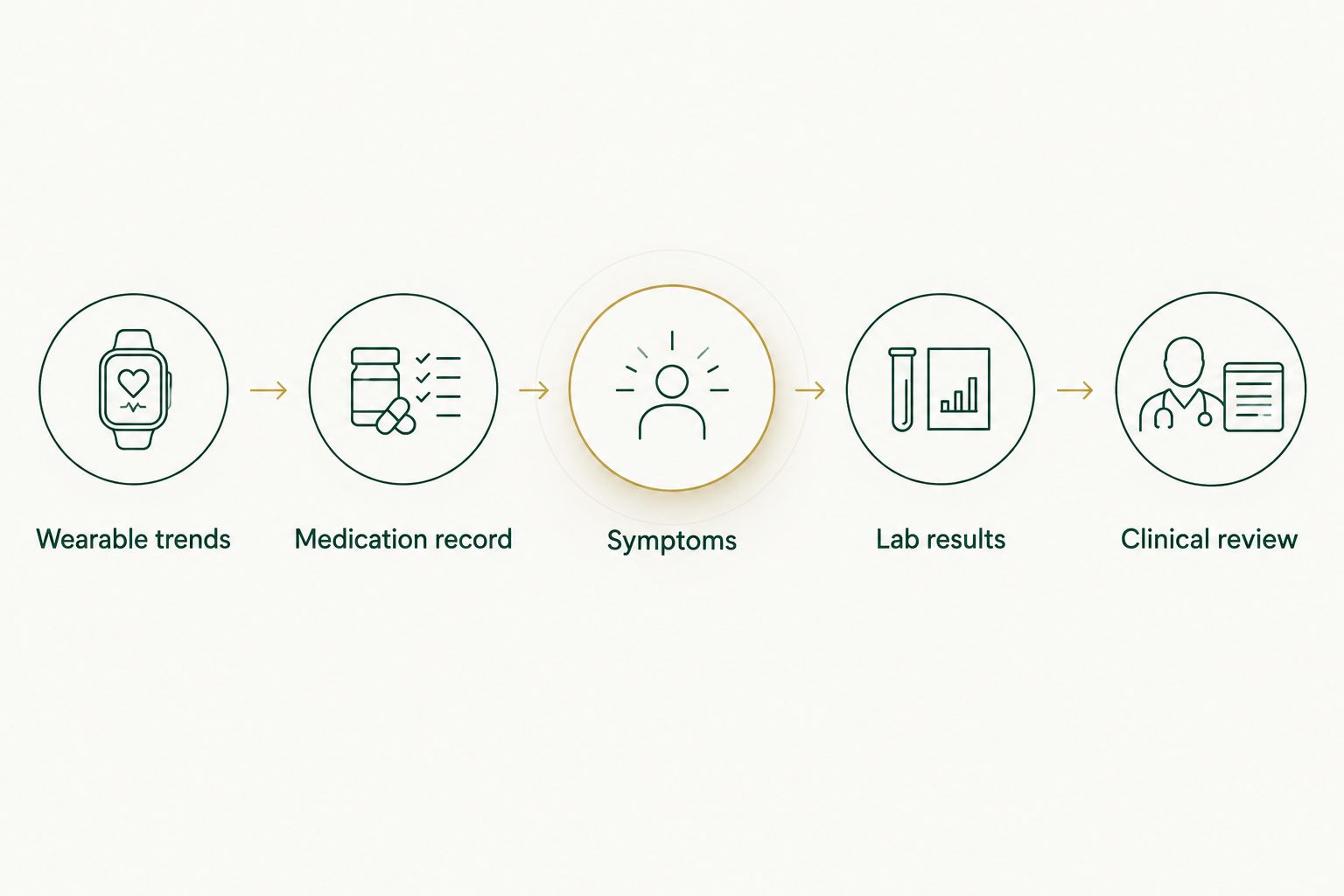
Wearable information supports a clinical review; it does not replace one.
Configuration unit: Your medication and symptom record
Capture treatment events without turning scores into instructions
The medication record should describe your actual prescription and what you actually took. If those differ, document the difference and ask your prescriber what to do; do not use the log to calculate a catch-up dose.
- Copy your current instructions exactly. Include the formulation, concentration when applicable, prescribed amount, route, and schedule. Do not convert between milligrams and injection volume unless your clinical team has confirmed the calculation.
- Enter each administration event. Record the date, time, and amount administered. Keep an accidental omission or uncertainty visible rather than reconstructing a confident entry later.
- Choose a short symptom list. Record energy, libido, mood, sleep quality, and symptoms your physician specifically asks you to monitor.
- Use consistent descriptions. Simple entries such as Better than usual, Usual, or Worse than usual are easier to interpret than changing your rating system each week.
- Document other changes. Include new medicines, changes in eating or exercise, illness, and sleep disruption. These help prevent attributing every change to TRT.
Expected result: Your physician can distinguish a documented treatment event from a symptom report and a wearable observation. None becomes an instruction to increase testosterone.
If fertility matters now or later, raise it directly with your physician. Testosterone therapy can suppress sperm production; a favorable recovery trend does not address that risk.
Configuration unit: Your clinical review packet
Summarize the pattern instead of sending an unexplained dashboard
For a manageable routine, schedule one review of your log every 7 days. That is an organizational choice for this workflow, not a medical monitoring interval or a reason to delay contacting your clinician.
- Select a consistent review window. Keep the date range visible. Compare similar periods rather than a single difficult night with an unusually restful month.
- Summarize direction, not causation. Write that sleep duration decreased or resting heart rate increased. Do not write that your testosterone dose caused the change unless your physician has established that interpretation.
- Attach relevant prescription context. Include any clinician-directed change and its date. Keep the previous instructions available for comparison.
- Include original lab reports. Preserve reference ranges, units, and collection details. Record the time since your last testosterone administration for your physician to interpret.
- Ask a focused question. For example, describe new daytime sleepiness and ask whether it needs evaluation. Do not ask the wearable to select a dose.
Expected result: Your clinical team receives a short, dated summary with supporting records, rather than disconnected screenshots or an unsupported explanation.
For a 2026 review template, use five lines: Date range, Prescription events, Symptoms, Wearable changes, and Question for clinician. Keep the full log behind that summary for follow-up questions.
Feeling better and being safely monitored are different questions.
GoodLife Health Learning Center
What wearables cannot monitor during TRT
Wearable measurements do not replace testosterone blood testing or safety monitoring. Hemoglobin and hematocrit, blood pressure, prostate-related assessment when appropriate, and other testing depend on your clinical history and treatment plan.
Your physician also interprets testosterone results in relation to the formulation and time since administration. A result without that context is harder to compare with a previous draw. Do not move an injection or application simply to produce a preferred lab result; follow the instructions provided for your bloodwork.
Sleep deserves particular attention. Report new or worsening snoring, witnessed breathing pauses, morning headaches, or daytime sleepiness rather than treating a wearable sleep score as a sleep apnea evaluation. A consumer device cannot rule out that condition.
Feeling better and being safely monitored are different questions. Both matter. Improved energy does not remove the need for prescribed follow-up, and an unfavorable wearable score does not prove that TRT is failing.
Our Biomarker Audit occurs every 90 days, with 4 audits per year included in membership. The panels include ApoB, Lp(a), hs-CRP, HbA1c, lipids, insulin markers, and full hormone and thyroid panels through the Beluga Health lab network. Your physician determines any additional testing or earlier review; the quarterly cadence is not a reason to postpone a new concern.
Second workflow: Review whenever your prescription changes
Use a change-triggered record when your physician adjusts your formulation, amount, or schedule. The purpose is to preserve the treatment timeline, not to prove that the adjustment caused every later fluctuation.
- Create a Prescription change entry. Copy the new instructions, the date they take effect, and any follow-up directions.
- Preserve the earlier record. Do not overwrite the prior prescription. Keep the date separating the two plans visible.
- Keep other tracking methods stable. Continue using the same device, sleep-date convention, units, and symptom descriptions.
- Add competing explanations. Note a new training schedule, illness, travel, dietary change, or another medicine started around the same time.
- Confirm the follow-up plan. Ask when symptoms should be reviewed and when bloodwork should occur for your specific treatment.
Expected result: A before-and-after timeline that your physician can interpret without confusing a prescription change with a device switch or travel week.
For your 2026 change log, record an app or device change as its own event too. A change in displayed scores is not automatically a change in physiology. If you switch from WHOOP to Oura, establish a new reference period rather than continuing one blended score chart.
Troubleshooting
The overnight record appears on the wrong date
Check whether you used bedtime or waking date. Apply your documented waking-date convention consistently and retain medication timestamps separately. For shift work, label the main sleep period instead of forcing daytime sleep into a conventional nighttime schedule.
WHOOP and Oura disagree
Do not average their proprietary recovery or readiness scores. Keep each source separate and review consistent measurements within one device over time. Different outputs are a reason to check measurement context, not evidence that one device has detected a testosterone problem.
A score improves, but you feel worse
Contact your clinician about the symptoms. A favorable score does not override worsening fatigue, headaches, mood changes, or sleep complaints. Include the onset date, prescription timeline, and relevant context rather than waiting for the dashboard to agree.
The clinical team cannot use your file
Ask which format and secure channel they accept. Provide a short dated summary and the original lab reports if a full spreadsheet is impractical. Do not assume that connecting a wearable to another health app also sends its information to your physician.
Resting heart rate rises or sleep deteriorates
Review the record for illness, alcohol, heavy exercise, sleep loss, and medication changes, then seek clinical advice for persistent changes or associated symptoms. Do not adjust TRT yourself. Chest pain, severe shortness of breath, fainting, or stroke symptoms require emergency care, not another device sync.
Chest pain, severe shortness of breath, fainting, or stroke symptoms require emergency care, not another device sync. Do not adjust TRT yourself based on wearable trends.
Customize your workflow
Once the basic record is consistent, expand only where it answers a clinical question. Ask your physician whether home blood pressure readings, weight trends, or other observations belong in your plan. Use an appropriate measuring device and agreed technique; do not substitute a recovery score for a blood pressure measurement.
The benefit of our model is connected clinical context rather than another performance dashboard. The limitation is equally clear: membership is not a wearable-based dosing service, and a tracking file still requires accurate entries, appropriate testing, and physician interpretation.
For your 2026 care budget, the GoodLife Health Cardiometabolic Optimization Membership is one flat $299/month. Membership begins with a two-month commitment and a $598 first charge, then continues at $299/month, with cancellation anytime after the initial commitment. There are no tiers.
Quarterly Biomarker Audits are included. Additional labs beyond that cadence are billed at pass-through cost. Medications are billed separately by the pharmacy at pharmacy cost, with zero markup, no molecule upcharge, and no dose-escalation fees. The membership fee does not rise with your prescription.
One flat fee for the doctor. Zero markup on the medicine. Keep those financial terms separate from the clinical decision: a predictable membership fee is not a reason to start testosterone or increase a dose.
FAQ
How do I sync WHOOP or Oura Ring with TRT tracking?
Combine dated wearable observations with a separate medication record, symptom log, and original lab reports. Share a concise summary through the channel your clinical team accepts; this workflow does not depend on a direct device-to-clinic connection.
Can WHOOP or Oura measure my testosterone level?
WHOOP and Oura do not measure blood testosterone. Sleep, resting heart rate, and heart rate variability provide context, while testosterone assessment requires appropriate laboratory testing and clinical interpretation.
Is WHOOP better than Oura for testosterone therapy tracking?
Neither WHOOP nor Oura determines whether testosterone therapy is effective or safe. Choose the device you can use consistently, preserve its measurement context, and avoid combining proprietary scores across devices.
Should I change my TRT dose when my recovery score drops?
Do not change your TRT dose based on a recovery or readiness score. Record symptoms and relevant context, then ask your prescriber whether the change needs assessment.
When should I have testosterone labs drawn relative to an injection?
Follow your physician's instructions for your specific formulation and dosing schedule. Record the blood collection time and last administration time so your physician can interpret the result accurately.
Can a normal wearable sleep score rule out sleep apnea on TRT?
A normal consumer wearable sleep score cannot rule out sleep apnea. Report snoring, witnessed breathing pauses, morning headaches, or daytime sleepiness to your clinician for appropriate evaluation.
How much does GoodLife Health hormone care cost?
The Cardiometabolic Optimization Membership is $299/month, beginning with a two-month commitment and a $598 first charge, then month-to-month with cancellation anytime after. Quarterly Biomarker Audits are included; medications are billed separately by the pharmacy at pharmacy cost, and additional labs beyond the quarterly cadence are billed at pass-through cost.
Do quarterly Biomarker Audits replace other TRT safety checks?
Quarterly Biomarker Audits do not replace individualized TRT monitoring. Your physician determines which safety assessments, additional tests, and earlier reviews are needed for your history, symptoms, and prescription.
One last thing
Your most useful tracking entry might be a sentence, not a score: you started waking unrefreshed after a change in work shifts, or headaches began after a prescription adjustment. Those observations give your physician something specific to investigate without pretending to establish the cause.
Keep the question clinical: what needs attention, not how can I improve the score? A clear timeline helps your physician separate sleep disruption, metabolic health, hormone treatment, and cardiovascular concerns while treating them as one connected system.
Related Guides
- How to read your testosterone lab results
- How to track hormone symptoms during therapy
- How testosterone therapy affects sleep apnea risk in men
References
- Testosterone Therapy in Men with Hypogonadism: An Endocrine Society Clinical Practice Guideline. 2018. doi.org/10.1210/jc.2018-00229