Your health already has its own budget. You pay a service you order lab panels from and a clinic that manages your hormones. You buy supplements, and you follow whatever the longevity program recommends this season. Now a concierge practice has sent a proposal for $20,000 a year. Reading it, you had a reasonable thought: you know what you need, you want the prescription, and you would rather not pay anyone a membership to get it.
That thought usually turns into a search: is concierge medicine worth it when all I want is the prescription? This piece answers the question plainly. It covers what the concierge fee buys and what a prescription-only service charges once you read past the monthly fee. It also covers what GoodLife Health's membership does for $299 a month, what it leaves out, and who should not join. If you would rather know first whether you qualify at all, start with the eligibility check. Not everyone is accepted.
- A prescription is a short document; the work worth paying for is the judgment around it, made against your labs.
- Services that sell "just the prescription" earn money somewhere, and often it is a margin on the medicine.
- A $20,000-a-year concierge practice sells broad access; GoodLife Health is narrower, at $299 a month or $3,588 a year.
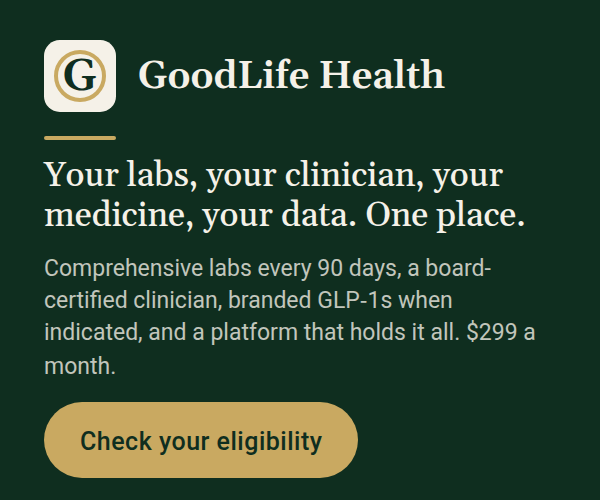
- The membership includes four cardiometabolic lab panels a year, messaging and video visits, and the pharmacy you choose bills medication separately.
- The fee is the same whatever medication or dose is indicated, and GoodLife Health takes nothing on medication.
- Not everyone is accepted, and the membership pairs with insurance rather than replacing it.
Four vendors, one quote, and nobody reading the whole file
Look at how the pieces fit together today. The lab service draws your blood and returns a report with some values flagged high or low. The hormone clinic writes a prescription and checks in on its own schedule, sometimes with its own labs. The longevity program has opinions about both. Each of them may be good at its part, and none of them answers for the whole picture. When a value drifts on one report while a dose changes at another office, nobody is paid to read the two side by side.
Ordinary primary care was supposed to be that reader, and you have probably found out why it usually is not. Traditional primary care appointments average 18 minutes, and a typical traditional practice carries a panel of 1,500 to 2,500 patients, as our guide to what direct primary care includes sets out. Eighteen minutes is enough to renew a prescription. It is rarely enough to read a year of your numbers in order.
So concierge medicine starts to look like the answer. It sells time and access, and the $20,000-a-year concierge practice prices that time accordingly. For some people the money buys exactly what they want: one doctor for everything, available when something comes up. Your hesitation is more specific. Most of what you would actually use is a clinician who understands hormones and metabolism, reads your labs, and manages one or two prescriptions well. Much of the rest of what the fee covers could sit unused.
At the other end of the market sits the opposite offer. It gives you a questionnaire, a prescription within a couple of days, and no conversation about what your numbers mean. You already know that is the pill mill you are trying to avoid, which is why "I just want the prescription" never quite settles the question. You want less than concierge and more than a transaction, and it is hard to tell what that middle option should cost or include.
GoodLife Health sits in that middle, between the $20,000-a-year concierge practice and the $99-a-month compounded app, and it says so openly. Whether the middle suits you depends on what you are actually paying for in each case, and the prices alone do not show that.
What a prescription costs once you trace the money
A prescription is a short document. Its value comes from the licence behind it. The clinician who signs it carries the responsibility for whether it was the right medication, at the right dose, for the right person. Nobody hands out that responsibility as a free accessory. Every service that offers "just the prescription" pays a clinician to sign, and the money comes from somewhere. Where it comes from tells you what the service is rewarded for.
Our white paper, How GLP-1 Telehealth Companies Make Money, sorts the market into three ways of getting paid. In the first, the membership fee looks small and the company earns a margin on the medicine. In the second, a low fee is paired with billing your insurance. In the third, the patient pays one flat fee and the medicine is sold at the pharmacy's own price. None of these makes a clinician good or bad. Each one decides what the company earns more from.
The first model is where a cheap-looking prescription can turn expensive. The comparison chart behind the white paper, compiled from public pricing pages in May 2026, found branded Zepbound or Mounjaro offered at up to $1,899 a month through legacy telehealth memberships. By comparison, LillyDirect's published self-pay prices in September 2026 put Zepbound vials at $299 to $449 a month depending on dose. The low monthly fee was never the whole price. The margin sat inside the medication line, where it is easy to miss.
The $99-a-month app has a different history. During the 2022–2025 shortage, federal law allowed pharmacies to make compounded copies of semaglutide and tirzepatide, and many low-cost services were built on them. The FDA declared the tirzepatide shortage resolved in December 2024 and the semaglutide shortage resolved on February 21, 2025. The last enforcement grace periods closed in spring 2025. A narrow exception remains for a specific patient with a documented clinical need the branded product cannot meet. The FDA has published its concerns about unapproved GLP-1 drugs, and both manufacturers have sued companies selling compounded versions. GoodLife Health does not prescribe compounded GLP-1, which means its patients pay branded prices.
Concierge medicine is paid in a simpler way still: a large annual fee for access. That fee pays for breadth and availability. Your question is narrower. If your real needs are cardiometabolic and hormonal, the part of the $20,000 you would use is the clinician who reads your labs and manages your prescriptions over time. You can buy that part on its own.
That brings the real answer to your question into view. The prescription is the cheapest part of the decision; the judgment that decides it is what you are paying for. Your lab subscription produces numbers. A number with no one accountable for acting on it is information, and information alone does not adjust a dose, catch a drift across three quarters, or tell you that the medication you asked for is the wrong one. A service that sells only the prescription has either priced that judgment out or hidden its cost in the medicine.
The prescription is the cheapest part of the decision; the judgment that decides it is what you are paying for.
In practice, that judgment looks unglamorous. A clinician decides which panel to draw before anything is prescribed and reads each result against the last one. The clinician chooses a medication and a dose, then checks the next panel to see what changed. Sometimes the clinician says no, or not yet, when the numbers do not support what you came in asking for. When a company earns on the medicine, the pressure runs toward yes. A flat fee keeps the medication out of the company's revenue entirely.
A GLP-1 or hormone protocol built without labs is a guess, and clinicians who prescribe without them are cutting a corner that matters. That is why the labs come first and keep coming, four panels a year.
GoodLife Health follows that order: diagnosis first, then treatment, then the long haul. Labs come before any prescription, and they continue after it. For a reader who already buys labs, that order makes someone accountable for the data you are already collecting.
What $299 a month buys, and what it leaves out
The membership is $299 a month, month to month. At sign-up, $598 is charged, which covers the first two months. If the clinician cannot accept you into care, the $598 is refunded in full; once you are accepted, the first two months are non-refundable. Medication billed by a pharmacy follows that pharmacy's own return and refund policy. Over a year, the membership is $3,588, set against the $20,000-a-year concierge practice. Medication is a separate line, so budget for it on its own.
The fee covers clinicians licensed in all fifty states and four cardiometabolic lab panels a year, with every result in your own hands. It also covers asynchronous messaging with the care team and video visits. The quarterly panels make up the Biomarker Audit, the 90-day rhythm around which the care is built. If you currently pay a separate lab service, these panels sit inside the membership fee. Whether you keep your other testing is your decision.
The fee is the same whatever medication is indicated and whatever the dose. GoodLife Health adds no molecule upcharge and no dose upcharge, and it calls this Medication-Neutral Pricing. When a medication is clinically indicated, it is prescribed to the pharmacy you choose, at that pharmacy's own price. GoodLife Health sets nothing, sees nothing and takes nothing on medication. This is the third model from the white paper. The company earns the same whether your clinician prescribes something, changes a dose, or decides you need nothing at all.
What can be prescribed is branded, FDA-approved medication. That includes Wegovy, Zepbound, Mounjaro and Ozempic for GLP-1, hormone therapy and thyroid medication where indicated, and any FDA-approved medication a clinician judges indicated. Because medication is unbundled, you can check its price yourself. As published in September 2026, NovoCare lists Wegovy pens at $199 a month for the first two fills and $349 a month after that. The $199 price is an introductory offer for new patients through December 2026. NovoCare lists the Wegovy pill from $149 a month at lower doses. Whether insurance covers a medication is between you, your plan and the pharmacy, and coverage is never promised. Prior authorization is the pharmacy's process; GoodLife Health does not claim to run it, speed it or win it.
Testosterone needs its own paragraph, because many readers who already spend on hormones ask about it first. It is a Schedule III controlled substance. It is prescribed and dispensed only where federal and state law allow, through the clinical partner's arrangement, and the membership never promises it. The clinician decides.
The membership fee is generally eligible for HSA or FSA pre-tax dollars. The membership pairs with insurance for catastrophic coverage and does not replace it. It replaces the primary-care relationship.
Some things a longevity budget often includes stay outside the model. GoodLife Health does not prescribe research peptides or offer hormone pellets or any other in-office procedure. Continuous glucose monitors are not part of the model either; the clinician works from the quarterly panels. Nothing about weight loss, remission or how you will feel is guaranteed. You get a clinician working from four panels a year, with the medication decision left to clinical judgment rather than to whatever earns the company more.

Setting the two quotes side by side
Put the concierge proposal and this membership next to each other and ask what you will actually use. If the answer is one doctor for everything, available in person, a concierge practice may be worth its fee to you, and nothing here argues otherwise. If the answer is a clinician who reads your hormone and metabolic labs every quarter, manages a prescription or two and answers your messages, this membership is built for that part.
The path in is deliberate. You take the eligibility check, complete the intake and check out. A clinician then reviews your file and decides whether to accept you into care. Not everyone is accepted. If you are not, the $598 comes back in full; if you are, the first two months are non-refundable, and medication follows your pharmacy's own policy. That review is the first piece of the judgment you are paying for, and it is the first step a pill mill would cut.
If you still want only the prescription after reading this, that is a legitimate preference, but this membership is not designed to serve it.
Who this is not for
If you want a prescription with no labs before it and no follow-up after it, GoodLife Health is the wrong place, and a $99-a-month app will look cheaper on paper. Read its medication pricing closely before you decide it is cheaper in fact. If your plan depends on compounded GLP-1, research peptides or hormone pellets, none of those are offered here, and none will be. If you need testosterone guaranteed before you join, the membership cannot give you that, because the clinician decides and the law sets the limits. If you want one doctor for every part of your health, seen in an office, the concierge practice is probably the better fit. And if you hope a membership will stand in for insurance, it will not, because it pairs with insurance for catastrophic coverage.
If you want a narrower relationship, built on quarterly cardiometabolic labs and branded medication at your pharmacy's price, the eligibility check is the next step.
Related Reading
- How GLP-1 Telehealth Companies Make Money: A Plain-Language Whitepaper
- What Does Direct Primary Care Include in 2026
References
- Zepbound Self Pay Journey Program — LillyDirect vial pricing (Eli Lilly). 2026. zepbound.lilly.com/savings
- NovoCare Pharmacy — Wegovy self-pay pricing (Novo Nordisk). 2026. www.novocare.com/pharmacy/wegovy.html
- FDA's Concerns with Unapproved GLP-1 Drugs Used for Weight Loss (U.S. Food and Drug Administration). 2025. www.fda.gov/drugs/postmarket-drug-safety-information-patients-and-providers/fdas-concerns-unapproved-glp-1-drugs-used-weight-loss