Night-shift nurses’ hormone panel testing is clinician-directed bloodwork interpreted alongside sleep timing, symptoms, medications, and reproductive history to identify endocrine disease and guide appropriate care. This 2026 guide explains which tests answer useful clinical questions, how to schedule your draw around overnight work, and why an abnormal result is not automatically a reason to start hormone therapy.
Key Takeaways
- Hormone panel testing for night shift nurses needs documented sleep timing, targeted thyroid testing, and clinician interpretation.
- GoodLife Health Cardiometabolic Optimization suits nurses seeking ongoing hormone and metabolic care, rather than testing alone.
- A post-shift blood draw is not equivalent to a rested morning sample for every hormone.
- Random cortisol testing does not diagnose burnout, and one abnormal hormone result does not establish a treatment indication.
Why hormone panel testing matters for night-shift nurses
Your work schedule belongs on the lab order, not just in the conversation afterward. Hormones do not all follow the same timing rules. Sleep, menstrual phase, meals, acute illness, and prescribed hormones affect different measurements in different ways.
An early appointment after an overnight shift can be convenient without being appropriate for the question your clinician is investigating. The clock says morning; your body has been awake through the night. Rotating schedules add another complication because your sleep pattern changes between workdays and days off.
Persistent fatigue, irregular periods, hot flashes, reduced libido, or unexplained weight changes deserve evaluation. They do not prove hormone deficiency. Sleep loss, anemia, medication effects, depression, pregnancy, and sleep apnea can produce overlapping symptoms.
The GoodLife Health Cardiometabolic Optimization model treats metabolic, hormonal, and cardiovascular health as one system. That framing matters when symptoms overlap: thyroid findings, glucose regulation, lipids, inflammation, and reproductive health should inform one clinical assessment rather than competing treatment plans.
For your 2026 evaluation, prioritize an interpretable baseline and a follow-up conversation. A larger panel cannot compensate for an unclear clinical question or an undocumented collection schedule.
How to arrange hormone testing around overnight nursing
1. Document your symptoms and actual sleep schedule
Start with a written record you can share with your existing primary care clinician. You do not need a wearable or paid tracking service. Record when you sleep, when you work, and whether symptoms persist after recovery sleep.
Separate sleepiness from fatigue. Sleepiness means difficulty staying awake; fatigue means low energy or reduced capacity even when you are alert. That distinction helps your clinician decide whether to investigate sleep disorders, endocrine disease, another medical cause, or several contributors together.
Include symptoms that do not fit a simple sleep-deprivation explanation, such as heavy menstrual bleeding, persistent cold intolerance, nipple discharge, or new erectile dysfunction. Note when each symptom started and whether it followed a schedule change, medication change, pregnancy, or substantial weight change.
For your first 2026 visit, bring prior results with collection dates and times. A screenshot of an isolated flagged value loses context that matters for comparison.
- Record work start, work end, sleep onset, and wake time.
- Describe symptoms on workdays and days off.
- List prescriptions, supplements, contraception, and hormone treatments.
- Include menstrual history, pregnancy possibility, and fertility goals when relevant.
- Bring previous laboratory reports, including reference intervals.
2. Ask what each requested test will change
Ask your clinician a practical question before buying a panel: what decision will this result help make? Start with your history and examination, then select tests that address plausible causes. Night work alone does not establish a need for every available hormone measurement.
For suspected thyroid dysfunction, TSH commonly starts the evaluation, with free T4 and other testing added according to the clinical question. Thyroid antibodies answer questions about autoimmunity; they do not replace assessment of thyroid function. A full thyroid panel is not proof that every component needs repeated measurement.
Reproductive testing also needs a purpose. Testosterone evaluation differs between someone with symptoms of male hypogonadism and someone being assessed for androgen excess. Estradiol, progesterone, FSH, LH, and prolactin are not interchangeable measures of a general hormone balance.
For many otherwise healthy people with typical perimenopause symptoms, the clinical history is more informative than a single fluctuating FSH or estradiol result. Pregnancy testing, a blood count, or iron studies can be more relevant than another hormone assay when symptoms point elsewhere.
- Ask which diagnosis each test is intended to investigate.
- Start with symptom-directed thyroid and reproductive evaluation.
- Discuss pregnancy testing when pregnancy is possible.
- Ask about anemia or iron deficiency when bleeding or fatigue warrants it.
- Avoid adding cortisol solely because work feels stressful.
3. Choose a clinician who will interpret the whole assessment
The manual route is straightforward: ask your primary care clinician to order appropriate tests and schedule a results visit. Request a written collection plan so the laboratory appointment matches your sleep schedule and the test’s purpose.
An ongoing membership is another option when you want repeated assessment and coordinated treatment. GoodLife Health hormone care is best for night-shift nurses seeking ongoing cardiometabolic management rather than a standalone lab report. Its Biomarker Audit includes hormone and thyroid panels alongside HbA1c, insulin markers, lipids, ApoB, Lp(a), and hs-CRP every 90 days, or 4 audits per year.
Clinical care is delivered by licensed physicians of Beluga Health, P.A., an independent professional corporation, under GoodLife Health’s clinical protocols. Labs run through the Beluga Health lab network. The clinician orders and reads the labs; membership does not make hormone treatment automatic.
The limitation is important: a recurring membership is a different commitment from a one-time investigation, and additional labs beyond the quarterly cadence are billed separately at pass-through cost. Review how telehealth hormone therapy visits work before deciding whether virtual ongoing care fits your needs.
- Identify who orders the tests and who reviews the results.
- Confirm how to share your shift and sleep schedule.
- Ask who arranges confirmatory testing or specialist referral.
- Distinguish included scheduled audits from additional diagnostic testing.
- Keep your existing clinicians informed about new prescriptions.
4. Schedule the draw for the hormone being measured
Do not apply one timing rule to an entire hormone panel. Your clinician should specify collection conditions for each timing-sensitive measurement, including what to do when your sleep schedule conflicts with standard laboratory instructions.
For testosterone evaluation in men, endocrine guidance emphasizes compatible symptoms and consistently low results, confirmed with repeat measurement under appropriate conditions. Tell your clinician if you sleep during the day. A post-shift morning sample is not automatically equivalent to a rested sample, and standard morning reference intervals need careful application to shift workers.
Progesterone testing to assess ovulation is generally timed relative to the expected next period, not assigned to the same calendar day for everyone. Estradiol, FSH, and LH interpretation also depends on reproductive stage, menstrual timing, and hormonal medication use.
Cortisol requires particular caution. Late-night salivary cortisol testing assumes a relevant sleep-wake pattern; rotating shifts can make that assumption unsuitable. Do not substitute your bedtime for the collection instructions without clinician approval. In 2026, the useful question remains the same: does this collection method fit the suspected condition and your actual schedule?
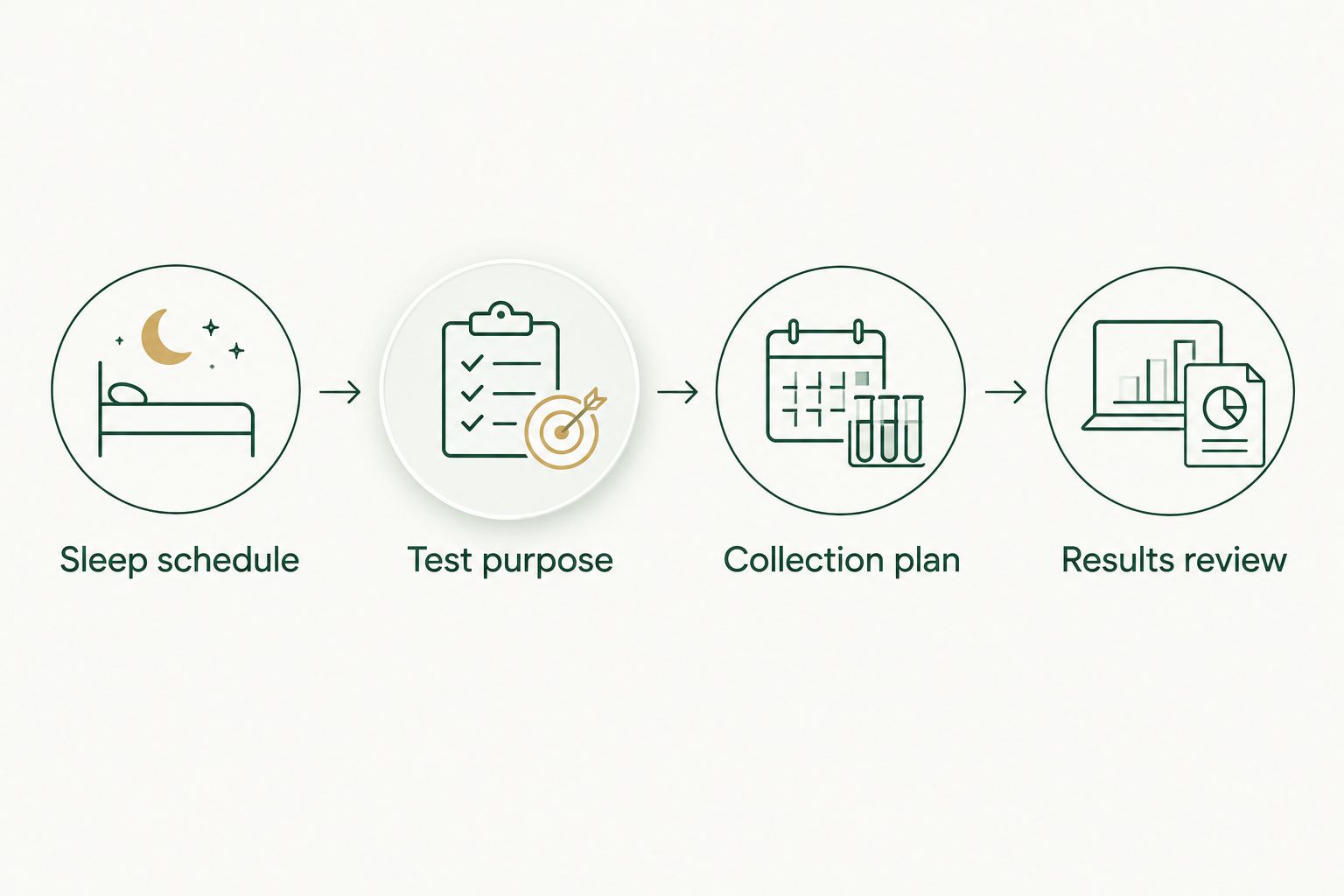
Choose collection conditions before booking the draw, not after receiving a flagged result.
Record the collection time and your preceding sleep period even when the laboratory does not ask. Give that information to the clinician reviewing the results.
- Share your Sleep schedule before selecting an appointment.
- Confirm the Test purpose for timing-sensitive hormones.
- Obtain a written Collection plan, including medication instructions.
- Record wake time, draw time, and recent sleep disruption.
- Arrange a Results review that includes the collection context.
5. Follow test-specific preparation without improvising
A hormone panel does not automatically require fasting. Some companion metabolic tests do, while HbA1c does not. HbA1c reflects average blood glucose over approximately 2–3 months, according to the American Diabetes Association; one overnight meal does not determine that result.
Ask the ordering clinician or laboratory for instructions specific to your order. If fasting is required, clarify the permitted beverages and how to handle medicines that can cause hypoglycemia. Do not extend a fast through a demanding shift simply to fit a convenient appointment.
Biotin supplements can interfere with some thyroid and hormone assays. Report the product and dose, then follow laboratory-specific instructions about whether and when to pause it. Do not stop prescribed thyroid medication, steroids, contraception, or hormone therapy on your own.
Recent illness and disrupted sleep also belong in the preparation discussion. Your clinician should decide whether an elective diagnostic draw should proceed or wait; urgent assessment should not be delayed to create ideal testing conditions.
- Obtain fasting instructions for the exact ordered tests.
- Confirm how to handle diabetes medication if fasting.
- Report biotin, supplements, and all prescribed hormones.
- Ask how the draw relates to your last medication dose.
- Tell the clinician about acute illness or unusually poor sleep.
6. Review patterns and confirm clinically important abnormalities
Read the result with your clinician before drawing conclusions from a flag. A laboratory reference interval describes a comparison population; it does not independently diagnose disease or define a personal treatment target.
For suspected testosterone deficiency in men, the Endocrine Society recommends symptoms consistent with deficiency plus unequivocally and consistently low testosterone. Repeat testing matters. Additional measurements, such as SHBG, free testosterone, LH, or FSH, answer specific follow-up questions rather than serving as automatic additions for every nurse.
Thyroid interpretation similarly depends on the relationship between TSH, free T4, symptoms, medication use, and clinical circumstances. A normal result does not mean fatigue is imaginary. It means your clinician should reconsider the differential rather than prescribe thyroid hormone solely to improve energy.
Review cardiometabolic findings in the same conversation. HbA1c informs glucose assessment, ApoB helps characterize atherogenic particle burden, and Lp(a) informs inherited cardiovascular risk. These markers are not tests for hormone deficiency, but they help prevent a narrow explanation for overlapping symptoms.
- Ask whether the result fits your symptoms and history.
- Identify collection or assay issues before accepting a diagnosis.
- Confirm which abnormalities require repeat testing.
- Discuss nonhormonal explanations when endocrine results are reassuring.
- Leave with a written assessment and next action.
7. Match follow-up to the diagnosis, not the calendar alone
Your existing clinician can manage follow-up with a symptom record, appropriately timed repeat labs, and treatment review. A calendar reminder helps, but the diagnosis and prescribed medication determine what needs monitoring and when.
A scheduled Biomarker Audit is not a reason to postpone necessary testing after a treatment change or new symptoms. Some therapies require safety monitoring beyond hormone concentrations, including a blood count or other condition-specific checks. Conversely, repeating a fluctuating marker without a clinical question can create noise instead of useful information.
Hormone therapy does not replace adequate sleep opportunity or evaluation for sleep apnea and shift-work-related sleep problems. If hormone treatment is indicated, discuss benefits, risks, fertility implications, and how dosing fits your work pattern. Avoid changing doses to chase a number in isolation.
For your 2026 follow-up plan, define what improvement means before treatment starts. Better symptoms, safe monitoring results, and progress on the diagnosed condition matter more than reaching a broadly advertised optimal level.
- Document the diagnosis and intended treatment outcome.
- Confirm the first follow-up date and required safety tests.
- Record symptoms alongside medication use and sleep changes.
- Discuss pregnancy plans before starting relevant therapies.
- Ask which changes warrant contact before the next scheduled audit.
Which testing option fits a night-shift nurse?
Choose the care pathway before choosing the panel. Testing through your established clinician is best for a focused initial assessment. An ongoing membership fits repeated coordinated care; specialist evaluation fits complex findings. Convenience alone should not decide the route.
The comparison below focuses on clinical fit for 2026. Confirm collection access and results-review arrangements directly, especially if daytime appointments conflict with your recovery sleep.
| Option | Best for | Main advantage | Key limitation |
|---|---|---|---|
| Established primary care clinician | An initial symptom-directed investigation | Connects new symptoms with your existing medical history | Confirm how shift timing and results follow-up will be handled |
| GoodLife Health Cardiometabolic Optimization Membership | Ongoing hormone, metabolic, and cardiovascular assessment | Includes a Biomarker Audit every 90 days and physician-directed care | Recurring membership differs from a one-time workup; additional labs are separate |
| Endocrinology or relevant specialist evaluation | Complex abnormalities, pituitary concerns, or diagnostic uncertainty | Focuses assessment on a specific endocrine or reproductive problem | Does not replace a separate plan for routine primary care |
| Direct-to-consumer testing | A specific assay selected with clinician input | Lets you arrange a test outside an existing office visit | A report alone does not establish a diagnosis or provide treatment oversight |
Direct-to-consumer testing is not automatically inaccurate, and a clinician-ordered panel is not automatically useful. Specimen type, assay performance, collection conditions, and interpretation determine whether a result answers the question. A test’s convenience does not remove those requirements.
Before committing to any option, ask who takes responsibility for an unexpected result. You need a defined route for repeat testing, medication review, and referral, not just access to a downloadable report. Membership care also does not replace health insurance for hospital, emergency, or other separately covered services.


Common testing mistakes night-shift nurses make
Treating a post-shift morning as a rested morning
A draw after overnight duty documents a different context from a draw after your main sleep period. For timing-sensitive testing, that distinction can affect interpretation. Tell the ordering clinician what happened before the appointment rather than assuming the clock time is sufficient.
Correct move: obtain test-specific timing instructions before booking. If your schedule changes unexpectedly, ask whether to keep the appointment and document the change or reschedule the elective draw.
Using cortisol as a burnout score
Random cortisol does not diagnose burnout, and adrenal fatigue is not a recognized endocrine diagnosis. Real adrenal disorders require specific clinical evaluation and validated testing. Shift work can complicate tests built around conventional sleep-wake patterns.
Correct move: explain the symptoms and ask whether they suggest an adrenal disorder. The Endocrine Society’s adrenal guidance addresses disease-specific testing, not general wellness scoring.
Calling one reproductive result a hormone imbalance
Menstrual phase, contraception, menopause transition, and prescribed hormones change the meaning of reproductive measurements. A single estradiol, progesterone, or FSH value does not summarize reproductive health. Clinical history remains central.
Correct move: record cycle information and medication use, then ask what the result establishes and what it does not. New abnormal bleeding needs assessment rather than interpretation through a hormone dashboard alone.
Testing while withholding medication without instructions
Skipping thyroid medicine or changing hormone dosing to produce a preferred result creates a misleading baseline and can be unsafe. The clinician needs to know both the prescribed regimen and what you actually took.
Correct move: follow the written preparation plan. Report any missed or altered doses honestly before the result is interpreted.
Expecting hormone treatment to compensate for unsafe sleepiness
Difficulty staying awake while driving or providing care needs prompt attention, not a delayed panel. Severe sleepiness can require evaluation of sleep opportunity, sleep disorders, medications, and occupational safety.
Correct move: do not drive when you cannot stay awake. Seek prompt clinical assessment; chest pain, fainting, severe shortness of breath, or acute neurological symptoms require urgent or emergency care rather than routine hormone testing.
FAQ
What's the best hormone panel for a night-shift nurse?
The best hormone panel for a night-shift nurse is selected for specific symptoms and interpreted with the nurse’s sleep schedule, medications, and reproductive history. Thyroid, testosterone, or reproductive tests answer different questions; night work alone does not justify every assay.
Should I get hormone bloodwork immediately after my night shift?
Do not assume an immediate post-shift draw is appropriate for every hormone test. Ask the ordering clinician to specify timing, especially for testosterone or cortisol evaluation, and document your preceding sleep period.
Do I need to fast before hormone panel testing?
You need to fast only when the ordered tests and laboratory instructions require it. HbA1c does not require fasting, while companion glucose or insulin testing can have different requirements; obtain a medication plan if fasting affects diabetes treatment.
Can a cortisol test tell me whether I'm burned out?
A cortisol test does not diagnose burnout. Testing for adrenal disease requires a specific clinical question, and overnight or rotating work can complicate collection methods that assume a conventional sleep-wake schedule.
Can hormone testing diagnose perimenopause if I work nights?
A single hormone panel does not reliably establish or exclude perimenopause because reproductive hormone levels fluctuate. Your clinician considers symptoms, menstrual changes, age, contraception, and other possible causes; selected testing is useful when the clinical situation warrants it.
Does one low testosterone result mean I need treatment?
One low testosterone result does not establish a treatment indication in men. Endocrine guidance requires compatible symptoms and consistently low measurements, with appropriate repeat testing and evaluation of the cause.
What does GoodLife Health include for ongoing hormone assessment?
GoodLife Health includes a Biomarker Audit every 90 days within its Cardiometabolic Optimization Membership, covering hormone and thyroid panels alongside metabolic and cardiovascular markers. Clinical care is delivered by licensed physicians of Beluga Health, P.A., under GoodLife Health’s clinical protocols; additional labs beyond the scheduled cadence are billed separately.
Can normal hormone results explain why I'm still exhausted?
Normal hormone results do not exclude other causes of exhaustion. Your clinician should consider sleep restriction, sleep apnea, anemia, medication effects, mental health conditions, and other medical causes according to your history and examination.
One last thing
Put your wake time beside your draw time. That small addition makes the collection context visible when someone reviews your report later. Record medication timing and menstrual information when relevant, too.
For your next 2026 appointment, bring a written question: what diagnosis are we testing for, and what will change if the result is abnormal? If the answer is unclear, clarify the plan before the needle goes in. The goal is not the largest panel. It is a result your clinician can interpret and act on safely.
Related Guides
- Cortisol testing: when to do it and what results mean
- How to prepare for a fasting lab draw
- How to track hormone levels over time with labs
References
- Treatment of Symptoms of the Menopause: An Endocrine Society Clinical Practice Guideline. 2015. doi.org/10.1210/jc.2015-2236
- Testosterone Therapy in Men with Hypogonadism: An Endocrine Society Clinical Practice Guideline. 2018. doi.org/10.1210/jc.2018-00229