For adults with familial heart disease, ApoB testing is a blood test that measures a protein on artery-plaque-forming particles to help guide cardiovascular prevention. When comparing ApoB test cost for family history of heart disease, evaluate the complete pathway: the order, blood collection, laboratory analysis, clinician interpretation, and follow-up, not just the test charge.
Key Takeaways
- Compare apob test cost for family history of heart disease by included services, not the laboratory charge alone.
- ApoB measures atherogenic particle burden; Lp(a) adds information about inherited cardiovascular risk.
- GoodLife Health Cardiometabolic Optimization fits adults seeking recurring biomarker review rather than a standalone ApoB test.
- Document which relatives had heart attacks and their ages before requesting testing.
- An ApoB result needs a clinician-owned prevention plan, not just a laboratory reference range.
Why ApoB testing matters for adults with early heart attacks in the family
A family history of early heart attacks changes the prevention conversation even when you feel well. The important details are who was affected, what happened, and how old that person was. A parent's heart attack and a distant relative's unspecified heart problem are not interchangeable histories.
ACC/AHA cardiovascular prevention guidance recognizes premature atherosclerotic cardiovascular disease in male relatives before 55 years and female relatives before 65 years as a risk-enhancing factor. Bring the actual ages to your appointment. These cutoffs help describe risk; they do not make later heart attacks irrelevant.
A standard lipid panel measures cholesterol and triglycerides. ApoB adds information about the number of atherogenic particles, which is especially useful when particle burden and LDL cholesterol tell different stories. It does not show whether an artery is blocked.
For your 2026 evaluation, the useful question is whether ApoB would change treatment or clarify uncertainty. Family history also supports discussing lipoprotein(a), or Lp(a), an inherited risk marker that an ApoB result does not replace.
GoodLife Health frames Cardiometabolic Optimization as treating metabolic, hormonal, and cardiovascular health as one system. For this audience, that means interpreting lipids alongside blood pressure, glucose regulation, thyroid function, medications, and family history rather than treating an isolated laboratory value.
How to arrange ApoB testing without paying for an incomplete answer
Document your family's cardiovascular history
Start with a written family history. Ask relatives what diagnosis they received and their age at the event; use existing medical records when available. You do not need a paid genetic test to begin this conversation.
Focus first on parents, siblings, and children. Distinguish a heart attack from heart failure, an abnormal heartbeat, a stroke, or sudden unexplained death. Each deserves attention, but each raises different clinical questions. If you cannot confirm a diagnosis, label it uncertain rather than filling in the gap.
Include known very high cholesterol, inherited lipid disorders, and relatives who needed coronary stents or bypass surgery. Tell your physician about smoking, diabetes, and high blood pressure in affected relatives when you know those details. Family history reflects both inherited biology and shared exposures.
Keep your own records beside this history: prior lipid panels, current prescriptions, blood pressure readings, and any existing cardiovascular diagnosis. Your goal is a usable clinical summary, not a perfect family tree. A documented pattern of early events helps your clinician decide whether advanced lipid testing or a specialist assessment belongs in your prevention plan.
- Record the relative's relationship to you.
- Write the diagnosis and age at the event.
- Mark uncertain information clearly.
- Include known inherited cholesterol disorders.
- Bring your existing lipid results and medication list.
Ask what ApoB would change in your care
Use your existing primary care relationship first. Request a discussion about ApoB and explain the family history rather than requesting a broad panel without a clinical question. Ask whether the result would change your treatment goal, medication decision, or monitoring plan.
ApoB is not the same as LDL cholesterol. LDL-C describes cholesterol carried within LDL particles; ApoB helps assess the burden of atherogenic particles. Insulin resistance and elevated triglycerides are settings in which those measurements can diverge. A reassuring LDL-C result therefore does not answer every question about particle burden.
Ask separately about Lp(a). ApoB includes information about atherogenic particles collectively, but it does not identify an elevated Lp(a) concentration. National Lipid Association guidance supports Lp(a) measurement in adults to improve risk assessment; premature cardiovascular disease in the family makes that discussion particularly relevant.
In 2026, order tests to resolve a clinical question, not to collect additional numbers. Your physician should also assess whether family history and cholesterol levels suggest familial hypercholesterolemia. ApoB alone does not diagnose that inherited disorder, and a normal result does not erase the need to investigate a strong family pattern.
- Ask why ApoB is useful in your particular case.
- Review LDL-C, non-HDL cholesterol, and triglycerides together.
- Discuss whether Lp(a) has already been measured.
- Ask whether an inherited lipid disorder needs evaluation.
- Identify the decision that would follow an abnormal result.
Compare the complete testing pathway
Before ordering, ask your physician's office and laboratory for an itemized written estimate. For insurance-based care, confirm the ordering clinician, performing laboratory, benefit rules, and whether the test requires authorization. A medically reasonable request does not guarantee coverage.
CPT 82172 is commonly used for apolipoprotein testing. Confirm the actual code and test description with the laboratory; a billing code alone does not establish coverage or identify every service in the order. Ask your insurer about the specific laboratory and documented clinical indication rather than asking whether bloodwork is covered generally.
For a self-pay order, clarify whether collection, interpretation, and a results appointment are included. Direct-purchase testing lets you obtain a measurement, but you still need a plan for review. Do not assume an automatically generated report supplies individualized cardiovascular care.
GoodLife Health Cardiometabolic Optimization includes a Biomarker Audit every 90 days, with ApoB, Lp(a), hs-CRP, HbA1c, lipids, insulin markers, and full hormone and thyroid panels. Clinical care is delivered by licensed physicians of Beluga Health, P.A., an independent Florida professional corporation, under GoodLife Health's clinical protocols. Labs run through the Beluga Health lab network.
This membership model fits recurring care, not simply purchasing one measurement. Additional labs outside the included cadence are billed separately at pass-through cost. Review the direct primary care approach to high cholesterol management before choosing an ongoing relationship.
- Request the exact test name and billing code.
- Confirm collection and interpretation arrangements.
- Verify laboratory network status with your insurer.
- Ask how additional testing is handled.
- Separate a one-time test from an ongoing care commitment.
Prepare for the blood draw correctly
Follow the instructions attached to your actual order. ApoB itself generally does not require fasting, but other tests drawn at the same appointment can have different preparation requirements. A combined order should have one clear set of instructions from the clinical team.
Do not stop prescribed medication to obtain an untreated result unless your physician explicitly directs you to do so. Your clinician needs to know what you were taking when the sample was collected. A result obtained while taking cholesterol-lowering medication can still be useful; it answers a different question from a pretreatment measurement.
Report recent illness, major dietary changes, and changes in medication or supplements. These details help your clinician decide how representative the results are and whether repeating part of the panel is appropriate. Avoid making a dramatic last-minute change merely to improve the report.
If you are comparing results over time, retain the collection date, laboratory name, units, and current treatment list. Consistent documentation makes trends easier to interpret. An ApoB report commonly uses mg/dL; do not compare values written in different units without confirming the conversion with your clinical team.
Preparation should protect interpretability, not manufacture a better number. Ask for clarification before the draw if your instructions conflict with medication directions or another appointment's requirements.
- Confirm whether the complete order requires fasting.
- Continue prescriptions unless your physician directs otherwise.
- Bring an updated medication and supplement list.
- Report recent illness and treatment changes.
- Save the report with its date, laboratory, and units.
Interpret ApoB alongside the rest of your risk profile
Schedule a results discussion rather than relying on a laboratory flag. A reference interval describes how the laboratory presents its results; it is not automatically your cardiovascular treatment target. The appropriate goal depends on your clinical history and overall risk.
Your physician should read ApoB beside LDL-C, non-HDL cholesterol, triglycerides, Lp(a), blood pressure, smoking history, and glucose markers. Existing cardiovascular disease changes the discussion. So do diabetes, chronic kidney disease, and a strong pattern of early events among close relatives.
Short-term risk estimates are useful, but age strongly affects them. A younger adult can have a relatively low estimated short-term risk while still needing attention to inherited risk and lifelong exposure to atherogenic particles. Ask how family history affects the recommendation instead of treating a calculator as the final decision.
In your 2026 review, distinguish a risk marker from a diagnosis. Elevated ApoB does not prove obstructive coronary disease, and a lower result does not rule out every cause of chest symptoms. Coronary calcium imaging answers a different question and requires its own discussion; it is not an automatic next step for everyone with a family history.
Leave with a written interpretation and a next action. If the recommendation is observation, ask what would trigger treatment or referral. If treatment is recommended, ask which finding supports it.
- Compare ApoB with the standard lipid panel.
- Review Lp(a) as a separate inherited-risk marker.
- Discuss blood pressure, glucose, kidney health, and smoking.
- Ask for your individualized treatment goal.
- Record the next action and who is responsible for it.
Build a prevention plan that addresses the whole system
Start with changes you can discuss and implement through ordinary care: food choices, physical activity, smoking cessation, sleep, and blood pressure management. ApoB testing is not a substitute for those measures. It helps your physician decide whether they are sufficient and whether medication belongs in the plan.
Replacing saturated fats with unsaturated fats and increasing soluble fiber are established cholesterol-management approaches. Match dietary advice to your medical conditions, preferences, and ability to sustain it. Physical activity supports cardiovascular and metabolic health even when a particular laboratory marker changes little.
When medication is indicated, statins are a standard treatment for lowering atherogenic lipoproteins and reducing cardiovascular events. Your physician can discuss alternatives or additional therapy based on response, risk, and tolerability. Do not select a drug from an ApoB number alone or stop treatment because a repeat result improves.
Thyroid dysfunction can affect lipid levels, while insulin resistance can alter the relationship between cholesterol concentration and particle burden. Those connections support evaluating metabolic, hormonal, and cardiovascular health together. They do not mean every patient needs hormone treatment or a weight-loss prescription.
For 2026 planning, separate treatment indications from enthusiasm about a particular therapy. GLP-1 treatment requires its own eligibility and safety assessment. Hormone therapy is not an ApoB-lowering strategy, and an inherited-risk evaluation must not become a prescription-first encounter.
- Review dietary fat sources and soluble fiber intake.
- Set an activity plan appropriate to your health.
- Address smoking and blood pressure directly.
- Discuss lipid-lowering medication when indicated.
- Evaluate relevant thyroid and glucose abnormalities.
Set a follow-up schedule tied to decisions
Ask when repeat testing would change management. ApoB is not a weekly score, and repeating it without a treatment change or defined question does not create a prevention plan. The interval should reflect the intervention, your risk, and your physician's assessment.
Keep follow-up practical. Save reports in one place, note medication changes, and record questions before the appointment. If several clinicians are involved, identify who owns lipid management and who will receive the results. Duplicate orders often arise when nobody has a complete record.
The membership's included Biomarker Audit cadence is every 90 days, or four audits per year. That is a defined service schedule, not a universal recommendation that every adult needs every marker repeated quarterly. Your clinician decides how to use the panel and whether a particular clinical issue needs additional testing sooner.
Use the following review cycle to keep the process focused. Family history establishes context; lab review clarifies the findings; a treatment plan defines action; repeat testing checks the response. The value is the connection between those stages, not testing frequency alone.
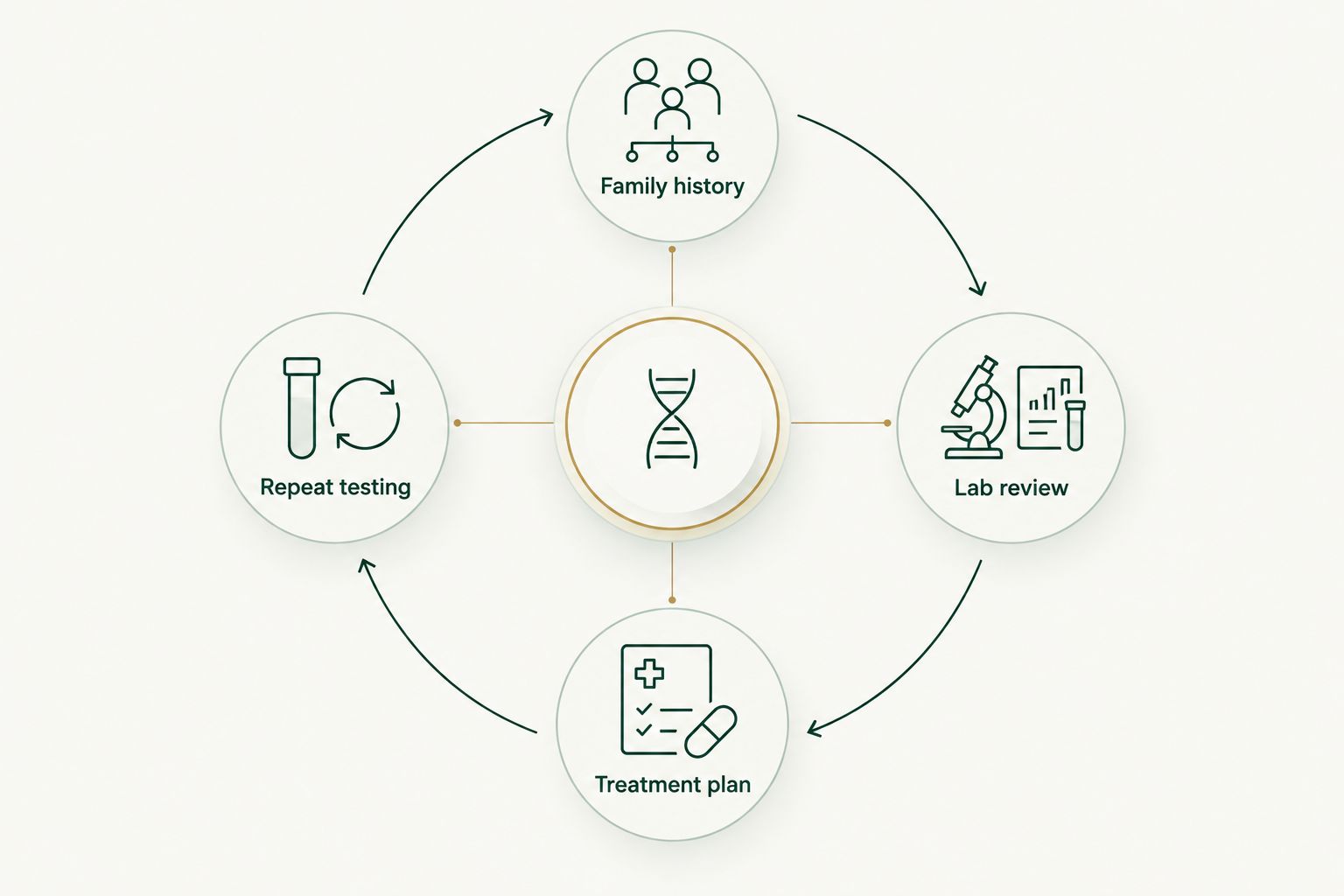
Repeat testing is useful when it checks a defined treatment plan.
Before ending the appointment, confirm the next checkpoint. You should know what is being monitored and how the result will affect care.
- Family history: update newly confirmed diagnoses or events.
- Lab review: retain reports and discuss meaningful changes.
- Treatment plan: record medication and lifestyle decisions.
- Repeat testing: confirm the timing and clinical question.
Compare ApoB testing options for your situation
The right testing route depends on whether you need an initial measurement, continuing treatment, or specialist evaluation. For a 2026 comparison, examine what each arrangement includes and where responsibility for the result sits. A standalone order and longitudinal care are different services.
| Option | Best for | Billing structure to verify | Main advantage | Key limitation |
|---|---|---|---|---|
| Existing primary care clinician | Adults with an established physician who need initial risk assessment | Visit, laboratory, collection, and results-review arrangements | Connects the result with existing medical history | ApoB ordering and coverage still require confirmation |
| Direct-purchase laboratory testing | Adults who need a measurement and already have a clinician to interpret it | Test, collection, and any separate clinician review | Separates obtaining the measurement from choosing ongoing care | A report alone does not provide a prevention plan |
| GoodLife Health Cardiometabolic Optimization | Adults seeking recurring biomarker review and integrated primary care | Membership terms, included audit cadence, and additional-lab arrangements | Includes ApoB within a recurring Biomarker Audit and clinical relationship | An ongoing membership is a broader commitment than one test |
| Lipid specialist or preventive cardiologist | Adults needing evaluation of suspected inherited lipid disorders or complex risk | Consultation, laboratory, imaging, and follow-up arrangements | Provides focused assessment of complex cardiovascular questions | Specialist care still needs coordination with primary care |
Use existing care first if it can supply both the test and a clear treatment discussion. A membership becomes relevant when you need the ongoing relationship, not simply because a biomarker sounds more advanced. Specialist assessment belongs in the comparison when the family pattern or existing findings require focused expertise.
Before committing, request the written terms and ask who reads results, who communicates recommendations, and what happens after an abnormal finding. Membership care does not replace health insurance, emergency services, or every specialist service. Compare those responsibilities explicitly rather than assuming one arrangement covers the entire cardiovascular pathway.


Common mistakes adults with familial heart disease make
Treating a relative's event as a complete diagnosis
A family story about a heart problem is a starting point, not a diagnosis. Heart attacks, arrhythmias, valve disease, and heart failure do not all indicate the same inherited risk. Record what you know and tell your physician what remains uncertain.
Get the age and diagnosis before drawing conclusions. If a parent had unexplained sudden death rather than a confirmed heart attack, that distinction deserves its own clinical discussion. ApoB testing cannot resolve every inherited cardiac concern.
Assuming normal LDL-C makes further discussion unnecessary
LDL-C remains an important measurement, but it is not identical to ApoB. Discordance between cholesterol concentration and particle burden is one reason a physician considers additional testing. Lp(a) also addresses inherited risk that a standard lipid panel does not directly measure.
Ask whether advanced testing changes the interpretation of your existing results. Do not assume a normal ApoB result cancels a documented family history either. Prevention uses the combined picture.
Buying a large panel without arranging interpretation
A broad panel can generate many results without identifying who will act on them. For someone worried about a parent's early heart attack, that creates more unanswered questions rather than a clear next step. Arrange review before purchasing the order.
Choose tests for their clinical purpose. Ask what each marker measures, what decision it supports, and whether it duplicates information already available. More measurements are not automatically better care.
Repeating inherited-risk markers as if they were progress scores
ApoB and Lp(a) serve different purposes. ApoB can help monitor changes in atherogenic particle burden during treatment; Lp(a) is largely genetically determined and usually does not need frequent repetition in a stable adult.
Ask which measurements your physician expects to change and which establish baseline risk. A fixed panel schedule does not imply that every included marker has the same monitoring role. Keep the interpretation specific to the marker.
Using a prevention test to assess active symptoms
ApoB is not a test for an acute heart attack. New chest pressure, severe shortness of breath, fainting, or other concerning symptoms require prompt medical assessment rather than waiting for preventive bloodwork.
Call emergency services for symptoms suggestive of a heart attack. Family history increases the importance of prevention, but it must never turn an urgent symptom into a routine laboratory-shopping task.
FAQ
What determines ApoB test cost when I have a family history of heart disease?
Your total expense depends on the testing route, insurance benefits, blood collection, clinician visit, and results review. Request an itemized estimate for the complete pathway rather than comparing the laboratory test alone.
Will insurance cover ApoB testing because my parent had an early heart attack?
Family history does not automatically guarantee insurance coverage for ApoB testing. Your clinician should document the indication, and you should verify the specific test, laboratory, and benefit requirements with your insurer before collection.
Is ApoB better than a regular cholesterol test for inherited heart risk?
ApoB adds information to a standard lipid panel rather than replacing it. ApoB assesses atherogenic particle burden, while LDL-C measures cholesterol carried in LDL particles; your clinician interprets both alongside family history and other risk factors.
Should I get both ApoB and Lp(a) if heart attacks run in my family?
Discuss both ApoB and Lp(a) with your clinician because they answer different risk questions. Lp(a) is largely inherited, and an ApoB measurement does not tell you whether your Lp(a) concentration is elevated.
Do I need to fast before an ApoB blood test?
ApoB testing itself generally does not require fasting. Other tests collected in the same draw can have different requirements, so follow the preparation instructions for your complete laboratory order.
What ApoB level should I aim for with a strong family history?
Your ApoB goal should reflect your overall cardiovascular risk, not family history alone or the laboratory reference interval. Existing cardiovascular disease, diabetes, other risk factors, and current treatment affect the goal your physician recommends.
How often should I repeat an ApoB test?
Repeat ApoB testing when the result will help assess treatment response or change management. Your physician sets the interval based on your risk, treatment changes, and clinical question rather than a universal schedule.
Does GoodLife Health include ApoB testing in its membership?
GoodLife Health includes ApoB in the Cardiometabolic Optimization Membership's Biomarker Audit every 90 days. Clinical care is delivered by licensed physicians of Beluga Health, P.A., under GoodLife Health's clinical protocols; additional labs outside the included cadence are billed separately at pass-through cost.
One last thing
Before paying for testing, ask who will act on the result. An ApoB measurement can clarify particle burden, but it cannot prescribe treatment, reconcile conflicting findings, or decide whether an inherited disorder needs further evaluation. Those are clinical responsibilities.
For your 2026 appointment, bring a short written brief: your family history, existing laboratory reports, current medications, and the decision you want testing to help resolve. Ask the physician to write down the next step before the conversation ends.
The strongest prevention plan is not the one with the longest test list. It is the one that connects inherited risk, current health, an appropriate intervention, and a clear follow-up decision. Start there, then choose the testing arrangement that supports it.
Related guides
- ApoB lab test: what the number means for heart risk
- Lp(a) blood test: why doctors order it for heart risk
- How to lower ApoB with diet, lifestyle, and medication
References
- Tirzepatide Once Weekly for the Treatment of Obesity (SURMOUNT-1). 2022. pubmed.ncbi.nlm.nih.gov/35658024/
- Once-Weekly Semaglutide in Adults with Overweight or Obesity (STEP 1). 2021. pubmed.ncbi.nlm.nih.gov/33567185/