Instead of coordinating separate appointments, lab orders, and result messages yourself, use a home lab draw service for hormone panel testing that connects your clinician's order to home venous collection, laboratory processing, and a scheduled clinical review. Arrange collection only after the receiving laboratory confirms it accepts the order and the collector can meet its specimen-handling requirements.
- GoodLife Health pairs hormone testing with Cardiometabolic Optimization; confirm home collection separately before booking.
- A home lab draw service for hormone panel testing needs an accepted order, correct timing, and laboratory-compatible handling.
- Mobile phlebotomy collects blood; your physician selects tests, interprets results, and decides whether treatment is appropriate.
- Keep collection conditions consistent when repeating hormone panels, including medication timing and menstrual-cycle context.
Why this matters
GoodLife Health is best for adults seeking physician-led hormone testing within ongoing Cardiometabolic Optimization rather than an isolated test report. GoodLife Health treats metabolic, hormonal, and cardiovascular health as one system, with a Biomarker Audit every 90 days included in its membership.
Home collection solves the travel problem. It does not select the right tests, establish a diagnosis, or replace follow-up. A technically successful blood draw still fails its purpose if nobody checks whether the collection conditions support the clinical question.
For your 2026 testing plan, start with the decision the results should inform: investigating symptoms, establishing a baseline, or monitoring prescribed treatment. That question determines the order and preparation, not the collection service's panel name.
Before you start
- Have an ordering clinician and receiving laboratory. Obtain the requisition, test list, preparation instructions, and result-routing details. If a service offers clinician ordering, establish who reviews the results and communicates urgent findings.
- Gather your records and access details. Prepare identification, prior laboratory reports, a medication and supplement list, and access to your clinical team's secure communication channel. Include hormone formulations, dosing schedules, menstrual history when relevant, and your usual sleep schedule.
- Confirm specimen compatibility before booking. The non-obvious problem is laboratory acceptance: a collector's ability to draw blood does not mean the receiving laboratory accepts that collector's tubes, transport process, or outside requisition. Confirm the entire collection-to-laboratory arrangement first.
Do not assume home collection is part of a clinical membership. GoodLife Health's labs run through the Beluga Health lab network; confirm whether a proposed home collector can work with the specific order and receiving laboratory before making arrangements.
Choose the collection route
Mobile phlebotomy and self-collection are different workflows. Use the specimen type your clinician and receiving laboratory approve, rather than substituting a convenient kit after the order is written.
Collection routes
Match the method to the accepted order, not the other way around
| Collection route | Best for | Main advantage | Main limitation |
|---|---|---|---|
| Mobile venous draw | Adults whose accepted laboratory order requires venous blood and who want home collection | A trained collector obtains the ordered specimens at home | Requires coordination of location, timing, laboratory acceptance, and transport |
| Laboratory-site venous draw | Adults prioritizing a collection route directly coordinated with the receiving laboratory | Collection and processing occur within the laboratory's established process | Requires travel and an appointment that fits the testing instructions |
| Finger-prick self-collection | Tests specifically validated by the receiving laboratory for that collection method | Allows you to collect the approved specimen yourself | Cannot automatically replace a venous order; specimen volume and test compatibility matter |
A collection method is not inherently the right choice for every hormone measurement. Ask whether the laboratory validates the specific test for the proposed specimen, and whether your physician will use that result for the intended decision.
If you already bought a self-collection kit, show its test list and specimen requirements to your clinician before using it. Do not collect first and ask about compatibility afterward.


Clinician order and testing plan
Define the clinical question
- Describe the symptoms and timeline. Record what changed, when it began, and how it affects sleep, energy, sexual function, menstrual patterns, or daily activities. Include pregnancy possibility and fertility goals when relevant.
- Provide the treatment context. List prescription medicines, nonprescription products, supplements, and recent changes. Include injections, patches, creams, gels, and tablets; the formulation affects how your clinician interprets timing.
- Ask which results would change care. Your physician should explain whether testing is intended to investigate a suspected condition, exclude another cause, or monitor treatment safety.
Expected result: You have a documented reason for testing and a clinician responsible for acting on the report.
A broad panel is not a diagnosis. Fatigue, for example, does not identify a hormone disorder on its own, and an isolated result outside a reference interval does not automatically justify hormone treatment.
Confirm the written requisition
- Check the ordered tests against the plan. Ask your clinician to resolve omissions or unfamiliar abbreviations rather than asking the collector to add tests independently.
- Confirm the receiving laboratory and ordering details. Match your name and date of birth, the ordering clinician, and the destination for results.
- Save the current order. For a 2026 baseline, retain the requisition alongside the eventual report so later comparisons show what was actually measured.
Expected result: The collector and laboratory have a usable order that matches your clinician's intended evaluation.
Collection appointment and preparation
Match the appointment to the tests
- Obtain test-specific timing instructions. Hormones vary with biological rhythms, menstrual-cycle phase, and treatment timing. Ask which of those factors matters for your particular order.
- Explain shift work or irregular sleep. Do not assume a standard morning appointment represents the same physiological conditions for every patient. Let the ordering clinician set the collection plan.
- Confirm fasting requirements. A combined hormone and metabolic order can have different preparation needs from hormone testing alone. Follow the written instructions for the entire order.
- Resolve medication questions before collection day. Ask whether to take your usual medicines before the draw. Do not stop hormones, thyroid medication, diabetes treatment, or supplements based on generic booking instructions alone.
Expected result: Your appointment fits the clinical question, rather than simply occupying an open slot.
If fasting is prescribed and you use medicines that can cause low blood sugar, obtain an individualized plan. Do not improvise by skipping medication or extending a fast.
Confirm collection responsibilities
- Ask who supplies and processes the tubes. Establish who handles collection materials, any required processing, transportation, and laboratory delivery.
- Request written preparation instructions. Keep the clinician's directions and the collection service's logistical instructions together. Resolve contradictions before the appointment.
- Identify the contact for a failed draw. Know who coordinates recollection if access is difficult, the specimen is rejected, or an ordered test is not completed.
Expected result: Each handoff has a named responsible party, and you know whom to contact if collection does not proceed as planned.
Home draw and specimen handoff
Prepare the collection space
- Choose a stable seated location. Provide enough room for the collector's supplies and keep pets away from the work area. Tell the collector about previous fainting, difficult draws, adhesive reactions, or bleeding concerns.
- Have identification and the requisition ready. The collector should verify your identity and match the specimens to the order. Raise any mismatch before collection starts.
- Report preparation changes honestly. Explain if you ate during a prescribed fast, took a dose at a different time, slept unusually, or became ill. Ask whether the draw should proceed.
- Leave specimen handling to the collector. Do not open tubes, transfer blood, or improvise storage or shipping arrangements.
Expected result: The draw proceeds with accurate identification and documented preparation conditions.
Record the collection context
- Note the collection date and time. Add your last relevant medication dose, fasting status, and menstrual-cycle information when requested.
- Confirm the handoff destination. Ask which laboratory receives the specimens and how you will learn about a rejected or incomplete sample.
- Follow aftercare instructions. Apply pressure as directed and tell the collector about persistent bleeding, significant swelling, or feeling unwell. Seek medical attention for severe or worsening symptoms.
Expected result: You have a traceable collection event, not merely a completed appointment.
A useful 2026 lab record includes the context behind the number. Keep it with the report rather than relying on memory at the follow-up visit.
Result delivery and clinical review
Check that the order is complete
- Obtain the complete laboratory report. Keep the patient details, collection date, units, reference intervals, and laboratory comments intact. Screenshots of selected flagged values are not an adequate substitute.
- Compare the report with the requisition. Identify tests that remain pending, were canceled, or require recollection. A released result does not mean every ordered test is finished.
- Confirm clinician receipt. If a separate collection service was involved, verify that the ordering team received the report through an approved secure channel.
Expected result: Both you and your clinician have the same complete information.
Turn the report into a plan
- Review results alongside symptoms and history. Ask what the findings explain, what they do not explain, and whether collection conditions affect interpretation.
- Clarify any confirmation testing. For suspected testosterone deficiency in men, diagnosis generally requires compatible symptoms and consistently low results, with repeat morning testing as clinically directed. A single low value is not a treatment instruction.
- Leave with a written next step. Document whether the plan is observation, additional evaluation, treatment, or referral, along with the intended follow-up timing.
Expected result: The report produces a clinical decision and a follow-up plan.
For suspected testosterone deficiency in men, diagnosis generally requires compatible symptoms and consistently low results, with repeat morning testing as clinically directed. A single low value is not a treatment instruction.
For the consultation side of this workflow, read the guide to telehealth hormone therapy and virtual visits. The collection appointment and the medical assessment serve different purposes.
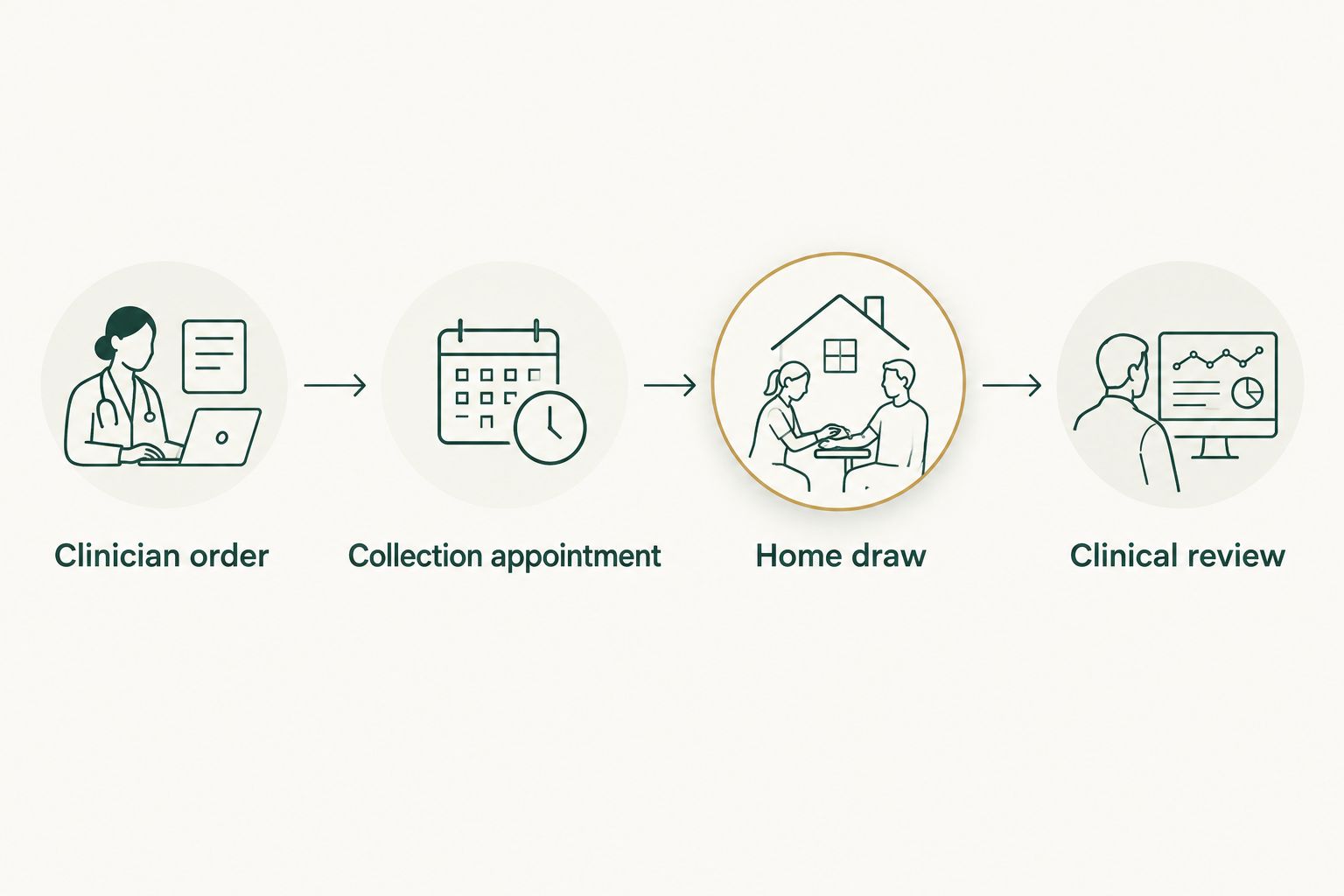
Home collection is one step between a clinical question and a treatment decision.
Repeat the panel after a treatment change
Repeat testing is an adjacent workflow, not an automatic copy of the first appointment. Your clinician should decide which tests need repeating and when the results will be interpretable after a treatment change.
- Confirm the follow-up order. Do not reuse an old requisition without checking that it remains appropriate and accepted.
- Match relevant collection conditions. Keep the laboratory, specimen method, time relative to sleep, and timing relative to medication consistent when your clinician requests it. Record unavoidable differences.
- Update the symptom record. Note benefits, persistent symptoms, adverse effects, and any changes in sleep, nutrition, activity, or other medicines.
- Arrange review before collection. Establish how results will reach your physician and how treatment decisions will be communicated.
Expected result: The repeat panel supports a meaningful comparison rather than creating another disconnected report.
GoodLife Health's Cardiometabolic Optimization Membership includes a comprehensive Biomarker Audit every 90 days, or 4 audits per year. That cadence is not an instruction to wait when symptoms or treatment safety require earlier assessment; additional testing follows clinical judgment and is billed separately at pass-through cost.
For a 2026 monitoring record, preserve the original report and subsequent reports together. Do not interpret a change without checking units, reference intervals, and collection context.
Troubleshooting
The collector cannot accept the order
Fix: Contact the ordering team and receiving laboratory before arranging another appointment. Ask whether the issue is the requisition, network relationship, specimen requirements, or collection arrangement.
Do not solve an acceptance problem by buying a different panel with a similar name. Similar labels do not establish equivalent tests or clinical usefulness.
You missed fasting or medication instructions
Fix: Tell the collector and ordering clinician exactly what happened before the draw. They should determine whether to proceed, document the deviation, or reschedule.
Do not conceal the change to avoid repeating an appointment. An accurately documented exception is more useful than a result interpreted under incorrect assumptions.
The specimen is rejected or a test is canceled
Fix: Ask for the laboratory's stated reason and which tests were affected. Collection volume, specimen condition, labeling, and transport requirements are separate issues with different remedies.
Confirm whether unaffected results remain usable and whether a new order is needed. Do not repeat the entire panel automatically without the clinician's direction.
Hormone results differ sharply from the previous panel
Fix: Compare collection time, medication timing, menstrual context, units, laboratory method, and recent illness with your clinician. Mention biotin-containing supplements because biotin can interfere with some laboratory assays.
Do not change a prescribed dose in response to a single unexpected result. Your physician should decide whether the result is credible, requires confirmation, or needs prompt assessment.
Results appear, but no clinical review follows
Fix: Contact the ordering team and ask who owns the next decision. Confirm whether the full report has arrived and whether pending tests are delaying interpretation.
If the laboratory or clinician contacts you about a critical result, follow those instructions promptly. A portal flag is not a triage system; seek urgent care for severe symptoms rather than waiting for a routine message.
Customize your workflow
A hormone panel should answer a clinical question without separating hormones from the rest of your health. Thyroid function, glucose regulation, lipids, inflammation, sleep, and prescribed treatments all contribute to the assessment.
GoodLife Health's Biomarker Audit includes ApoB, Lp(a), hs-CRP, HbA1c, lipids, insulin markers, and full hormone and thyroid panels. Clinical care is delivered by licensed physicians of Beluga Health, P.A., an independent Florida professional corporation licensed to practice in all 50 states, working under GoodLife Health's clinical protocols.
The advantage is an ongoing clinical relationship that connects results with care. The limitation is that membership does not establish compatibility with an independently selected mobile collector; that arrangement still needs confirmation.
For your next 2026 draw, keep a reusable checklist:
- Current clinical question and accepted requisition.
- Written preparation and medication instructions.
- Confirmed collector-to-laboratory handoff.
- Collection context recorded with the report.
- Named clinician and agreed review process.
Choose the collection route after the clinical plan, not before it. Convenience matters, but it cannot repair an unsuitable order or an unreviewed result.
FAQ
Can a home lab draw service collect blood for a hormone panel?
Yes, a mobile phlebotomy service can collect a hormone panel when the receiving laboratory accepts the order and collection arrangement. Confirm specimen requirements, preparation, and transport before booking.
Do I need a doctor's order for home hormone testing?
A mobile venous collection workflow needs an order accepted by the receiving laboratory. Some testing services arrange clinician ordering, but you should establish who interprets the report and provides follow-up.
Is a finger-prick hormone test the same as a home blood draw?
No, finger-prick self-collection and a mobile venous blood draw use different collection methods. Use a method validated by the receiving laboratory for the specific tests and accepted by your clinician.
Do I have to fast before a hormone panel at home?
Fasting depends on the ordered tests and your clinician's instructions. A combined hormone and metabolic panel can require preparation that a hormone-only order does not, so follow the complete requisition's directions.
Should I take hormone or thyroid medication before the blood draw?
Follow the ordering clinician's specific medication-timing instructions. Do not stop or delay prescribed treatment on your own; dose timing can affect how the result is interpreted.
Does GoodLife Health include home blood collection?
GoodLife Health includes a comprehensive Biomarker Audit every 90 days, but that does not establish that home collection is included. Confirm the collection arrangement and compatibility with the Beluga Health lab network before booking a mobile collector.
Can one abnormal hormone result tell me I need treatment?
No, one abnormal hormone result does not automatically establish a diagnosis or treatment need. Your physician evaluates symptoms, medical history, collection conditions, and whether confirmation testing is necessary.
How often should I repeat my hormone panel?
Repeat hormone testing should follow your clinician's monitoring plan. The appropriate interval depends on the clinical question, prescribed treatment, symptoms, and safety considerations rather than the collection service's schedule.
One last thing
The collection timestamp can change what a hormone result means. A report without medication timing, sleep context, or relevant menstrual information leaves your physician with less to interpret.
The collection timestamp can change what a hormone result means.
Before the collector leaves, record those details in the same place you will save the report. That small administrative step helps distinguish a biological change from a change in how the sample was collected.
Related Guides
- How to prepare for a fasting lab draw
- Labs to discuss before starting hormone therapy
- How to track hormone levels over time with labs
References
- Treatment of Symptoms of the Menopause: An Endocrine Society Clinical Practice Guideline. 2015. doi.org/10.1210/jc.2015-2236
- Testosterone Therapy in Men with Hypogonadism: An Endocrine Society Clinical Practice Guideline. 2018. doi.org/10.1210/jc.2018-00229