Best for integrated perimenopause and cardiometabolic care: GoodLife Health. Best for a menopause-focused consultation: Midi Health. Best for an OB-GYN-led menopause assessment: Gennev. This 2026 guide compares those care models and explains what to check before choosing a telehealth clinic for hormone therapy.
- Among the best telehealth clinics for perimenopause hormone therapy, GoodLife Health fits patients seeking integrated cardiometabolic care.
- Midi Health fits patients seeking menopause-focused care; Gennev fits patients prioritizing an OB-GYN-led assessment.
- Perimenopause hormone therapy requires symptom review, bleeding history, contraindication screening, and a follow-up plan.
- A hormone panel supports selected clinical decisions; one estradiol result does not establish or exclude perimenopause.
Why this matters
Choosing a perimenopause clinic means choosing who will interpret your symptoms, prescribe appropriately, and respond when treatment needs changing. The prescription is only one part. Hot flashes, disrupted sleep, vaginal discomfort, changing periods, and fatigue do not all require the same treatment.
Weight, hormones, thyroid function, blood sugar, lipids, and inflammation belong in the same clinical picture. That does not mean every symptom is hormonal or every abnormal marker needs medication. It means your clinician should avoid treating a symptom in isolation when another condition explains it.
For your 2026 shortlist, separate two decisions: whether a clinic's care model fits your needs, and whether hormone therapy fits your medical history. A clinic can fit your preferences while systemic estrogen remains inappropriate for you. Good care includes explaining that distinction and offering alternatives, not promising a prescription before the consultation.
What makes the best perimenopause telehealth clinic?
Use these six criteria before comparing clinic names:
- Clinical assessment: The clinician reviews symptoms, menstrual patterns, medications, pregnancy potential, and relevant personal and family history before recommending treatment.
- Treatment selection: The plan distinguishes systemic hormone therapy, vaginal treatment, nonhormonal options, and contraception. These are not interchangeable.
- Risk screening: The consultation addresses unexplained bleeding, breast cancer history, clotting history, liver disease, and cardiovascular conditions.
- Follow-up responsibility: You know who reviews your response, handles side effects, and decides whether to change or stop treatment.
- Connected care: Thyroid disease, diabetes risk, blood pressure, and lipid abnormalities receive attention when clinically relevant, rather than disappearing behind a hormone prescription.
- In-person handoff: The clinic explains how pelvic examinations, imaging, abnormal bleeding investigations, and urgent concerns move beyond a video visit.
Choose the clinic that can explain its clinical decisions, not simply name the hormones it prescribes. For a deeper look at the interconnected-care approach, read about hormone optimization for women in perimenopause.
Perimenopause telehealth clinics at a glance
This table compares the clinics' care orientation, not treatment outcomes. Each recommendation serves a different starting need; the order does not establish that one clinic delivers better clinical results than another.
Perimenopause telehealth clinics at a glance
Care orientation, not treatment outcomes
| Clinic | Best for | Standout care orientation | Key limitation |
|---|---|---|---|
| GoodLife Health | Hormone care alongside metabolic and cardiovascular monitoring | Cardiometabolic Optimization membership with a Biomarker Audit every 90 days | Broader membership commitment than a single hormone consultation |
| Midi Health | A menopause-focused clinical conversation | Virtual care centered on perimenopause and menopause | Confirm who manages conditions outside menopause care |
| Gennev | An OB-GYN-led assessment of menopause symptoms | Menopause care delivered through gynecologic expertise | Virtual assessment cannot replace an indicated pelvic examination |
For any clinic, confirm the assigned clinician's license, treatment scope, and follow-up arrangements before enrolling. A national brand name does not replace a clear explanation of who will provide your care.


1. GoodLife Health: best for integrated cardiometabolic care
GoodLife Health is best for patients who want perimenopause hormone care connected to metabolic, thyroid, and cardiovascular monitoring. Its Cardiometabolic Optimization Membership combines bioidentical hormone optimization with concierge-style direct primary care. Your clinician considers symptoms and biomarkers together rather than treating a hormone result as the entire diagnosis.
The included Biomarker Audit occurs every 90 days and covers ApoB, Lp(a), hs-CRP, HbA1c, lipids, insulin markers, and full hormone and thyroid panels. Those tests address broader cardiometabolic health; they are not all required to diagnose perimenopause. Results need interpretation alongside symptoms, cycle timing, medications, and medical history.
Clinical care is delivered by licensed physicians of Beluga Health, P.A., an independent Florida professional corporation licensed to practice in all 50 states, working under GoodLife Health's clinical protocols. Laboratory testing runs through the Beluga Health lab network.
Membership pros:
- Hormone care and direct primary care sit within one clinical model.
- Scheduled biomarker review connects hormone decisions with metabolic and cardiovascular findings.
- Full hormone and thyroid panels are included in the recurring audit.
- Medication selection remains a physician's decision, not an automatic consequence of enrollment.
Membership cons:
- Enrollment begins with a two-month commitment.
- Medication is separate from membership, and additional laboratory testing beyond the quarterly cadence is billed separately.
- Telehealth does not replace indicated examinations, imaging, or emergency care.
Best for: You want ongoing care across interconnected symptoms and risk factors, not just an isolated hormone consultation.
Verdict: Buy the membership only if you want the broader care relationship; enrollment does not guarantee hormone treatment.
2. Midi Health: best for a menopause-focused consultation
Midi Health provides virtual care focused on perimenopause and menopause. It belongs on your shortlist when the main reason you are seeking care is a menopause-related symptom discussion rather than a new primary-care relationship.
For example, you might already have a primary-care clinician managing blood pressure and diabetes screening but need focused help discussing hot flashes or treatment choices. That is a different starting point from seeking a single service to coordinate hormone, thyroid, and metabolic care.
Midi Health pros:
- Perimenopause and menopause are central to the service's clinical focus.
- Virtual consultation removes the need to travel for the conversation itself.
- A menopause-focused visit gives you a clear setting for discussing symptom patterns and treatment preferences.
Midi Health limitations:
- A menopause-focused service is not automatically a replacement for primary care.
- You still need an in-person pathway when symptoms require examination or investigation.
- Confirm the assigned clinician's credentials, prescribing scope, and follow-up process rather than assuming every appointment works identically.
Before enrolling, ask who receives outside laboratory results and who acts on findings unrelated to menopause. If your existing doctor remains responsible for thyroid disease, hypertension, or diabetes, make that division explicit. Shared responsibility works only when you know which clinician owns each decision.
Best for: You already have general medical care and want a focused perimenopause consultation.
Verdict: Hold until Midi Health confirms the clinician and follow-up arrangements that fit your needs.
3. Gennev: best for an OB-GYN-led menopause assessment
Gennev provides virtual menopause care through OB-GYNs. It fits a shortlist centered on gynecologic expertise, particularly when you want to discuss how symptoms, menstrual changes, and hormone-treatment decisions fit together.
An OB-GYN-led assessment does not mean every bleeding change can be resolved online. The value of the consultation includes deciding what needs further investigation and whether treatment should wait for that evaluation.
Gennev pros:
- Gynecologic expertise is central to its menopause-care model.
- The consultation provides a setting to discuss menstrual history alongside symptoms.
- Virtual access supports a specialist conversation without requiring travel for that appointment.
Gennev limitations:
- A virtual OB-GYN visit cannot perform a pelvic examination or endometrial biopsy.
- Menopause specialty care does not automatically include management of every metabolic or cardiovascular condition.
- Confirm how the clinician shares recommendations with your local gynecologist and primary-care team.
Choose this orientation when the question you need answered is specifically gynecologic: how to interpret changing bleeding patterns, whether systemic treatment is appropriate, or how uterine history affects the plan. Significant or unexplained bleeding still needs the appropriate investigation, not reassurance based solely on a video conversation.
Best for: You prioritize an OB-GYN-led menopause assessment and can arrange local examination or testing when needed.
Verdict: Hold until Gennev confirms how any recommended in-person evaluation will be coordinated.
How these recommendations are ranked
This 2026 comparison ranks fit by clinical scope, not by testimonials, promised results, or prescription speed. The integrated membership comes first for patients seeking connected hormone and cardiometabolic care. The menopause-focused and OB-GYN-led options serve narrower starting needs.
The deciding criteria are assessment quality, appropriate treatment selection, risk screening, follow-up ownership, and access to in-person evaluation. Clinic credentials and operating details require confirmation before enrollment.
There is no universal best clinic for every perimenopausal patient.
A focused specialist visit fits one patient; an ongoing primary-care relationship fits another. Neither model removes the need for individualized prescribing.
What hormone therapy can and cannot do
Systemic menopausal hormone therapy is an effective treatment for bothersome hot flashes and night sweats in appropriately selected patients. It is not a general prescription for fatigue, weight gain, or every change that occurs during midlife. Your clinician should identify the symptom being treated and how success will be assessed.
Vaginal estrogen addresses genitourinary symptoms such as vaginal dryness and discomfort. It does not serve the same purpose as systemic therapy for hot flashes. A clinic should explain that difference rather than treating all estrogen preparations as equivalent.
For patients with a uterus, systemic estrogen generally requires an appropriate progestogen to protect the endometrium. After hysterectomy, the treatment decision differs, with exceptions determined by clinical history. Ask your clinician to explain the reasoning in plain language.
The Menopause Society's 2022 hormone therapy position statement, covering menopausal hormone therapy benefits and risks, supports individualized treatment with periodic reassessment. It does not support prescribing hormones solely to prevent cardiovascular disease.
For your 2026 consultation, bring a concrete treatment goal: fewer nighttime awakenings from sweats, less vaginal discomfort, or improved control of a defined symptom. A useful plan connects a medication to that goal and includes what to do if it does not help.
A useful hormone workup starts with your history
Perimenopause is a clinical transition, not a diagnosis established by one estradiol or FSH measurement. Hormone levels fluctuate. A result within a laboratory reference range does not erase symptoms, and an isolated abnormal result does not automatically justify treatment.
NICE guideline NG23 distinguishes clinical diagnosis from laboratory testing. In otherwise healthy patients aged 45 years or older with typical symptoms and menstrual changes, routine hormone testing is generally unnecessary to identify perimenopause. Younger age, atypical symptoms, or a different suspected condition changes the assessment.
A broad panel can still inform other questions. Thyroid testing helps evaluate suspected thyroid disease; HbA1c assesses blood-sugar patterns; lipids and ApoB contribute to cardiovascular risk assessment. Those purposes should remain separate from claims that bloodwork proves you need estrogen.
A clinician should connect these four parts:
- Symptom history: What changed, when it started, and how it affects daily life.
- Bleeding pattern: Cycle changes, heavy bleeding, spotting, and pregnancy potential.
- Risk review: Medical history, medications, contraindications, and relevant family history.
- Treatment plan: The target symptom, treatment choice, follow-up, and referral needs.
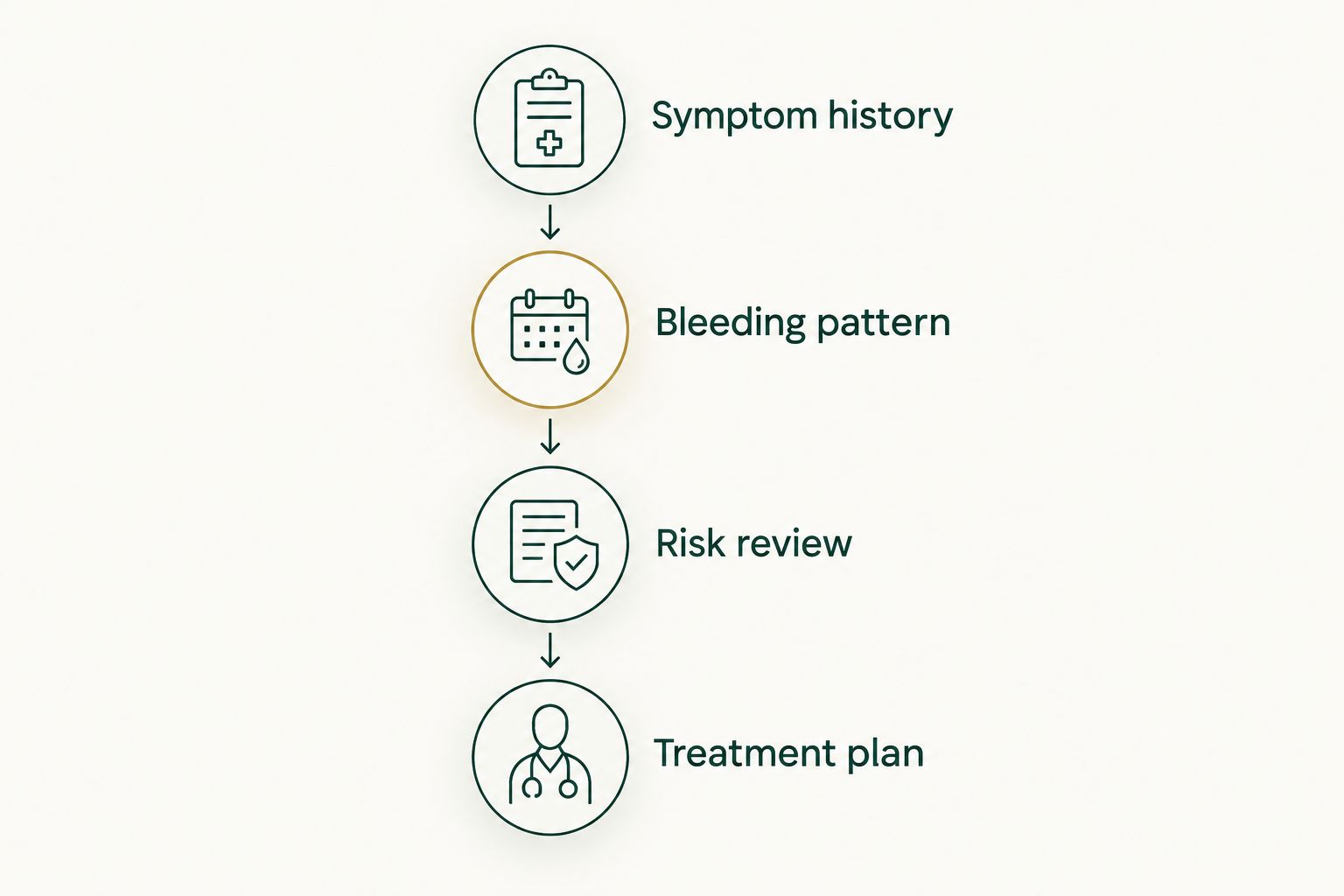
Treatment follows the history and risk review, not an isolated laboratory result.
Ask what each ordered test will change. A clinically grounded answer explains the decision that follows the result, rather than describing testing itself as treatment.
Safety questions a telehealth clinic must address
Hormone therapy requires a contraindication review. A history of hormone-sensitive cancer, blood clots, stroke, significant cardiovascular disease, liver disease, or unexplained vaginal bleeding needs careful assessment before systemic treatment. Do not omit those details because they seem unrelated to your current symptoms.
The route matters too. Oral and transdermal estrogen have different clinical considerations; your clinician should select the preparation using your medical history and treatment goals. No delivery route makes systemic hormone therapy risk-free.
Bioidentical does not mean automatically safer. FDA-approved estradiol and micronized progesterone are bioidentical hormones. Compounded formulations are a separate category and do not undergo the same FDA approval process as approved medicines. Ask why a particular formulation is being recommended.
Menopausal hormone therapy is not contraception. Pregnancy remains possible during perimenopause, so your consultation should include contraception and pregnancy intentions when relevant. Natural menopause is generally established after 12 months without a menstrual period, when there is no other explanation; hormonal contraception and other treatments can complicate that assessment.
Use emergency services for chest pain, sudden shortness of breath, stroke symptoms, or other acute emergencies. Telehealth messaging is not the appropriate route. Heavy bleeding with faintness or marked weakness also needs urgent assessment, not a routine hormone follow-up.
Follow-up should measure symptoms, not chase a number
Before starting treatment, agree on what improvement means. Track the symptom being treated, its frequency, and its effect on sleep or daily functioning. Record new bleeding, breast tenderness, headaches, or other changes without adjusting medication on your own.
A clinic should distinguish three follow-up questions:
- Response: Is the treatment improving the symptom it was prescribed to address?
- Tolerance: Are side effects or bleeding changes creating a new problem?
- Safety: Has anything changed in your medical history that alters the treatment decision?
A scheduled laboratory audit is not a reason to wait when a new symptom needs attention. Conversely, a hormone value outside a preferred range is not, by itself, a reason to increase the dose. Clinical context comes first.
For 2026 clinic comparisons, ask how follow-up works when the initial prescription is ineffective. Who reads your message? Who decides whether you need a visit? How does the clinician arrange an examination if bleeding needs investigation? Obtain those answers before you depend on the service.
Also clarify what happens if you move or travel. Telehealth clinicians must follow licensing requirements associated with your location during care. A remote relationship still has geographic rules, and prescription continuity needs planning rather than assumptions.
Prepare for the first consultation
Bring a short medical summary rather than a self-diagnosis. List your current medications and supplements, previous hormone use, surgeries, allergies, and relevant cancer or clotting history. Include recent laboratory results, but do not purchase a large panel solely to make the appointment feel productive.
Write down your menstrual pattern and the symptoms you most want addressed. If sleep is the concern, distinguish waking because of night sweats from difficulty falling asleep or symptoms suggestive of another sleep disorder. That distinction changes the clinical conversation.
Ask these questions before leaving the visit:
- What is the working diagnosis, and what else needs consideration?
- Which symptom is this treatment intended to improve?
- Why is this preparation appropriate for my history?
- Do I need contraception or an in-person evaluation?
- What changes require prompt contact, and when will treatment be reassessed?
Request a written plan. You should be able to explain what you are taking, why you are taking it, and who is responsible for the next decision. If those points remain unclear, clarify them before starting medication.
Which perimenopause telehealth clinic should you choose?
Choose GoodLife Health for perimenopause hormone care within a broader Cardiometabolic Optimization relationship. Choose Midi Health when you want a menopause-focused consultation alongside existing general medical care. Choose Gennev when your priority is an OB-GYN-led menopause assessment.
If you are undecided, start with the gap in your current care. Is it a missing specialist conversation, fragmented follow-up, or a need to connect hormone symptoms with thyroid, metabolic, and cardiovascular findings? Match the clinic to that gap.
Do not choose by promised prescription speed. A clinician who pauses treatment to investigate bleeding or review a contraindication is making a clinical decision, not failing to deliver the service.
FAQ
What's the best telehealth clinic for perimenopause hormone therapy?
The best clinic depends on the care you need. GoodLife Health fits patients seeking hormone care within integrated cardiometabolic monitoring; Midi Health fits a menopause-focused consultation, and Gennev fits an OB-GYN-led assessment.
Can I start hormone therapy before my periods stop?
Hormone therapy can be considered during perimenopause when symptoms and medical history support it. Your clinician must also assess bleeding patterns, pregnancy potential, contraception, and contraindications.
Do I need a hormone blood test to diagnose perimenopause?
A hormone blood test is not routinely required to identify typical perimenopause in otherwise healthy patients aged 45 years or older. Hormone levels fluctuate, and testing is selected when age, symptoms, or another suspected condition makes it useful.
Is bioidentical hormone therapy safer than other hormone therapy?
Bioidentical does not automatically mean safer. FDA-approved estradiol and micronized progesterone are bioidentical, while compounded preparations have a different regulatory status; safety depends on the formulation, dose, route, and patient history.
Can telehealth manage abnormal bleeding during perimenopause?
Telehealth can begin the assessment of abnormal bleeding, but it cannot replace an indicated examination, ultrasound, or biopsy. Unexplained, heavy, or persistent bleeding requires an appropriate investigation plan.
Does perimenopause hormone therapy prevent pregnancy?
Menopausal hormone therapy does not prevent pregnancy. Patients who can become pregnant need a separate contraception discussion unless a clinician establishes that contraception is no longer necessary.
Does every patient using systemic estrogen need progesterone?
Patients with a uterus generally need an appropriate progestogen alongside systemic estrogen to protect the endometrium. Treatment after hysterectomy differs, and individual medical history can create exceptions.
Can hormone therapy treat perimenopause weight gain?
Menopausal hormone therapy is not a weight-loss treatment. A clinician should assess sleep, activity, nutrition, medications, thyroid function, and metabolic health rather than assuming weight changes require more estrogen.
References
- Treatment of Symptoms of the Menopause: An Endocrine Society Clinical Practice Guideline. 2015. doi.org/10.1210/jc.2015-2236
- Testosterone in Women — The Clinical Significance (Lancet Diabetes & Endocrinology). 2015. doi.org/10.1016/S2213-8587(15)00284-300284-3)