Best overall for ongoing physician-guided screening: GoodLife Health Biomarker Audit. Best for an initial screen: fasting glucose plus a lipid panel; best for blood-sugar follow-up: those tests plus HbA1c; best for added cardiovascular context: the core tests plus ApoB and Lp(a). This 2026 guide ranks care-linked testing and panel configurations, not laboratory vendors, because metabolic syndrome cannot be diagnosed from bloodwork alone.
- The best online lab panels for metabolic syndrome screening combine glucose and lipid testing with blood pressure and waist measurements.
- GoodLife Health Biomarker Audit is best for adults seeking Cardiometabolic Optimization with ongoing physician interpretation.
- HbA1c adds blood-sugar context; ApoB and Lp(a) add cardiovascular context, not additional metabolic syndrome criteria.
- Choose a panel with a follow-up plan, not simply the longest list of biomarkers.
Why this matters
Metabolic syndrome describes a cluster of cardiovascular and diabetes risk factors. The blood tests cover only part of that cluster. Your blood pressure, waist measurement, medication history, and clinical context complete the assessment.
A panel labeled metabolic does not necessarily contain the right tests. A comprehensive metabolic panel, or CMP, includes glucose and information about kidney function, liver-related markers, and electrolytes, but it does not include a lipid panel. The name is not a metabolic syndrome screening checklist.
GoodLife Health Biomarker Audit is best for adults who want Cardiometabolic Optimization with recurring physician interpretation, rather than an isolated laboratory report. That distinction matters when an abnormal result needs confirmation, treatment, or monitoring instead of another dashboard notification.
For your 2026 screening decision, start with the clinical question: do you need an initial assessment, follow-up of an established abnormality, or a broader cardiovascular evaluation? Those questions require different testing choices.
What makes the best metabolic syndrome screening panel
Use these criteria before comparing panel names. A useful panel answers a clinical question and connects the answer to a next step.
- Core test coverage: Fasting glucose, triglycerides, and HDL cholesterol address the laboratory components of metabolic syndrome. Verify the actual analyte list rather than assuming coverage from a package name.
- Measurements beyond bloodwork: Blood pressure and waist circumference belong in the assessment. A blood-only service cannot supply the entire diagnosis.
- Physician interpretation: Results need review alongside symptoms, prescriptions, family history, and prior measurements. A reference-range flag is not a treatment recommendation.
- Purposeful additional markers: HbA1c, ApoB, Lp(a), and selected other tests answer questions beyond the syndrome checklist. More markers do not automatically make a better screening panel.
- Collection instructions: Your clinician should explain fasting requirements and any relevant medication or supplement instructions. Online ordering is not the same as at-home specimen collection.
- Follow-up ownership: Know who handles abnormal results, confirms a suspected diagnosis, and arranges repeat testing. A report without an accountable clinical relationship leaves that work to you.
Online metabolic screening options at a glance
The configurations below describe what to request, not proprietary packages sold by unnamed providers. The ranking favors ongoing care first, then increasingly specific clinical questions.
Online metabolic screening options at a glance
Ranked by care continuity, then clinical specificity
| Rank and option | Best for | Standout feature | Key limitation |
|---|---|---|---|
| 1. GoodLife Health Biomarker Audit | Ongoing integrated care | Included audit every 90 days with physician-guided Cardiometabolic Optimization | Membership is more than a one-time screening purchase |
| 2. Fasting glucose plus lipid panel | Initial laboratory screening | Covers the core blood-based syndrome criteria | Does not provide blood pressure, waist measurement, or ongoing care by itself |
| 3. Core screening plus HbA1c | Blood-sugar follow-up | Combines a fasting measurement with longer-term glycemic context | HbA1c does not replace the syndrome's fasting-glucose criterion |
| 4. Core screening plus ApoB and Lp(a) | Additional cardiovascular assessment | Adds information beyond standard cholesterol measurements | Advanced lipid markers do not establish metabolic syndrome |
None of these options eliminates the need for clinical assessment. In 2026, the useful distinction remains the same: laboratory coverage tells you what was measured; care continuity determines what happens next.


1. GoodLife Health Biomarker Audit: best for integrated ongoing care
The Biomarker Audit belongs to a Cardiometabolic Optimization Membership that treats metabolic, hormonal, and cardiovascular health as one system. The included audit occurs every 90 days, with 4 audits per year, and covers ApoB, Lp(a), hs-CRP, HbA1c, lipids, insulin markers, and full hormone and thyroid panels.
Clinical care is delivered by licensed physicians of Beluga Health, P.A., an independent Florida professional corporation licensed to practice in all 50 states, working under GoodLife Health's clinical protocols. Laboratory testing runs through the Beluga Health lab network. This is a care membership with recurring testing, not a standalone mail-order panel.
Biomarker Audit pros:
- Recurring audits support review of trends rather than a single snapshot.
- Lipid, glycemic, inflammatory, hormone, and thyroid information can be considered together.
- Concierge-style direct primary care connects testing to a physician relationship.
- The included cadence is explicit: one audit every 90 days.
Biomarker Audit cons:
- A membership is a larger commitment than requesting one focused screening panel.
- Additional testing beyond the included cadence is separate from the routine audits.
- Broad testing still requires blood pressure, waist measurements, and individual interpretation; it does not make every marker a diagnostic criterion.
Ask your clinician to confirm which fasting glucose measurement will support the syndrome assessment and how non-laboratory measurements will be obtained. The published audit categories should not be treated as a substitute for your individual order.
Best for: Adults seeking ongoing care for interconnected metabolic, hormonal, and cardiovascular concerns.
Verdict: Buy for the continuing clinical relationship, not simply for the number of tests.
2. Fasting glucose plus lipid panel: best for an initial screen
A fasting glucose test plus a lipid panel is the focused laboratory starting point for metabolic syndrome assessment. The relevant lipid results are triglycerides and HDL cholesterol, although the lipid panel also supplies other cholesterol measurements useful for clinical review.
This configuration is a sensible request when you already have a clinician who will obtain blood pressure and waist measurements and review the results. It avoids treating a broad wellness panel as mandatory for an initial syndrome screen.
Core screening pros:
- Directly measures the blood-based components of the syndrome criteria.
- Keeps the initial question narrow and interpretable.
- Provides standard lipid information relevant to cardiovascular assessment.
- Fits an existing primary care relationship without requiring a new care model.
Core screening cons:
- Does not show longer-term glycemic exposure unless HbA1c is ordered separately.
- Does not include ApoB or Lp(a) unless those tests are added.
- Provides no follow-up relationship on its own.
Do not confuse total cholesterol with the syndrome's lipid criteria. An order that reports only total cholesterol misses the required triglyceride and HDL information. Likewise, a glucose result collected without the requested fasting preparation needs to be interpreted according to its actual collection conditions.
Best for: Adults obtaining their first laboratory assessment who already have a clinician responsible for interpretation.
Verdict: Buy as a focused initial screen when blood pressure, waist measurement, and follow-up are already arranged.
3. Core screening plus HbA1c: best for blood-sugar follow-up
Adding HbA1c to fasting glucose and a lipid panel provides a broader view of blood-sugar regulation. HbA1c reflects average glycemic exposure over approximately 3 months, while fasting glucose captures the concentration at the time of collection.
This configuration answers a different question from basic screening: is an abnormal glucose result part of a sustained pattern? It also gives your clinician information relevant to prediabetes or diabetes assessment, which must be distinguished from the metabolic syndrome label.
Glycemic follow-up pros:
- Combines a fasting snapshot with longer-term blood-sugar context.
- Supports discussion of prediabetes and diabetes risk.
- Provides a marker that can be followed during treatment when clinically appropriate.
- Helps identify results that need further evaluation when glucose and HbA1c disagree.
Glycemic follow-up cons:
- HbA1c does not replace fasting glucose in the standard syndrome criteria.
- Conditions affecting red blood cells can make HbA1c misleading.
- A single abnormal result does not settle every diabetes diagnosis without clinical confirmation.
Your clinician should review anemia, recent blood loss or transfusion, and relevant hemoglobin variants when interpreting an unexpected HbA1c result. A disagreement between tests is a reason to investigate, not to choose whichever number looks more reassuring.
Fasting insulin is a separate question. It is not interchangeable with fasting glucose or HbA1c, and there is no single universally accepted fasting-insulin threshold that independently diagnoses metabolic syndrome.
Best for: Adults with an abnormal glucose result, established prediabetes, or a clinician-directed glycemic monitoring plan.
Verdict: Buy when longer-term blood-sugar assessment will change the follow-up plan.
4. Core screening plus ApoB and Lp(a): best for cardiovascular context
Adding ApoB and Lp(a) to the core tests expands the cardiovascular discussion beyond standard cholesterol concentrations. ApoB helps assess the burden of atherogenic lipoprotein particles. Lp(a) identifies an additional, largely inherited cardiovascular risk factor.
This configuration is especially relevant to a clinician-led discussion of family history, existing cardiovascular disease, or uncertainty about risk after standard lipid testing. It is an expanded risk assessment, not a more definitive metabolic syndrome test.
Advanced cardiovascular configuration pros:
- Adds ApoB information beyond LDL cholesterol alone.
- Includes Lp(a), which a standard lipid panel does not measure.
- Supports a broader discussion of inherited and acquired cardiovascular risk.
- Preserves the core glucose, triglyceride, and HDL measurements when ordered as an addition.
Advanced cardiovascular configuration cons:
- Neither ApoB nor Lp(a) is one of the standard metabolic syndrome criteria.
- An abnormal result requires a clinician-led prevention plan, not an automatic supplement purchase.
- Repeating every advanced marker at every blood draw is not automatically necessary.
Lp(a) is largely genetically determined, so its testing purpose differs from tracking a treatment-responsive marker. Ask your clinician what a repeat measurement would change before building it into every order.
Keep the core panel intact. An advanced cholesterol package without glucose testing cannot cover all the laboratory components of metabolic syndrome screening, regardless of how detailed the lipoprotein report appears.
Best for: Adults whose clinician wants additional cardiovascular risk information alongside the initial syndrome assessment.
Verdict: Buy as a targeted extension; skip it as a replacement for core screening.
What the metabolic syndrome criteria actually require
The National Heart, Lung, and Blood Institute describes metabolic syndrome as having at least 3 of 5 qualifying risk factors. The following table summarizes commonly used U.S. adult criteria for this 2026 guide; your clinician must account for treatment history and population-specific waist thresholds.
Metabolic syndrome criteria
Common qualifying thresholds for U.S. adults
| Risk factor | Common qualifying threshold | How it is assessed |
|---|---|---|
| Elevated triglycerides | At least 150 mg/dL, or treatment for elevated triglycerides | Blood test and medication history |
| Low HDL cholesterol | Below 40 mg/dL in men or 50 mg/dL in women, or treatment for reduced HDL | Blood test and medication history |
| Elevated blood pressure | Systolic at least 130 mmHg or diastolic at least 85 mmHg, or hypertension treatment | Blood pressure measurement and history |
| Elevated fasting glucose | At least 100 mg/dL, or treatment for elevated glucose | Fasting blood test and history |
| Increased waist circumference | Common U.S. thresholds exceed 40 inches in men or 35 inches in women | Waist measurement; thresholds vary by population |
These are syndrome criteria, not universal treatment targets. A blood pressure threshold used in this checklist does not independently determine your blood pressure diagnosis or medication plan. The same distinction applies to glucose and lipid results.
Bloodwork covers glucose, triglycerides, and HDL; measurements and history complete the assessment. A normal-looking panel does not cancel treated hypertension, and a smaller waist threshold can apply to some populations.
For a fuller explanation of the diagnosis and its clinical management, read metabolic syndrome and how a doctor treats it.
Separate screening markers from additional clinical questions
A useful 2026 order distinguishes the syndrome checklist from broader Cardiometabolic Optimization. You can use the following categories when discussing a panel with your physician:
- Core screening: Fasting glucose, triglycerides, HDL cholesterol, blood pressure, and waist circumference address the syndrome criteria.
- Glycemic context: HbA1c adds information about longer-term blood-sugar exposure. Insulin testing addresses a different question and requires contextual interpretation.
- Cardiovascular context: ApoB and Lp(a) add risk information beyond the syndrome checklist. They do not replace the basic lipid measurements.
- Clinical context: Symptoms, medications, sleep, family history, and selected hormone or thyroid tests help explain the patient's broader situation.
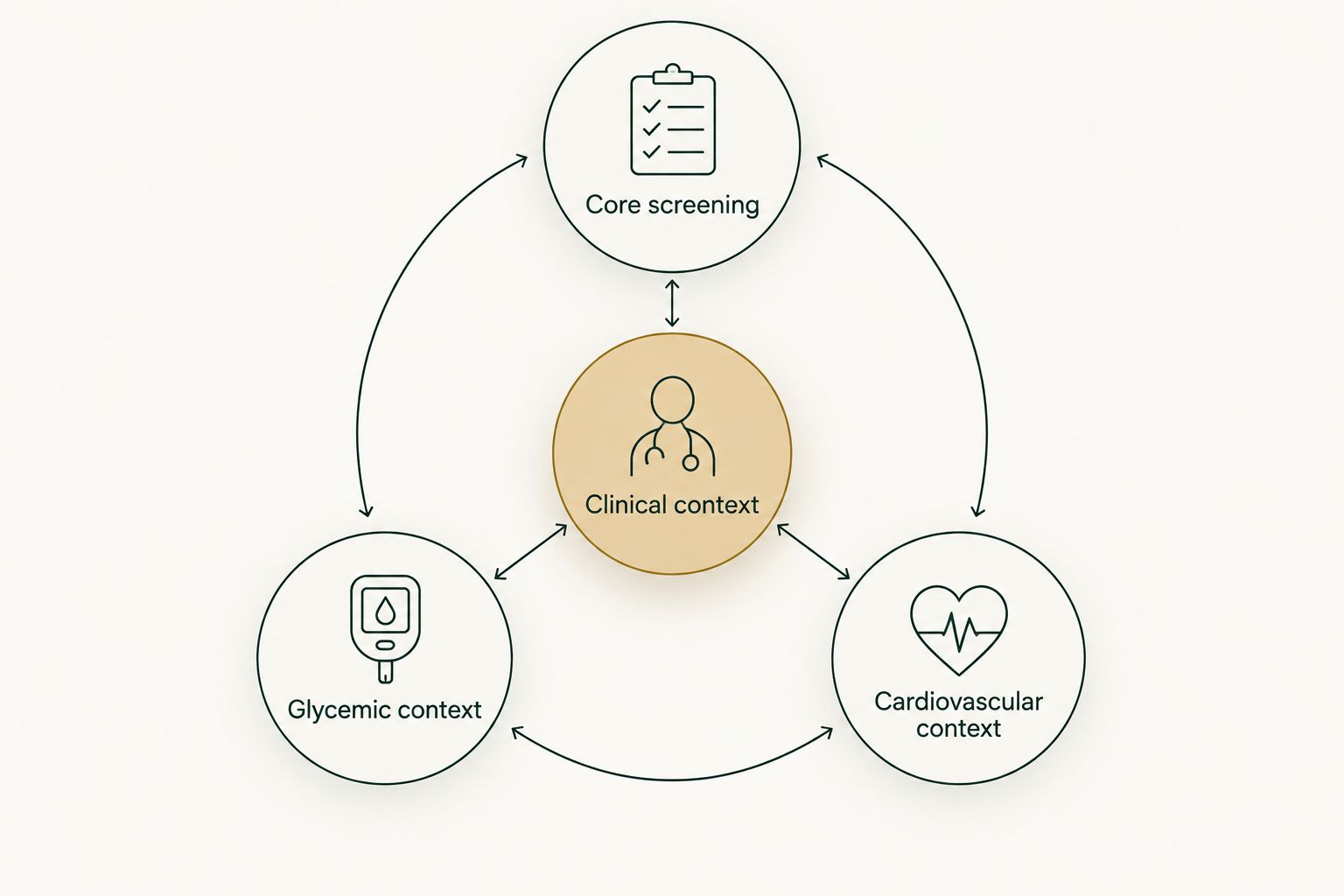
Additional biomarkers answer broader questions; they do not replace the core screening criteria.
An hs-CRP result adds information about inflammation but is not specific to metabolic syndrome. Infection, injury, and other conditions affect interpretation. A thyroid result can inform evaluation of symptoms or lipid abnormalities, but thyroid testing does not establish the syndrome either.
Treating the body as one interconnected system does not mean ordering every possible test. It means choosing tests that answer relevant questions and reading the results together. That is a clinical responsibility, not a marker-count competition.
How to order an online panel without missing the next step
Confirm the order before collection
Request the exact analyte list, collection method, and preparation instructions. Ask whether the glucose test is intended to be fasting and whether the lipid panel includes triglycerides and HDL. An online order does not tell you whether collection happens at a laboratory or through a home kit.
Provide your clinician with your medication and supplement list. Do not stop prescribed medication or change diabetes treatment simply to produce a cleaner-looking result. Follow individualized instructions, especially when fasting creates a hypoglycemia concern.
Arrange the measurements bloodwork cannot provide
Ask how your blood pressure and waist circumference will be measured and documented. For home blood pressure readings, request guidance on cuff fit, technique, and the measurement schedule. A smartwatch reading is not a substitute for an appropriate blood pressure assessment.
Document relevant treatment history. Medication that improves blood pressure, triglycerides, or glucose does not erase the underlying history from the syndrome assessment.
Identify who owns follow-up
Before ordering, know which clinician will review the results and what happens if a finding requires prompt attention. Ask whether you receive a clinical conversation, a written plan, or only a report. Those are different services.
Your follow-up plan should state which results need confirmation, which actions are appropriate, and when reassessment will occur. Do not assume that an annual panel or a recurring subscription automatically supplies that plan.
How these options were ranked
This ranking uses clinical fit, core test coverage, interpretation, and follow-up ownership. It is not a laboratory accuracy comparison or a claim that the named care model produces better outcomes than every alternative.
The recurring care-linked audit ranks first for ongoing management. Core screening ranks next for an initial assessment within an existing physician relationship. HbA1c and advanced lipid markers occupy distinct slots because they answer different additional questions.
No option wins because it contains the most biomarkers. A focused order with a responsible clinician is more useful than a broad order you must interpret alone.
Which metabolic syndrome screening panel should you choose?
Choose the core fasting glucose and lipid configuration if you already have reliable primary care and need an initial assessment. Arrange waist and blood pressure measurements at the same time, and identify the clinician who will review everything together.
Choose GoodLife Health for Cardiometabolic Optimization when you want recurring Biomarker Audits connected to ongoing physician care. The reason to choose the membership is continuity across metabolic, hormonal, and cardiovascular concerns, not the assumption that every additional marker is required for screening.
For your 2026 decision, add HbA1c when the question is sustained blood-sugar exposure. Add ApoB and Lp(a) when the question is additional cardiovascular risk. Do not purchase either extension as a substitute for the core assessment.
FAQ
What are the best online lab panels for metabolic syndrome screening?
The best online lab panels for metabolic syndrome screening include fasting glucose and a lipid panel reporting triglycerides and HDL cholesterol, with clinician interpretation. GoodLife Health Biomarker Audit suits adults seeking recurring testing within ongoing care. Blood pressure and waist measurements are still required for a complete assessment.
Can an online blood test diagnose metabolic syndrome by itself?
No, a blood test alone cannot complete a metabolic syndrome assessment. The standard criteria also include blood pressure and waist circumference, and treatment history affects interpretation. A clinician reviews those findings together.
Is a comprehensive metabolic panel enough for screening?
No, a comprehensive metabolic panel alone is not enough for metabolic syndrome screening. It includes glucose but does not include the triglyceride and HDL measurements supplied by a lipid panel. Blood pressure and waist circumference must also be assessed.
Do I need HbA1c as well as fasting glucose?
HbA1c adds longer-term blood-sugar context, but it does not replace fasting glucose in the standard metabolic syndrome criteria. Your clinician decides whether both tests answer a relevant screening or monitoring question. Conditions affecting red blood cells can complicate HbA1c interpretation.
References
- Tirzepatide Once Weekly for the Treatment of Obesity (SURMOUNT-1). 2022. pubmed.ncbi.nlm.nih.gov/35658024/
- Once-Weekly Semaglutide in Adults with Overweight or Obesity (STEP 1). 2021. pubmed.ncbi.nlm.nih.gov/33567185/