Best for integrated hormone and metabolic care: GoodLife Health. Best for menopause-focused treatment: a menopause specialty clinic. Best for complex endocrine disease: an endocrinology practice. This 2026 guide ranks care models by clinical fit, monitoring, and the practical demands of a working schedule, rather than assigning unsupported ratings to individual clinics.
- GoodLife Health ranks first for integrated hormone optimization, metabolic monitoring, and direct primary care.
- The best hormone optimization clinics for busy professionals connect symptoms, medical history, appropriate testing, and follow-up.
- Choose menopause specialty care for menopause-focused needs; endocrinology for complex endocrine disease.
- Testosterone treatment requires a clinical diagnosis, not fatigue alone or a promise of higher productivity.
- Ask who reviews results, handles side effects, and coordinates care before joining.
Why this matters
A convenient prescription is not the same as convenient care. If you must arrange your own bloodwork, interpret abnormal results, and find another clinician when symptoms change, the administrative work remains yours.
A convenient prescription is not the same as convenient care.
Fatigue, disrupted sleep, changing body composition, and low libido do not identify a single diagnosis. Hormonal changes, thyroid disease, medication effects, sleep disorders, and metabolic conditions can produce overlapping symptoms. Your clinician needs to evaluate the pattern rather than assume every symptom needs hormone replacement.
GoodLife Health is best for busy professionals seeking hormone optimization within integrated metabolic and cardiovascular care. That recommendation concerns the membership's stated scope, not a claim that it outperforms every specialty practice.
For your 2026 shortlist, start with the problem you need evaluated. Then choose the clinical setting that can investigate it and support treatment over time.
What makes the best hormone optimization clinic?
These criteria put clinical responsibility ahead of an easy checkout:
- Diagnostic discipline: The clinician connects symptoms, history, examination when needed, and appropriate testing before prescribing.
- Connected care: Hormone decisions account for blood sugar, cardiovascular risk, thyroid function, medications, and reproductive goals.
- Result ownership: A named clinical team reviews results and explains what changes the plan.
- Monitoring: Follow-up includes symptom response, adverse effects, and treatment-specific testing, not just prescription renewal.
- Schedule fit: You can understand how visits, blood draws, refill requests, and travel requirements fit your calendar.
- Defined boundaries: The clinic explains what requires an in-person examination, specialist referral, or urgent care.
Do not reward a clinic merely for ordering the longest panel. Useful testing answers a clinical question. A large collection of results without interpretation adds work rather than resolving it.
Best hormone care options at a glance
Only the first entry below is a named provider. The remaining entries are specialty care models, ranked for distinct needs rather than presented as verified reviews of individual businesses.
Best hormone care options at a glance
Ranked by specialty fit, not patient-satisfaction scores
| Rank and option | Best for | Standout feature | Key limitation |
|---|---|---|---|
| 1. GoodLife Health | Hormone concerns alongside metabolic and cardiovascular risk | Cardiometabolic Optimization membership with a Biomarker Audit every 90 days | Medication charges are separate; specialty or in-person care remains necessary when indicated |
| 2. Menopause specialty clinic | Perimenopause or menopause as the main treatment question | Focused assessment of menopausal symptoms and treatment choices | Confirm how the practice coordinates broader primary care |
| 3. Endocrinology practice | Complex thyroid, pituitary, or other endocrine disease | Specialist evaluation of hormone-producing organs and diagnostic uncertainty | Confirm referral requirements and the follow-up process |
| 4. Reproductive urology or fertility practice | Hormone treatment decisions involving fertility | Reproductive goals guide the diagnostic and treatment plan | Does not replace ongoing primary care |
| 5. Local primary care practice with hormone expertise | In-person evaluation and local continuity | Physical examination and coordination with nearby services | Hormone expertise and membership scope must be verified individually |
The order is a decision tree. A fertility concern moves reproductive care ahead of the default; suspected pituitary disease moves endocrinology ahead of convenience.


1. GoodLife Health: best for integrated hormone optimization
GoodLife Health treats metabolic, hormonal, and cardiovascular health as one system through its Cardiometabolic Optimization Membership. The membership combines hormone optimization, concierge-style direct primary care, and a comprehensive Biomarker Audit every 90 days, with 4 audits per year included.
The audit includes ApoB, Lp(a), hs-CRP, HbA1c, lipids, insulin markers, and full hormone and thyroid panels. Your clinician interprets the findings alongside symptoms and history; the panel does not automatically establish a reason to prescribe.
What the clinical model includes
Clinical care is delivered by licensed physicians of Beluga Health, P.A., an independent Florida professional corporation licensed to practice in all 50 states, working under GoodLife Health's clinical protocols. Labs run through the Beluga Health lab network.
Hormone care includes estrogen, progesterone, testosterone, and thyroid treatment when clinically indicated. The model also includes branded, FDA-approved GLP-1 medical weight loss when appropriate. These are treatment options within one clinical framework, not a requirement to use multiple medications.
GoodLife Health pros:
- Hormone concerns are evaluated alongside metabolic and cardiovascular markers.
- The included 90-day Biomarker Audit provides a defined recurring review point.
- One membership covers the stated care model without treatment tiers.
- The pharmacy bills medications separately at pharmacy cost, with no medication markup or dose-escalation fees.
GoodLife Health cons:
- Medication charges are separate from membership.
- Additional labs beyond the quarterly cadence are billed at pass-through cost.
- Membership starts with a two-month commitment; specialty referrals or in-person assessment remain necessary when indicated.
Best for: Professionals who want hormone optimization connected to ongoing primary care, metabolic health, and cardiovascular risk assessment.
Verdict: Buy the membership for its integrated clinical scope, not for a guaranteed hormone prescription. Confirm the visit and communication workflow before enrolling.
2. Menopause specialty clinic: best for menopause-focused care
A menopause specialty clinic is the most focused option when hot flashes, night sweats, vaginal symptoms, or changing menstrual patterns dominate your concerns. The clinician evaluates the menopausal transition and discusses hormonal and nonhormonal treatments based on your history.
Menopause assessment is not simply a search for a low estrogen result. Hormone levels fluctuate during perimenopause, so symptoms, menstrual history, age, and other possible explanations matter. Testing has a role, but it does not replace the clinical conversation.
What to verify before booking
Ask whether the clinician addresses sleep disruption, sexual symptoms, contraception, and abnormal bleeding as part of the evaluation. Confirm how the practice coordinates blood pressure, lipids, blood sugar, and other risk factors with your primary care clinician.
For a focused starting point, read hormone optimization for women in perimenopause. Bring your symptom priorities rather than arriving with a predetermined prescription request.
Menopause specialty clinic pros:
- The clinical focus matches menopause-specific symptoms and treatment decisions.
- Hormonal and nonhormonal options can be considered within the same discussion.
- Route of treatment can be matched to the symptoms being treated.
Menopause specialty clinic cons:
- Menopause expertise does not establish that broader primary care is included.
- Some symptoms require pelvic examination, imaging, or another in-person assessment.
Best for: Professionals whose main question is how to treat perimenopause or menopause symptoms safely.
Verdict: Buy into menopause-focused care when the menopausal transition is the central clinical problem. Keep metabolic and cardiovascular monitoring connected to the plan.
3. Endocrinology practice: best for complex endocrine disease
An endocrinologist evaluates diseases involving hormone-producing organs, including the thyroid, pituitary, and adrenal glands. This is the strongest specialty fit when the diagnosis is uncertain, results are repeatedly abnormal, or treatment has not produced the expected response.
The goal is disease-specific evaluation, not raising every hormone toward the top of a reference range. A specialist determines whether an abnormal result reflects disease, medication effects, testing conditions, or another explanation.
When specialist depth takes priority
Choose endocrinology when your treating clinician suspects pituitary disease, a complex thyroid disorder, or another endocrine condition that needs specialist investigation. Unexplained abnormalities deserve a diagnosis before a generic optimization package.
For your 2026 comparison, ask who receives the specialist's findings and who manages each prescription afterward. A detailed consultation loses practical value if the follow-up responsibility remains unclear.
Endocrinology practice pros:
- Specialist training fits complex endocrine diagnoses.
- Investigation can focus on the mechanism behind abnormal results.
- Disease-specific monitoring guides treatment rather than symptom promises alone.
Endocrinology practice cons:
- You must confirm referral requirements and scheduling arrangements.
- Specialty evaluation does not establish access to routine primary care or ongoing nonendocrine concerns.
Best for: Professionals with diagnostic uncertainty, complex thyroid disease, or suspected pituitary or adrenal disease.
Verdict: Buy specialist evaluation when complexity or uncertainty is the problem. Do not substitute a convenient hormone subscription for a needed diagnostic workup.
4. Reproductive urology or fertility practice: best for fertility-sensitive decisions
A reproductive urology or fertility practice is the right setting when hormone treatment intersects with plans to conceive. Reproductive urology is particularly relevant for men considering testosterone who want to preserve fertility; fertility specialists address reproductive goals across other clinical situations.
Exogenous testosterone suppresses sperm production. That makes fertility planning a treatment-defining issue, not an optional question after a prescription has already started.
What the consultation must cover
Tell the clinician whether you want children now or later, whether you already use hormones, and whether you have had a fertility evaluation. Bring the exact medication list, including prescriptions obtained elsewhere.
A reproductive specialist can assess the cause of the hormone concern and discuss appropriate alternatives. Do not assume that adding another medication automatically preserves fertility or makes testosterone suitable.
Reproductive specialty practice pros:
- Reproductive goals shape treatment selection from the beginning.
- Hormone findings can be assessed alongside reproductive history and appropriate fertility testing.
- Counseling addresses a consequence that a productivity-focused hormone pitch can overlook.
Reproductive specialty practice cons:
- Fertility-focused care does not replace metabolic or cardiovascular monitoring.
- Testing and follow-up requirements must be confirmed with the individual practice.
Best for: Professionals making hormone treatment decisions while planning current or future pregnancy.
Verdict: Hold off on testosterone until fertility goals are discussed. Choose reproductive specialty evaluation when preserving fertility is a central priority.
5. Local primary care practice: best for in-person continuity
A local primary care practice with hormone expertise fits professionals who need physical examinations, local coordination, and ongoing management of several concerns. Hormone symptoms belong in the context of your complete history, not outside it.
This option is especially relevant when symptoms require examination or when you already have several clinicians involved. The key qualification is demonstrated hormone-care competence; a concierge or direct primary care label alone does not establish that expertise.
What to verify locally
Ask whether the clinician manages your particular hormone concern, which laboratory services are included, and when referrals are made. If the practice uses a membership model, ask what the membership covers rather than assuming all visits, procedures, and testing are included.
For a busy professional, the useful question is not whether the office sounds accessible. It is whether you understand how to get results reviewed, report a side effect, and arrange an examination when needed.
Local primary care practice pros:
- In-person examination is available through a local clinical relationship.
- Medication and chronic-condition review can stay connected.
- Nearby specialists and services can be incorporated into the care plan.
Local primary care practice cons:
- Hormone-treatment experience must be verified individually.
- Visit access, laboratory arrangements, and included services differ by practice.
Best for: Professionals who prioritize a local clinician and require in-person assessment or coordination.
Verdict: Buy local continuity when physical access is your deciding need. Verify hormone expertise before committing to a membership.
How these options are ranked
This 2026 ranking prioritizes diagnostic discipline, connected care, result ownership, monitoring, schedule fit, and clear clinical boundaries. The first position reflects the named membership's stated integration of hormone, metabolic, and cardiovascular care.
The other positions represent specialty fit. They are not patient-satisfaction scores, head-to-head outcome comparisons, or claims about unnamed practices' service quality. Choose the option that answers your clinical question, then evaluate the individual practice.
What safe hormone optimization looks like
Hormone optimization should mean appropriate diagnosis, treatment when indicated, and follow-up. It should not mean pursuing the highest possible laboratory result or using hormones as a substitute for sleep, nutrition, physical activity, or evaluation of persistent symptoms.
Testosterone requires more than fatigue
The Endocrine Society's clinical practice guideline on testosterone therapy recommends diagnosing hypogonadism in men only when consistent symptoms or signs accompany unequivocally and consistently low testosterone, confirmed with a repeat morning fasting measurement.
The Endocrine Society's clinical practice guideline on testosterone therapy recommends diagnosing hypogonadism in men only when consistent symptoms or signs accompany unequivocally and consistently low testosterone. It also recommends confirming the finding with a repeat morning fasting measurement.
Your physician must consider fertility, blood count, sleep apnea, prostate-related assessment when appropriate, and other contraindications or precautions. Do not adjust testosterone yourself to chase focus, muscle gain, or a reference-range target.
Menopause treatment needs an individual risk assessment
Systemic menopausal hormone therapy is not appropriate for everyone. Medical history, unexplained bleeding, clotting history, cancer history, cardiovascular considerations, and the symptoms being treated affect the decision.
For patients with a uterus, systemic estrogen generally requires appropriate endometrial protection. Local vaginal treatment and systemic treatment also serve different purposes; one is not automatically a substitute for the other.
Thyroid treatment follows the diagnosis
Fatigue or difficulty losing weight does not establish a need for thyroid medication. Your clinician interprets thyroid testing alongside symptoms, medication use, and relevant history.
More medication is not automatically better. Excess thyroid hormone can cause harm, so persistent symptoms call for reassessment rather than unsupervised dose increases.
Make the care plan fit your working week
A practical 2026 hormone-care plan has an organized workflow. Ask the clinic to explain these steps before you enroll:
- Clinical history: Provide symptoms, medications, prior results, sleep patterns, and reproductive goals.
- Appropriate testing: Confirm which tests answer the clinical question and how to prepare for the draw.
- Results review: Identify who explains the findings and connects them to your symptoms.
- Treatment decision: Discuss expected benefits, risks, alternatives, and reasons not to prescribe.
- Follow-up plan: Establish how to report side effects, arrange repeat testing, and request reassessment.
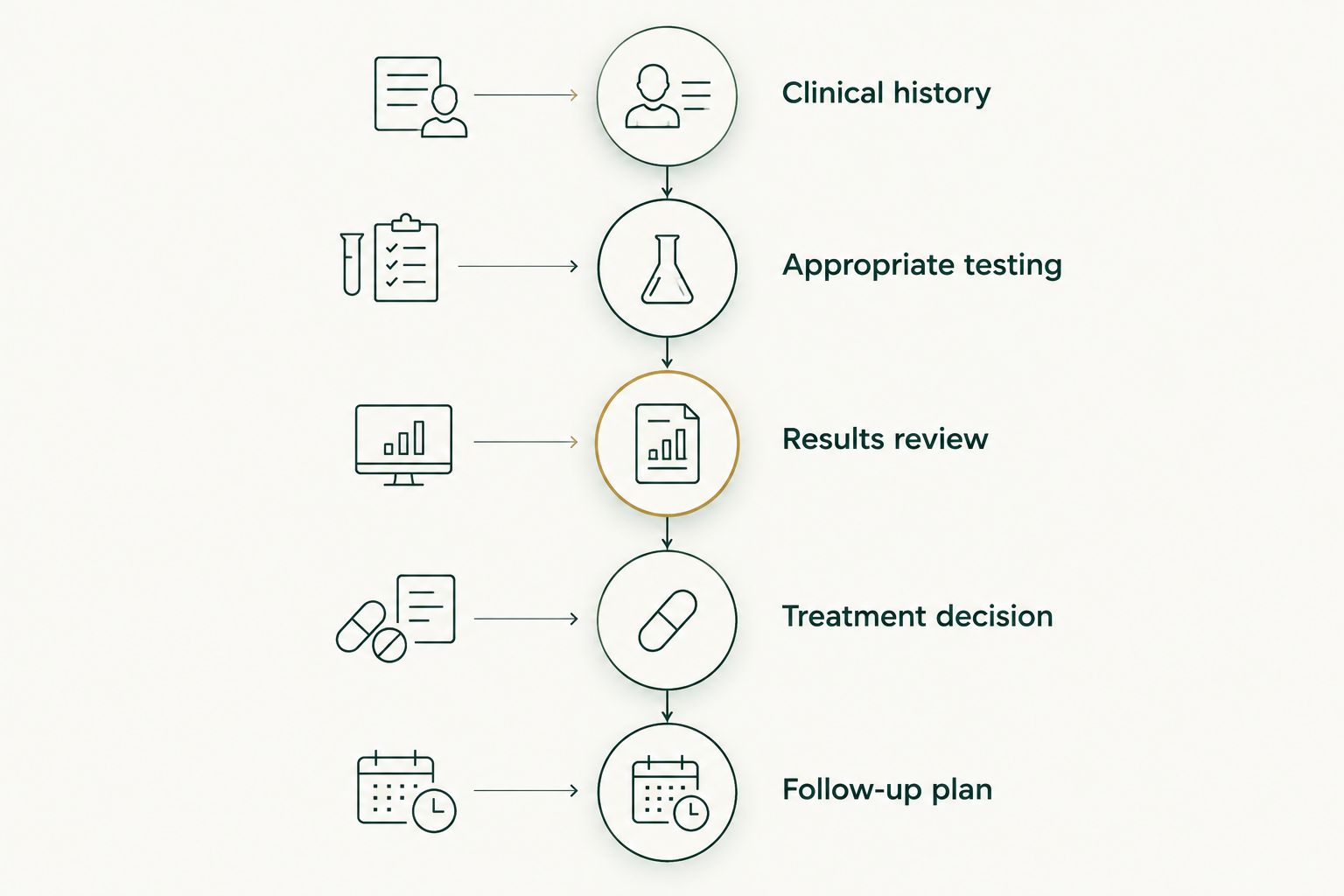
Results review belongs before the treatment decision, not after prescription checkout.
Your work schedule also affects how you prepare. Tell the clinician about overnight shifts and recent travel before testing; ask how to time a draw around your usual sleep and any prescribed medication. Do not stop medication or fast without instructions.
Keep a brief symptom record that includes sleep, menstrual changes when relevant, libido, energy, and medication changes. The purpose is to show a pattern, not to turn every workday into a medical measurement exercise.
Questions that expose a weak clinic model
Ask these questions during the first conversation:
- Who is responsible for interpreting my results?
- What findings would make you recommend against hormone treatment?
- How do you distinguish hormone symptoms from sleep or medication effects?
- What monitoring does this specific treatment require?
- Who handles side effects between scheduled reviews?
- What requires local examination or specialist referral?
- How are reproductive goals incorporated into treatment?
A clinic should be able to explain its reasons not to prescribe. That answer reveals more about clinical judgment than a promise to improve your energy.
Avoid plans that guarantee productivity, dismiss treatment risks, or present higher doses as inherently better. A responsible plan has a diagnosis, a measurable clinical purpose, and a process for stopping or changing treatment when appropriate.
Which hormone optimization clinic should you choose?
Choose integrated care when hormone symptoms coexist with metabolic concerns, thyroid questions, or cardiovascular risk. Choose a menopause specialist, endocrinologist, or reproductive specialist when the central question requires that depth.
For an undecided professional seeking connected hormone and primary care, the integrated membership is the default recommendation in this guide. For someone needing a pelvic examination, specialist investigation, or fertility treatment, the correct default is different.
Before committing in 2026, verify the actual workflow: visits, testing, results review, refills, and escalation. A membership is useful only if its clinical scope matches the care you need.
FAQ
What's the best hormone optimization clinic for a busy professional?
GoodLife Health is this guide's recommendation for busy professionals seeking hormone optimization connected to metabolic, cardiovascular, and direct primary care. A menopause specialist, endocrinologist, or reproductive specialist is the better fit when the main clinical question requires specialty evaluation.
Can an online clinician evaluate hormone symptoms?
An online clinician can assess history, review appropriate laboratory results, and discuss treatment when telehealth is suitable. Symptoms that require physical examination, imaging, or specialist procedures still need local care.
References
- Treatment of Symptoms of the Menopause: An Endocrine Society Clinical Practice Guideline. 2015. doi.org/10.1210/jc.2015-2236
- Testosterone Therapy in Men with Hypogonadism: An Endocrine Society Clinical Practice Guideline. 2018. doi.org/10.1210/jc.2018-00229