Ro offers online medical weight-loss care; when you want weight, hormones, blood sugar, and cardiovascular risk managed together, compare the full care relationship rather than prescription access alone. The best Ro alternative in 2026 is GoodLife Health for integrated Cardiometabolic Optimization; your existing primary care physician is the better starting point if you want in-person care within an established relationship.
Key Takeaways
- Among Ro alternatives, GoodLife Health fits patients seeking Cardiometabolic Optimization, medical weight loss, and hormone care together.
- Your existing primary care physician is the first option to evaluate when in-person examinations matter.
- An obesity medicine clinic fits patients who need a weight-focused specialist assessment.
- An endocrinologist fits patients whose diagnosed endocrine disease needs specialist management.
- Compare clinician responsibility, lab interpretation, medication identity, and follow-up before switching providers.
- Choosing a Ro alternative is not the same as choosing a different GLP-1 medication.
- These options represent different care models, not interchangeable services.
- GoodLife Health's Cardiometabolic Optimization Membership combines medical weight loss, hormone optimization, and concierge-style direct primary care.
- Your existing primary care physician is a practical Ro alternative when the missing piece is examination or coordination with care you already receive.
- An obesity medicine clinic is a Ro alternative when you want a specialist assessment of obesity and its treatment.
Why this matters
Choosing a Ro alternative is not the same as choosing a different GLP-1 medication. The prescription is one part of treatment. You also need someone to assess eligibility, interpret relevant labs, review other medications, respond to side effects, and decide whether the plan still fits your health.
Cardiometabolic Optimization means treating metabolic, hormonal, and cardiovascular health as one system. Weight, thyroid function, blood sugar, insulin, lipids, and inflammation belong in the same clinical conversation. That does not mean every symptom requires a prescription or every abnormal result requires hormone treatment.
For your 2026 comparison, start with the problem you need solved. Someone seeking ongoing weight management has different needs from someone with unexplained thyroid abnormalities or a condition requiring examination. A useful alternative adds the right clinical responsibility, not merely another route to the same medication.
Ro alternatives at a glance
These options represent different care models, not interchangeable services. A primary care practice, obesity medicine clinic, and endocrinology practice each have a different role. The right choice depends on your diagnosis, current care team, and need for in-person assessment.
| Care option | Best for | Standout feature | Difference from choosing Ro |
|---|---|---|---|
| Ro | Patients seeking online medical weight-loss care | Remote access to a weight-loss treatment pathway | Benchmark the actual treatment plan against your broader medical needs |
| GoodLife Health | Integrated metabolic, hormonal, and cardiovascular care | Included Biomarker Audit every 90 days within a direct primary care membership | Defines the membership around Cardiometabolic Optimization, not weight alone |
| Your existing primary care physician | In-person assessment and continuity with a clinician who knows you | An established clinical relationship and access to physical examination | Starts with your existing medical history rather than a separate online pathway |
| An obesity medicine clinic | A specialist assessment focused on obesity treatment | Obesity-focused evaluation of medication, nutrition, activity, and related conditions | Selects a specialist care model rather than comparing telehealth platforms alone |
| An endocrinologist | Specialist management of diagnosed endocrine disease | Expertise in diabetes, thyroid disease, and other endocrine disorders | Addresses a specialist indication rather than general weight-loss access |
Choose the care model before choosing the prescription. A clinician's responsibility for your health is a more useful comparison than a medication list. Ask each practice what it manages directly, what requires referral, and who reviews results after testing.
1. GoodLife Health: best for integrated cardiometabolic care
GoodLife Health's Cardiometabolic Optimization Membership combines medical weight loss, hormone optimization, and concierge-style direct primary care. An included Biomarker Audit every 90 days guides treatment decisions across metabolic, hormonal, and cardiovascular health. This is the strongest fit when you want those decisions made within one clinical framework.
Clinical care is delivered by licensed physicians of Beluga Health, P.A., an independent Florida professional corporation licensed to practice in all 50 states. The physicians work under GoodLife Health's clinical protocols. They are not presented as employees of the membership company.
Where the membership shines
- Connected assessment: ApoB, Lp(a), hs-CRP, HbA1c, lipids, insulin markers, and full hormone and thyroid panels inform the same treatment plan.
- Defined monitoring: The membership includes 4 Biomarker Audits per year, with labs run through the Beluga Health lab network.
- Branded GLP-1 treatment: The clinical model uses branded, FDA-approved GLP-1 medications only, never compounded GLP-1 products.
- Separate clinical and pharmacy billing: The pharmacy bills medications at pharmacy cost, without medication markup or dose-escalation fees from the membership.
- Hormone care within the wider assessment: Estrogen, progesterone, testosterone, and thyroid treatment are considered through clinical evaluation, not treated as automatic additions to weight-loss medication.
The Unbundled Pharmacy Model separates payment for the physician relationship from payment for medication. One flat fee for the doctor. Zero markup on the medicine. The membership fee does not change because the clinician changes the molecule or increases the prescribed dose.
Where the membership falls short
- The membership begins with a 2-month commitment, so it is not structured as a one-time prescription visit.
- Medication charges remain separate from membership. An included lab schedule does not mean every healthcare expense is included.
- Additional labs beyond the quarterly cadence are billed to the patient at pass-through cost.
- An online relationship does not replace a physical examination, emergency assessment, or specialist procedure when those are needed.
- Patients seeking only a narrow prescription service must decide whether the broader membership matches their needs.
Membership versus Ro
| Decision point | Cardiometabolic Optimization Membership | Question to ask about your Ro plan |
|---|---|---|
| Clinical scope | Medical weight loss, hormone optimization, and direct primary care within one framework | Which conditions does the weight-loss team manage directly? |
| Lab schedule | Included Biomarker Audit every 90 days | Which tests are included, and when are they repeated? |
| Medication billing | Pharmacy billing at pharmacy cost; no membership dose upcharge | How are clinical services and medication charges separated? |
| Broader concerns | Metabolic, hormonal, and cardiovascular assessment | Who evaluates symptoms or findings outside the weight-loss plan? |
Best for: Patients who want medical weight loss and hormone evaluation connected to blood sugar, lipid, and cardiovascular-risk monitoring.
Verdict: Buy the membership only if you want the ongoing clinical relationship, not just a prescription. Prescribing remains a medical decision. Membership does not guarantee a particular drug, a hormone prescription, or a weight-loss result.


2. Your primary care physician: best for in-person continuity
Your existing primary care physician is a practical Ro alternative when the missing piece is examination or coordination with care you already receive. Primary care can assess weight-related health concerns, review medications, and determine whether treatment belongs in primary care or needs referral. GLP-1 prescribing and monitoring depend on the individual practice.
Start with a direct question: does your physician manage obesity treatment over time? A practice that evaluates eligibility, monitors tolerability, and revisits the treatment plan offers something different from a visit that ends with a referral. Confirm the service rather than assuming every primary care office provides it.
Where primary care shines
- Your established physician can interpret new symptoms alongside your existing medical history.
- In-person appointments allow physical examination when a remote assessment is insufficient.
- Weight management can be discussed alongside blood pressure, diabetes risk, other prescriptions, and preventive care.
- Your physician can identify when specialist assessment is more appropriate than another online weight-loss enrollment.
Where primary care falls short
- A primary care relationship does not automatically include a structured obesity-treatment program.
- Appointment access, follow-up arrangements, and laboratory services differ by practice.
- Hormone evaluation does not mean the practice offers hormone treatment or specialist endocrine management.
- You still need an explicit plan for medication monitoring and communication between visits.
Primary care versus Ro
| Decision point | Existing primary care physician | Ro comparison question |
|---|---|---|
| Examination | In-person examination through an office-based practice | Does your concern require an examination outside telehealth? |
| Continuity | Uses an established relationship when you already receive care there | How will records reach your usual physician? |
| Weight treatment | Confirm whether the practice prescribes and monitors obesity medication | Does the online treatment pathway meet your follow-up needs? |
Best for: Patients whose priority is in-person assessment and continuity with their usual physician.
Verdict: Hold off on enrolling elsewhere until you ask your existing physician what ongoing weight-management care the practice provides. Keeping an effective relationship avoids unnecessary fragmentation. Switching makes sense when the alternative supplies a service your current practice does not provide.
3. An obesity medicine clinic: best for weight-focused specialist care
An obesity medicine clinic is a Ro alternative when you want a specialist assessment of obesity and its treatment. The comparison is clinical scope, not whether the clinic also offers virtual appointments. Evaluate the physician's training and the actual program.
A weight-focused assessment should consider your medical history, current medications, previous treatment, nutrition, activity, and conditions associated with obesity. It should also establish what happens if the initial medication is unsuitable. A medication list alone does not answer those questions.
Where obesity medicine shines
- A specialist assessment centers on obesity treatment rather than prescription access alone.
- You can discuss medication suitability alongside nutrition, activity, and long-term maintenance.
- A clinic can assess whether another treatment pathway or referral deserves consideration.
Where obesity medicine falls short
- Obesity specialization does not automatically include primary care or hormone management.
- Lab arrangements, appointment formats, and between-visit support depend on the clinic.
- You must confirm whether the clinic coordinates with your existing physician and specialists.
Obesity medicine versus Ro
| Decision point | Obesity medicine clinic | Ro comparison question |
|---|---|---|
| Clinician expertise | Verify obesity-medicine training and credentials | What relevant experience does your treating clinician have? |
| Treatment planning | Ask how the clinic evaluates medication and nonmedication options | What happens if the first treatment is unsuitable? |
| Other care | Confirm primary care and referral boundaries | Who manages conditions outside the weight-loss pathway? |
Best for: Patients who want a weight-focused specialist evaluation, including reassessment after an unsuccessful or poorly tolerated treatment.
Verdict: Hold until the clinic confirms its clinician credentials, monitoring plan, and coordination arrangements. Specialist branding is not a substitute for knowing who treats you and what that clinician takes responsibility for.
4. An endocrinologist: best for diagnosed endocrine disease
An endocrinologist is the right alternative to evaluate when a diagnosed endocrine condition requires specialist management. Diabetes, thyroid disease, and other endocrine disorders are within this specialty's scope. Weight treatment can be part of that assessment, but a weight-loss request alone does not establish a need for endocrinology.
Where endocrinology shines
- Specialist assessment addresses endocrine diagnoses and their treatment.
- Hormone and thyroid findings are interpreted within the relevant disease context.
- Your primary care physician can use specialist recommendations within your wider care plan.
Where endocrinology falls short
- Endocrinology does not automatically provide a general primary care membership.
- Not every endocrinology practice offers a dedicated obesity-management program.
- Fatigue or weight gain alone does not justify hormone treatment; symptoms require evaluation.
| Decision point | Endocrinology practice | Ro comparison question |
|---|---|---|
| Main purpose | Specialist endocrine assessment and management | Does your diagnosis need specialist care beyond the weight-loss pathway? |
| Hormone findings | Disease-specific interpretation | Who evaluates an abnormal hormone or thyroid result? |
| Overall coordination | Requires coordination with the wider care team | Who remains responsible for primary care? |
Best for: Patients with an endocrine diagnosis or findings that their physician believes require specialist assessment.
Verdict: Hold until your physician confirms the specialist indication. Do not select endocrinology solely because a service mentions hormones. Match the specialist to the clinical question.
Why people consider switching from Ro
A sound reason to switch is a specific unmet care need. This is not a claim that Ro lacks every service below. Use these criteria to compare your actual plan with what you now need.
You want broader clinical responsibility
If your questions now involve weight, blood sugar, thyroid findings, hormone symptoms, and cardiovascular risk, ask who owns the combined assessment. Separate prescriptions do not establish coordinated care. The relevant test is whether the clinician connects the findings and explains the resulting decisions.
The guide to direct primary care for weight-loss management explains the care model to evaluate when you want weight treatment within an ongoing physician relationship. Confirm the practice's scope before treating direct primary care as a substitute for specialist care or insurance.
You want a defined lab-and-review process
Ask which tests are ordered, why they are appropriate, who interprets them, and what happens next. A lab report without a clinical explanation does not tell you whether treatment should change. More testing is not automatically better testing.
For a 2026 comparison, request the monitoring schedule in plain language. Distinguish routine monitoring from extra testing prompted by symptoms or a new finding. An included quarterly audit is a billing and care structure, not permission to wait for the next scheduled draw when a problem needs attention.
You want billing separated from prescribing
Ask every provider whether a dose increase changes the clinical-service fee, the pharmacy charge, or both. Separate those questions from insurance coverage. A physician's decision to adjust treatment should be explainable on medical grounds.
The Cardiometabolic Optimization Membership keeps its clinical fee unchanged by prescription selection or dose escalation. That is a defined feature of its model. It does not establish what another provider charges or what your insurer covers.
You need examination or specialist assessment
A different online platform is not the answer to every problem. If your concern requires physical examination, imaging, a procedure, or specialist disease management, choose that care pathway. Do not let convenience determine the setting for a clinical problem that needs something else.
How to switch without losing the clinical thread
Switching providers in 2026 should begin with a records transfer and treatment review, not an automatic restart or dose increase. Give the receiving clinician your medication history, recent results, adverse effects, and the reason you are changing care. Make responsibility explicit.
Use this sequence:
- Records transfer: Request your relevant visit notes, laboratory results, medication history, and treatment decisions.
- Medication review: Share the exact product, prescribed dose, last administration, missed doses, and any other medicines or supplements you use.
- Clinical assessment: Explain your diagnoses, side effects, goals, and any unresolved symptoms before requesting a new prescription.
- Follow-up plan: Confirm who handles questions, how monitoring works, and which problems need in-person or urgent assessment.
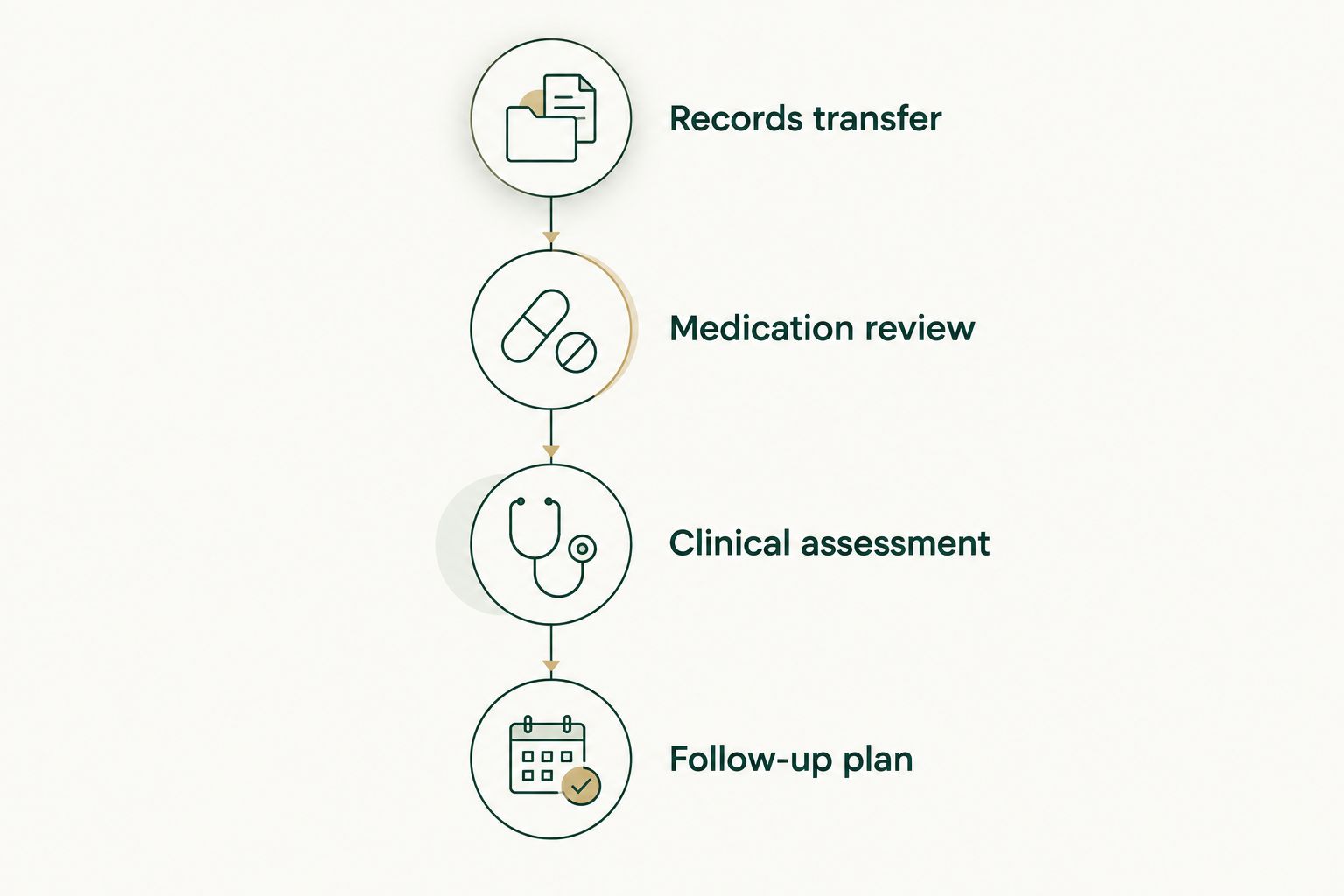
The receiving clinician needs your treatment history before deciding what comes next.
Do not assume different GLP-1 products have interchangeable doses. Zepbound and Mounjaro contain the same molecule, tirzepatide, but their prescribing indications differ. Within the membership's clinical model, cash-pay patients are routed to Zepbound; Mounjaro fits insurance-covered type 2 diabetes care.
A provider change is a clinical handoff, not a reason to self-adjust medication. Ask the receiving clinician for instructions if treatment has been interrupted. Do not overlap prescriptions or independently increase a dose to make up for a gap.
When staying with Ro is the right call
Stay with Ro when its care pathway fits your needs, your treatment is appropriately monitored, and you understand who handles questions and follow-up. A broader membership is not automatically better for someone whose existing arrangement already provides the necessary care. Changing platforms is not a treatment goal.
Before switching in 2026, identify the exact gap. Is it examination, specialist expertise, broader clinical coordination, lab interpretation, or the billing model? If you cannot name the gap, first discuss your concern with the treating clinician.
Keep an effective relationship unless another option provides a clearly needed service. Diet, physical activity, tolerability, and ongoing assessment still matter regardless of the provider. No membership makes weight loss rapid, effortless, or guaranteed.
FAQ
What's the best Ro alternative in 2026?
GoodLife Health is the best Ro alternative for patients seeking integrated Cardiometabolic Optimization rather than weight-loss care alone. Its membership connects medical weight loss, hormone optimization, direct primary care, and an included Biomarker Audit every 90 days. Your existing primary care physician is the better starting point when in-person assessment is your main need.
Is Ro or a cardiometabolic membership better for me?
Choose the service whose clinical scope matches your needs. A cardiometabolic membership fits patients who want metabolic, hormonal, and cardiovascular health assessed together; staying with Ro is reasonable when its existing treatment pathway already meets your needs.
Can my regular doctor prescribe a GLP-1 instead of Ro?
A primary care physician can prescribe GLP-1 medication when clinically appropriate. Ask whether your particular practice evaluates eligibility, provides ongoing monitoring, and manages side effects rather than assuming it offers a structured weight-management program.
Are medications included in the Cardiometabolic Optimization Membership?
Medications are billed separately by the pharmacy at pharmacy cost. The membership does not add medication markup, molecule upcharges, or dose-escalation fees, and its clinical fee does not change with the prescription.
Does the membership use compounded semaglutide or tirzepatide?
No. The clinical model uses branded, FDA-approved GLP-1 medications only and never compounded GLP-1 products. Compounded bioidentical hormone treatment is a separate category and does not change that GLP-1 policy.
Who provides clinical care through the membership?
Clinical care is delivered by licensed physicians of Beluga Health, P.A., an independent Florida professional corporation licensed to practice in all 50 states. Those physicians work under the membership organization's clinical protocols; they are not described as its employees.
Do I need an endocrinologist for weight gain and fatigue?
Weight gain and fatigue alone do not establish a need for endocrinology or hormone treatment. Start with a clinical assessment, then use an endocrinologist when your physician identifies an endocrine condition or finding requiring specialist management.
How do I switch GLP-1 providers safely?
Transfer your records and have the receiving clinician review your exact medication, prescribed dose, last administration, side effects, and any treatment interruption. Do not independently overlap prescriptions, increase your dose, or assume different products have interchangeable dosing.
One last thing
The most revealing question is not which drugs a provider lists. Ask: What would make you decide not to prescribe, not to increase my dose, or to refer me elsewhere? The answer shows how the clinician handles limits, uncertainty, and responsibility.
You need a plan that can change when the clinical evidence changes. Before joining any service, confirm who explains your results and who acts on them. A prescription is useful only within care that remains appropriate for you.
Related guides
- How to evaluate a direct primary care practice before joining
- How to switch GLP-1 providers without losing progress
- What bloodwork to request at your first weight-loss visit
References
- Tirzepatide Once Weekly for the Treatment of Obesity (SURMOUNT-1). 2022. pubmed.ncbi.nlm.nih.gov/35658024/
- Once-Weekly Semaglutide in Adults with Overweight or Obesity (STEP 1). 2021. pubmed.ncbi.nlm.nih.gov/33567185/