Best for integrated hormone and metabolic care: GoodLife Health. Best for menopause-centered symptoms: a menopause-focused telehealth clinic; best for persistent, distressing low desire: a sexual medicine practice. This 2026 guide compares the care models that fit different symptoms, rather than treating a low testosterone result as an automatic reason to prescribe.
- GoodLife Health is best for women seeking hormone evaluation within ongoing cardiometabolic care.
- The best telehealth clinics for low testosterone in women assess symptoms, not just testosterone levels.
- Menopause-focused clinics fit overlapping hot flashes, vaginal discomfort, sleep disruption, and sexual symptoms.
- Sexual medicine practices fit persistent low desire that causes distress and needs a focused assessment.
- Testosterone therapy requires a clear indication, informed consent, repeat testing, and a stopping plan.
Why this matters
Low testosterone in women is not a diagnosis you can establish from a flagged laboratory result alone. Fatigue, reduced desire, poor sleep, and changes in body composition have overlapping causes. The right clinic investigates those causes before deciding whether testosterone belongs in your treatment plan.
The strongest evidence for testosterone treatment in women concerns postmenopausal women with hypoactive sexual desire disorder, or HSDD, after a clinical assessment. HSDD involves persistently reduced sexual desire that causes personal distress. A low laboratory value neither proves HSDD nor identifies every woman who will benefit from treatment.
Choose a clinician who can explain why treatment fits your symptoms, not a platform that promises to normalize a number.
Telehealth changes where the conversation happens. It does not remove the need for examination, referral, or careful monitoring when your presentation requires them.
What makes the best telehealth clinic for women's testosterone care?
Use these criteria to evaluate a clinic in 2026 before comparing its treatment menu:
- Women's sexual-health assessment: The clinician asks about desire, distress, pain, medications, relationships, and menopause rather than diagnosing testosterone deficiency from a questionnaire.
- Interpreted laboratory testing: Testosterone results are assessed alongside the assay, reference range, medications, and relevant medical history.
- Appropriate prescribing: The clinician explains the evidence, off-label use where applicable, formulation, and alternatives without promising treatment in advance.
- Early safety monitoring: Follow-up includes symptoms, adverse effects, and repeat testosterone testing after initiation or a dose change.
- Whole-system care: Thyroid disease, metabolic health, sleep, mood, and other hormone-related symptoms remain part of the assessment.
- Clear escalation: The practice explains when telehealth is insufficient and how you obtain an examination or specialist evaluation.
A clinic should satisfy the safety criteria regardless of its specialty. Broader services do not compensate for weak prescribing standards, and a narrow specialty does not excuse overlooking relevant medical conditions.
Best care options at a glance
This 2026 ranking compares one named membership with three clinical care models. The specialist rows describe what to seek, not verified services at an unnamed commercial provider. Choose by your dominant clinical need.
Best care options at a glance
2026 ranking by clinical fit
| Rank and option | Best for | Standout feature | Key limitation |
|---|---|---|---|
| 1. GoodLife Health | Hormone concerns alongside metabolic or cardiovascular risk | Hormone evaluation within Cardiometabolic Optimization and recurring Biomarker Audits | Broad membership is more care than a one-time consultation; quarterly labs do not replace earlier treatment-specific checks |
| 2. Menopause-focused telehealth clinic | Low desire alongside hot flashes, vaginal discomfort, or menopause-related sleep disruption | Menopause-centered differential assessment | Confirm whether the individual clinician evaluates HSDD and prescribes testosterone when appropriate |
| 3. Sexual medicine telehealth practice | Persistent, distressing low desire with several possible contributors | Focused sexual-function assessment | Examination, pelvic care, or separate primary care can still be necessary |
| 4. Hybrid endocrinology practice | Complex or discordant hormone results | Specialist interpretation with an in-person pathway | Endocrine evaluation does not automatically include sexual medicine expertise |


1. GoodLife Health: best for integrated cardiometabolic care
GoodLife Health is best for women who want hormone evaluation within ongoing cardiometabolic care rather than a testosterone-only service. Cardiometabolic Optimization treats metabolic, hormonal, and cardiovascular health as one interconnected system. That scope fits symptoms that cross several domains: changing weight, disrupted sleep, thyroid concerns, blood-sugar changes, and sexual symptoms.
The Cardiometabolic Optimization Membership includes a Biomarker Audit every 90 days, with hormone and thyroid panels alongside markers such as ApoB, Lp(a), hs-CRP, and HbA1c. These tests provide broader clinical context; they do not establish that testosterone is the cause of low desire or fatigue.
Clinical care is delivered by licensed physicians of Beluga Health, P.A., an independent professional corporation, working under GoodLife Health's clinical protocols. Laboratory testing runs through the Beluga Health lab network. Prescribing remains a clinical decision, not an enrollment guarantee.
Membership strengths and limitations
GoodLife Health pros:
- Hormone evaluation sits within ongoing primary care rather than an isolated prescription transaction.
- Recurring Biomarker Audits support review of hormone, thyroid, metabolic, and cardiovascular markers together.
- Bioidentical hormone optimization is part of the stated clinical offering.
- Pharmacy billing is separate from the membership, with no medication markup or dose-escalation fee.
Membership cons:
- The initial two-month commitment does not fit someone seeking only a single consultation.
- A broad membership is unnecessary if your only need is a focused specialist opinion.
- The 90-day audit cadence is not, by itself, the early monitoring schedule recommended when testosterone treatment begins.
Best for: Women who want continuing care for hormone concerns alongside other cardiometabolic needs.
Verdict: Buy into the care model if you need ongoing assessment across those systems; do not join solely to secure testosterone. Ask your clinician how indication-specific testing and follow-up would fit between scheduled audits.
2. Menopause-focused telehealth clinic: best for overlapping menopause symptoms
A menopause-focused telehealth clinic is the strongest care model when reduced desire appears alongside hot flashes, night sweats, vaginal dryness, painful sex, or disrupted sleep. These symptoms need a menopause-centered assessment. Testosterone does not substitute for evaluation of estrogen-related symptoms or genitourinary problems.
Look for a clinician who distinguishes low desire from avoidance caused by pain, exhaustion, or poor sleep. Treating the contributing problem can change the sexual-health picture without adding testosterone. The assessment should also review whether symptoms began during perimenopause, after menopause, or following surgery.
The guide to hormone optimization for women in perimenopause explains that broader context. A menopause label alone does not tell you whether an individual clinician has expertise in HSDD or women's testosterone prescribing.
Menopause clinic strengths and limitations
Menopause-focused telehealth clinic pros:
- Organizes the consultation around the menopause transition rather than a single hormone result.
- Creates space to assess vaginal discomfort, vasomotor symptoms, and sleep disruption together.
- Supports discussion of alternatives when testosterone is not the appropriate treatment.
Menopause-focused telehealth clinic cons:
- You must confirm the individual clinician's approach to HSDD and testosterone monitoring.
- Persistent pelvic pain, bleeding, or examination findings require an in-person pathway.
- Menopause-focused care does not automatically provide continuing metabolic or cardiovascular management.
Best for: Women whose sexual symptoms occur within a broader menopause symptom pattern.
Verdict: Buy a menopause-focused assessment when menopause symptoms dominate; hold on testosterone until the clinician separates the contributing causes. In 2026, the useful distinction is clinical scope, not whether a website uses the word hormones.
3. Sexual medicine telehealth practice: best for distressing low desire
A sexual medicine practice is the best care model when persistent low desire itself causes distress and needs a focused evaluation. The clinician should assess the sexual concern in its medical, psychological, and relationship context. That is more specific than asking whether your libido feels lower than it once did.
Expect questions about onset, situational versus generalized symptoms, pain, arousal, orgasm, medication changes, mood, and relationship circumstances. The purpose is to identify treatable contributors and determine whether an HSDD diagnosis fits. The conversation should not assume that every contributing factor is hormonal.
Sexual medicine expertise is particularly useful when previous hormone treatment did not resolve the concern. Raising a testosterone level further is not a substitute for reassessing the diagnosis.
Sexual medicine strengths and limitations
Sexual medicine telehealth practice pros:
- Places personal distress and sexual function at the center of the assessment.
- Evaluates medication effects and nonhormonal contributors alongside hormone-related factors.
- Supports a treatment goal defined by meaningful symptom improvement rather than a laboratory target alone.
Sexual medicine telehealth practice cons:
- Telehealth cannot replace a pelvic examination when symptoms require one.
- Other clinicians can still be needed for thyroid, metabolic, or cardiovascular care.
- Expertise in sexual medicine does not guarantee that testosterone is appropriate for your situation.
Best for: Women with persistent, distressing low desire that remains unexplained or unresolved.
Verdict: Buy a focused sexual medicine assessment when distressing low desire is the central problem; skip prescription-first services that bypass this assessment. A careful consultation can lead to testosterone, another treatment, or no medication.
4. Hybrid endocrinology practice: best for complex hormone results
A hybrid endocrinology practice combines specialist assessment with access to in-person evaluation. This model fits markedly abnormal results, conflicting laboratory findings, suspected endocrine disease, or symptoms that do not match the proposed diagnosis. A low testosterone flag should not distract from a more significant thyroid, pituitary, or androgen-related concern.
Look for a referral question your primary clinician can state clearly. Examples include unexplained hormone abnormalities or uncertainty about how medications affect interpretation. Specialist input is most useful when it resolves a specific diagnostic problem.
Endocrinology strengths and limitations
Hybrid endocrinology practice pros:
- Supports specialist interpretation of complex hormone findings.
- Provides a route to examination when virtual assessment reaches its limits.
- Helps separate endocrine disease from nonspecific symptoms attributed to low testosterone.
Hybrid endocrinology practice cons:
- Endocrinology expertise does not automatically include HSDD treatment expertise.
- A specialist consultation does not replace longitudinal primary care.
- Diagnostic clarification can precede treatment rather than produce an immediate prescription.
Best for: Women with complex, discordant, or unexplained endocrine findings.
Verdict: Buy specialist evaluation when the diagnosis is uncertain; wait on testosterone until the abnormal findings are explained. A diagnostic referral is not a failure of telehealth. It is an appropriate boundary.
What the evidence supports—and what it does not
The 2019 Global Consensus Position Statement on the Use of Testosterone Therapy for Women identified postmenopausal HSDD, following a formal biopsychosocial assessment, as the evidence-based indication for testosterone therapy. The statement did not support prescribing testosterone broadly for general wellbeing, cognitive performance, or disease prevention.
The 2021 International Society for the Study of Women's Sexual Health clinical practice guideline provides practical guidance for systemic testosterone treatment in women with HSDD. These are published clinical references, not evidence that any particular telehealth provider follows them.
For your 2026 clinic search, the central lesson is unchanged: a low testosterone result is not a stand-alone treatment indication. Evidence from appropriately selected women cannot justify a blanket promise of better energy, more muscle, improved mood, or weight loss.
Ask how off-label treatment is explained
The consensus statement and ISSWSH guideline discuss using testosterone formulations developed for men when an appropriate female formulation is unavailable. That requires careful prescribing and explanation of off-label use.
Never copy a male dosing schedule or adapt someone else's prescription. The clinician should identify the proposed product, explain why it was selected, and describe how excessive exposure will be avoided.
Compounded testosterone has additional limitations involving product consistency and the evidence supporting its use. Bioidentical describes a molecule's relationship to hormones in the body; it does not establish that a formulation is safer, better studied, or appropriate for you.
A treatment offer without that explanation is incomplete.
What a safe telehealth assessment should include
A good consultation follows a clinical sequence rather than moving directly from an intake form to medication. Bring previous laboratory reports, your medication list, and a clear description of the symptom you want treated. Include supplements and any hormones obtained elsewhere.
Symptoms
Describe when the problem began, whether it causes distress, and what changed around its onset. Mention painful sex, sleep disruption, menstrual changes, hot flashes, mood symptoms, and pregnancy plans. You do not need to decide which hormone caused the problem before the visit.
History
Your clinician reviews menopause status, relevant surgery, medications, medical conditions, and contraindications. Antidepressants and other medications can affect sexual function, but do not stop a prescribed medicine on your own. Changes require a coordinated plan.
Testing
Testing should answer a clinical question. Total testosterone and sex hormone-binding globulin, or SHBG, inform testosterone assessment, while other tests depend on your history. Laboratory methods differ, and accuracy at the low concentrations typical in women matters.
Decision
The clinician explains the diagnosis, treatment alternatives, expected benefit, uncertainties, and risks. You should know what improvement would count as success. Consent is not meaningful if the only explanation is that your number needs optimization.
Monitoring
The plan specifies early testing, symptom review, adverse-effect checks, and when to stop or refer. Monitoring remains necessary even when the initial prescription is small. A recurring membership does not replace a treatment-specific plan.
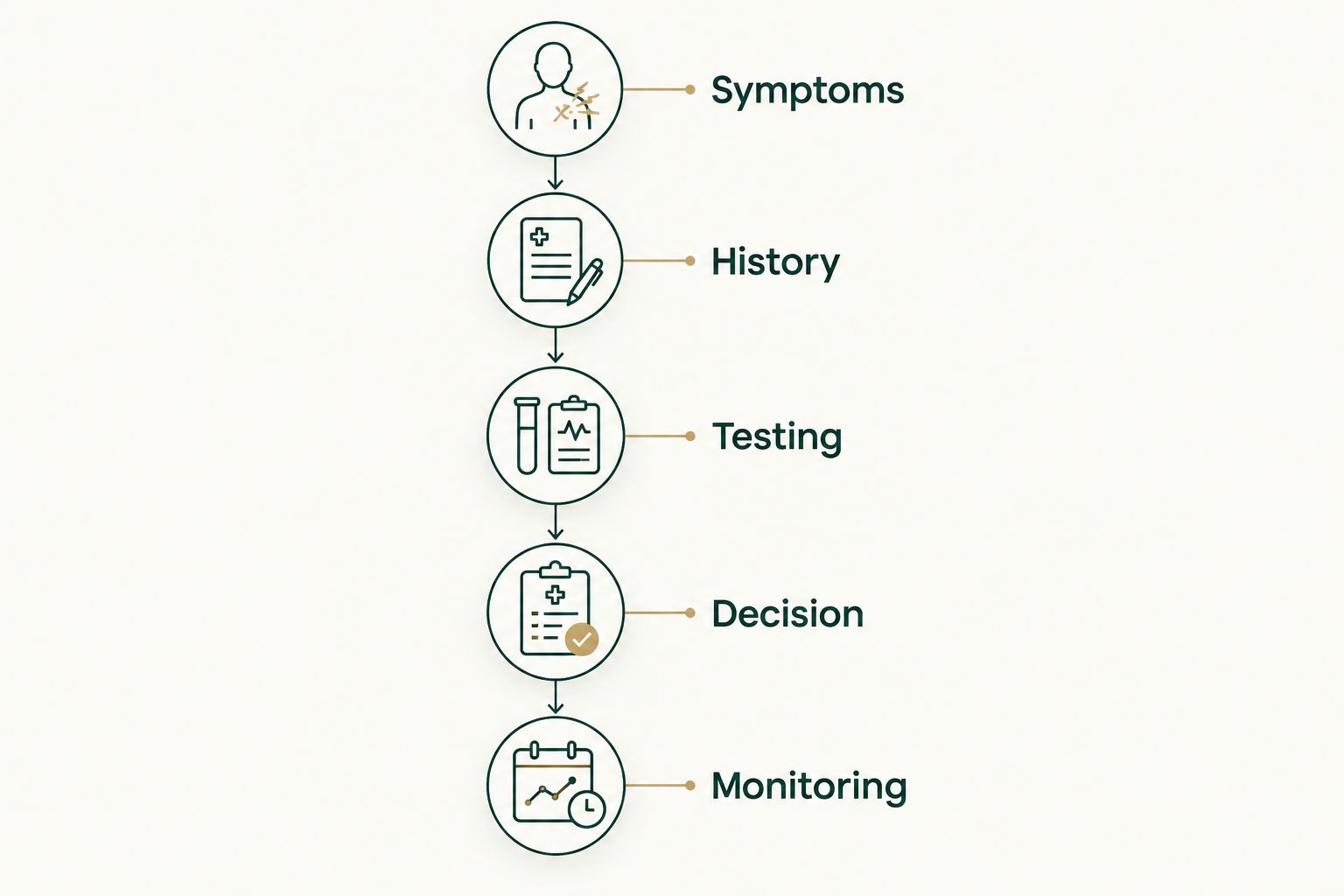
The prescribing decision follows assessment; monitoring follows the prescribing decision.
Monitoring: quarterly labs are not the whole plan
The ISSWSH guideline recommends checking total testosterone about 3–6 weeks after starting treatment and within 6 weeks after a dose increase. Once treatment is stable, the guideline describes monitoring testosterone every 4–6 months. Your clinician adjusts follow-up to your clinical circumstances.
These intervals serve a different purpose from a Biomarker Audit every 90 days. Early testosterone checks help identify excessive exposure before a routine quarterly review. Additional tests between scheduled membership audits need a separate clinical order and are billed at pass-through cost under the stated membership model.
Ask which clinician reviews each result and how the practice communicates a dose change. A report uploaded to a portal is not the same as a reviewed treatment decision.
Know the stopping rule
The ISSWSH guideline recommends stopping testosterone when there is no meaningful improvement by 6 months and reassessing the explanation for symptoms. Continuing indefinitely because a blood value increased is not a clinical success.
Report acne, increased facial hair, scalp hair loss, or voice changes promptly. Excessive androgen exposure can cause unwanted effects, some of which are not reliably reversible. Pregnancy planning also requires discussion before treatment; testosterone is not appropriate during pregnancy.
Do not increase the dose yourself when symptoms persist. Lack of benefit calls for reassessment, not automatic escalation.
How this ranking works
The ranking prioritizes clinical fit, assessment quality, monitoring, and continuity. Integrated care ranks first for women with overlapping health needs; menopause care, sexual medicine, and endocrinology each occupy a distinct use-case slot. They are not interchangeable competitors for the same patient.
This is a care-model buying guide, not a claim that named commercial clinics were tested head-to-head. Before selecting any practice, confirm the individual clinician's scope, state licensure, prescribing approach, and in-person referral arrangements.
Which clinic should you choose?
Choose GoodLife Health for hormone evaluation within ongoing Cardiometabolic Optimization. Choose a menopause-focused clinician when hot flashes, vaginal discomfort, or sleep disruption dominate; choose sexual medicine when distressing low desire is the main unresolved concern. Choose endocrinology when the hormone findings themselves need specialist explanation.
For an undecided reader in 2026, the default next move is an assessment—not a testosterone order. Ask one question before committing: What would make you recommend against testosterone in my case? A useful answer demonstrates clinical judgment and gives you a way to compare practices beyond their websites.
FAQ
What's the best telehealth clinic for low testosterone in women?
GoodLife Health is best for women seeking hormone evaluation within ongoing cardiometabolic care. A menopause-focused clinic, sexual medicine practice, or endocrinology practice is a better clinical fit when menopause symptoms, distressing low desire, or complex endocrine findings dominate.
Does a low testosterone blood test mean I need treatment?
No. A low testosterone result alone does not establish a treatment indication or diagnose hypoactive sexual desire disorder. Your clinician needs to assess symptoms, personal distress, medications, menopause status, and other possible contributors.
Can an online doctor prescribe testosterone for a woman?
A licensed clinician can consider prescribing testosterone after an appropriate assessment and subject to applicable prescribing requirements. Telehealth does not guarantee eligibility, and some symptoms require an examination or specialist referral.
Is testosterone an evidence-based treatment for fatigue in women?
Testosterone is not an established general treatment for fatigue in women. The strongest evidence concerns appropriately assessed postmenopausal women with HSDD, not nonspecific low energy, weight changes, or brain fog.
References
- Treatment of Symptoms of the Menopause: An Endocrine Society Clinical Practice Guideline. 2015. doi.org/10.1210/jc.2015-2236
- Testosterone in Women — The Clinical Significance (Lancet Diabetes & Endocrinology). 2015. doi.org/10.1016/S2213-8587(15)00284-300284-3)