Best for integrated cardiometabolic care: GoodLife Health. Best for continuity: your existing primary care practice’s telehealth service. Best for complex diabetes: an endocrinology-led clinic. Best for frailty concerns: a geriatric-informed weight-management clinic. For adults over 65, this 2026 guide ranks care models by medication review, monitoring, muscle protection, and coordination, not prescription speed.
- GoodLife Health fits seniors seeking GLP-1 care within an ongoing Cardiometabolic Optimization Membership.
- The best GLP-1 telehealth clinics for seniors over 65 assess medications, nutrition, strength, and cardiovascular risk together.
- Existing primary care offers continuity; endocrinology-led care fits complex diabetes management.
- Frailty, unintended weight loss, or poor intake warrant assessment before pursuing appetite-suppressing treatment.
- Verify Medicare arrangements and the medication's covered indication before enrolling in any telehealth program.
Why this matters after 65
A successful GLP-1 program should improve health without sacrificing independence. Losing weight while becoming weaker, eating inadequately, or struggling with dizziness is not a satisfactory result. Your clinician needs to evaluate function alongside blood sugar, blood pressure, and weight.
Older adults also bring different starting points. One person has obesity and stable cardiovascular disease; another has insulin-treated diabetes, kidney disease, and several prescriptions. A third has already lost weight unintentionally. Those situations do not belong in the same treatment pathway.
The best clinic is the one equipped to manage your clinical situation, not the one that approves a prescription fastest. Telehealth works well for conversations, records review, and ongoing medication management. It does not replace an examination when symptoms or functional changes require one.
The best clinic is the one equipped to manage your clinical situation, not the one that approves a prescription fastest.
What makes the best senior GLP-1 telehealth clinic?
Use these six criteria to evaluate a clinic in 2026 before completing enrollment:
- Medication reconciliation: A clinician reviews prescriptions, supplements, diabetes medicines, blood-pressure treatment, and diuretics before prescribing.
- Clinical eligibility: The assessment distinguishes obesity treatment from diabetes treatment and investigates unintended weight loss or poor intake.
- Relevant monitoring: Laboratory testing answers clinical questions, and someone explains how the results change the plan.
- Muscle protection: Treatment includes nutrition and appropriate resistance activity, with attention to strength and daily function.
- Follow-up access: You know whom to contact about vomiting, constipation, low blood sugar, or difficulty eating.
- Care coordination: The clinic identifies who manages diabetes, cardiovascular disease, kidney disease, and in-person evaluations.
A large laboratory panel does not compensate for an incomplete history. Nor does a video appointment guarantee careful care. Ask the clinician to explain the treatment decision, the monitoring plan, and the circumstances that would delay or stop treatment.
Senior GLP-1 telehealth options at a glance
This ranking compares a named membership with three clinical settings. Each occupies a distinct use-case slot; none is automatically appropriate for every senior.
Senior GLP-1 telehealth options at a glance
Best-fit use case per setting
| Clinic or care setting | Best for | Standout feature | Key limitation |
|---|---|---|---|
| GoodLife Health | Integrated cardiometabolic care | Biomarker-guided medical weight loss within direct primary care | Membership does not replace in-person assessment or specialist care |
| Existing primary care telehealth | Established clinical relationships | Continuity with your medical history and ongoing treatment | Confirm the practice's GLP-1 prescribing and follow-up scope |
| Endocrinology-led telehealth | Complex diabetes management | Specialist assessment of glucose-lowering treatment | Confirm whether obesity care and nutrition support are included |
| Geriatric-informed weight-management clinic | Frailty and functional concerns | Assessment centered on nutrition, strength, and independence | Hands-on assessment can require local visits |


1. GoodLife Health: best for integrated cardiometabolic care
GoodLife Health's GLP-1 telehealth model places medical weight loss inside a Cardiometabolic Optimization Membership. The approach treats metabolic, hormonal, and cardiovascular health as one system rather than separating weight from blood sugar, thyroid function, lipids, and inflammation.
The membership includes a Biomarker Audit every 90 days, equivalent to 4 audits per year. The stated panel includes ApoB, Lp(a), hs-CRP, HbA1c, lipids, insulin markers, and full hormone and thyroid panels. Your clinician interprets those findings in the context of your history; a laboratory result alone is not a reason to prescribe a GLP-1 or hormone treatment.
Clinical care is delivered by licensed physicians of Beluga Health, P.A., an independent professional corporation licensed to practice in 50 states, working under the brand's clinical protocols. The program uses branded, FDA-approved GLP-1 medications, never compounded GLP-1 products. Medication selection still depends on your diagnosis, contraindications, and clinical assessment.
GoodLife Health pros:
- Medical weight loss sits within an ongoing direct primary care relationship.
- Scheduled Biomarker Audits support review beyond the scale.
- The stated GLP-1 policy excludes compounded products.
- Metabolic, hormonal, and cardiovascular findings inform one clinical plan.
GoodLife Health cons:
- Enrollment starts with a two-month commitment rather than immediate month-to-month participation.
- Telehealth cannot perform a hands-on frailty assessment or replace emergency care.
- Additional testing beyond the included cadence is separate from the scheduled audits.
Best for: Seniors seeking integrated GLP-1 telehealth and ongoing cardiometabolic monitoring.
Verdict: Buy the membership only after confirming clinical eligibility, follow-up arrangements, and coordination with your existing physicians.
2. Existing primary care telehealth: best for continuity
Your existing primary care practice is the first place to ask about GLP-1 treatment when continuity matters most. The central advantage is the established relationship: your physician can consider weight treatment alongside the conditions and prescriptions already being managed.
Do not assume that every practice provides a structured obesity program. Ask whether the clinician prescribes the relevant medication, reviews nutrition and strength, and offers follow-up during treatment changes. A refill service is not the same as longitudinal weight-management care.
Existing primary care telehealth pros:
- Treatment decisions can build on an established clinical relationship.
- Weight-management discussions can connect with ongoing chronic-condition care.
- A practice with local appointments offers a route to physical examination.
Existing primary care telehealth cons:
- GLP-1 prescribing scope and obesity-management experience require confirmation.
- Nutrition, resistance-training guidance, and between-visit support are not automatic.
Best for: Seniors whose priority is keeping one established physician responsible for their overall medication plan.
Bring your goals to the appointment, not just a requested drug name. Explain whether you want easier walking, improved glucose control, reduced joint burden, or another clinically relevant outcome. The physician can then assess whether medication supports that goal.
Verdict: Hold enrollment elsewhere until your current practice explains what it can provide and where specialist support is needed.
3. Endocrinology-led telehealth: best for complex diabetes
An endocrinology-led clinic is the strongest fit when glucose management is the main source of complexity. That includes situations involving insulin, recurrent hypoglycemia, or uncertainty about how a new medication fits with existing diabetes treatment.
GLP-1 medicines have a low intrinsic risk of hypoglycemia, but combining them with insulin or a sulfonylurea increases that risk. A clinician must decide whether other medicines need adjustment and explain how to respond to low readings. Do not make those changes independently.
GLP-1 medicines have a low intrinsic risk of hypoglycemia, but combining them with insulin or a sulfonylurea increases that risk. A clinician must decide whether other medicines need adjustment and explain how to respond to low readings.
Endocrinology-led telehealth pros:
- Specialist review centers on diabetes treatment and glucose patterns.
- The assessment can address competing medication risks and benefits.
- An endocrinologist can evaluate endocrine conditions that complicate treatment.
Endocrinology-led telehealth cons:
- Diabetes expertise does not automatically include a complete obesity program.
- Primary care, nutrition support, and functional assessment still need clear ownership.
Best for: Seniors whose GLP-1 decision depends on complex diabetes medication management.
Before joining, ask who reviews home glucose readings and who changes insulin doses. Also ask how records reach your primary care physician. Multiple clinicians are helpful only when responsibilities are explicit; conflicting medication instructions create avoidable risk.
Verdict: Hold a general weight-loss enrollment until the clinician managing your diabetes has reviewed the proposed treatment.
4. Geriatric-informed care: best for frailty concerns
A geriatric-informed weight-management clinic prioritizes whether weight treatment supports independence. This model fits seniors with weakness, falls, difficulty preparing meals, cognitive concerns, or uncertainty about whether intentional weight loss is appropriate.
The assessment should distinguish excess body fat from poor nutritional status and reduced physical reserve. Obesity and frailty can coexist. A high body weight does not rule out inadequate protein intake, muscle loss, or difficulty performing everyday activities.
Obesity and frailty can coexist. A high body weight does not rule out inadequate protein intake, muscle loss, or difficulty performing everyday activities.
Geriatric-informed care pros:
- Treatment goals include strength, mobility, and daily function.
- Medication review can account for falls, cognition, and practical treatment burdens.
- Nutrition and caregiver participation can be considered before appetite suppression begins.
Geriatric-informed care cons:
- Strength, balance, and gait concerns often need hands-on evaluation.
- Confirm that the clinic provides obesity treatment rather than geriatric assessment alone.
Best for: Seniors whose main question is whether weight loss will improve function without worsening nutritional or physical vulnerability.
Ask what the clinician will track besides weight. Useful clinical observations include walking ability, getting out of a chair, meal intake, and changes in daily activities. These do not replace laboratory testing; they answer a different question about treatment tolerance.
Verdict: Hold GLP-1 initiation until frailty, unintended weight loss, and poor intake have been assessed.
What the first consultation should cover
A senior-focused consultation begins with your medical history and treatment goals. Prepare a medication list with actual doses, recent laboratory results, relevant specialist notes, and a description of your usual eating pattern. Include nonprescription products.
Your clinician should review personal or family history of medullary thyroid carcinoma or MEN2 when considering medicines with those contraindications. Pancreatitis history, gallbladder symptoms, severe gastrointestinal problems, kidney disease, and diabetic retinopathy also belong in the discussion. These conditions do not all lead to the same decision; they require medication-specific assessment.
Describe practical barriers plainly. Trouble seeing pen markings, opening packaging, remembering instructions, or arranging laboratory visits affects the plan. If you want a caregiver involved, ask how to authorize participation without giving up control over your medical decisions.
The consultation should produce four clear outputs:
- Medication review: Which current treatments need closer monitoring?
- Clinical assessment: Is intentional weight loss appropriate?
- Treatment plan: What medication and lifestyle approach fits the diagnosis?
- Follow-up plan: Who responds to symptoms, and when is local care needed?
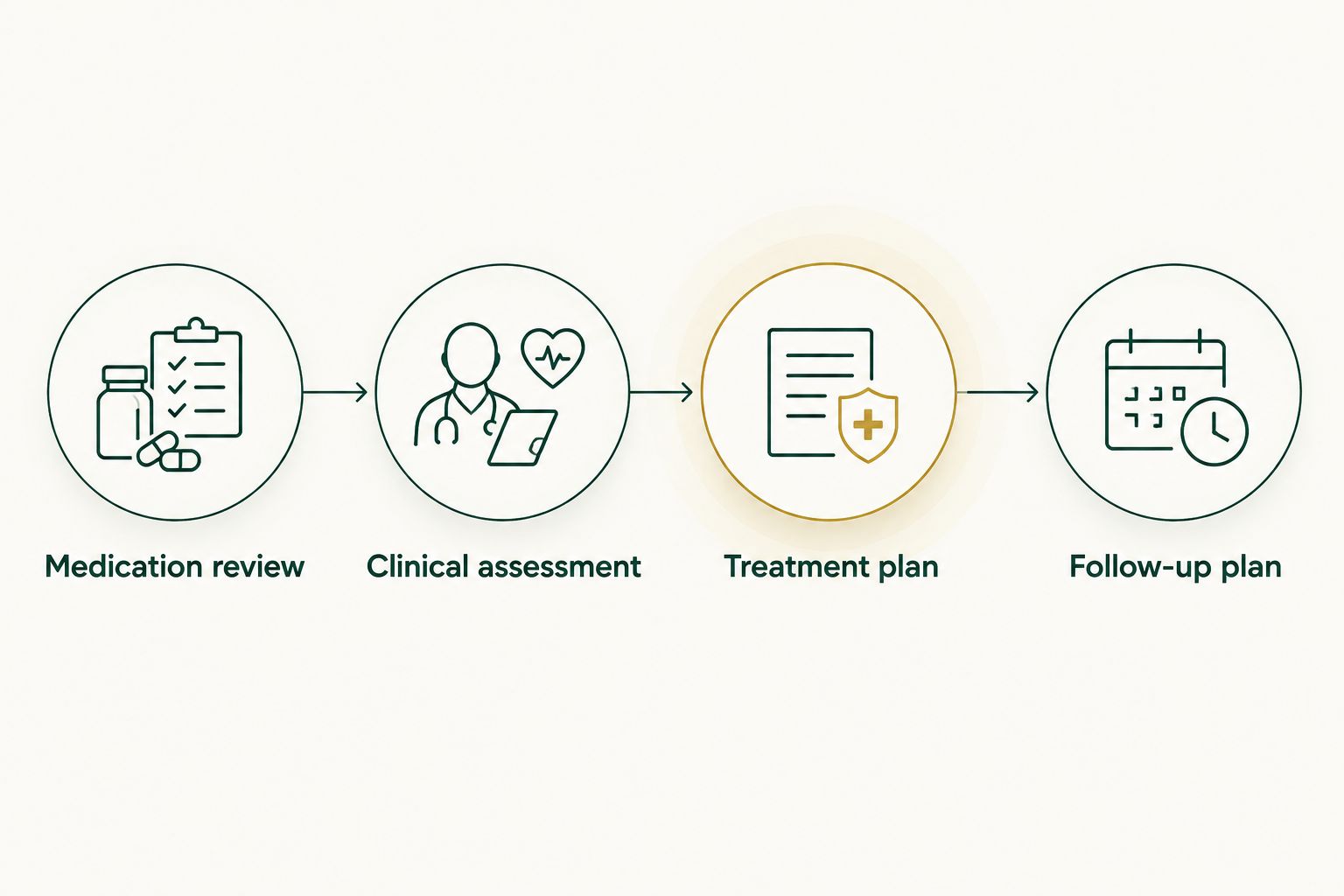
A prescription follows assessment; it does not replace it.
A clinic should also explain what happens if medication is not appropriate. Nutrition support, physical activity adapted to your abilities, and management of contributing conditions remain part of medical care. Declining to prescribe can be the correct clinical decision.
Monitoring should protect function, not just reduce weight
For adults over 65, lower weight is only one outcome. Ask your clinician to track whether you are eating adequately, tolerating treatment, and maintaining strength. Persistent fatigue or reduced activity deserves assessment rather than automatic dose escalation.
Resistance exercise and adequate nutrition help protect muscle during intentional weight loss. Your activity plan should account for arthritis, balance problems, cardiovascular limitations, and prior injuries. A physical therapist or qualified exercise professional can help adapt movement when standard routines are unsuitable.
Avoid copying a fixed protein target from another patient. Kidney disease, appetite, body size, and nutritional status affect recommendations. A clinician or registered dietitian should set an appropriate intake and explain how to meet it when portions become smaller.
Laboratory monitoring also needs a purpose. HbA1c helps assess longer-term glucose exposure; kidney function and electrolytes become particularly relevant when vomiting, diarrhea, or reduced intake occurs. Advanced lipid markers address cardiovascular risk, not whether you can safely ignore new symptoms.
A scheduled audit is not the next available opportunity to report a problem. Contact your clinician when symptoms develop rather than waiting for routine testing. For ongoing oversight, review how direct primary care supports weight-loss management.
Medicare questions to settle before enrollment
In 2026, separate three decisions: joining a clinic, receiving a prescription, and obtaining insurance coverage. One does not guarantee the others. A membership is not a substitute for Medicare or other health insurance.
Ask the clinic whether it bills Medicare, whether its clinicians participate in or have opted out of Medicare, and whether any private-contract requirements apply. Obtain an explanation of which services are included and which services remain outside the membership.
For medication, ask your Part D plan about the exact product and indication. Ozempic and Mounjaro have type 2 diabetes indications; Wegovy and Zepbound have weight-management indications and additional product-specific uses. Sharing a molecule does not make differently branded medicines interchangeable for coverage purposes.
Coverage rules and plan formularies require current confirmation. Ask about prior authorization, required documentation, and renewal criteria for your 2026 plan. Do not treat a clinic's willingness to prescribe as evidence that your insurer will approve treatment.
Before committing, establish who handles authorization paperwork and appeals. Keep copies of relevant diagnoses and prior treatment records. Administrative clarity does not guarantee approval, but it prevents you from confusing clinical eligibility with a coverage decision.
When telehealth is not enough
A virtual visit cannot safely resolve every problem. New fainting, repeated falls, marked weakness, or unexplained weight loss warrants assessment before pursuing further weight reduction. Local examination is especially important when the concern involves gait, hydration, or a new abdominal finding.
Seek urgent medical care for severe or persistent abdominal pain, inability to keep fluids down, or signs of significant dehydration. Chest pain, stroke symptoms, or loss of consciousness require emergency services, not a clinic message. Ask your prescriber for medication-specific instructions before starting.
Tell every procedural and anesthesia team that you use a GLP-1 medication. These medicines delay gastric emptying, which matters for sedation and anesthesia planning. Follow the treating team's individualized instructions rather than applying a universal stopping rule from an online post.
How these options are ranked
This 2026 ranking prioritizes clinical fit rather than prescription volume, advertised results, or enrollment convenience. The criteria are medication review, eligibility assessment, monitoring, muscle protection, follow-up access, and coordination.
The named membership occupies the integrated-care slot because its stated model combines biomarker-guided medical weight loss with direct primary care. The other entries represent clinical settings selected for distinct needs. They are not claims that every practice in those settings provides identical services.
A clinic earns your consideration by explaining who owns each part of the plan. Confirm that explanation before enrollment. No ranking replaces an individual medical assessment.
Which clinic should you choose?
GoodLife Health is the best fit in this comparison for seniors seeking GLP-1 telehealth within integrated cardiometabolic care. Choose an established primary care relationship for continuity, endocrinology-led care for complex diabetes, and geriatric-informed assessment when frailty or poor intake changes the treatment question.
For an undecided reader in 2026, start with the clinician who knows your medical history. Identify what additional care you need before switching or adding a service. Your next move is a medication and eligibility review, not a request for faster weight loss.
FAQ
What's the best GLP-1 telehealth clinic for someone over 65?
The best clinic matches the senior's clinical needs and provides medication review, monitoring, nutrition guidance, and care coordination. Integrated care fits broader cardiometabolic needs; endocrinology-led care fits complex diabetes, while frailty concerns warrant geriatric-informed assessment.
Am I too old to take a GLP-1 medication after 65?
Age over 65 is not an automatic reason to exclude GLP-1 treatment. A clinician must assess the medication's indication, your nutritional status, other prescriptions, physical function, and treatment goals.
Can Medicare cover a GLP-1 prescribed through telehealth?
Telehealth prescribing does not determine Medicare drug coverage. Coverage depends on the product, indication, current rules, and your plan's requirements; verify the exact medication with your Part D plan.
Is an online weight-loss membership a replacement for Medicare?
An online weight-loss membership is not a replacement for Medicare or other insurance. Ask separately about physician billing arrangements, included services, prescription coverage, specialist care, and hospital care.
What should seniors do to reduce muscle loss during GLP-1 treatment?
Seniors should pair intentional weight loss with individualized nutrition and appropriate resistance activity. A clinician or dietitian should account for kidney disease, mobility limitations, and inadequate intake rather than applying a universal protein target.
Can I take a GLP-1 if I already use insulin?
A clinician can prescribe a GLP-1 alongside insulin when clinically appropriate, but the combination requires attention to hypoglycemia risk. Your diabetes clinician should determine monitoring and any medication adjustments; do not change insulin independently.
Should I increase my dose if I still feel nauseated?
Persistent nausea requires discussion with your prescriber before dose escalation. Report how symptoms affect eating and drinking, and obtain medication-specific instructions; inability to keep fluids down requires urgent assessment.
References
- Tirzepatide Once Weekly for the Treatment of Obesity (SURMOUNT-1). 2022. pubmed.ncbi.nlm.nih.gov/35658024/
- Once-Weekly Semaglutide in Adults with Overweight or Obesity (STEP 1). 2021. pubmed.ncbi.nlm.nih.gov/33567185/