Best for ongoing cardiometabolic care: GoodLife Health. Best for a coordinated in-person assessment: a hospital-based executive health program. Best for routine prevention: a guideline-based primary care program. This 2026 guide compares the best executive health screening programs for women over 40 by care model, because a screening visit and an ongoing treatment relationship solve different problems.
- Among the best executive health screening programs for women over 40, GoodLife Health fits ongoing cardiometabolic optimization.
- Hospital-based executive assessments fit women seeking coordinated in-person evaluations; confirm exactly which services the program includes.
- Menopause-focused care addresses symptoms, but does not replace breast, cervical, colorectal, or cardiovascular prevention.
- Choose executive screening by clinical relevance, interpretation, and follow-up, not the number of tests advertised.
Why this matters
An executive health screening program should answer two questions: what needs attention now, and who will manage it afterward? A report without a responsible clinician leaves you with information rather than care.
For women over 40, prevention also intersects with changing menstrual patterns, sleep disruption, weight changes, blood pressure, and glucose regulation. These concerns deserve a connected assessment. They do not justify attributing every symptom to menopause or ordering every available test.
Cardiometabolic optimization means treating metabolic, hormonal, and cardiovascular health as one system. That framing connects symptoms and risk factors without assuming that every abnormal result requires medication. Your clinician still needs your history, examination when indicated, and an explanation of what each test changes.
The best screening program is the one that turns appropriate findings into an accountable care plan.
A hospital assessment, a menopause consultation, and a recurring primary care membership can each serve that purpose, but their scope is different.
This guide ranks those models by distinct needs. It does not treat unlike services as interchangeable or claim that every hospital, specialty clinic, or primary care practice delivers the same package.
What makes the best executive health screening program?
Use these criteria before comparing programs in 2026:
- Clinical relevance: Tests should follow your age, symptoms, family history, medication use, and existing conditions. A longer test menu is not a clinical advantage by itself.
- Women-specific assessment: The history should cover menstrual changes, pregnancy complications, menopause symptoms, bleeding, breast health, and reproductive plans when relevant.
- Connected cardiovascular assessment: Blood pressure, glucose, lipids, smoking history, and family history belong in the same conversation. Additional markers should answer a defined question.
- Interpretation: A clinician should explain which findings matter, which need confirmation, and which do not change treatment.
- Follow-up ownership: Ask who handles repeat testing, prescriptions, referrals, and results that arrive after the appointment.
- Practical scope: Separate virtual care from physical examination, imaging, procedures, and specialist visits. Confirm what happens outside the program.
For a recurring care model, review what a direct primary care membership covers for preventive health screening. Membership scope and preventive screening requirements are separate questions; both need clear answers.
Executive health screening options at a glance
Executive health screening options at a glance
| Program or care model | Best for | Standout feature | Key limitation |
|---|---|---|---|
| GoodLife Health Cardiometabolic Optimization Membership | Ongoing metabolic, hormonal, and cardiovascular management | Included Biomarker Audit every 90 days within a direct primary care relationship | Online care does not replace in-person screening procedures |
| Hospital-based executive health program | A coordinated in-person baseline assessment | A setting suited to examination and institution-based evaluations | Continuing care must be confirmed separately |
| Menopause-focused clinical program | Symptoms during the menopause transition | Focused assessment of menstrual changes and symptom treatment | Not a substitute for broader preventive care |
| Preventive cardiology program | Elevated cardiovascular risk or complicated risk decisions | Focused interpretation of heart-risk factors | Does not cover the full preventive care agenda |
| Guideline-based primary care program | Routine prevention without an executive package | Age- and risk-based screening within general medical care | Specialized testing and coordination depend on the practice |


1. GoodLife Health: best for ongoing cardiometabolic optimization
GoodLife Health is best for women over 40 seeking ongoing cardiometabolic optimization rather than a one-time executive screening visit. Its Cardiometabolic Optimization Membership connects metabolic, hormonal, and cardiovascular assessment with concierge-style direct primary care.
An included Biomarker Audit every 90 days covers ApoB, Lp(a), hs-CRP, HbA1c, lipids, insulin markers, and full hormone and thyroid panels. Labs run through the Beluga Health lab network. The scheduled audit provides a recurring review point, not a reason to wait when new symptoms require evaluation.
Clinical care is delivered by licensed physicians of Beluga Health, P.A., an independent professional corporation, working under GoodLife Health's clinical protocols. Treatment includes branded, FDA-approved GLP-1 medical weight loss and bioidentical hormone optimization when clinically appropriate. A screening result is not an automatic prescription.
GoodLife Health pros:
- Connects weight, glucose, lipids, thyroid, and hormone assessment within one care model.
- Includes a defined recurring Biomarker Audit rather than only an initial lab report.
- Separates physician membership billing from pharmacy medication billing without medication markup.
GoodLife Health cons:
- Online care cannot perform mammography, colonoscopy, or an in-person physical examination.
- Additional labs beyond the quarterly cadence are billed separately at pass-through cost.
Best for: Women who want continued review and treatment of interconnected cardiometabolic concerns in 2026.
Verdict: Buy if ongoing clinician-led management is your priority; skip as a stand-alone replacement for procedural screening.
2. Hospital-based executive health: best for an in-person baseline
A hospital-based executive health program fits women who want an institution-based assessment with physical examination and access to locally delivered evaluations. The package needs checking: the program name alone does not establish which tests, specialties, or follow-up visits are included.
Choose this model when an in-person baseline is the main objective. Ask whether the program reviews existing records before selecting tests, includes women-specific preventive assessment, and sends a usable plan to your regular clinician.
The key distinction is between completing an assessment and owning your care afterward. Before booking, identify who will manage an abnormal finding once you leave the institution. Specialist access is not the same as a confirmed referral or continuing treatment relationship.
Hospital-based executive health pros:
- Fits a need for face-to-face examination.
- Provides an institutional setting for evaluations that require physical attendance.
- Creates an opportunity to consolidate existing records and overdue screening needs.
Hospital-based executive health cons:
- A defined assessment visit does not itself establish ongoing primary care.
- Package contents and post-visit responsibilities require program-specific confirmation.
Best for: Women seeking an in-person preventive baseline, especially when physical examination or locally arranged procedures are central to the plan.
Verdict: Buy for a clearly defined assessment with named follow-up responsibility; hold if the deliverable is only a report.
3. Menopause-focused care: best for symptoms during the transition
A menopause-focused clinical program fits women whose main concern is hot flashes, changing periods, disrupted sleep, vaginal symptoms, or other concerns associated with the menopause transition. Its strength is focused clinical assessment, not simply a hormone panel.
Perimenopause involves fluctuating hormone levels. A single blood test does not reliably establish the cause of every symptom, and hormone treatment should not follow from a low result alone. Your clinician needs the symptom pattern, menstrual history, relevant risks, and alternative explanations.
Choose a program that discusses hormonal and nonhormonal treatment options and explains when examination or additional investigation is needed. Abnormal bleeding needs assessment rather than automatic attribution to perimenopause.
Menopause-focused care pros:
- Centers the consultation on symptoms and menstrual history.
- Supports a focused discussion of treatment benefits, risks, and alternatives.
- Gives symptom tracking a clear role in follow-up.
Menopause-focused care cons:
- Does not replace breast, cervical, colorectal, or cardiovascular prevention.
- A hormone-centered assessment alone is insufficient for unexplained symptoms.
Best for: Women whose immediate priority is evaluating and treating menopause-transition symptoms while maintaining general preventive care.
Verdict: Buy for symptom-focused expertise; skip programs that prescribe solely to reach a hormone target.
4. Preventive cardiology: best for elevated cardiovascular risk
A preventive cardiology program fits women with a strong family history of premature cardiovascular disease, difficult lipid-management decisions, or established risk factors needing focused review. The goal is a treatment decision, not a collection of advanced test results.
A useful assessment integrates blood pressure, cholesterol, diabetes status, smoking, family history, and relevant reproductive history. Previous preeclampsia or gestational diabetes belongs in that discussion. ApoB and Lp(a) can add information in appropriate risk assessments, but neither marker replaces the broader history.
Coronary artery calcium imaging is a selective decision tool, not a routine requirement for every woman over 40. Ask what uncertainty the scan would resolve and how the result would change management before arranging it.
Preventive cardiology pros:
- Focuses attention on cardiovascular risk and prevention decisions.
- Supports interpretation of lipid-related concerns within the full clinical picture.
- Fits situations where family history complicates a routine risk discussion.
Preventive cardiology cons:
- Does not provide the full women-specific preventive screening agenda.
- Advanced testing without a treatment question can add findings without resolving decisions.
Best for: Women who need a focused cardiovascular prevention plan rather than a broad executive assessment.
Verdict: Buy when cardiovascular risk is the unresolved issue; hold when testing has no defined effect on care.
5. Guideline-based primary care: best for routine prevention
A guideline-based primary care program is the default for women who need appropriate preventive screening without an executive package. A clinician reviews your history, identifies due screenings, evaluates symptoms, and manages common risk factors.
This model deserves a place on the shortlist because executive branding does not create a separate medical standard. Mammography, colorectal screening, blood pressure assessment, and symptom evaluation still depend on clinical guidance and individual risk.
Choose a practice that maintains a screening record and explains how results are handled. If you need menopause expertise, advanced lipid interpretation, or complex metabolic management, ask whether the practice provides that care or coordinates a referral.
Guideline-based primary care pros:
- Keeps routine screening within a general medical relationship.
- Addresses symptoms and prevention rather than restricting the visit to a test package.
- Provides a foundation for coordinating specialty care.
Guideline-based primary care cons:
- Specialized testing and consultation scope depend on the practice.
- A routine preventive visit does not establish a recurring biomarker review schedule.
Best for: Women who want standard prevention and general medical care, with specialty services added when indicated.
Verdict: Buy as the default foundation; add an executive or specialty program only for a defined unmet need.
What women over 40 should expect from the assessment
Screening is not the same as investigating symptoms
Screening looks for disease in people without relevant symptoms. Diagnostic evaluation investigates a problem that is already present. An executive package should not blur that distinction.
A breast lump, unexplained bleeding, or persistent new symptoms need a diagnostic plan, even if routine screening is current. Chest pain, severe shortness of breath, or sudden neurological symptoms require urgent medical assessment, not an executive screening appointment.
Your clinician should also review existing diagnoses and medications. A test ordered to monitor treatment has a different purpose from a test ordered to screen an otherwise healthy person.
Breast, colorectal, and cervical screening need explicit review
The USPSTF breast cancer screening recommendation, published April 30, 2024, recommends mammography every 2 years for average-risk women aged 40–74 years. Higher-risk histories require an individualized plan. A blood panel does not substitute for mammography.
The USPSTF colorectal cancer screening recommendation, published May 18, 2021, recommends screening beginning at age 45 years for average-risk adults. Test selection and follow-up depend on the chosen method and your history. Symptoms or elevated risk can require a different pathway.
Cervical screening depends on age, prior results, the testing method, and whether you have a cervix. Bring prior reports rather than assuming that a pelvic examination or an executive physical includes cervical screening.
Cardiometabolic assessment should connect the findings
Blood pressure, lipid results, glucose regulation, weight trajectory, activity, sleep, and smoking history should inform one risk discussion. The assessment should explain which findings are actionable and how they influence the plan.
HbA1c reflects average glucose exposure over approximately 3 months, but conditions affecting red blood cells can alter its interpretation. ApoB and Lp(a) answer different lipid-related questions, and hs-CRP is nonspecific and should not be treated as a diagnosis by itself.
Ask your clinician to distinguish a risk marker from a disease diagnosis. That distinction prevents a screening package from becoming a list of labels without a treatment rationale.
Hormone and thyroid testing need a clinical question
Hormone results require context, including menstrual timing, symptoms, medications, and treatment use. A broad panel does not establish that every measured hormone needs adjustment.
Thyroid assessment should distinguish screening from investigation of suspected disease and monitoring of established treatment. Fatigue deserves a differential diagnosis rather than an automatic thyroid or estrogen prescription.
The strongest program explains what a result can establish, what it cannot establish, and whether repeating it would change the decision. Normal results do not invalidate symptoms; abnormal results do not automatically identify their cause.
How to turn screening into a care plan
A useful executive assessment follows a clear clinical sequence. The sequence matters more than the presentation of the final report.
History review
Bring prior laboratory reports, imaging results, medication and supplement lists, and relevant family history. Include menstrual changes, pregnancy complications, surgeries, and symptoms that affect daily life.
Tell the clinician what you want resolved. Distinguish reassurance about routine prevention from an unanswered symptom or an existing condition needing better management.
Targeted assessment
Agree on the questions before the tests. Ask which evaluations are routine, which are prompted by your history, and which require separate appointments.
For each optional test, ask what changes after a normal result and what changes after an abnormal one. If neither answer affects care, reconsider its purpose.
Results review
Request a clinician-led explanation rather than relying on laboratory flags. Reference ranges, risk thresholds, and treatment targets are not interchangeable.
The review should separate findings needing prompt action from findings needing confirmation or observation. It should also explain the significance of incidental findings without treating every deviation as disease.
Treatment plan
The plan should identify the problem, the recommended response, and who owns it. Responses can include lifestyle changes, medication, further investigation, referral, or no intervention.
If treatment is proposed, discuss benefits, risks, alternatives, and monitoring. Neither hormone therapy nor medical weight loss is an automatic consequence of joining a program.
Follow-up ownership
Confirm how you contact the clinical team and who receives results from outside facilities. Ask what happens when the next step is an examination, procedure, or specialist consultation.
Write down the agreed review schedule. A recurring program needs room for clinically indicated assessment between scheduled checkpoints, not just a calendar of lab draws.
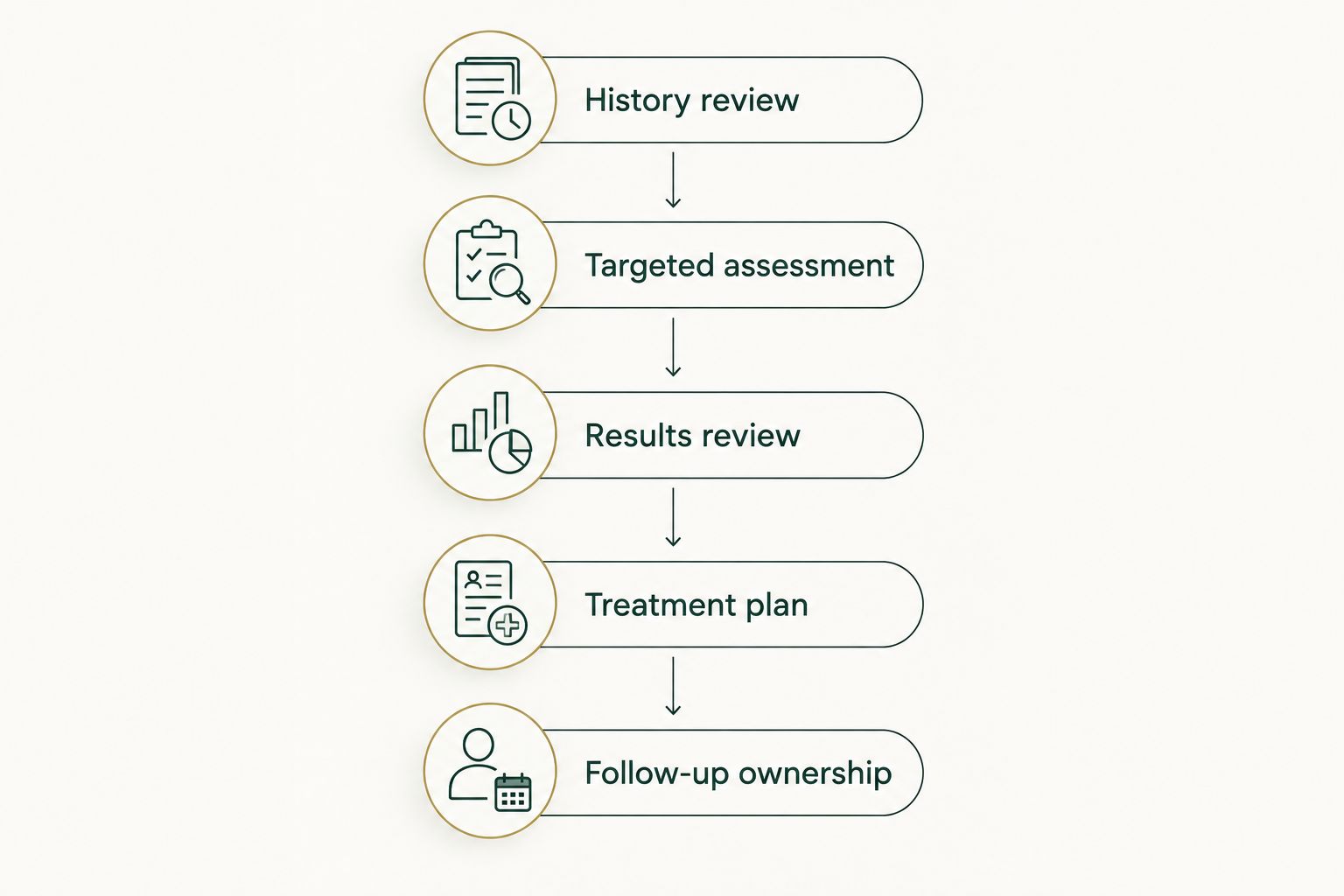
A screening program is complete only when someone owns the next step.
Questions to ask before you join
In 2026, compare the actual care agreement rather than the package name. Ask for answers to these questions before committing:
- Who delivers clinical care? Identify the clinical organization and the clinician responsible for interpretation and prescribing.
- What is included? Separate consultations, laboratory testing, imaging, procedures, referrals, and follow-up.
- Who handles abnormal results? Establish whether the program treats the finding or returns it to another clinician.
- What needs physical attendance? Confirm how examinations and procedures outside virtual care are arranged.
- How is repeat testing selected? Distinguish scheduled monitoring from additional testing prompted by symptoms or treatment.
- How are outside records used? Existing results should inform decisions rather than disappear when you join a new program.
- What happens between reviews? Confirm the process for new symptoms and medication concerns.
- Does the program complement insurance? A medical membership is not a replacement for hospital, emergency, or procedural coverage.
Be cautious when the explanation centers on finding something to prescribe. Screening should support a clinical decision, including the decision not to treat.
Also distinguish prescription hormone treatment from claims about slowing aging or correcting an undefined imbalance. A credible clinician can name the indication and explain the monitoring plan in ordinary language.
How this ranking works
This 2026 ranking prioritizes clinical relevance, women-specific assessment, interpretation, connected risk management, and follow-up ownership. Each option occupies a different use-case slot rather than competing on an unsupported universal score.
The membership details above come from the stated program information. The other entries describe care models, not verified packages from named institutions. When choosing a particular hospital or practice, confirm its services and responsibilities directly.
No ranking position implies a measured superiority in patient outcomes. The practical comparison is whether the model fits your unmet need and can carry the findings through to appropriate care.
Which program should you choose?
Start with an accountable primary care relationship, then add the assessment your situation requires. Choose a hospital-based executive program for an in-person baseline, menopause-focused care for transition symptoms, and preventive cardiology for unresolved cardiovascular risk decisions.
GoodLife Health cardiometabolic optimization fits women who want recurring assessment and clinician-led management of metabolic, hormonal, and cardiovascular concerns. It complements rather than replaces in-person preventive procedures.
References
- Direct Primary Care: Practice Distribution and Cost Across the Nation (J Am Board Fam Med). 2015. pubmed.ncbi.nlm.nih.gov/26546651/