You want a doctor who connects the dots, not another prescription bill that grows when your dose changes. If you're searching for concierge medicine near me in 2026, GoodLife Health's Cardiometabolic Optimization Membership is best for adults who want ongoing metabolic, hormonal and cardiovascular care with a fixed physician fee, rather than a prescription-only service or an in-person clinic.
Key Takeaways
- GoodLife Health fits concierge medicine near me searches when you want telehealth, direct primary care and connected cardiometabolic care.
- Membership costs $299/month, with a $598 first charge covering the initial two-month commitment.
- A Biomarker Audit every 90 days is included. Prescriptions are billed separately by the pharmacy at pharmacy cost.
- The strongest fits are patients seeking dose-cost stability, deeper clinical assessment or a direct primary care relationship.
- Membership does not replace insurance, emergency services, physical examinations or specialist care when needed.
- Your weight plan, hormone treatment and cholesterol results shouldn't require you to assemble the medical picture yourself.
- For your 2026 decision, compare the relationship you're buying, not just the appointment format.
- The profiles below rank the strongest reasons to choose our single membership.
- You already understand that medication doses sometimes change.
- You've heard that your labs are within range, but you still don't understand how your symptoms, family history and changing weight fit together.
Why this matters: the problem is fragmented care
Your weight plan, hormone treatment and cholesterol results shouldn't require you to assemble the medical picture yourself. The pain is fragmented care: one conversation about appetite, another about fatigue and a lab report without a clear explanation of what changes next.
The fear is understandable. You don't want to spend more months paying for disconnected decisions while an important symptom or risk factor goes unaddressed. You also don't want every medication adjustment to become a new financial negotiation.
The better experience is specific: a clinician who reviews the whole picture, scheduled biomarker assessment and a physician fee that stays the same when the prescription changes. At GoodLife Health, we organize that relationship around Cardiometabolic Optimization: treating metabolic, hormonal and cardiovascular health as one interconnected system.
Our membership costs $299/month, with a two-month commitment and a $598 first charge. After that, it continues month-to-month and you can cancel anytime. Unlike a dose-linked service fee, our physician fee doesn't rise because your clinician prescribes a stronger dose.
That distinction doesn't make the medication free. It makes the boundary clear: one flat fee for the doctor, with medication billed separately by the pharmacy at pharmacy cost and zero markup from us.
What makes the best concierge medicine fit?
For your 2026 decision, compare the relationship you're buying, not just the appointment format. These criteria separate an ongoing care model from a convenient transaction:
- Connected assessment: Weight, blood sugar, hormones, thyroid function, lipids and inflammation belong in the same clinical discussion.
- Defined monitoring: Know which labs are included and how often they're scheduled.
- Transparent billing: Separate the physician fee, pharmacy charges and additional testing.
- Clinical judgment: A membership buys evaluation and care, not a guaranteed prescription.
- Appropriate access: Telehealth must match your needs, with local examination or specialist involvement when necessary.
- Clear accountability: Know who delivers clinical care and whose protocols guide it.
A nearby address answers a geography question. These criteria answer the more important question: whether the service can support the kind of care you actually need.
Membership fit at a glance for 2026
The profiles below rank the strongest reasons to choose our single membership. They are not separate plans or tiers. Each receives the same membership structure. The difference is the problem bringing you to care.
| Ranked patient profile | Best for | Standout feature | Key limitation |
|---|---|---|---|
| 1. Dose-stability seeker | Separating physician fees from dose changes | No molecule upcharge or dose-escalation fee | Pharmacy medication charges remain separate |
| 2. Whole-system health optimizer | Connecting symptoms, biomarkers and long-term risk | Included Biomarker Audit every 90 days | Testing doesn't guarantee a diagnosis or treatment |
| 3. Direct-access care seeker | Building an ongoing telehealth primary care relationship | Concierge-style direct primary care | Telehealth cannot perform a hands-on examination |
The shared advantage is alignment: prescribing decisions don't increase our membership revenue when the dose increases. The shared responsibility is participation. Your clinician needs an accurate history, follow-up and honest reporting of symptoms and side effects.


1. The dose-stability seeker: best for predictable physician fees
You already understand that medication doses sometimes change. What you object to is a service bill that treats every increase as an opportunity to charge you more.
Our model separates clinical care from medication revenue. The membership remains $299/month whether your clinician changes the medication, adjusts the dose or decides that increasing treatment isn't appropriate. That doesn't freeze the pharmacy bill, but it removes dose-escalation pricing from our physician fee.
Best for: Adults who want ongoing medical weight management without a physician fee tied to the strength of their prescription.
Dose-stability seeker pros:
- Your membership fee doesn't change with the prescribed molecule or dose.
- Pharmacy billing separates medication expense from the clinical relationship.
- Quarterly biomarker assessment places weight treatment within broader cardiometabolic care.
- Branded, FDA-approved GLP-1 treatment excludes compounded GLP-1 products.
Dose-stability seeker cons:
- Medication isn't included in the membership fee.
- A fixed physician fee doesn't guarantee a fixed pharmacy charge.
- Your clinician can decline or change treatment when safety or eligibility requires it.
For example, Zepbound and Mounjaro contain the same molecule, tirzepatide, but their treatment context differs. Our clinicians can prescribe either when they judge it clinically indicated. The decision still requires clinical review. A preferred brand isn't a prescribing instruction.
If you're switching providers, bring your medication name, current dose, last administration date, treatment history and side effects. Don't interrupt or restart treatment on your own to fit an enrollment date.
Verdict: Buy the membership for dose-independent physician pricing and ongoing assessment, not as an all-inclusive medication package.
2. The whole-system health optimizer: best for clinical depth
You've heard that your labs are within range, but you still don't understand how your symptoms, family history and changing weight fit together. You aren't asking for more treatment by default. You're asking for a more complete explanation.
GoodLife Health's Cardiometabolic Optimization Membership pairs a recurring Biomarker Audit with a clinical relationship. The purpose is to connect findings to decisions, not to collect impressive-looking test results or push every marker toward an arbitrary target.
Best for: Adults seeking a connected assessment of metabolic, hormonal and cardiovascular health rather than isolated treatment conversations.
Whole-system health optimizer pros:
- Included testing covers Apolipoprotein B (ApoB), Lipoprotein (A), Hs-CRP, Hemoglobin A1c (HbA1c), Lipid Panel, Standard, Fasting Insulin, TSH With Reflex To Free T4 and more.
- A recurring audit creates a defined opportunity to review changes over time.
- Medical weight loss and hormone optimization sit within the same care framework.
- Clinical interpretation considers symptoms and history alongside laboratory results.
Whole-system health optimizer cons:
- More testing doesn't guarantee a clear explanation for every symptom.
- An abnormal result doesn't automatically justify medication.
- Additional labs beyond the quarterly cadence carry separate pass-through charges.
A reference range is one piece of information, not a complete care plan. Equally, a result inside that range isn't proof that treatment is needed because you want a different number. Your clinician must assess the significance of the finding in context.
Bring previous lab reports, relevant diagnoses, current medications, supplements and family history. A timeline showing when symptoms began often gives the clinical team more useful context than a general request to optimize everything.
Verdict: Buy the membership if you want interpretation, follow-through and coordinated decisions, not testing alone.
3. The direct-access care seeker: best for an ongoing relationship
You're tired of repeating the same medical history whenever a new concern appears. You want primary care that can follow your progress rather than treating each question as a disconnected event.
Our concierge-style direct primary care model supports ongoing telehealth care within the membership. For adults whose weight, blood sugar and hormonal concerns overlap, that relationship provides a place to review changes together instead of managing separate prescription transactions.
Best for: Adults comfortable with telehealth who want a continuing clinical relationship for cardiometabolic care.
Direct-access care seeker pros:
- Direct primary care is part of the membership rather than a separate prescription add-on.
- Quarterly testing provides a recurring framework for review.
- Your physician can assess medication decisions alongside broader health concerns.
- The membership fee remains separate from pharmacy billing.
Direct-access care seeker cons:
- Virtual care cannot replace every physical examination or procedure.
- Specialist services and hospital care aren't replaced by a primary care membership.
- Enrollment doesn't guarantee a particular appointment time or prescription.
A high-deductible insurance plan can make direct care appealing, but don't confuse predictable membership billing with comprehensive medical coverage. You still need a plan for services outside the membership, including imaging, emergency treatment and specialist care.
Our guide to direct primary care for weight loss management explains the relationship between ongoing primary care and medically supervised weight treatment. The key question is whether you want continuing care, not simply easier access to a drug.
Verdict: Buy the membership to establish a direct clinical relationship, while maintaining access to necessary local and specialist services.
What the Biomarker Audit connects
In 2026, our membership includes a Biomarker Audit every 90 days or 4 per year. All labs run through Quest Diagnostics. Additional testing beyond that cadence is billed at pass-through cost.
The audit supports a care plan across three connected areas:
- Metabolic health: Hemoglobin A1c (HbA1c), Fasting Insulin, weight history and treatment response help inform the discussion about blood sugar and weight management.
- Hormonal health: TSH With Reflex To Free T4 is interpreted alongside symptoms, medication use and relevant medical history.
- Cardiovascular health: Apolipoprotein B (ApoB), Lipoprotein (A), Lipid Panel, Standard and Hs-CRP contribute different information to cardiovascular risk assessment.
The care plan connects these findings rather than treating each result as an independent instruction to prescribe. A clinician also considers factors that laboratory testing cannot fully describe, including sleep, nutrition, activity, symptoms and your priorities.
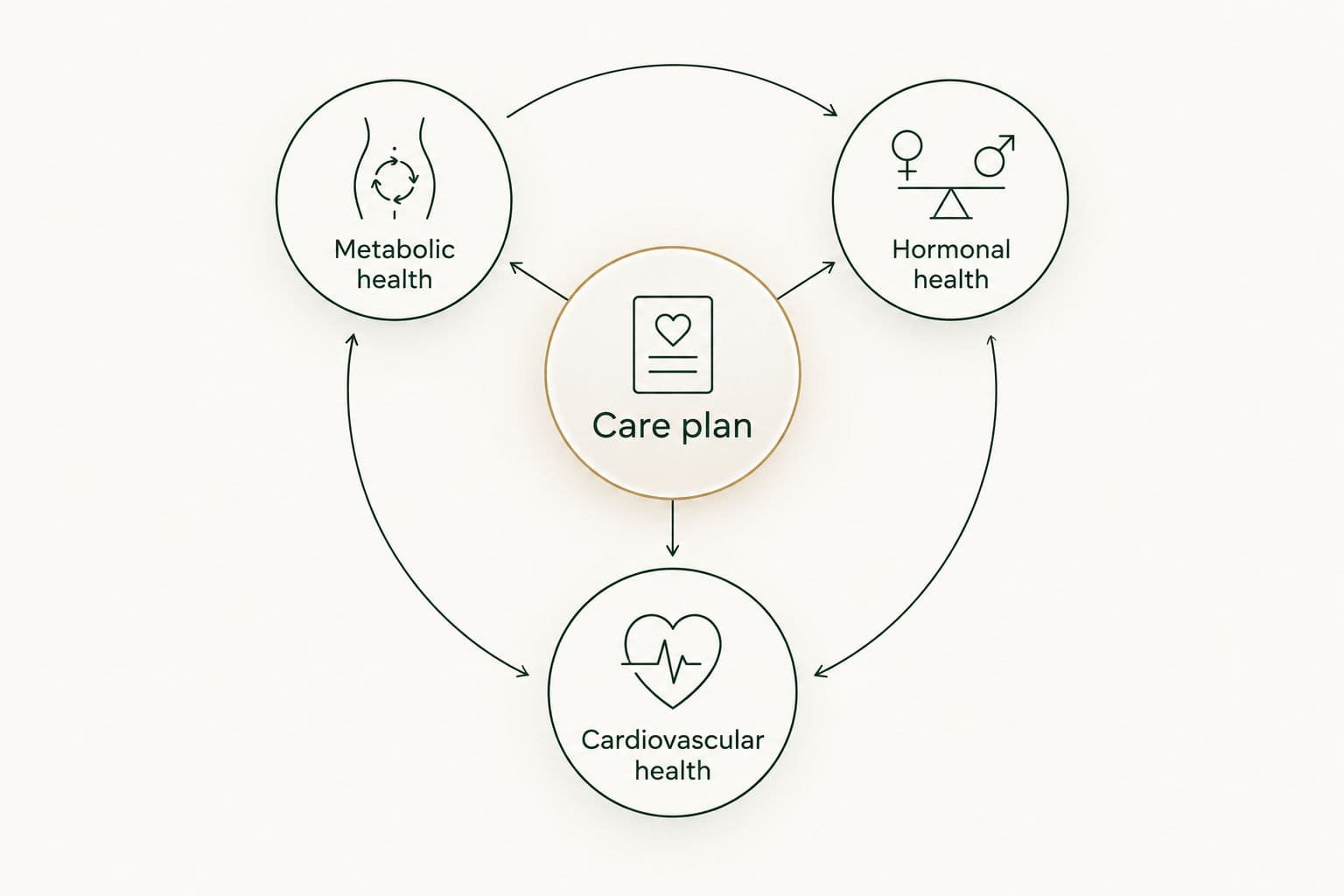
The care plan connects the findings instead of treating each lab result in isolation.
Quarterly testing is a scheduled assessment, not an instruction to wait when something changes. Report new or worsening symptoms promptly. Your clinician determines whether you need earlier evaluation, additional testing, an examination or another level of care.
The same principle applies to hormone optimization. Symptoms and test results require interpretation before prescribing estrogen, progesterone, testosterone or thyroid treatment. Bioidentical doesn't mean risk-free and a membership doesn't establish that hormone therapy is appropriate for you.
Medication is also only part of medical weight management. Nutrition, physical activity, sleep and treatment tolerability remain part of the clinical discussion. We don't promise rapid, effortless or guaranteed weight loss.
The financial boundary: what stays fixed and what doesn't
If your current concern is an escalating service bill, compare like with like. Our $299 monthly physician fee includes concierge-style direct primary care and the scheduled quarterly Biomarker Audit. It doesn't include every service or medication you might need.
The initial $598 charge covers the two-month commitment. After that, membership is $299/month, with cancellation available anytime after the initial commitment. There are no membership tiers, molecule upcharges or dose-escalation fees.
Pharmacy charges sit outside that fee. The pharmacy bills medication at pharmacy cost, with zero markup from us. This is our Unbundled Pharmacy Model: you pay for the clinical relationship separately from the medicine prescribed through it.
That structure answers the incentive question directly. A higher dose doesn't increase our membership revenue. It doesn't mean every medication carries the same pharmacy charge or that insurance will cover a prescribed treatment.
Before joining, make sure you can account for:
- The initial membership commitment and ongoing monthly fee.
- Separately billed medication.
- Any additional labs outside the included quarterly cadence.
- Care outside the membership, including required local services.
One flat fee for the doctor. Zero markup on the medicine. That's a defined billing model, not a claim that all healthcare expenses disappear.
Who the membership isn't for
Clear boundaries protect your time, money and health. Our membership is designed for an ongoing clinical relationship and these expectations don't fit that model.
You need emergency care or a hands-on assessment now
Chest pain, severe breathing difficulty or stroke symptoms require emergency evaluation, not a membership decision. Call 911 for a suspected emergency. Telehealth is also not a substitute for a physical examination when your symptoms require one.
You want a guaranteed prescription
Joining doesn't guarantee GLP-1 treatment, testosterone, thyroid medication or another requested therapy. Your clinician reviews indications, contraindications, current medicines and treatment goals before making a decision. Clinical judgment is part of what you're paying for.
You're specifically seeking compounded GLP-1 medication
We never prescribe compounded GLP-1 products. Our GLP-1 care uses branded, FDA-approved medication only. That policy is distinct from hormone therapy, which is prescribed where clinically indicated.
You want insurance replacement or a local physical clinic
Our membership is a telehealth care relationship, not health insurance or a nearby examination room. If your search for concierge medicine near me means you require regular hands-on visits, identify that need before enrolling. Your broader care arrangements still matter.
You don't want monitoring or follow-up
The membership isn't a prescription purchase with optional medical oversight. Be prepared to share an accurate history, complete recommended assessments, discuss side effects and revisit decisions. The strongest fit is someone who wants care, not authorization.
How to decide before joining
Use these steps to turn a broad search into a practical decision. You don't need to arrive with a diagnosis or know which medication to request.
- Name the problem. Write down whether your main concern is dose-linked billing, unexplained symptoms, disconnected care or all three. Include what a useful clinical outcome would mean to you.
- Gather your records. Bring recent labs, diagnoses, medication names and doses, allergies and relevant treatment history. Include supplements and any prior adverse reactions.
- Check the care format. Decide whether telehealth meets your ongoing needs and which services require local access. Don't assume virtual membership includes a physical clinic.
- Separate the expenses. Review the membership commitment, pharmacy billing and additional testing boundary. Ask questions before treating the monthly fee as your total healthcare budget.
- Choose the relationship. Be ready for a clinician to recommend a different treatment, further evaluation or no medication. The goal is an appropriate plan, not agreement with a predetermined prescription.
Clinical care is delivered by licensed physicians of Beluga Health, P.A., an independent Florida professional corporation licensed to practice in all 50 states, working under GoodLife Health's clinical protocols. These physicians are not employees of our platform.
If this model matches what you've been seeking, explore the membership and review your fit before committing. Start with your clinical needs and the full financial picture, not the promise of a particular drug.
How these patient profiles are ranked
This 2026 ranking prioritizes fit with the membership's stated structure: fixed physician billing, included quarterly testing, connected cardiometabolic care and telehealth delivery. It isn't a ranking of clinical outcomes or a claim that one patient deserves care more than another.
The dose-stability seeker ranks first because the no-upcharge mechanism directly answers a defined financial concern. The whole-system optimizer values the testing and interpretation framework. The direct-access seeker values the continuing relationship. These motivations overlap, but each gives you a distinct reason to evaluate membership.
Which care model should you choose?
Choose GoodLife Health's Cardiometabolic Optimization Membership when you want connected, ongoing care with a fixed physician fee and separate, zero-markup pharmacy billing. That's the default recommendation for adults whose concerns cross weight, hormones, blood sugar and cardiovascular risk, provided telehealth fits their needs.
The decision isn't whether a nearby office is inherently better than a virtual relationship. It's whether you understand who will provide care, how findings become decisions, what monitoring includes and what you'll pay separately. Use those answers to choose the relationship deliberately.
FAQ
What's the best fit if I'm searching for concierge medicine near me?
GoodLife Health is best suited to adults seeking telehealth-based Cardiometabolic Optimization with ongoing direct primary care, quarterly biomarker assessment and a fixed physician fee. Adults who require hands-on examinations also need appropriate local care.
How much does the Cardiometabolic Optimization Membership cost?
The membership costs $299/month, with a $598 first charge covering the initial two-month commitment. After that, it continues month-to-month and you can cancel anytime. Medication and additional labs beyond the quarterly cadence are billed separately.
Are medications included in the monthly membership?
No, medications are billed separately by the pharmacy at pharmacy cost. GoodLife Health adds zero markup, no molecule upcharge and no dose-escalation fee. The physician membership fee remains $299/month.
What lab testing is included in the membership?
A Biomarker Audit every 90 days is included through Quest Diagnostics. The audit includes Apolipoprotein B (ApoB), Lipoprotein (A), Hs-CRP, Hemoglobin A1c (HbA1c), Lipid Panel, Standard, Fasting Insulin, TSH With Reflex To Free T4 and more. Additional labs beyond the quarterly cadence are billed at pass-through cost.
Who provides the medical care?
Clinical care is delivered by licensed physicians of Beluga Health, P.A., an independent Florida professional corporation licensed to practice in all 50 states. The physicians work under GoodLife Health's clinical protocols and are not employees of the platform.
Can I join just to get a GLP-1 or testosterone prescription?
Membership does not guarantee a GLP-1, testosterone or any other prescription. Your clinician evaluates your medical history, symptoms, test results and treatment risks before deciding whether medication is appropriate.
Does the membership offer compounded semaglutide or tirzepatide?
No, compounded GLP-1 medications are never prescribed through this model. GLP-1 care uses branded, FDA-approved medications only. Hormone therapy is a separate category and is prescribed where clinically indicated.
Does a concierge-style primary care membership replace health insurance?
No, a direct primary care membership does not replace health insurance. You still need arrangements for services outside the membership, including emergency treatment, hospital care, imaging, specialist services and necessary in-person evaluation.
One last thing
The most revealing question isn't whether a clinician can prescribe the drug you want. It's what happens when the right medical decision is not to increase the dose.
In our model, that decision doesn't reduce or increase the physician membership fee. Neither does switching molecules. The financial structure leaves room for a conversation about tolerability, symptoms, nutrition, monitoring and whether the existing plan needs to change.
When you're comparing memberships in 2026, ask that question alongside the usual questions about visits and labs. You deserve to understand the incentive behind the recommendation as well as the recommendation itself.
Related Guides
- Is concierge medicine worth it? A cost breakdown
- How to evaluate a direct primary care practice before joining
- How to choose the right health membership plan
References
- Tirzepatide Once Weekly for the Treatment of Obesity (SURMOUNT-1). 2022. pubmed.ncbi.nlm.nih.gov/35658024/
- Once-Weekly Semaglutide in Adults with Overweight or Obesity (STEP 1). 2021. pubmed.ncbi.nlm.nih.gov/33567185/