You do not want another comprehensive metabolic panel marked normal while your fatigue, weight changes or blood sugar concerns remain unexplained. GoodLife Health is our best pick for ongoing cardiometabolic care beyond a standalone panel, with one distinction: a standard CMP and our broader Biomarker Audit are different tests, so confirm the exact laboratory order with your clinician.
- GoodLife Health is best for ongoing cardiometabolic care, not simply purchasing a comprehensive metabolic panel.
- A standard CMP measures 14 substances. It does not include cholesterol, HbA1c, insulin or thyroid testing.
- Our membership includes a Biomarker Audit every 90 days with a Comprehensive Metabolic Panel in each.
- Choose a testing provider that explains abnormal results, medication implications and the next clinical step.
Why this matters: a normal panel is not a complete answer
The pain is getting results without an explanation that connects them to how you feel. The fear is spending more months repeating the same limited testing while a relevant condition remains unexamined. The better outcome is a physician who connects symptoms, medications, metabolic health, hormones and cardiovascular risk, then explains what deserves attention.
At GoodLife Health, our Cardiometabolic Optimization Membership costs $299/month, including direct primary care and a Biomarker Audit every 90 days. Instead of separating the physician relationship from the recurring audit, we include both in one membership. $598 is held on your card at sign-up and covers the first two months, then the membership is $299 a month, month to month. It is a hold, charged only once the clinician accepts you. If the clinician cannot accept you, the hold is released and you are never charged. Once accepted, the first two months are charged and non-refundable.
Medication is separate, billed by the pharmacy at pharmacy cost with zero markup. Additional laboratory testing beyond the quarterly cadence is also separate and is billed by the lab at its own rates. Your membership fee does not increase when your prescription changes or your dose rises.
That distinction matters when comparing providers in 2026. Buying a laboratory result and buying an ongoing clinical relationship solve different problems. This guide ranks the care models by what happens after the blood draw, rather than assigning unsupported scores to individual laboratories.
What makes the best comprehensive metabolic panel provider?
A useful provider answers these questions before you commit:
- Exact test scope: Is the order a standard CMP, a basic metabolic panel or a broader collection of separate tests?
- Clinical ownership: Who reviews the result, explains its significance and takes responsibility for follow-up?
- Appropriate testing: Does the order address your symptoms, medical history, medications and existing diagnoses?
- Result continuity: Can the clinician compare previous results rather than interpreting each report in isolation?
- Clear financial boundaries: Are laboratory collection, clinical interpretation, repeat testing and medication billed separately?
- Safe escalation: What happens when a result requires an examination, urgent treatment or specialist assessment?
The best testing provider is the one that can turn an appropriate test into a clear clinical decision. A longer list of biomarkers does not automatically mean better care. Each test needs a reason and each meaningful finding needs a response.
The best testing provider is the one that can turn an appropriate test into a clear clinical decision.
Comprehensive metabolic panel providers at a glance
These are care-model recommendations for 2026, not claims that every practice or laboratory offers identical services. Verify the actual order, collection arrangements and follow-up terms before purchasing testing.
Comprehensive metabolic panel providers at a glance
| Provider or care model | Best for | Standout feature | Key limitation |
|---|---|---|---|
| GoodLife Health | Ongoing cardiometabolic assessment and treatment | Quarterly Biomarker Audit within direct primary care | Ongoing membership, month to month after the first two months |
| Primary-care-ordered laboratory testing | A defined CMP question within general medical care | Interpretation alongside your medical history | Broader testing and follow-up depend on the practice |
| Direct-access laboratory testing | Obtaining a specific test when you understand its scope | Separates test purchasing from a recurring care relationship | A purchased report does not necessarily include ongoing treatment |
| Specialist-ordered laboratory testing | Monitoring an established kidney, liver or endocrine condition | Disease-specific selection and interpretation | Narrower focus than whole-person primary care |


1. GoodLife Health: best for ongoing cardiometabolic care
Our recommendation is for people whose question extends beyond whether a routine chemistry panel is abnormal. If your concerns involve weight, blood sugar, thyroid symptoms, hormonal changes or cardiovascular risk together, our Cardiometabolic Optimization model treats those concerns as one interconnected system.
Our membership includes a Biomarker Audit every 90 days or four audits per year. The audit includes the Comprehensive Metabolic Panel, Apolipoprotein B (ApoB), Lipoprotein (A), Hs-CRP, Hemoglobin A1c (HbA1c), Fasting Insulin and more. Hormone testing is not part of the panel. The clinician orders it when there is a reason and the lab bills it at its own rates.
Clinical care is delivered by licensed physicians of Beluga Health, P.A., an independent Florida professional corporation licensed to practice in all 50 states, working under GoodLife Health's clinical protocols. Laboratory testing is drawn at Quest Diagnostics patient service centers. These are distinct clinical and laboratory responsibilities, not a claim that a website itself practices medicine.
GoodLife Health pros:
- Quarterly biomarker testing is included in the membership.
- Direct primary care connects laboratory interpretation with ongoing treatment.
- The membership fee stays fixed as prescriptions or doses change.
- Pharmacy billing has zero medication markup.
GoodLife Health limitations:
- The membership starts with a two-month commitment.
- Medication and additional testing beyond the quarterly cadence are separate expenses.
- Hormone testing is ordered by the clinician only when there is a reason.
Membership: $299 a month, month to month. $598 is held at sign-up for the first two months and charged only once the clinician accepts you. If not accepted, the hold is released and you are never charged.
Best for: People seeking ongoing physician-guided care across metabolic, hormonal and cardiovascular health.
Verdict: Buy the membership for continuing clinical care, not as a substitute name for a standalone CMP.
2. Primary-care-ordered testing: best for a defined general medical question
A primary care clinician can order a CMP to investigate a specific concern, review medication safety or monitor an existing condition. The value comes from connecting the laboratory findings to your history and examination, not simply placing an order.
This model fits a focused question such as whether a change in kidney-related markers needs further assessment. Ask who will review the report and whether that review includes your previous results. An isolated value is less informative without its clinical setting.
Primary-care-ordered testing pros:
- The order can reflect symptoms, diagnoses and current medications.
- Results can be assessed alongside other medical information.
- A clinician can decide whether repeat testing or referral is appropriate.
Primary-care-ordered testing limitations:
- A CMP does not automatically trigger broader metabolic or hormone testing.
- Follow-up arrangements and laboratory billing vary by practice.
- A single appointment does not establish a recurring monitoring plan.
Best for: A specific CMP-related question within general medical care.
For broader concerns, the differentiator is continuity. Our direct primary care approach to chronic disease management connects testing with treatment over time instead of treating the report as the endpoint.
Verdict: Choose clinician-ordered testing for the immediate question. Choose our membership when you need continuing cardiometabolic care.
3. Direct-access testing: best for obtaining a clearly defined test
Direct-access laboratory testing separates purchasing a test from establishing an ongoing physician relationship. Ordering rules, collection methods and clinical review differ, so read the provider's actual terms rather than assuming every service works the same way.
This route is most useful when you know exactly which test you need and have arranged appropriate interpretation. Do not mistake access to a report for access to treatment. A result can create a new clinical question that the original purchase does not address.
Direct-access testing pros:
- You can evaluate the listed test components before purchasing.
- A defined order can avoid paying for unrelated tests.
- The report can become part of a discussion with your treating clinician.
Direct-access testing limitations:
- Ordering access depends on the service and applicable requirements.
- Ongoing assessment or prescribing is not inherent in a laboratory purchase.
- You must establish who handles abnormal or urgent findings.
Best for: Someone seeking a specific laboratory test with a clear plan for interpretation.
For 2026 comparisons, check whether clinical review means an actual discussion, a written comment or only notification of flagged results. These are materially different services. If your aim is to understand persistent symptoms and change treatment, our physician-guided membership addresses the larger task.
Verdict: Skip report-only testing as your entire care plan when symptoms or treatment decisions remain unresolved.
4. Specialist-ordered testing: best for established organ-specific disease
A specialist can select and interpret chemistry testing in the context of a diagnosed condition. Nephrology, hepatology and endocrinology address different clinical questions. A CMP is one possible part of that work, not a replacement for specialist assessment.
For example, creatinine and electrolyte changes need different interpretation in someone with established kidney disease than in someone undergoing routine screening. The appropriate response depends on the diagnosis, medications, symptoms and prior measurements. A generic wellness report cannot supply that context by itself.
Specialist-ordered testing pros:
- Testing can address a defined disease or treatment concern.
- The specialist can select additional investigations when needed.
- Results can inform disease-specific management.
Specialist-ordered testing limitations:
- A specialty visit does not necessarily cover broader primary care needs.
- You still need coordination across clinicians and medications.
- Referral and appointment requirements depend on the practice and coverage.
Best for: Monitoring an established condition that requires specialty expertise.
Our membership supports an ongoing primary care relationship. It does not replace a necessary specialist, physical examination or emergency service. The stronger model connects those responsibilities instead of asking one laboratory panel to do everything.
Verdict: Use specialist-directed testing for specialist disease management, with primary care coordinating the wider picture.
What a comprehensive metabolic panel actually measures
A standard comprehensive metabolic panel contains 14 measurements. Despite the word comprehensive, it covers a defined set of blood chemistry markers, not every dimension of metabolic health.
MedlinePlus, the U.S. National Library of Medicine's patient resource, describes the standard CMP components. This 2026 guide uses that established test definition. It does not redefine CMP to mean an advanced longevity panel.
What a standard CMP measures
| CMP component group | Standard measurements | What the group helps assess |
|---|---|---|
| Blood sugar | Glucose | Blood glucose at the time of collection |
| Kidney-related markers | Blood urea nitrogen and creatinine | Kidney function in clinical context |
| Electrolytes and acid-base balance | Sodium, potassium, chloride and carbon dioxide | Fluid, electrolyte and acid-base status |
| Calcium | Calcium | Calcium balance in clinical context |
| Proteins | Albumin and total protein | Protein status and related liver or kidney questions |
| Liver-related markers | ALT, AST, alkaline phosphatase and bilirubin | Patterns requiring liver, biliary or other assessment |
These results are clues, not diagnoses by themselves. AST, for example, is not exclusive to the liver. Creatinine interpretation also depends on context, including muscle mass and the broader clinical picture.
A normal CMP does not rule out every cause of fatigue, weight change or cardiovascular risk. It does not include HbA1c, a lipid panel, ApoB, Lp(a), fasting insulin or thyroid and sex hormone testing. Those require separate orders when clinically appropriate.
A basic metabolic panel or BMP, contains eight measurements and omits the CMP's liver-related markers and protein measurements. Confirm the test name before comparing offers. A BMP, CMP and broader biomarker package are not equivalent purchases.
How a CMP fits into Cardiometabolic Optimization
Cardiometabolic Optimization means treating metabolic, hormonal and cardiovascular health as one system. It does not mean treating every mildly unusual result or ordering every available test. The purpose is to connect useful measurements with decisions that fit the person.
A practical assessment has four connected parts:
- Chemistry: A CMP can contribute information about glucose, kidney-related markers, electrolytes and liver-related patterns.
- Blood sugar: HbA1c reflects average glucose over roughly two to three months. It answers a different question from a single glucose result.
- Cardiovascular risk: Lipids and selected markers such as ApoB or Lp(a) contribute information not supplied by a CMP.
- Hormones and thyroid: Appropriate testing helps evaluate relevant symptoms within the broader medical history.
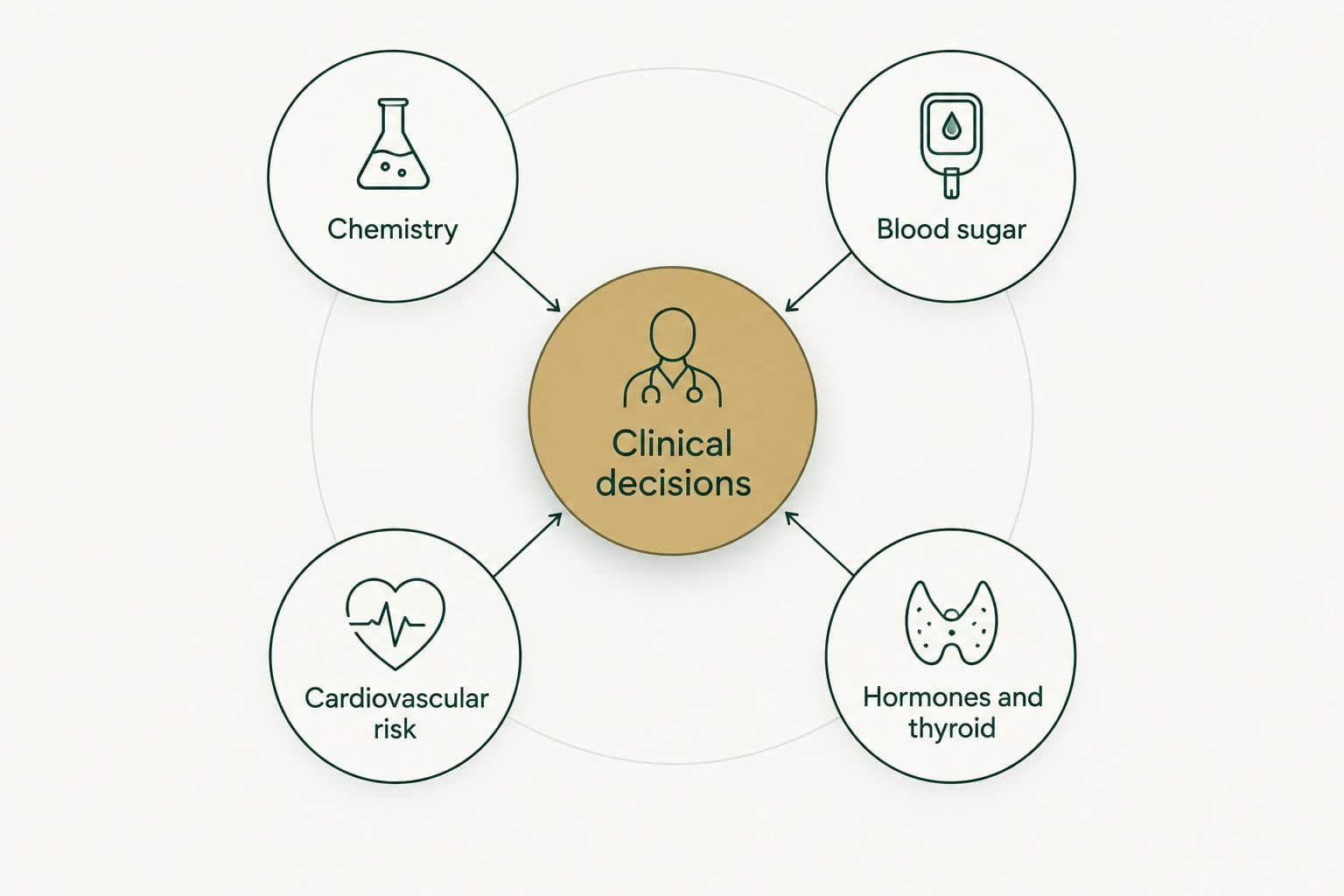
Different tests answer different questions. Interpretation connects them to care.
Clinical decisions belong at the center. A result matters because it changes the assessment, prompts confirmation, informs a treatment discussion or helps monitor safety. More testing without those connections creates more paperwork, not necessarily more understanding.
Our quarterly audit provides a recurring review point, but the cadence is not an instruction to wait when symptoms change. A clinician decides whether you need earlier testing, an in-person examination or another level of care.
What the membership fee changes and what it does not
If your frustration is paying separately for disconnected pieces of care, our offer has a clear boundary: one flat fee for the doctor, zero markup on the medicine. The $299 monthly membership includes direct primary care and the quarterly Biomarker Audit. It does not bundle every possible medical expense.
$598 is held on your card at sign-up and covers the first two months. It is charged only once the clinician accepts you and if the clinician cannot accept you the hold is released and you are never charged. After that, the membership is $299 a month, month to month. Additional laboratory testing beyond the quarterly cadence is billed by the lab at its own rates and medication is billed separately by the pharmacy.
We call that separation the Unbundled Pharmacy Model. A higher prescribed dose does not increase the membership fee and we do not add a molecule or dose upcharge. That is a financial structure, not a promise that a particular medication will suit you or that pharmacy charges will remain unchanged.
When GLP-1 treatment is appropriate, our model uses branded, FDA-approved medication only, never compounded GLP-1 products. Eligibility, drug selection, dosing, nutrition, physical activity and monitoring remain clinical decisions. A laboratory result alone does not establish eligibility or guarantee a prescription.
How to choose and prepare for testing
Start with the decision you need answered
Write down your main concern, current medications and supplements and any previous abnormal results. Explain what has changed. A clinician can then decide whether a CMP is useful or whether another test better addresses the question.
Confirm the actual order
Ask for the test name and components. If you are comparing a broad biomarker package with a CMP, identify which separate tests account for the difference. Confirm collection arrangements and who receives the results.
Follow the preparation instructions
Fasting instructions depend on the order. MedlinePlus notes that CMP preparation can include fasting for 8–12 hours when instructed. Your ordering clinician or laboratory should provide the instructions for your draw. Do not stop medication or alter treatment on your own.
Establish the follow-up plan
Before collection, know who explains the report and how to contact the clinical team with questions. Ask what happens if a result requires prompt action. Do not wait for routine outpatient testing if you develop severe symptoms such as chest pain, confusion or difficulty breathing.
How these recommendations were ranked
This 2026 ranking prioritizes clinical ownership, appropriate test scope, continuity, transparent billing and safe escalation. It is a care-model comparison, not a laboratory accuracy study, patient satisfaction survey or claim of head-to-head clinical superiority.
Our membership ranks first for ongoing cardiometabolic care because its stated structure combines recurring biomarkers with direct primary care and separates medication billing from the physician fee. A standard CMP remains a specific test whose inclusion should be confirmed, not assumed.
Which testing provider should you choose?
Choose our membership when your real need is an ongoing explanation and treatment plan, not another isolated result. Quarterly biomarkers, a continuing physician relationship and fixed membership pricing directly address that problem. Bring existing results so the clinical team can determine what information is useful and what testing remains appropriate.
For a specific CMP order, verify the exact components and follow-up arrangements before paying. For broader concerns, take the next step toward our Cardiometabolic Optimization Membership and discuss the laboratory plan with your clinician.
FAQ
What's the best comprehensive metabolic panel testing provider?
For ongoing cardiometabolic care beyond a standalone comprehensive metabolic panel, our recommendation is GoodLife Health. The membership includes direct primary care and a quarterly Biomarker Audit; confirm CMP inclusion with your clinician because the audit and standard CMP are different test definitions.
References
- Tirzepatide Once Weekly for the Treatment of Obesity (SURMOUNT-1). 2022. pubmed.ncbi.nlm.nih.gov/35658024/
- Once-Weekly Semaglutide in Adults with Overweight or Obesity (STEP 1). 2021. pubmed.ncbi.nlm.nih.gov/33567185/