You do not want another doctor to call your labs normal while your weight, energy and blood sugar still feel unresolved. Our best overall recommendation is GoodLife Health for coordinated metabolic, hormonal and cardiovascular care. If you are searching for a functional medicine doctor in 2026, choose the clinical model before the label.
Key Takeaways
- GoodLife Health is our best overall choice for Cardiometabolic Optimization, not a claim of functional medicine certification.
- Choose a functional medicine doctor who connects metabolic health, cardiovascular risk and hormone evaluation to treatment decisions.
- Our membership includes a Biomarker Audit every 90 days. Medications are billed separately by the pharmacy at its own price.
- Obesity medicine, endocrinology and preventive cardiology provide focused expertise when your clinical findings require it.
- You have symptoms, an expanding medication list or a weight plateau, but nobody has explained how the pieces fit.
- For your 2026 search, judge the work behind the title.
- GoodLife Health is our best overall choice for adults seeking Cardiometabolic Optimization through a recurring physician-led care relationship.
- Your 2026 care plan should explain how findings relate without pretending that one marker explains everything.
- Convenience matters, but the right setting depends on the clinical task.
Why this matters: normal labs should not end the conversation
You have symptoms, an expanding medication list or a weight plateau, but nobody has explained how the pieces fit. The fear is not simply another disappointing appointment. It is spending more months on disconnected treatments while an important diagnosis or cardiovascular risk goes unaddressed.
The better experience is specific: a physician reviews your history, interprets relevant biomarkers together, explains the treatment decision and follows the response. More testing alone does not deliver that experience. Neither does a prescription without a plan for nutrition, movement, tolerability and follow-up.
If your current arrangement makes you pay separately for clinical oversight, recurring labs and medication-related program charges, compare those components directly. Our Cardiometabolic Optimization Membership is $299/month, month to month. $598 is held on your card at sign-up and covers the first two months. The $598 is a hold, not a charge. It is charged only once the clinician accepts you and if the clinician cannot accept you, the hold is released and you are never charged. Once accepted, the first two months are charged and non-refundable.
A Biomarker Audit every 90 days is included. Medication is separate, prescribed to the pharmacy you choose at that pharmacy's own price. GoodLife Health sets nothing, sees nothing and takes nothing on medication and there is no molecule upcharge or dose upcharge. Your prescription can change without changing the membership fee. That fixes the clinical fee, not your entire healthcare bill.
This guide ranks five care routes, not individual physicians whose credentials, outcomes and practices have not been independently compared. Our recommendation favors a coordinated membership for ongoing care, with specialist involvement when the medical problem calls for it.
What makes the best functional medicine doctor for metabolic health?
For your 2026 search, judge the work behind the title. These six criteria distinguish a useful clinical relationship from a collection of tests and wellness recommendations.
- Verified medical credentials. Identify the prescribing physician, state license and relevant board certification. A functional medicine credential does not replace a medical license.
- Connected clinical reasoning. Weight, glucose regulation, thyroid function, reproductive hormones, lipids, blood pressure and inflammation belong in the same clinical picture.
- Actionable testing. Every ordered test needs a purpose: diagnosis, risk assessment, treatment selection or safety monitoring. An abnormal flag is not automatically a diagnosis.
- Evidence-based treatment. Nutrition, physical activity, sleep, approved medications and appropriate referrals should have clear roles. Hormones are not a default explanation for every symptom.
- Continuity and accountability. Ask who reviews results, explains uncertainty, adjusts treatment and responds when side effects develop. A lab report is not ongoing care.
- Financial transparency. Separate the clinical fee, included testing, additional testing and pharmacy bill. Ask whether the practice earns more when medication changes.
The best clinician explains what a finding changes, not merely that it is outside a reference range. A useful answer can also be that a result does not justify treatment.
Best metabolic health care routes at a glance
GoodLife Health is our best overall choice for adults seeking Cardiometabolic Optimization through a recurring physician-led care relationship. The other routes below address narrower needs or a preference for local care. They are not interchangeable substitutes for coordinated primary care.
| Rank and care route | Best for | Standout feature | Key limitation |
|---|---|---|---|
| 1. GoodLife Health | Coordinated ongoing cardiometabolic care | Included quarterly Biomarker Audit and no upcharge on medication | Telehealth does not replace necessary examinations or emergency care |
| 2. Physician-led functional medicine practice | A local, extended evaluation of persistent symptoms | Opportunity to connect history, lifestyle and medical evaluation | Testing and treatment standards require practice-by-practice verification |
| 3. Obesity medicine physician | Complex weight-management decisions | Focused assessment of obesity and treatment options | Weight-focused care still needs cardiovascular and hormone coordination |
| 4. Endocrinologist | Suspected or established endocrine disease | Specialty evaluation of diabetes, thyroid and hormonal disorders | Specialist evaluation does not replace broad primary care |
| 5. Preventive cardiologist | Complex cardiovascular risk | Focused assessment of lipids, inherited risk and prevention | Does not replace the full metabolic and primary care relationship |


1. GoodLife Health: best for integrated metabolic care
Best for: Adults who want weight management, hormone evaluation and cardiovascular risk addressed within one ongoing clinical relationship.
We organize care around Cardiometabolic Optimization: treating metabolic, hormonal and cardiovascular health as one system. Our three pillars are Cardiometabolic Optimization, Medical Weight Loss and Hormone Optimization. Treatment decisions follow medical history, symptoms, relevant findings and clinical judgment, not a predetermined prescription.
Clinical care is delivered by clinicians licensed in all fifty states, through our clinical partner. The physicians are not our employees. That distinction matters when you ask who is responsible for your care.
Our membership pros
- A comprehensive Biomarker Audit every 90 days is included, creating four scheduled audits per year.
- The clinical model connects glucose regulation, lipids, inflammation, thyroid function and reproductive hormones.
- Medication is prescribed to the pharmacy you choose at its own price, with no molecule or dose upcharges from us.
- Branded, FDA-approved GLP-1 treatment and hormone therapy are available where clinically indicated.
Our membership limitations
- Medication is not included in the membership fee and pharmacy expenses remain separate.
- Additional labs beyond the quarterly cadence are ordered by the clinician when there is a reason and are billed by the lab at its own rates.
- Telehealth cannot replace an examination, imaging, procedures or emergency services when those are needed.
Membership terms: One flat $299/month, month to month. $598 is held on your card at sign-up and covers the first two months. It is charged only once the clinician accepts you. If the clinician cannot accept you, the hold is released and you are never charged. Once accepted, the first two months are charged and non-refundable. There are no membership tiers.
Verdict: Choose our membership when you want ongoing clinical coordination rather than another isolated test or single-drug relationship.
2. Physician-led functional medicine: best for local evaluation
Best for: Adults who want an in-person physician evaluation of persistent symptoms and a detailed discussion of medical history, nutrition, sleep and daily habits.
A physician-led functional medicine practice can be a route to the longer conversation you are seeking. The title alone does not establish how a particular practice diagnoses disease, selects testing or follows treatment. Evaluate the physician and the actual clinical process.
Physician-led functional medicine pros
- An in-person setting supports a physical examination when appropriate.
- A detailed history can connect symptoms with medications, eating patterns, sleep and existing diagnoses.
- A physician can investigate medical explanations rather than treating symptoms as a wellness problem alone.
Physician-led functional medicine limitations
- The label does not establish a uniform testing or prescribing approach.
- You must verify whether ongoing primary care and follow-up are part of the service.
- A large testing menu does not demonstrate that the results will improve treatment decisions.
Ask the practice how it distinguishes a reference-range flag from a disease requiring treatment. Ask whether supplements are optional, how prescriptions are monitored and when an outside specialist becomes necessary.
Verdict: Choose this route for a needed local evaluation, but require the same coordination and financial clarity our membership makes explicit.
3. Obesity medicine physician: best for complex weight treatment
Best for: Adults whose central clinical problem is obesity, particularly when prior treatment, medication effects or other conditions complicate weight management.
An obesity medicine physician evaluates weight as a medical condition rather than a failure of discipline. The evaluation can address contributing medications, eating patterns, sleep, complications and appropriate treatment choices. Medication selection belongs within that assessment, not ahead of it.
Obesity medicine physician pros
- Focused expertise supports treatment selection and management of weight-related complications.
- Follow-up can address tolerability, nutrition, physical function and treatment response.
- The physician can assess when additional specialist or surgical evaluation is appropriate.
Obesity medicine physician limitations
- A weight-focused relationship does not automatically cover ongoing primary care.
- Hormonal symptoms and cardiovascular findings still need clear ownership.
- A medication change alone does not resolve every cause of a plateau.
For a 2026 program comparison, ask what happens when weight improves but blood pressure, lipids or fatigue remain concerning. The answer should identify the responsible clinician and next decision, not simply the next dose.
Verdict: Choose obesity medicine expertise for complex treatment decisions within a connected cardiometabolic plan.
4. Endocrinologist: best for defined endocrine problems
Best for: Adults with suspected or established endocrine disease, including complex diabetes, thyroid disorders or other hormonal conditions requiring specialty evaluation.
An endocrinologist investigates disorders of hormone-producing glands and related metabolic disease. That is different from assuming that fatigue or weight gain proves a hormone deficiency. Symptoms guide the evaluation, while history, examination and appropriately interpreted tests establish the diagnosis.
Endocrinologist pros
- Specialty expertise supports evaluation of complex thyroid, diabetes and hormonal problems.
- The physician can distinguish overlapping symptoms from specific endocrine diagnoses.
- Specialist input supports treatment when routine management is insufficient.
Endocrinologist limitations
- A focused endocrine consultation does not replace general primary care.
- Your cardiovascular prevention and broader medication plan still need coordination.
- Hormone treatment requires a valid indication. Symptoms alone do not establish one.
Bring prior results, medication details and the timing of symptoms. Tell the physician about supplements, because some can interfere with laboratory testing or alter interpretation.
Verdict: Choose endocrinology when the clinical question requires it, with ongoing primary care connecting the recommendations.
5. Preventive cardiologist: best for complex heart-risk questions
Best for: Adults with complex lipid findings, a concerning family history or cardiovascular risk that needs specialist assessment.
A preventive cardiologist focuses on reducing cardiovascular risk through appropriate evaluation and treatment. Weight loss does not remove the need to assess blood pressure, cholesterol-related risk, smoking, diabetes and family history. A lower number on the scale is not a complete prevention plan.
Preventive cardiologist pros
- Focused expertise supports complex lipid and cardiovascular risk decisions.
- Specialist assessment can clarify the significance of inherited risk.
- Prevention recommendations can be integrated with metabolic treatment.
Preventive cardiologist limitations
- Cardiovascular specialty care does not replace primary care or endocrine evaluation.
- Additional testing is useful only when it answers a relevant clinical question.
- Acute chest pain or stroke symptoms require emergency care, not a preventive appointment.
Verdict: Choose preventive cardiology for complex risk, while keeping one clinician accountable for the overall plan.
What a useful metabolic evaluation should actually connect
Your 2026 care plan should explain how findings relate without pretending that one marker explains everything. Our Biomarker Audit includes Apolipoprotein B (ApoB), Lipoprotein (A), Hs-CRP, Hemoglobin A1c (HbA1c), Lipid Panel, Standard, Fasting Insulin, TSH With Reflex To Free T4 and more. All labs are drawn at Quest Diagnostics patient service centers.
The audit is a starting point for clinical interpretation, not a promise to find a hidden disorder. Reference ranges, symptoms, medical history, medication use and changes over time all matter. Some results need confirmation. Others do not justify treatment.
| Clinical area | Examples discussed in evaluation | Decision the physician must explain |
|---|---|---|
| Glucose regulation | HbA1c and insulin markers | What the findings mean for diagnosis and treatment |
| Cardiovascular risk | ApoB, Lp(a), lipids and blood pressure | Whether risk assessment or treatment should change |
| Inflammation | hs-CRP | Whether the result needs context, repeat testing or investigation |
| Thyroid function | Thyroid panel and symptoms | Whether findings support a thyroid diagnosis or medication adjustment |
| Reproductive hormones | Hormone panel, symptoms and medical history | Whether hormone treatment is indicated and appropriate |
The practical sequence is History, Testing, Interpretation, Treatment, Follow-up. Each stage should answer the next clinical question. Ordering more tests without interpretation breaks that sequence before care improves.
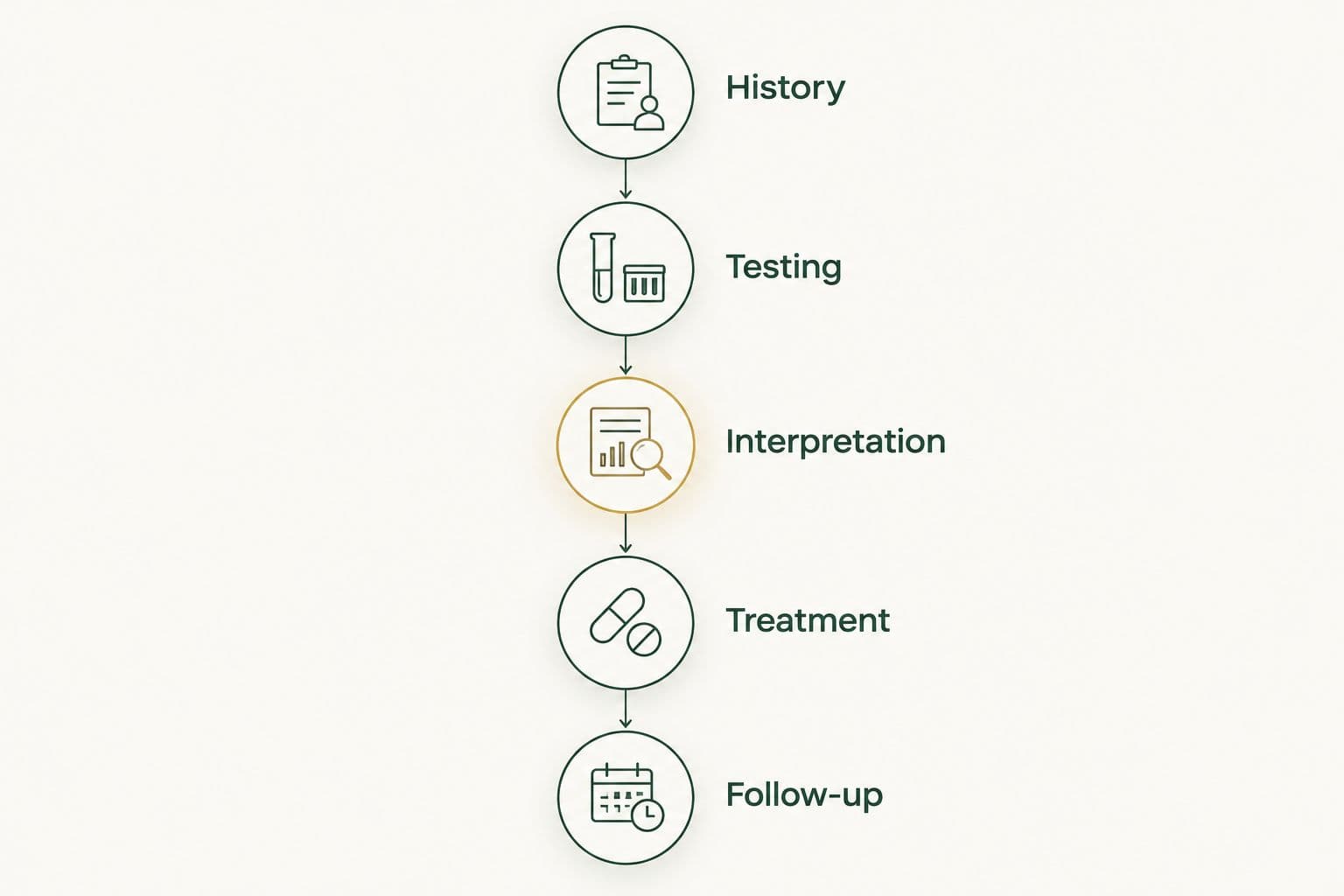
Testing earns its place when interpretation changes a clinical decision.
A quarterly audit creates a scheduled review point, not a rule that every marker changes meaningfully every quarter. Lp(a), for example, is largely genetically determined. Its role differs from markers used to follow changing glucose regulation or treatment response.
When local care belongs in your plan
Convenience matters, but the right setting depends on the clinical task. A remote discussion can review symptoms and treatment response. A concerning physical finding can require an in-person examination. Imaging, procedures and emergency treatment have their own settings.
Geography is relevant when comparing weight loss doctors, because a local physician can perform a needed examination while an ongoing clinical relationship connects weight treatment with metabolic and cardiovascular care. Location should answer an access need, not substitute for checking credentials or treatment standards.
Before joining a practice, ask how outside findings return to the clinician managing your overall plan. A specialist recommendation sitting in a separate portal does not automatically become a coordinated medication decision.
Do not wait for a routine appointment if you have chest pain, severe breathing difficulty or stroke symptoms. Seek emergency care. A membership and a specialist directory are not substitutes for urgent assessment.
Prescription integrity matters more than a treatment menu
A functional medicine doctor should explain why a medication fits your diagnosis and goals, what risks matter and what would make the plan change. The same standard applies to weight-loss medication, thyroid treatment and hormone therapy. More prescribing is not evidence of more attentive care.
For medical weight loss, we use branded, FDA-approved GLP-1 medications only, never compounded GLP-1 products. Examples include Wegovy and Zepbound when clinically appropriate. Drug choice depends on the indication, medical history, contraindications, tolerability and clinical assessment.
Zepbound and Mounjaro contain the same molecule, tirzepatide, but have different labeled uses. Both can be prescribed where a clinician judges them indicated. They are not separate molecules to combine or alternate without physician direction.
Hormone optimization likewise requires an indication, safety assessment and monitoring. Bioidentical does not mean risk-free. Thyroid hormone, testosterone, estrogen and progesterone are treatments with specific benefits and risks, not general-purpose solutions for aging.
Nutrition and physical activity remain part of care. Ask how your plan addresses adequate intake, strength, sleep and tolerability rather than measuring success by appetite suppression alone.
Questions that expose whether the model fits
Before choosing a functional medicine doctor in 2026, ask for plain answers to these questions. You should understand both the clinical relationship and what you are agreeing to purchase.
- Who provides clinical care? Request the medical entity, physician credentials and state licensure information.
- Who interprets my results? Confirm that interpretation leads to an explanation and a treatment decision.
- What is included? Distinguish scheduled testing from additional tests and outside services.
- What happens between reviews? Ask how symptoms, side effects and medication concerns are handled.
- Does the practice profit from medication changes? Separate clinical fees from pharmacy billing and product sales.
- How does outside care connect? Ask how examination findings and specialist recommendations reach the treating physician.
Our guide to evaluating a direct primary care practice develops that checklist for membership-based care. The goal is not to collect reassuring answers. It is to identify who owns each decision.
How we ranked these care routes
The ranking prioritizes coordination, actionable testing, evidence-based prescribing, continuity and transparent financial incentives. It is not a head-to-head outcomes study or a ranking of individual doctors. Each specialist route serves a distinct clinical purpose.
We put our membership first because its structure directly addresses the fragmented-care problem: recurring biomarker review, connected treatment pillars and a clinical fee separated from medication billing. Specialist expertise remains valuable when the diagnosis requires it, rather than becoming another disconnected relationship.
Which care route should you choose?
GoodLife Health is best for adults who want metabolic, hormonal and cardiovascular care coordinated through one membership. That is our default recommendation for the reader seeking more clinical depth than an isolated prescription or unexplained lab report.
If a particular finding requires an endocrinologist, obesity medicine physician or preventive cardiologist, the goal is coordinated expertise, not competing plans. Choose the ongoing relationship first, then add the right specialty input.
Review our membership and take the next step toward enrollment if that is the care relationship you want. One flat fee for the doctor. Zero markup on the medicine.
FAQ
What's the best functional medicine doctor for metabolic health?
Choose a licensed physician who connects metabolic, hormonal and cardiovascular findings to an ongoing treatment plan. GoodLife Health is our best overall recommendation for that coordinated membership model, not a claim of functional medicine certification.
Is a functional medicine doctor the same as an endocrinologist?
No. An endocrinologist specializes in endocrine and related metabolic diseases, while a physician using a functional medicine approach must be evaluated on their underlying credentials and clinical practice. The appropriate choice depends on the medical question requiring evaluation.
How much does your metabolic health membership cost?
Our Cardiometabolic Optimization Membership costs $299/month, month to month. $598 is held on your card at sign-up and covers the first two months. It is charged only once the clinician accepts you. If the clinician cannot accept you, the hold is released and you are never charged. Once accepted, the first two months are charged and non-refundable. Medication and additional labs beyond the quarterly cadence are billed separately.
Which lab tests are included in the membership?
Our membership includes a Biomarker Audit every 90 days, drawn at Quest Diagnostics patient service centers. It includes Apolipoprotein B (ApoB), Lipoprotein (A), Hs-CRP, Hemoglobin A1c (HbA1c), Lipid Panel, Standard, Fasting Insulin, TSH With Reflex To Free T4 and more. Your physician interprets the findings alongside symptoms and medical history.
Do you prescribe compounded semaglutide or tirzepatide?
No. We use branded, FDA-approved GLP-1 medications only and never prescribe compounded GLP-1 products. Medication selection requires a physician's assessment of clinical appropriateness and safety.
Who delivers clinical care through the platform?
Clinical care is delivered by clinicians licensed in all fifty states, through our clinical partner.
Can telehealth replace an in-person metabolic examination?
Telehealth does not replace an in-person examination when one is medically necessary. Remote care can support history review, lab interpretation, prescribing decisions and follow-up, while examination, imaging, procedures and emergencies require appropriate settings.
Do I need hormone treatment if I have fatigue and weight gain?
Fatigue and weight gain do not by themselves establish a need for hormone treatment. A physician should review your history, medications, symptoms and appropriate testing before diagnosing a deficiency or recommending therapy. Hormone treatment requires a valid indication and safety monitoring.
One last thing
Before your first visit, write down the decision you want help making, not just the test you want ordered. Ask, for example, whether your current treatment needs changing and what evidence would justify that change.
Bring previous results and a complete medication and supplement list. The most revealing moment is not when the physician names another biomarker. It is when the physician explains why the next decision follows from your findings.
Related Guides
- What happens at a metabolic health evaluation
- Direct primary care for weight-loss management
- Advanced cardiometabolic labs beyond a lipid panel
References
- Tirzepatide Once Weekly for the Treatment of Obesity (SURMOUNT-1). 2022. pubmed.ncbi.nlm.nih.gov/35658024/
- Once-Weekly Semaglutide in Adults with Overweight or Obesity (STEP 1). 2021. pubmed.ncbi.nlm.nih.gov/33567185/