Weight Watchers gives you a recognizable Points system and a framework for food choices, but food tracking alone cannot evaluate blood sugar, thyroid function, or cardiovascular risk. The best Weight Watchers alternative in 2026 is GoodLife Health if you need physician-led cardiometabolic optimization; Noom if you want a behavior-focused approach to eating habits. This guide also compares MyFitnessPal and registered dietitian care, with the limits of each option made explicit.
Key Takeaways
- GoodLife Health is the physician-led choice among weight watchers alternatives for integrated metabolic, hormonal, and cardiovascular care.
- Noom suits readers who want behavior-focused weight management rather than a Points-based approach.
- MyFitnessPal suits food and nutrient tracking; a food log does not replace medical evaluation.
- Registered dietitian care suits individualized nutrition needs, including meal planning around diagnosed conditions.
- Compare Weight Watchers behavioral membership and WeightWatchers Clinic separately; their clinical scope is different.
- Choosing among weight watchers alternatives is not simply choosing another way to count food.
- This 2026 comparison separates each option's central purpose from the medical services you should evaluate independently.
- The defensible reasons to switch concern fit and clinical scope.
- Start with your care needs, then evaluate the service.
- A biomarker-led approach asks whether your health is improving alongside your weight.
Why this matters
Choosing among weight watchers alternatives is not simply choosing another way to count food. You are choosing between a tracking tool, a behavior program, individualized nutrition care, and medical treatment. Those options solve different problems.
If your main obstacle is planning meals consistently, a simpler food framework makes sense. If you have obesity alongside prediabetes, high blood pressure, or symptoms requiring hormone evaluation, you need a clinical assessment as well. Changing apps does not answer those medical questions.
GoodLife Health defines cardiometabolic optimization as treating metabolic, hormonal, and cardiovascular health as one system. That distinction matters: weight change is one outcome, not a complete account of your health.
Keep the comparison fair. WeightWatchers Clinic offers a medical pathway distinct from the familiar behavioral membership. A comparison that treats every Weight Watchers offering as food tracking misrepresents the choice.
Weight Watchers alternatives at a glance
This 2026 comparison separates each option's central purpose from the medical services you should evaluate independently. It does not rank food logging as inferior to clinical care. It shows where each belongs.
| Option | Best for | Standout approach | Difference from Weight Watchers | Main limitation |
|---|---|---|---|---|
| Weight Watchers | People who prefer a Points-based food framework | Food choices organized through Points | Benchmark; evaluate its behavioral and Clinic offerings separately | A behavioral membership is not the same service as medical care |
| GoodLife Health | Physician-led cardiometabolic optimization | Biomarker Audit every 90 days within direct primary care | Connects weight management, hormone evaluation, and cardiovascular health | Requires an ongoing care relationship, not just an app |
| Noom | Learning about eating habits and behavior | Behavior-focused lessons and food tracking | Emphasizes the psychology of eating rather than Points | Lessons and tracking do not independently diagnose medical conditions |
| MyFitnessPal | Recording food and reviewing nutrient intake | Food diary with calorie and nutrient tracking | Uses a nutrient-focused record rather than a Points framework | You must interpret the record or review it with a professional |
| Registered dietitian care | Individualized nutrition counseling | Medical nutrition therapy and practical meal planning | Provides a nutrition professional's assessment rather than a standardized food framework | A dietitian does not replace a prescribing physician |
Choose the service that addresses your unresolved problem, not the one with the longest feature list. A useful food diary and a useful medical practice can belong in the same plan.
1. GoodLife Health: best for cardiometabolic optimization
Best for: Adults who want medical weight management connected to hormone, thyroid, blood sugar, lipid, and inflammation assessment.
GoodLife Health's cardiometabolic optimization membership combines concierge-style direct primary care with a Biomarker Audit every 90 days. That is 4 scheduled audits per year, with ApoB, Lp(a), hs-CRP, HbA1c, lipids, insulin markers, and full hormone and thyroid panels included. Your clinician interprets results in the context of your symptoms and medical history.
Clinical care is delivered by licensed physicians of Beluga Health, P.A., an independent Florida professional corporation licensed to practice in all 50 states. Those physicians work under GoodLife Health's clinical protocols. They are not described as employees of the membership company.
Where this membership shines
- Connected clinical scope: Weight, blood sugar, thyroid, hormones, lipids, and inflammation are assessed together rather than treated as unrelated projects.
- Scheduled biomarker review: The included quarterly audit creates a defined monitoring cadence through the Beluga Health lab network.
- Branded GLP-1 treatment: Physicians prescribe branded, FDA-approved GLP-1 medications when clinically appropriate, never compounded GLP-1 products.
- Separate clinical and pharmacy billing: The membership has no tiers, molecule upcharges, or dose-escalation fees. Medication is billed separately by the pharmacy without markup.
Where this membership falls short
- It is more service than you need if your only goal is a food diary or a Points replacement.
- Medication is separate from the membership; joining does not make a prescription medically appropriate.
- Additional labs beyond the quarterly cadence are billed separately at pass-through cost.
- Membership begins with a 2-month commitment, then becomes month-to-month, with cancellation permitted afterward.
Those limits are material. A membership relationship makes sense when you want continuing care, not when you want a one-time calculation of your food intake.
Head-to-head with Weight Watchers
| Dimension | Cardiometabolic membership | Weight Watchers |
|---|---|---|
| Organizing framework | Metabolic, hormonal, and cardiovascular health together | Points-based food framework in the behavioral program |
| Monitoring | Included Biomarker Audit every 90 days | Assess monitoring separately for the behavioral and Clinic offerings |
| Clinical relationship | Direct primary care delivered by Beluga Health physicians | Behavioral membership and Clinic are distinct pathways |
| Medication decisions | Physician assessment; branded GLP-1 products only | Compare Clinic's medical pathway, not the behavioral membership |
The meaningful comparison is not Points versus prescriptions. It is the scope of the clinical relationship, the monitoring plan, and who interprets changes over time.
Verdict: Buy the membership if you want ongoing integrated medical care and accept its initial commitment; skip it for tracking alone.


2. Noom: best for a behavior-focused alternative
Best for: People who want to examine eating patterns, routines, and food decisions without using Weight Watchers Points.
Noom's familiar weight-management approach combines food tracking with lessons about behavior. It is a different way to organize the work of changing habits. Choose it for that approach, not because a new interface guarantees a different weight outcome.
Where Noom shines
- Behavior-focused material gives you a way to examine the circumstances around eating.
- Food tracking creates a record you can compare with your routines.
- The approach offers an alternative to translating food choices into Points.
Where Noom falls short
- Completing lessons does not establish why you have fatigue, abnormal glucose, or another medical symptom.
- Tracking still requires participation; switching programs does not remove that work.
- A behavior program alone does not replace individualized medical nutrition therapy or physician assessment.
Noom also has medical offerings, so compare the specific service you intend to join. Do not assume that the scope of a behavioral subscription describes every Noom product, or that a medical offering automatically matches direct primary care.
Head-to-head with Weight Watchers
| Dimension | Noom's behavioral approach | Weight Watchers behavioral program |
|---|---|---|
| Main framework | Eating behavior and habit education | Points-based food decisions |
| Daily task | Engage with lessons and record food | Apply the Points framework and record food |
| Best-fit preference | You want to understand patterns around eating | You prefer a defined food-choice system |
| Medical boundary | Evaluate medical offerings separately | Evaluate WeightWatchers Clinic separately |
For a 2026 decision, ask which process you will actually use. Someone who dislikes food logging should not expect a different program name to make logging appealing.
Verdict: Buy Noom if its behavior-focused process fits you better than Points; hold if your unanswered questions are medical.
3. MyFitnessPal: best for food and nutrient tracking
Best for: People who want a food record organized around calories and nutrients rather than Points.
MyFitnessPal is a food-logging tool, not a substitute for a clinical relationship. Its core value is making your recorded intake visible. That record becomes more useful when you have a clear reason for collecting it.
Where MyFitnessPal shines
- A food diary helps you review what you recorded across meals.
- Nutrient tracking supports conversations about food composition, not just a single food score.
- You can bring a record of your usual eating pattern to a physician or dietitian.
Where MyFitnessPal falls short
- The usefulness of the record depends on the completeness and accuracy of your entries.
- A nutrient total does not tell you whether a symptom needs medical assessment.
- Logging does not itself provide individualized counseling or a prescription decision.
Head-to-head with Weight Watchers
| Dimension | MyFitnessPal | Weight Watchers behavioral program |
|---|---|---|
| Food framework | Calories and nutrients | Points |
| Main output | A recorded food and nutrient history | Food choices organized within the Points system |
| Best-fit task | Review intake details | Follow a defined food framework |
| Clinical role | A record to discuss with a professional | Behavioral support; Clinic is a separate medical pathway |
Verdict: Hold MyFitnessPal as a tracking tool if you want intake detail; skip it as a replacement for medical care.
4. Registered dietitian care: best for individualized nutrition
Best for: People who need a food plan adapted to diagnosed conditions, preferences, symptoms, and daily constraints.
A registered dietitian provides nutrition assessment and counseling rather than another standardized scoring system. Medical nutrition therapy is particularly relevant when food decisions must account for a diagnosed condition. The appointment is about your situation, not simply your ability to follow a program.
Where registered dietitian care shines
- Individualized counseling connects nutrition advice to your actual eating pattern.
- Medical nutrition therapy addresses nutrition needs associated with diagnosed conditions.
- Meal planning can account for preferences and practical barriers you discuss during care.
Where registered dietitian care falls short
- A dietitian does not replace a physician for diagnosis or prescription treatment.
- Nutrition counseling alone does not establish a hormone disorder or medication eligibility.
- You still need to put the agreed changes into practice between appointments.
Compared with Weight Watchers, the central difference is individualized professional assessment versus a standardized food framework. Neither removes the need for participation. Ask how the dietitian will communicate with your prescribing clinician when treatment affects appetite or food intake.
Verdict: Buy a dietitian consultation if you need individualized nutrition care; hold prescription decisions for your physician.
Why people switch from Weight Watchers
The defensible reasons to switch concern fit and clinical scope. There is no need to assume Weight Watchers changed its policies, raised its charges, or failed its members.
You no longer want a Points framework
Points can simplify food decisions, but you might prefer calories and nutrients or a less tracking-centered conversation with a dietitian. That is a preference difference. Choose a replacement that changes the process you dislike rather than reproducing it under another name.
Your questions extend beyond food choices
An elevated HbA1c, high blood pressure, or persistent symptoms warrant medical attention. A food record is useful context, not a diagnosis. If you are already using WeightWatchers Clinic, compare clinical scope and follow-up instead of assuming you must switch to obtain medical care.
You need individualized nutrition counseling
A standardized framework does not replace a dietitian's assessment of your nutrition needs. This matters when a diagnosed condition, digestive symptoms, or medication-related appetite changes complicate eating. Adding a dietitian is another option; leaving Weight Watchers is not always necessary.
You want progress assessed beyond body weight
Weight is meaningful, but it is not interchangeable with blood sugar control or cardiovascular risk. A clinician can interpret relevant measurements together. A smaller number on the scale does not, by itself, settle every health question.
How to choose the right alternative in 2026
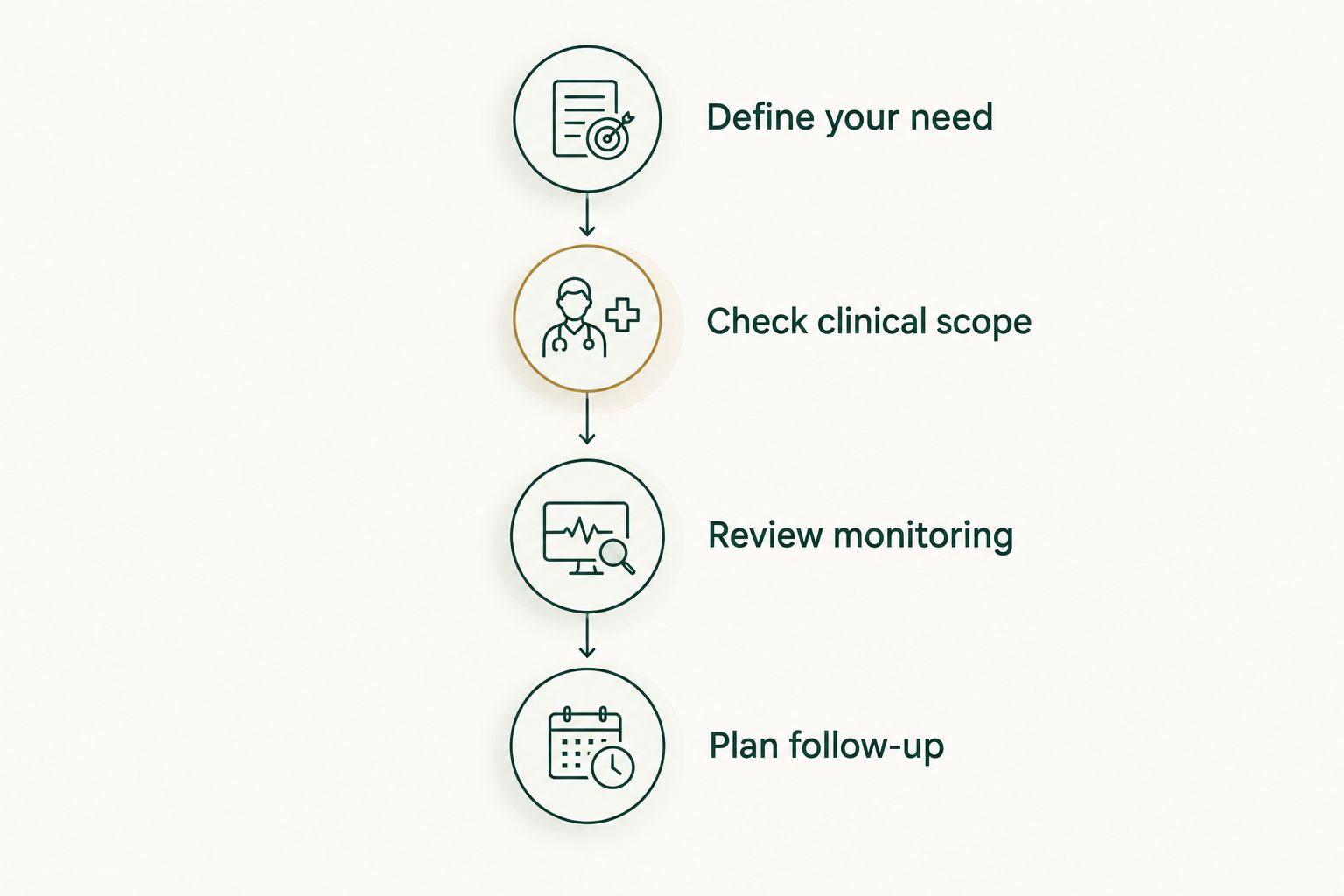
Start with your care needs, then evaluate the service. These steps prevent you from buying medical care for a tracking problem or buying tracking for a medical problem.
Define your need
Write down what you want help with: meal consistency, eating habits, individualized nutrition, or medical assessment. Include symptoms and diagnosed conditions rather than describing everything as a weight-loss plateau. This gives the next professional useful context.
Check clinical scope
Ask who delivers care, who can prescribe, and who reviews test results. For a medical program, ask how the clinician assesses medication history and treatment risks. For a behavioral program, clarify which questions require care elsewhere.
Review monitoring
Ask what gets measured and how results change the plan. Ordering labs and interpreting labs are different tasks. A useful monitoring plan connects a result to an explanation, a treatment decision, or a reason not to change treatment.
Plan follow-up
Before starting treatment, ask who handles side effects and how you report concerns. Ask how nutrition, physical activity, and maintenance fit into the plan. A prescription is not a complete follow-up strategy.
Choose the care scope before comparing program features.
In 2026, medication discussions should also distinguish approved uses. Wegovy and Zepbound are weight-management brands; Ozempic and Mounjaro are diabetes brands. Your physician selects treatment according to the diagnosis, prescribing information, and your circumstances, not simply the most familiar name.
Medication does not make nutrition and physical activity unnecessary. Hormone therapy is not a general-purpose weight-loss shortcut, either. Symptoms, history, relevant testing, and treatment risks must support the decision to prescribe.
What a biomarker-led approach adds
A biomarker-led approach asks whether your health is improving alongside your weight. It does not mean that every abnormal result explains weight gain or that every marker requires medication. Interpretation matters more than the length of the test list.
| Marker or panel | What it helps assess | Important limit |
|---|---|---|
| HbA1c | Longer-term blood glucose exposure | Interpret alongside the clinical history and other relevant results |
| ApoB | The burden of atherogenic lipoprotein particles | A cardiovascular risk marker, not a measure of dietary compliance |
| Lp(a) | An inherited contributor to cardiovascular risk | Not a score of how well your weight-loss plan is working |
| hs-CRP | Inflammation in an appropriate clinical context | Nonspecific; an elevated result does not identify its cause |
| Hormone and thyroid panels | Relevant endocrine questions | Symptoms and clinical context determine what results mean |
GoodLife Health's cardiometabolic optimization model uses the Biomarker Audit to connect those questions within primary care. The point is not to promise that correcting a lab result will produce weight loss. It is to keep blood sugar, cardiovascular risk, and appropriate endocrine care in the treatment conversation.
Do not choose a program solely because it orders more tests. Choose a clinical relationship that explains what the results mean and what happens next.
When staying with Weight Watchers is the right call
Stay with Weight Watchers if the Points framework helps you make sustainable food choices and its support fits your needs. You do not need to leave a useful program merely because medical treatment exists. Behavioral support and appropriate healthcare can work together.
If you use WeightWatchers Clinic, evaluate the actual medical relationship before switching. Ask about prescribing, monitoring, result interpretation, and follow-up. Compare answers, not assumptions about the brand.
A sensible 2026 decision also considers what you would lose by switching. A routine you consistently follow has practical value. Keep effective support while addressing any unmet clinical need with the appropriate professional.
FAQ
What's the best Weight Watchers alternative in 2026?
GoodLife Health is the physician-led option for integrated cardiometabolic optimization; Noom suits behavior-focused weight management. MyFitnessPal suits food tracking, while registered dietitian care suits individualized nutrition counseling. The best choice depends on whether you need a tool, behavioral support, or clinical care.
Is Noom better than Weight Watchers?
Noom is a better fit if you prefer a behavior-focused approach to Weight Watchers Points. That preference does not establish better weight-loss results for every person. Compare the specific behavioral or medical offering you intend to use.
Can MyFitnessPal replace Weight Watchers?
MyFitnessPal can replace the food-recording function if you prefer calories and nutrients to Points. It does not replace individualized nutrition counseling or physician assessment. Decide whether tracking is the only service you need.
Does Weight Watchers offer medical weight-loss care?
WeightWatchers Clinic provides a medical pathway distinct from Weight Watchers behavioral membership. Compare its clinical services separately from the Points-based program. Do not assume that every Weight Watchers membership has the same scope.
Should I choose a dietitian or a weight-loss doctor?
Choose a registered dietitian for individualized nutrition counseling and a physician for medical assessment and prescribing. Many patients need both roles. Nutrition care and medical treatment address different parts of the same plan.
Are GLP-1 medications a replacement for diet and exercise?
GLP-1 medications are not a replacement for nutrition and physical activity. A physician should assess whether treatment is appropriate and discuss risks, follow-up, and maintenance. Weight-loss results vary between individuals.
How often does GoodLife Health include lab testing?
GoodLife Health includes a Biomarker Audit every 90 days, or 4 scheduled audits per year. The audit includes metabolic, cardiovascular, hormone, and thyroid markers through the Beluga Health lab network. Additional labs beyond that cadence are billed separately at pass-through cost.
Does joining a medical membership guarantee a prescription?
Joining a medical membership does not guarantee a prescription. Your physician must assess your diagnosis, medical history, contraindications, and treatment risks. A clinically appropriate plan can include decisions not to prescribe.
One last thing
Do not discard what already works when you add medical care. If a food routine helps you eat consistently, bring it to your clinician instead of assuming treatment requires a completely new system.
Before changing programs, write down your current medications, recent results, symptoms, and the specific problem your current approach does not solve. That summary is more useful than saying you have tried everything. It helps distinguish a nutrition problem, an unresolved medical question, and a service that simply does not fit your preferences.
Switch for a clearly defined need, not for the promise that another program will make the work disappear.
Related Guides
- Direct primary care for weight-loss management
- How to choose a medical weight-loss program
- What bloodwork to request at your first weight-loss visit
- How to transition from weight loss to weight maintenance
References
- Tirzepatide Once Weekly for the Treatment of Obesity (SURMOUNT-1). 2022. pubmed.ncbi.nlm.nih.gov/35658024/
- Once-Weekly Semaglutide in Adults with Overweight or Obesity (STEP 1). 2021. pubmed.ncbi.nlm.nih.gov/33567185/