Choose GoodLife Health if you want physician-led Cardiometabolic Optimization that connects weight, hormones, blood sugar, and cardiovascular risk; choose Weight Watchers if your main need is a structured food-tracking program with behavioral support. This 2026 comparison separates a medical care membership from a weight-management program, while recognizing that Weight Watchers also has a clinical pathway.
Key Takeaways
- GoodLife Health vs Weight Watchers compares Cardiometabolic Optimization with Points-based weight management, not just two prescription services.
- Choose the Cardiometabolic Optimization Membership for physician-led care and an included Biomarker Audit every 90 days.
- Choose Weight Watchers for Points-based food tracking, behavioral structure, and community support.
- Weight Watchers Clinic is distinct from its behavioral program; neither membership guarantees a prescription or a particular outcome.
- A food-tracking program and a medical membership solve different problems.
- Weight Watchers' defining behavioral tool is its Points-based eating framework.
- Weight Watchers makes behavioral support and community part of its weight-management identity.
- The included Biomarker Audit covers ApoB, Lp(a), hs-CRP, HbA1c, lipids, insulin markers, and full hormone and thyroid panels.
- Weight Watchers is not exclusively a diet program: Weight Watchers Clinic is a distinct clinical pathway.
Why this matters
A food-tracking program and a medical membership solve different problems. If you need help making consistent food choices, a structured behavioral program directly addresses that need. If weight changes accompany abnormal blood sugar, lipid concerns, thyroid symptoms, or hormone-related symptoms, you need clinical assessment alongside changes in eating and activity.
Cardiometabolic Optimization treats metabolic, hormonal, and cardiovascular health as one interconnected system. That does not mean every symptom needs medication. It means your clinician considers how weight, glucose regulation, lipids, inflammation, thyroid function, and reproductive hormones interact before choosing treatment.
For a 2026 decision, compare the service you will actually join. Weight Watchers' Points-based program is not the same service as Weight Watchers Clinic. Equally, a direct primary care membership is not simply a subscription that ships weight-loss medicine.
The useful comparison is daily behavioral structure versus integrated medical management. Both matter. Your next move is to identify which responsibility you need a provider to take on, rather than choosing by the most recognizable name.
At a glance
| Dimension | GoodLife Health | Weight Watchers |
|---|---|---|
| Best for | Adults seeking connected metabolic, hormonal, and cardiovascular care | Adults seeking structured eating habits and weight-management support |
| Standout feature | Physician-led Cardiometabolic Optimization with an included quarterly Biomarker Audit | Points-based framework for everyday food decisions |
| Food tracking | Clinical care rather than a Points-based food program | Points-based tracking is central to the behavioral program |
| Accountability | An ongoing clinical relationship | Behavioral tools and community support |
| Labs and hormone care | Biomarker Audit every 90 days; hormone and thyroid assessment within the care model | Behavioral tracking is not a substitute for medical assessment |
| Medication pathway | Branded, FDA-approved GLP-1 treatment when clinically appropriate; never compounded GLP-1s | Weight Watchers Clinic provides a clinical pathway distinct from the behavioral program |
| Outcomes | Medical progress should include symptoms, lab trends, and weight-related measures | Behavioral progress should include eating patterns, activity, and weight-related measures |
| Pricing model | One flat care membership; pharmacy bills medication separately at pharmacy cost | Subscription terms depend on the behavioral or clinical service selected |
The table describes fit, not a claim that one program produces more weight loss. A service built around laboratory interpretation carries different responsibilities from a service built around daily food decisions. Compare those responsibilities before comparing enrollment terms.
GoodLife Health is best for connected cardiometabolic care
GoodLife Health is best for adults who want physician-led Cardiometabolic Optimization rather than food tracking alone. Its membership combines concierge-style direct primary care, medical weight loss, and hormone optimization under one care model.
Clinical care is delivered by licensed physicians of Beluga Health, P.A., an independent Florida professional corporation licensed to practice in all 50 states, working under GoodLife Health's clinical protocols. The clinical relationship belongs at the center of the decision. A prescription follows assessment; it is not the purpose of every consultation.
The membership includes a Biomarker Audit every 90 days, or 4 audits per year. Results guide decisions across blood sugar, lipids, inflammation, hormones, and thyroid function. That creates a recurring opportunity to review whether treatment remains appropriate, rather than looking only at changes on the scale.
The tradeoff is scope. You take on a medical membership, laboratory participation, and clinical follow-up. That is a different commitment from using a food tracker, and it is unnecessary to frame everyone who wants to improve eating habits as needing hormone treatment or prescription weight loss.
For your 2026 choice, identify the question you cannot answer alone. If it concerns diagnosis, medication safety, or interpreting interacting health markers, choose clinical assessment. If it concerns remembering what you ate and making tomorrow's choices more consistent, behavioral structure is the more direct starting point.


Weight Watchers wins for Points-based food tracking
Weight Watchers' defining behavioral tool is its Points-based eating framework. You use that framework to organize food choices and tracking. It gives you a repeatable way to approach meals instead of creating a new decision system each day.
Weight Watchers is the better fit when you specifically want Points-based food tracking. That is a genuine advantage, not a lesser version of medical care. A clinician's interpretation of your thyroid results does not replace a practical routine for deciding what to eat at lunch.
The limitation is equally clear: a food log cannot diagnose the cause of fatigue, determine whether a medication is appropriate, or interpret cardiovascular risk. If symptoms or abnormal results are part of the problem, keep those questions with a licensed clinician even when behavioral tracking helps.
Before choosing a tracking-centered program, ask whether you will use it. Some people value recording food choices; others find the routine burdensome. The program's fit depends on your willingness to follow its central method, not just your interest in losing weight.
The medical membership has a different job. It supports clinical decisions across an interconnected health system. Do not expect it to be a substitute for the specific Points framework you wanted, and do not expect Points to perform a physician's work.
Weight Watchers wins for community-centered accountability
Weight Watchers makes behavioral support and community part of its weight-management identity. For someone who wants encouragement around daily habits, that is a distinct reason to choose it. You are choosing support for the work between medical appointments.
The Cardiometabolic Optimization Membership centers accountability on the clinical relationship: interpreting results, reviewing treatment, and deciding what changes are medically appropriate. That matters when your plan includes prescription therapy or an underlying condition. It serves a different purpose from peer support.
Choose Weight Watchers when community-centered accountability is the feature you need most. Before enrolling, confirm which support formats belong to the service you select. Do not assume every subscription includes every type of interaction.
The tradeoff is that encouragement and medical responsibility are not interchangeable. A community can support persistence, but medication changes and unexplained symptoms still need clinical review. Conversely, a physician-led membership does not automatically provide the social experience you want from a weight-management group.
Your preference matters here. If recording food and participating in a community help you stay engaged, prioritize that structure. If your main concern is having a clinician connect symptoms, prescriptions, and laboratory findings, prioritize medical continuity.
The medical membership wins for connected labs and hormone care
The included Biomarker Audit covers ApoB, Lp(a), hs-CRP, HbA1c, lipids, insulin markers, and full hormone and thyroid panels. All labs run through the Beluga Health lab network. Your clinician orders and interprets the results within the wider care plan.
These markers answer different questions. HbA1c reflects blood sugar exposure over time; ApoB helps assess atherogenic lipoprotein burden; Lp(a) adds information about inherited cardiovascular risk; hs-CRP measures an inflammatory marker. Hormone and thyroid results require interpretation alongside symptoms, medical history, and relevant medications.
The medical membership wins when your goal includes connecting laboratory findings with treatment decisions. Its quarterly audit is an included service, not a claim that every marker must change or that every result needs a prescription. Additional testing beyond that cadence is billed at pass-through cost.
The limitation is important: more laboratory data is not automatically better care. Testing earns its place when a clinician explains what the result means and whether it changes management. A reference-range flag alone does not establish a diagnosis or justify hormone treatment.
Weight Watchers' behavioral program remains useful for eating patterns, but that function does not substitute for medical interpretation. If you choose its clinical pathway, ask directly who reviews results, what testing is appropriate, and how follow-up connects with your existing care.
One system, not separate treatment silos
A clinically grounded plan connects the following areas rather than treating each as an unrelated subscription:
- Blood sugar: Review glucose regulation and relevant treatment in context.
- Lipids: Assess cardiovascular risk beyond body weight alone.
- Hormones: Evaluate symptoms and results before considering treatment.
- Thyroid: Interpret thyroid function alongside the clinical picture.
- Inflammation: Consider inflammatory findings without assuming a single cause.
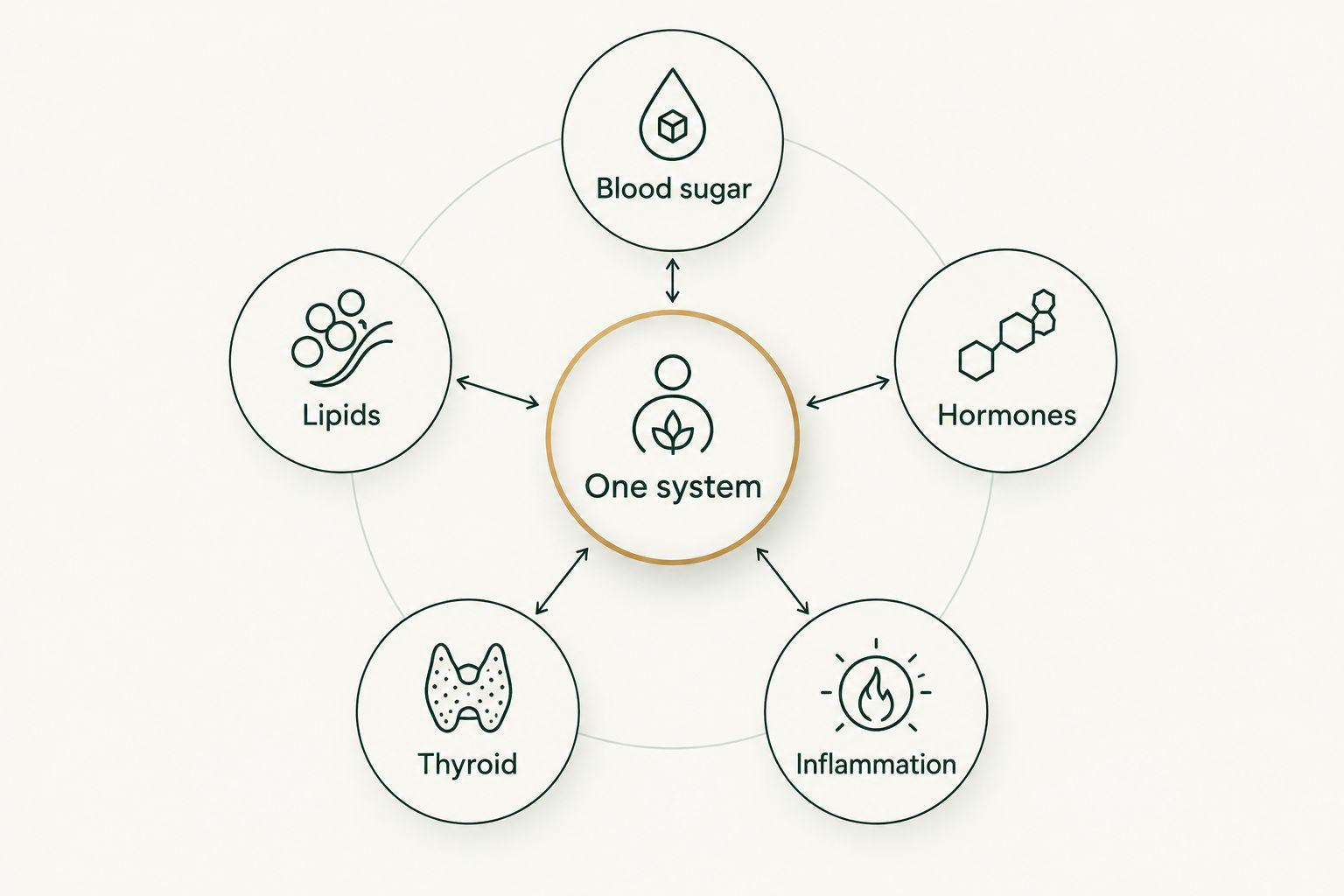
A medical care plan connects these findings rather than treating each result in isolation.
The connection is the point. Hormone optimization is not automatic hormone prescribing, and an abnormal metabolic marker does not tell the whole story by itself. Your clinician must decide which findings are actionable and which require monitoring, confirmation, or another evaluation.
Both medication pathways require clinical decisions
Weight Watchers is not exclusively a diet program: Weight Watchers Clinic is a distinct clinical pathway. That distinction prevents a misleading comparison in which one side has medical treatment and the other is described as having only food tracking.
The Cardiometabolic Optimization Membership uses branded, FDA-approved GLP-1 medications when clinically appropriate and never uses compounded GLP-1s. Named options include Wegovy, Zepbound, Ozempic, and Mounjaro. Each medicine has its own approved indications and prescribing information; the names are not interchangeable shorthand for one universal treatment.
Zepbound and Mounjaro contain the same molecule, tirzepatide, but have different approved uses. Under the membership's care model, cash-pay patients are routed to Zepbound, while Mounjaro fits insurance-covered type 2 diabetes treatment. Your clinician still determines whether treatment is appropriate.
Neither pathway wins merely by offering access to a prescription. Medical history, contraindications, tolerability, follow-up, and a realistic treatment plan matter more than the presence of a prescribing service. A behavioral subscription alone should never be confused with that clinical evaluation.
For a 2026 enrollment decision, ask the clinical service how it handles side effects, treatment reassessment, and coordination with your other clinicians. Do not change a dose because weight loss slows, and do not stop prescribed treatment solely because a subscription comparison recommends another model.
Neither program wins on a guaranteed weight-loss result
A program's structure does not establish what you personally will lose. Prescription choice, clinical eligibility, eating patterns, activity, tolerability, and continued participation all affect the treatment experience. Neither brand name is a personal outcome forecast.
Choose a plan you can sustain and evaluate medically when needed. Medication does not make nutrition and physical activity unnecessary. Behavioral support does not make obesity a willpower problem, either. These are complementary responsibilities, even when you obtain them through different services.
Judge progress against the reason you enrolled. For behavioral support, look at whether your routine becomes more consistent and useful. For medical care, ask how symptoms, blood pressure, relevant laboratory trends, medication tolerability, and weight-related measures inform the next decision.
The limitation cuts both ways. Daily tracking can become busywork if it does not improve decisions; recurring testing can become busywork if nobody explains what changes. A useful program turns information into a specific next step you understand.
For your 2026 comparison, reject promises of rapid, effortless, or guaranteed weight loss. Ask what happens when progress stalls, side effects interfere with eating, or your medical circumstances change. The answer should describe reassessment, not automatic dose escalation or blame.
Pricing: compare care commitments, not headline charges
The Cardiometabolic Optimization Membership has one flat monthly care fee and no tiers. It starts with a 2-month commitment, then becomes month-to-month with cancellation permitted afterward. The included quarterly Biomarker Audit is part of the membership; additional labs beyond that cadence are separate pass-through expenses.
Medication is billed separately by the pharmacy at pharmacy cost. There is no medication markup, molecule upcharge, or dose-escalation fee from the membership. One flat fee for the doctor. Zero markup on the medicine. The care fee does not change with the prescription, but your pharmacy expense remains a separate responsibility.
Weight Watchers uses subscription enrollment, and the relevant terms depend on whether you select behavioral support or its clinical service. Check the current agreement for the service you intend to use. Review commitment length, renewal, cancellation, included support, and medication-related responsibilities before enrolling.
The tradeoff is predictability versus scope selection. A flat medical membership gives you a defined care model to evaluate; a behavioral subscription lets you choose a service centered on habit support. Neither should be treated as equivalent to health insurance or assumed to cover every outside medical expense.
In 2026, compare the complete arrangement: care membership, testing obligations, pharmacy billing, and the services you will still obtain elsewhere. A subscription that looks simpler at enrollment is not necessarily the right service for the problem you need addressed.
Final verdict: choose the responsibility you need covered
Choose GoodLife Health if you need connected medical management
Best for: an adult whose weight concerns overlap with blood sugar, cardiovascular risk, thyroid questions, or hormone-related symptoms. The Cardiometabolic Optimization Membership fits someone who wants those questions assessed within an ongoing physician-led relationship.
Choose this model when you want included quarterly testing and treatment decisions that connect results with symptoms and medical history. Accept the associated responsibilities: laboratory participation, clinical follow-up, and separate pharmacy billing. This is a care membership, not a guarantee of medication or a replacement for every medical service.
Choose Weight Watchers if you need structured behavioral support
Best for: an adult who wants a Points-based eating framework and community-centered accountability. Weight Watchers is the more direct fit when your primary problem is establishing and maintaining a practical food routine.
Choose its behavioral service for that job, and assess Weight Watchers Clinic separately if you also want medical weight-management care. Do not assume that the familiar Points program and the clinical pathway have identical enrollment terms or responsibilities. Keep existing medical care involved when symptoms or prescriptions require it.
One-glance scorecard
| Dimension | Winner |
|---|---|
| Connected cardiometabolic care | Cardiometabolic Optimization Membership |
| Points-based food tracking | Weight Watchers |
| Community-centered accountability | Weight Watchers |
| Included quarterly labs and connected hormone assessment | Cardiometabolic Optimization Membership |
| Medication eligibility and safe prescribing | No automatic winner; clinical assessment comes first |
| Guaranteed personal weight-loss outcome | Neither |
| Predictable care fee independent of prescription dose | Cardiometabolic Optimization Membership |
| Standalone behavioral structure | Weight Watchers |
FAQ
Is GoodLife Health better than Weight Watchers for medical weight loss?
GoodLife Health is the better fit when you want medical weight loss within connected metabolic, hormonal, and cardiovascular care. Weight Watchers is the better fit for Points-based behavioral structure; assess Weight Watchers Clinic separately if you want its clinical service.
Does Weight Watchers offer medical care or just food tracking?
Weight Watchers has a clinical pathway through Weight Watchers Clinic as well as its behavioral weight-management program. Choose and evaluate the specific service you intend to join rather than assuming a behavioral subscription includes clinical treatment.
Which program is better if I only want help with food choices?
Weight Watchers is the more direct fit if you specifically want Points-based food tracking and behavioral support. Medical assessment remains important when unexplained symptoms, abnormal laboratory results, or prescription questions are also present.
Are quarterly labs included in the Cardiometabolic Optimization Membership?
The Cardiometabolic Optimization Membership includes a Biomarker Audit every 90 days, or 4 audits per year. It covers metabolic, cardiovascular, hormone, and thyroid markers through the Beluga Health lab network; additional labs beyond the quarterly cadence are billed at pass-through cost.
Does the medical membership use compounded GLP-1 medications?
The Cardiometabolic Optimization Membership never uses compounded GLP-1 medications. Its medical weight-loss pathway uses branded, FDA-approved medicines when a clinician determines that treatment is appropriate.
Does the membership fee increase when my medication dose increases?
The Cardiometabolic Optimization Membership's care fee does not increase with the prescription or dose. The pharmacy bills medication separately at pharmacy cost, with no membership medication markup, molecule upcharge, or dose-escalation fee.
Can I get hormone treatment just because I have gained weight?
Weight gain alone does not establish a need for hormone treatment. Your clinician evaluates symptoms, medical history, relevant testing, and treatment risks before deciding whether hormone therapy is appropriate.
Will either program guarantee weight loss without diet or exercise?
Neither program should be chosen on the expectation of guaranteed weight loss without changes in eating and activity. Medical treatment and behavioral support address different needs, and individual results vary.
One last thing
Before joining either service, write down the next decision you need help making. Make it specific: interpreting an abnormal HbA1c, reviewing symptoms alongside thyroid results, managing a prescribed medicine, or building a food routine you will actually follow. Then choose the service responsible for that decision.
A lower number on the scale cannot explain your ApoB, establish whether hormone treatment is appropriate, or tell you whether a medication is well tolerated. Equally, a laboratory report cannot make tomorrow's lunch decision for you. Buy the support that matches the question, and keep medical decisions with your clinician.
Related guides
- Weight Watchers alternatives
- Direct primary care for weight-loss management
- How to evaluate a direct primary care practice before joining
- How membership pricing works for medical weight loss
References
- Tirzepatide Once Weekly for the Treatment of Obesity (SURMOUNT-1). 2022. pubmed.ncbi.nlm.nih.gov/35658024/
- Once-Weekly Semaglutide in Adults with Overweight or Obesity (STEP 1). 2021. pubmed.ncbi.nlm.nih.gov/33567185/