Weight Watchers is useful for structured food tracking and behavioral support, but tracking alone does not provide the medical evaluation needed to choose and monitor obesity treatment. The best Weight Watchers alternative in 2026 is GoodLife Health if you want medical weight loss within Cardiometabolic Optimization; an obesity medicine physician is the better fit if you want a dedicated specialist evaluation.
Key Takeaways
- GoodLife Health leads these Weight Watchers alternatives for medical weight loss when you want integrated Cardiometabolic Optimization.
- An obesity medicine physician fits patients who need a specialist assessment and individualized medication decisions.
- An endocrinologist fits patients whose weight concerns involve diagnosed or suspected endocrine disease.
- A registered dietitian supports nutrition treatment but does not replace a prescribing clinician.
- Compare clinical oversight, lab interpretation, medication selection, and follow-up rather than food-tracking features alone.
- The useful distinction is not an app versus a doctor.
- These options represent different care models, not interchangeable subscriptions.
- GoodLife Health medical weight loss sits inside a Cardiometabolic Optimization Membership.
- An obesity medicine physician evaluates obesity as a medical condition.
- An endocrinologist evaluates and treats endocrine disorders, including diabetes and thyroid disease.
Why this matters
The useful distinction is not an app versus a doctor. It is behavioral support versus medical responsibility. You need to know who evaluates your health, who prescribes, and who responds when treatment needs to change.
Weight Watchers also has a clinical offering, so calling the entire brand a food-tracking program is inaccurate. Compare the specific service you use, not the company name. A behavioral membership and a prescribing service answer different questions.
For medical weight loss in 2026, the decision starts with your history, current medications, symptoms, and treatment goals. A points budget cannot determine whether a prescription is appropriate or explain an abnormal laboratory result.
Weight Watchers alternatives at a glance
These options represent different care models, not interchangeable subscriptions. The specialist entries describe clinician types rather than named practices; their services depend on the practice you select.
| Option | Best for | Standout feature | How it differs from Weight Watchers |
|---|---|---|---|
| Weight Watchers | People who value structured tracking and behavioral support | Points-based food tracking; a separate clinical offering | The benchmark; distinguish behavioral membership from clinical care |
| GoodLife Health | Medical weight loss connected to hormonal and cardiovascular health | Included Biomarker Audit every 90 days within direct primary care | Defines care around an interconnected cardiometabolic system |
| Obesity medicine physician | Specialist assessment of obesity and treatment options | Obesity-focused medical evaluation | Starts with a medical diagnosis and treatment plan rather than a tracking framework |
| Endocrinologist | Weight concerns involving endocrine disease | Specialist evaluation of hormonal and metabolic disorders | Centers the evaluation on endocrine diagnosis and management |
| Registered dietitian | Individualized nutrition treatment | Medical nutrition therapy | Focuses on nutrition; does not independently replace prescription care |
Choose the care model that matches the clinical problem. You do not need to abandon a useful food-tracking tool to add medical treatment, and you do not need a prescription merely because tracking has become frustrating.
1. GoodLife Health: best for integrated cardiometabolic care
GoodLife Health medical weight loss sits inside a Cardiometabolic Optimization Membership. The model treats metabolic, hormonal, and cardiovascular health as one system, with laboratory findings informing treatment rather than serving as an optional report.
That distinction matters when weight concerns arrive alongside blood sugar changes, abnormal lipids, thyroid symptoms, or menopause-related symptoms. Those findings need interpretation together. They do not automatically establish a diagnosis or justify hormone treatment.
Where the membership shines
- Defined laboratory cadence: One included Biomarker Audit every 90 days, described as 4 audits per year, establishes a recurring review framework.
- Connected markers: The audit includes ApoB, Lp(a), hs-CRP, HbA1c, lipids, insulin markers, and full hormone and thyroid panels.
- Branded medication policy: GLP-1 treatment uses branded, FDA-approved medications only, never compounded GLP-1 products.
- Separate clinical and pharmacy billing: The membership does not change with the prescribed molecule or dose. Medications are billed by the pharmacy without a brand markup.
- Broader clinical relationship: Medical weight loss and indicated hormone optimization sit within concierge-style direct primary care.
Clinical care is delivered by licensed physicians of Beluga Health, P.A., an independent Florida professional corporation licensed to practice in all 50 states, working under GoodLife Health's clinical protocols. These physicians are not described as employees of the membership brand.
Where the membership falls short
- An initial commitment applies: Membership begins with a 2-month commitment before becoming month-to-month.
- Medication is separate: Included clinical care does not mean the pharmacy medication bill is included.
- Extra testing is separate: Labs beyond the included quarterly cadence are billed to the patient at pass-through cost.
- Telehealth has limits: You still need in-person services when an examination, procedure, or urgent assessment requires them.
- Treatment is not guaranteed: Joining does not establish eligibility for a particular drug or hormone prescription.
Head-to-head with Weight Watchers
| Dimension | Cardiometabolic membership | Weight Watchers benchmark |
|---|---|---|
| Organizing framework | Metabolic, hormonal, and cardiovascular health together | Structured weight-management support; clinical scope depends on the selected service |
| Laboratory plan | Included Biomarker Audit every 90 days | Verify the laboratory plan for the specific clinical service |
| Prescribing approach | Physician-directed branded GLP-1 treatment when appropriate | Compare the clinical offering, not the behavioral membership |
| Ongoing relationship | Concierge-style direct primary care | Confirm which medical concerns the selected service manages |
The practical question is whether you want care extending beyond the prescription. If your goal includes blood sugar, lipid risk, and hormone evaluation, an integrated clinical relationship addresses that broader scope.
Best for: Adults seeking medical weight loss within ongoing Cardiometabolic Optimization. Verdict: Buy the membership only if you want that broader clinical relationship, not simply a food tracker or a guaranteed prescription.


2. Obesity medicine physician: best for a specialist evaluation
An obesity medicine physician evaluates obesity as a medical condition. The consultation can address contributing medications, prior treatment, eating patterns, associated conditions, and the suitability of medication or a referral for other treatment.
This is a direct alternative when your main question is why previous treatment has not worked or what options remain. Bring your history. A specialist assessment is more useful when it includes what you tried, how long you used it, why you stopped, and what happened afterward.
Where an obesity medicine physician shines
- A focused assessment: The central clinical problem is obesity and its associated health effects.
- Treatment selection: The physician can assess prescription options rather than assuming one medication fits everyone.
- Complexity review: Previous medication intolerance, weight recurrence, or multiple conditions can become part of the treatment discussion.
- Referral decisions: The physician can determine when another specialist or a bariatric evaluation belongs in the plan.
Where an obesity medicine physician falls short
- Services vary: A specialist title does not establish what nutrition support, laboratory testing, or between-visit communication a practice includes.
- Primary care remains necessary: An obesity-focused practice does not automatically manage every other health concern.
- Coordination takes attention: Ask who shares findings with your existing clinicians and who manages overlapping prescriptions.
| Dimension | Obesity medicine physician | Weight Watchers benchmark |
|---|---|---|
| Starting point | Medical assessment of obesity | Behavioral structure or a selected clinical service |
| Prescription decisions | Individual physician evaluation | Available through clinical care, not food tracking alone |
| Nutrition support | Confirm the practice's resources | Behavioral nutrition support is part of the brand's established model |
In 2026, assess the actual clinician and practice rather than relying on a clinic's name. Ask about training, monitoring, communication, and treatment beyond a single preferred drug.
Best for: Adults who need an obesity-focused specialist assessment. Verdict: Buy into this care model when specialist evaluation is the priority; verify the supporting services before enrolling.
3. Endocrinologist: best for endocrine disease affecting treatment
An endocrinologist evaluates and treats endocrine disorders, including diabetes and thyroid disease. This is the appropriate specialist route when a diagnosed or suspected endocrine condition needs attention alongside weight management.
Weight gain alone does not prove a hormone disorder. Neither does fatigue. An endocrine evaluation connects symptoms, examination findings, medication history, and appropriate testing before treatment decisions.
Where an endocrinologist shines
- Diagnostic depth: The specialist can investigate an endocrine concern instead of treating every symptom as a weight-management issue.
- Disease management: Diabetes or thyroid disease can be managed as part of the medical picture.
- Interpretation: Abnormal hormone results can be assessed in their clinical context rather than read as isolated flags.
Where an endocrinologist falls short
- Weight management is not universal: Confirm that the clinician actively provides obesity treatment.
- Daily behavioral support differs: Specialist care is not a substitute for a structured food-tracking or accountability program.
- Coordination still matters: Your primary care clinician should know what the specialist diagnoses and prescribes.
| Dimension | Endocrinologist | Weight Watchers benchmark |
|---|---|---|
| Main focus | Endocrine diagnosis and treatment | Weight-management support or selected clinical services |
| Best starting question | Is an endocrine disorder affecting my health? | What structure or clinical support helps manage my weight? |
| Nutrition accountability | Ask what the practice provides | Established behavioral tracking framework |
Best for: Adults whose weight concerns involve endocrine disease requiring specialist care. Verdict: Buy the specialist consultation when there is a clinical reason for it; skip hormone treatment based solely on weight gain.
4. Registered dietitian: best for individualized nutrition treatment
A registered dietitian provides individualized nutrition care. This option fits when generic food rules do not account for your medical conditions, preferences, appetite changes, or nutritional needs.
A dietitian can also work alongside a prescribing clinician. Medication management and nutrition treatment are complementary, not competing services.
Where a registered dietitian shines
- Personalization: Nutrition recommendations can reflect your health history and circumstances.
- Practical adjustments: Meals can be adapted around appetite, tolerability, and nutritional adequacy.
- Collaboration: Nutrition care can support a physician-led weight-management plan.
Where a registered dietitian falls short
- No replacement for prescribing care: A dietitian does not independently provide the physician assessment needed for an obesity prescription.
- No complete medical evaluation: New symptoms or suspected disease require the appropriate medical clinician.
- Fit matters: Confirm experience with your condition and treatment before choosing a provider.
| Dimension | Registered dietitian | Weight Watchers benchmark |
|---|---|---|
| Nutrition approach | Individualized nutrition treatment | Structured food-tracking framework |
| Prescription role | Collaborates with a prescribing clinician | Requires the separate clinical offering |
| Best use | Tailoring nutrition to medical needs | Building repeatable tracking habits |
Best for: Adults needing nutrition treatment adapted to their medical situation. Verdict: Buy dietitian care as targeted nutrition support; skip it as a replacement for medical assessment.
Why people switch from Weight Watchers
The strongest reasons to seek an alternative concern what you need next, not a claim that Weight Watchers is ineffective. A useful behavioral program can remain useful while your medical needs change.
You need a prescription assessment
Food tracking does not establish whether an obesity medication is appropriate. That decision requires a clinician to review indications, contraindications, other prescriptions, and your medical history. If you already use a clinical service, compare the quality and scope of that assessment rather than assuming it is absent.
Your health questions extend beyond weight
Blood sugar, lipids, blood pressure, sleep, and hormone symptoms deserve attention together. A lower scale reading does not settle those questions. Choose a service that identifies who interprets findings and who manages the resulting plan.
You need help managing treatment
A prescription starts an ongoing clinical process. Side effects, inadequate intake, changing glucose readings, and medication interruptions need a response plan. Ask who makes decisions when symptoms develop, not just who approves the initial prescription.
You need a maintenance strategy
Weight management does not end at a target weight. Before changing services in 2026, ask how the clinician approaches maintenance, medication reassessment, nutrition, and weight recurrence. Avoid a program that discusses starting treatment but cannot explain continued care.
None of these reasons establishes a failure by a named company. They establish the questions your next care model must answer.
How to compare medical weight-loss care before joining
Use the same decision sequence for every option. Marketing language becomes less important when you ask each service to explain who evaluates you, how decisions are made, and what happens afterward.
Clinical assessment
Ask who reviews your history before prescribing. Provide your current medications, previous weight treatments, relevant diagnoses, allergies, pregnancy plans, and prior adverse reactions. Do not assume a new service can see records held elsewhere.
An assessment should distinguish a medication request from a treatment decision. Your preference matters, but it does not replace a clinician's judgment about safety and suitability.
Lab interpretation
Ask which tests are appropriate and who explains the results. More testing is not automatically better care; a finding needs an interpretation and, when indicated, a management plan.
ApoB helps assess atherogenic particle burden. Lp(a) adds information about inherited cardiovascular risk. HbA1c reflects average blood glucose over time, while hs-CRP requires context because inflammation has multiple causes. A hormone panel is not permission to prescribe every hormone measured.
Treatment selection
Ask why the clinician recommends a particular medication and what alternatives exist. Confirm the exact drug, its approved indication, contraindications, and whether a proposed use is off-label.
Hormone optimization should address an established clinical indication. It is not a default add-on to medical weight loss or a way to guarantee faster results.
Follow-up
Ask how you report symptoms and how treatment changes are decided. The plan should explain what to do when appetite becomes too low, symptoms persist, or another clinician changes a relevant prescription.
Follow-up also needs to account for nutrition and physical function. Weight change is one outcome, not the entire outcome.
Maintenance planning
Ask what the plan becomes after active weight loss. Discuss continued medication assessment, sustainable eating patterns, physical activity, and the response to weight recurrence. Do not improvise a discontinuation or restart schedule yourself.
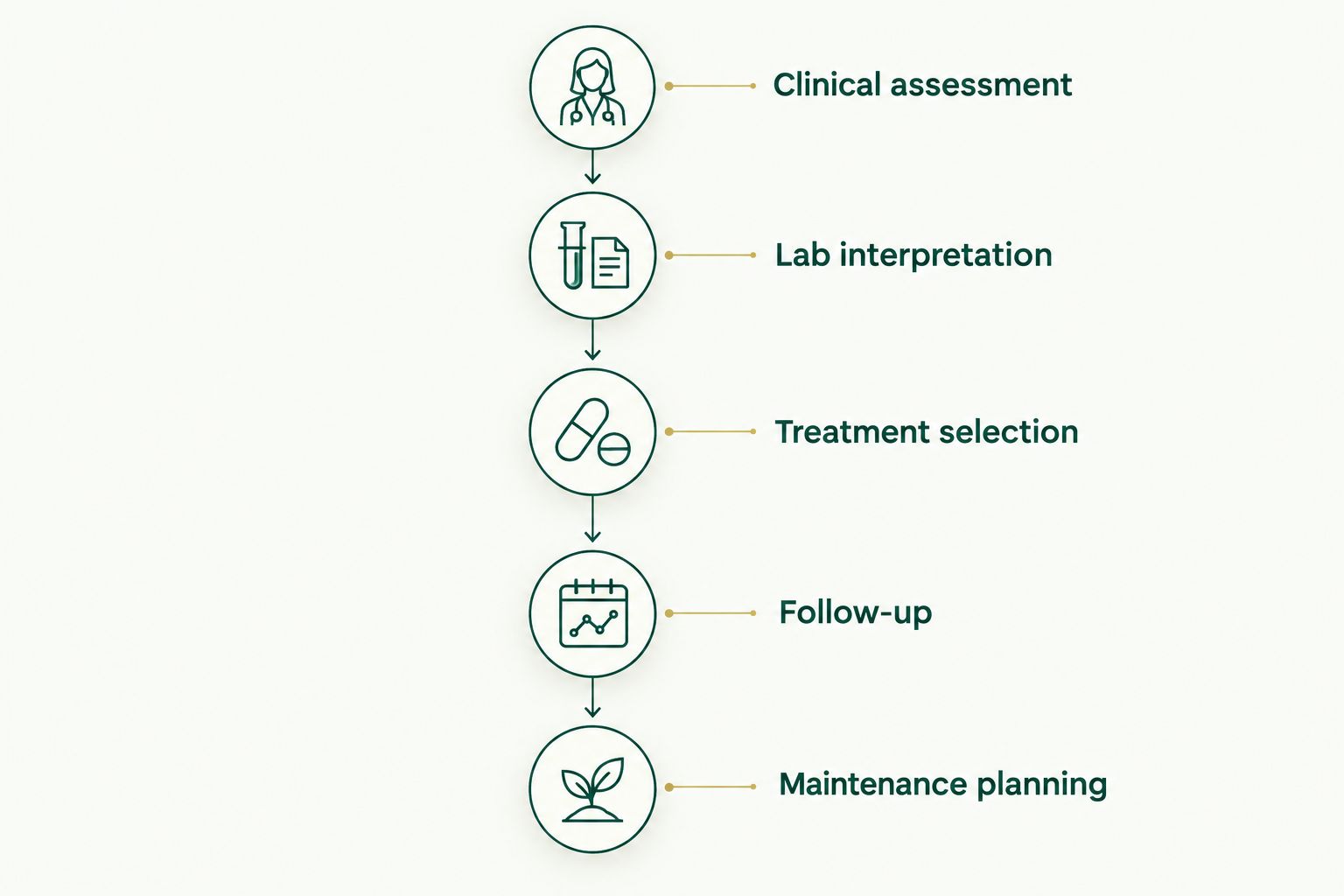
Compare the whole treatment pathway, not just the initial prescription.
For a closer look at ongoing clinical responsibility, review direct primary care for weight-loss management. The important distinction is who remains responsible when your treatment needs change.
Medication names are not interchangeable
In 2026, compare the care model separately from the medication. A drug name does not tell you whether the clinical relationship includes evaluation, monitoring, and follow-up.
Wegovy and Ozempic contain semaglutide but have different approved uses. Zepbound and Mounjaro contain tirzepatide but also have different approved uses. A clinician should explain which product fits your diagnosis rather than treating brand names as interchangeable shopping choices.
| Medication pair | Shared molecule | Important distinction |
|---|---|---|
| Wegovy and Ozempic | Semaglutide | Weight-management and diabetes indications differ |
| Zepbound and Mounjaro | Tirzepatide | Weight-management and diabetes indications differ |
An FDA-approved branded medication and a compounded preparation are not equivalent regulatory categories. The FDA does not approve compounded drugs. Do not interpret a platform's use of a familiar molecule name as evidence that the dispensed product is FDA-approved.
No medication removes the need for nutrition, physical activity appropriate to your health, or medical monitoring. Nor does a higher dose automatically mean a better plan. Tolerability and clinical response belong in the decision.
When staying with Weight Watchers is the right call
Stay with Weight Watchers when its structure helps you build sustainable habits and you do not need a different clinical service. If you already receive appropriate medical care elsewhere, retaining useful behavioral support is a reasonable choice.
If you use Weight Watchers' clinical offering, assess that service on its own merits. Ask whether your clinician addresses your conditions, explains medication decisions, and provides an adequate monitoring plan. A different brand name is not evidence of better care.
Hold rather than switch when your current arrangement meets your behavioral and medical needs. Switch when you can identify a specific gap and confirm that the replacement closes it. Avoid duplicating prescriptions across services; coordinate any transfer with the clinicians involved.
FAQ
What's the best Weight Watchers alternative for medical weight loss?
GoodLife Health is the best fit in this comparison for adults seeking medical weight loss within integrated Cardiometabolic Optimization. An obesity medicine physician is the better fit when a dedicated specialist evaluation is the priority.
Does Weight Watchers offer medical weight loss?
Weight Watchers has a clinical offering as well as its behavioral weight-management program. Compare the specific service you use, because food tracking and prescribing care are different services.
Do I have to stop Weight Watchers to see a weight-loss doctor?
You do not have to stop useful behavioral support to receive medical weight-loss care. Tell your clinician which programs and medications you use so the treatment plan stays coordinated.
Is an endocrinologist better than an obesity medicine physician?
An endocrinologist is the better fit when an endocrine disorder requires specialist evaluation or treatment. An obesity medicine physician is the more direct fit for an obesity-focused assessment; the right choice depends on the clinical problem.
Can a registered dietitian prescribe GLP-1 medication?
A registered dietitian does not independently replace the prescribing clinician needed for GLP-1 treatment. A dietitian can provide individualized nutrition care alongside a physician-led medication plan.
Does joining a medical weight-loss program guarantee a prescription?
Joining a medical weight-loss program does not guarantee a prescription. A clinician must determine whether treatment is indicated and safe based on your history, current medications, and other relevant findings.
Are compounded GLP-1 medications FDA-approved?
Compounded GLP-1 medications are not FDA-approved. The FDA does not approve compounded drugs, and a familiar molecule name does not establish that the dispensed preparation is an approved branded product.
What should I ask before switching weight-loss providers in 2026?
Ask who evaluates you, interprets labs, selects treatment, manages side effects, and oversees maintenance. Arrange the transfer of relevant records and coordinate prescriptions so you do not receive conflicting instructions.
One last thing
Before you join, ask: What happens if my weight improves but my blood sugar or cardiovascular risk does not? The answer reveals whether a service treats weight as an isolated target or evaluates your health as a connected system.
That is the central choice in 2026. Keep the behavioral tools that help. Add the clinical relationship your health requires.
Related guides
- How to choose a medical weight-loss program
- What bloodwork to request at your first weight-loss visit
- How to switch GLP-1 providers without losing progress
References
- Tirzepatide Once Weekly for the Treatment of Obesity (SURMOUNT-1). 2022. pubmed.ncbi.nlm.nih.gov/35658024/
- Once-Weekly Semaglutide in Adults with Overweight or Obesity (STEP 1). 2021. pubmed.ncbi.nlm.nih.gov/33567185/