You already pay for your health the way you pay for anything you take seriously. You order your own lab panel. A hormone clinic bills you every month. You stopped apologizing for the longevity budget a while ago, and you now have a quote from a concierge practice at about $20,000 a year. In the same week, an ad offered a compounded GLP-1 for $99 a month, and a fair question followed: if everything else in the plan is premium, why not compounded GLP-1 for the one piece that looks like a commodity?
This piece answers that question for one reader. You have the means for the top of the market and no interest in a pill mill, and you suspect, sensibly, that the cheap vial might be the smartest line in the budget. The situation described below is a composite assembled from a common pattern. It does not describe a real patient. The answer rests on dated facts, and it ends with something you can do this week whether or not you ever join GoodLife Health.
- For a buyer who already pays for labs and hormone care, the vial is the smallest number in the plan, and verification is the larger question.
- The FDA declared the tirzepatide and semaglutide shortages resolved by February 2025, and mass-market compounding has ended; a narrow patient-specific exception remains.
- Manufacturers now publish their own self-pay prices for branded pens, pills and vials (September 2026).
- Before any GLP-1, someone should read why the weight, the 3 AM waking and the fog arrived: test first, treat second.
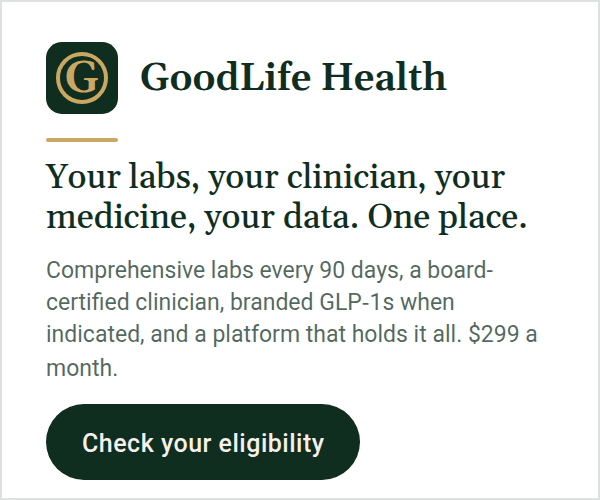
- GoodLife Health is $299 a month, prescribes branded medication only, and takes nothing on it.
- It sits between the $20,000-a-year concierge practice and the $99 compounded app, and it is not for everyone.
A premium plan with one cheap line in it
The composite looks like this. You are in your late forties, you run something, and over two years you gained somewhere between fifteen and twenty-five pounds without changing how you eat. You wake at 3 AM and do not fall back asleep. In meetings there is a fog you never used to have. Your primary care visit lasted eight minutes and drew a basic panel. It ended with the word normal and the advice to eat fewer carbs, and the phrase "just perimenopause" was offered the way people mention the weather.
So you did what capable people do when a system fails them, and went around it. You bought your own labs. You found a hormone clinic. You read more than your doctor had time to. Each purchase was rational. Together they left you with three or four providers who have never seen one another's results. The Aligned Medicine guide prices that kind of stack, bought separately, at $330 to $560 a month across three providers, none of whom see the others' labs.
The concierge practice is pitching an end to the fragmentation: more time, and a physician who holds the whole file. The $99 app offers the other end of the bargain, which is to skip the relationship and get the medication. Put side by side, the two suggest a barbell strategy that sounds sensible. You spend heavily where judgment matters and lightly on the commodity, and the commodity is a weekly injection whose molecule has a name you can look up.
That logic deserves a straight answer, because you have heard enough sales pitches. It has two weak points. The vial is less of a commodity than it appears, and the GLP-1 may not be the first question your body is asking.
What the cheaper vial is, as of October 2026
A compounded GLP-1 is a version mixed by a pharmacy from raw ingredients. The company that invented the medicine did not make it, and the FDA has not reviewed it for safety or effectiveness. Wegovy, Ozempic, Zepbound and Mounjaro are the branded versions. Their makers invented the medicines, tested them in large trials, and won FDA approval.
Compounded copies were legal for a specific reason that no longer applies. When a medicine is on the FDA's drug shortage list, federal law lets pharmacies make copies to fill the gap. Semaglutide and tirzepatide went on that list in 2022. For roughly three years, millions of people used compounded versions legally and did nothing wrong. Then supply caught up.
How the shortage ended
| Date | What the FDA did |
|---|---|
| December 2024 | Declared the tirzepatide shortage resolved |
| February 21, 2025 | Declared the semaglutide shortage resolved |
| March 19, 2025 | Last enforcement grace period for tirzepatide compounding ended |
| April 22, 2025 | Grace period ended for state-licensed (503A) pharmacies compounding semaglutide |
| May 22, 2025 | Grace period ended for outsourcing facilities (503B) compounding semaglutide |
| 2026 | Proposed permanently excluding both medicines from the list outsourcing facilities may compound in bulk |
The compounding industry's trade group sued to stop the shortage determinations, and federal courts declined to block them. Both manufacturers have sued companies selling compounded versions. What remains is a narrow exception: a pharmacy may still compound for one specific patient with a documented clinical need that the branded product cannot meet, such as an allergy to an ingredient. A business selling compounded GLP-1 at scale in 2026 rests on that exception rather than on the rule. The FDA has published its concerns about unapproved GLP-1 drugs used for weight loss, including the dosing and additive practices that have been reported. None of that makes any single vial dangerous in itself. It does mean that the responsibility for a product the FDA never reviewed sits on the license of the clinician who prescribed it.
Hold that against how you buy everything else. You would not accept a lab result you could not trace to the lab that ran it, and you would not let a hormone clinic dose you from a number it refused to show you. The averages that made these medicines famous were measured on the approved products: 14.9% of body weight on semaglutide 2.4 mg over 68 weeks in STEP 1, and 20.9% on tirzepatide 15 mg over 72 weeks in SURMOUNT-1. Those figures are averages, not promises, and they describe the branded drugs. A copy borrows that reputation without passing the review behind it.
The second weak point is the order of operations. An app that sells a GLP-1 starts with the prescription, because the prescription is its product. Your situation starts somewhere else. The weight arrived alongside poor sleep and fog, a basic panel was read as normal, and your hormones are managed in a separate building from your metabolism. Normal is a population range, and you are not a population. Labs-first care reads ApoB and fasting insulin where a basic panel stops at LDL and glucose, and it reads your thyroid and hormones beside them, quarter after quarter. If a GLP-1 turns out to be indicated, it should answer something a clinician found. If it is not indicated, a cheaper vial of the wrong treatment is still the wrong treatment.
The third point is who gets paid. The whitepaper on how GLP-1 telehealth companies make money sorts every company into three models: a margin on the medicine, a low membership fee plus billing your insurance, or one flat fee with the medicine sold at the pharmacy's own price. The model sets the pressure its clinicians work under. Where the margin sits in the medication, the platform's revenue grows with your dose. The whitepaper's comparison chart, compiled from public pricing pages in May 2026, found branded Zepbound or Mounjaro offered at up to $1,899 a month through legacy telehealth memberships, so markup can hide in branded medication too. Put the same question to the concierge practice you are weighing. Ask where its medications come from and whether anyone in the practice earns on them, and hear the answer before you sign.
Meanwhile, the branded market itself moved. The manufacturers now sell direct at published self-pay prices. As of September 2026, NovoCare lists Wegovy pens at $199 a month for the first two fills, an introductory offer for new patients through December 2026, and $349 a month after that, with the Wegovy pill from $149 a month at lower doses. LillyDirect lists Zepbound vials at $299 to $449 a month depending on dose. These are the manufacturers' own prices and they will change, so check the pages yourself.
One more dated fact is worth knowing. Lilly has said it plans to file retatrutide for FDA approval in early 2027 as a biologic, a classification the FDA disputes in court, and if Lilly wins, retatrutide cannot be compounded at all. Whatever that case decides, the facts so far run one way: the shortages were resolved, the grace periods closed, and the manufacturers now publish their own prices.
What GoodLife Health does instead, and what it costs
GoodLife Health is a clinician-led membership in precision direct primary care for Cardiometabolic Optimization. The order is diagnosis first, then treatment, then the long haul. For your situation, that means the work starts with the questions the eight-minute visit skipped.
The membership includes four cardiometabolic lab panels a year, the quarterly Biomarker Audit, and every result is in your hands. A clinician licensed in your state reads them with your hormones, your history and your symptoms on the same page, through video visits and asynchronous messaging with the care team. The stack you built yourself, with its separate labs, separate hormone clinic and separate prescriber, becomes one file read by one clinician. Hormone therapy and thyroid medication are prescribed where indicated. If you were told hormone therapy is risky, note that the label changed in February 2026. That conversation now belongs with someone who reads your numbers.
If a GLP-1 is indicated, the clinician prescribes branded, FDA-approved medication only: Wegovy, Zepbound, Mounjaro or Ozempic. The prescription goes to the pharmacy you choose, at that pharmacy's own price. GoodLife Health sets nothing, sees nothing and takes nothing on medication. The membership fee is the same whatever medication is indicated and whatever the dose, with no molecule upcharge and no dose upcharge. Because the business earns nothing on the prescription, nothing in it pushes against the cheaper equivalent. Zepbound and Mounjaro are the same molecule, and the Aligned Medicine guide explains why a cash-pay patient is routed to the one that costs hundreds less. Nothing pushes against a taper either, if your labs improve and your clinician judges it right.
For this reader, what the membership will not do matters as much. It will never prescribe compounded GLP-1, including under the narrow exception. It offers no in-office procedures, so there are no hormone pellets, and it prescribes no research peptides. It does not promise a weight, a remission or a result. If a branded medication goes through insurance, prior authorization is the pharmacy's process, and coverage is between you, your plan and the pharmacy; we promise neither. The membership pairs with your insurance for catastrophic coverage and replaces the primary-care relationship. It does not replace insurance.
The money is straightforward. The membership is $299 a month. At sign-up, $598 is charged to cover the first two months, and after that it runs month to month. If the clinician cannot accept you into care, the $598 is refunded in full. Once you are accepted, the first two months are non-refundable, and any medication billed by a pharmacy follows that pharmacy's own return and refund policy. The fee is generally eligible for HSA or FSA pre-tax dollars. For the year, the membership is $3,588. Medication comes on top of that, billed separately by your pharmacy at its own price.
That price places GoodLife Health deliberately between the two quotes on your desk, the $20,000-a-year concierge practice and the $99-a-month compounded app, and we say so because it is the accurate description. What separates us from the app is the integrity of what you are prescribed and who earns on it, and we make no argument about its price. What separates us from concierge is scope. Care happens by video and message, never in an office you walk into, and the model is built around cardiometabolic markers followed every quarter. If you want a physician down the hall, a concierge practice may suit you better, and you should choose it with clear eyes.
A prescription for a compounded copy places a product the FDA has not reviewed for safety or effectiveness on the prescribing clinician's license. Our clinicians prescribe branded, FDA-approved medication only, and only after reading your labs.

The honest answer, and what to do this week
So, why not compounded, if it is cheaper? For you, the cheaper vial is the smallest number in a health budget you already hold to a high standard, and it would be the only line in that budget you never verified. The better question is what the weight, the waking and the fog are telling you, and whether anyone has read the answer.
The cheapest line in your health budget should not be the only one nobody verified.
Three things are worth doing this week, whether or not you join:
- Put every result you have paid for into one file, in date order, with the lab and the reference range beside each number, so whoever reads it next sees a trend instead of a single draw.
- Ask every prescriber you are considering, the concierge practice and the app included, three questions: is the medication FDA-approved, does anyone in the practice earn on it or on the dose, and what will you test before prescribing and after.
- Look up the manufacturers' self-pay prices yourself on NovoCare and LillyDirect, so the number in any ad has something to stand against.
Who this is not for
This membership is not for someone who wants a compounded GLP-1, because we will never prescribe one, and the $99 app is built for that buyer. It is not for someone who wants a prescription without labs or a dose raised on a schedule, and it is not for anyone who wants a guaranteed number on the scale. If you are looking to replace your health insurance, keep the insurance for the hospital; this replaces the clinician. If you need an in-person physician at every visit, a concierge practice may be the better fit. The membership serves residents of the fifty states only. And not everyone who applies is accepted, because the clinician's review is real.
What joining costs, and why now
The membership is $299 a month: $598 at sign-up covers the first two months, and it runs month to month after that. If a clinician cannot accept you, the $598 is refunded in full; once you are accepted, the first two months are non-refundable, and medication follows your pharmacy's own refund policy. It buys a cardiometabolic panel every quarter and a clinician who stays and reads every result with you. When medication is indicated, it is branded and prescribed to your pharmacy at that pharmacy's price, with nothing taken on it. In return you get the diagnosis an eight-minute visit never produced, your markers followed over time, and no repeat of that visit. It differs from both quotes on your desk because it tests first, treats second, and sells neither the drug nor the dose. The reason to start now is in your own situation. You are already paying for pieces that never meet, and every quarter they stay apart is another quarter of results nobody reads together.
Related Reading
- How GLP-1 Telehealth Companies Make Money: A Plain-Language Whitepaper
- Aligned Medicine: How Zero-Markup Healthcare Actually Works
References
- FDA's Concerns with Unapproved GLP-1 Drugs Used for Weight Loss (U.S. Food and Drug Administration). 2025. www.fda.gov/drugs/postmarket-drug-safety-information-patients-and-providers/fdas-concerns-unapproved-glp-1-drugs-used-weight-loss
- NovoCare Pharmacy — Wegovy self-pay pricing (Novo Nordisk). 2026. www.novocare.com/pharmacy/wegovy.html
- Zepbound Self Pay Journey Program — LillyDirect vial pricing (Eli Lilly). 2026. zepbound.lilly.com/savings
- Once-Weekly Semaglutide in Adults with Overweight or Obesity (STEP 1). 2021. pubmed.ncbi.nlm.nih.gov/33567185/
- Tirzepatide Once Weekly for the Treatment of Obesity (SURMOUNT-1). 2022. pubmed.ncbi.nlm.nih.gov/35658024/