Best for integrated weight, hormone and cardiovascular care: GoodLife Health. Best for focused medication management alongside an established primary care relationship: clinician-led telehealth weight loss programs. Best for examination-dependent care: an in-person practice.
- GoodLife Health is best for adults seeking weight loss treatment within ongoing Cardiometabolic Optimization and direct primary care.
- Telehealth weight loss vs concierge medicine compares different concepts: visit format versus an ongoing care relationship.
- Choose medical weight loss care by clinical responsibility, medication oversight, lab interpretation, and follow-up, not app features.
- Our membership includes a Biomarker Audit every 90 days; medications are billed separately at pharmacy cost.
Why this matters
An app can connect you with excellent medical care. It cannot supply clinical judgment by itself. The meaningful distinction in 2026 is not whether your visit happens through a screen, but whether a clinical team remains responsible for interpreting changes and adjusting your plan.
Telehealth describes how care reaches you. Concierge medicine describes a relationship and payment model, while direct primary care generally centers on a membership for primary care services. These models overlap. A virtual membership can provide continuing clinical care, and an in-person practice can still leave important follow-up unclear.
We define Cardiometabolic Optimization as treating metabolic, hormonal, and cardiovascular health as one system. Weight, blood sugar, insulin, thyroid function, lipids, and inflammation belong in the same clinical conversation. That does not mean every symptom needs medication or every abnormal result needs treatment.
The right question is who takes responsibility when the treatment stops being straightforward.
A prescription is one decision. An ongoing relationship connects that decision to your history, symptoms, other medications, and future results.
What makes the best weight loss care model?
Use these criteria before comparing memberships or downloading another app. A polished intake experience tells you little about what happens after your prescription arrives.
- Clinical responsibility: Identify the prescribing clinician, the team reviewing results, and the process for obtaining a reassessment.
- Connected assessment: Look for medication review, relevant medical history, nutrition, activity, symptoms, and cardiovascular risk considered together.
- Lab interpretation: Ask which tests are included, why they are ordered, and how results change the treatment plan.
- Medication oversight: Confirm the prescribed product, its indication, contraindication screening, and the process for discussing adverse effects.
- Financial clarity: Separate clinician fees, laboratory charges, and pharmacy bills. Ask whether the care fee changes when the prescription changes.
- Care boundaries: Establish what requires an examination, specialist assessment, urgent care, or emergency treatment outside the program.
These criteria matter more than whether a service calls itself concierge, personalized, or physician-led. Ask for concrete answers. A message inbox is useful only when it connects you to a clinical process with clear responsibilities.
Weight loss care models at a glance
This 2026 comparison ranks care models by their fit for different needs, not by measured clinical outcomes. The options describe different scopes of care; they are not interchangeable substitutes.
Weight loss care models at a glance
Ranked by fit, not by measured clinical outcomes
| Rank and option | Best for | Standout feature | Key limitation |
|---|---|---|---|
| 1. GoodLife Health Cardiometabolic Optimization | Integrated weight, hormone, and cardiovascular management | Direct primary care with an included Biomarker Audit every 90 days | Pharmacy bills and additional labs remain separate |
| 2. Focused clinician-led telehealth weight loss | Medication management with an existing primary care clinician | A defined weight-management service delivered remotely | Broader primary care requires a separate relationship unless expressly included |
| 3. In-person concierge or direct primary care | Patients whose assessment requires physical examination | Office-based evaluation within a continuing relationship | Weight loss prescribing and advanced lab coverage require confirmation |
| 4. Specialist obesity medicine care | Patients needing specialist assessment of complex obesity | Focused expertise in obesity treatment decisions | General primary care remains a separate responsibility unless included |
A narrower service is not inherently poor care. It becomes a poor fit when you expect responsibilities that the service never agreed to take on. Read the scope before treating any program as your primary medical home.


1. GoodLife Health: best for integrated cardiometabolic care
Our Cardiometabolic Optimization Membership brings medical weight loss, hormone optimization, and concierge-style direct primary care into one connected approach. A Biomarker Audit every 90 days informs clinical decisions rather than treating the scale as the only measure of progress.
Clinical care is delivered by licensed physicians of Beluga Health, P.A., an independent Florida professional corporation licensed to practice in all 50 states, working under GoodLife Health's clinical protocols. Your physician determines whether medication or hormone treatment is appropriate. Membership is not a guarantee of a prescription.
Best for: Adults who want weight management considered alongside blood sugar, lipids, thyroid function, hormone-related symptoms, and cardiovascular risk.
What the membership includes
The included audit covers ApoB, Lp(a), hs-CRP, HbA1c, lipids, insulin markers, and full hormone and thyroid panels. There are 4 included audits per year, performed through the Beluga Health lab network. Additional testing beyond the quarterly cadence is billed at pass-through cost.
Testing is a starting point, not a diagnosis by itself. Your physician must interpret the results alongside your symptoms, medical history, medications, and treatment goals. A hormone panel does not establish that hormone therapy is necessary, and a weight plateau does not automatically justify increasing a dose.
GoodLife Health pros:
- Weight, hormone, and cardiovascular concerns are considered within one clinical framework.
- Quarterly Biomarker Audits are included in the membership.
- The clinician fee does not increase with the prescribed molecule or dose.
- GLP-1 treatment uses branded, FDA-approved medication only, never compounded GLP-1 products.
Membership limitations:
- Medication charges are separate from the membership, even though there is no pharmacy markup.
- Additional labs beyond the included cadence create separate charges.
- Telehealth does not replace examinations, emergency care, or specialist services when those are necessary.
The financial terms, plainly stated
Our membership is $299/month. It begins with a two-month commitment and a $598 first charge, then continues at $299/month, with cancellation available anytime after that initial commitment. There are no tiers.
Medication is billed by the pharmacy at pharmacy cost, with zero markup, no molecule upcharge, and no dose-escalation fee added by us. The membership fee remains unchanged when the prescription changes; the pharmacy bill is a separate expense.
One flat fee for the doctor. Zero markup on the medicine.
Verdict: Buy the membership if you need connected, ongoing care and accept its separate pharmacy costs and initial commitment. Do not choose it solely because you expect the monthly fee to include medication.
2. Focused telehealth: best alongside established primary care
A focused clinician-led telehealth weight loss program addresses a defined concern remotely. For this comparison, that means weight assessment, prescribing when appropriate, and weight-treatment follow-up, rather than a full primary care membership.
This model fits a patient whose existing primary care clinician already manages broader medical needs. The arrangement works only when responsibility is explicit: both teams need an accurate medication list, and important treatment changes need to reach the clinician managing related conditions.
Best for: Adults who want a focused weight-management service while retaining an established primary care relationship.
Focused telehealth pros:
- Remote visits avoid travel for consultations that do not require an examination.
- A defined scope makes it easier to identify the service you are buying.
- You can retain an existing primary care relationship rather than replace it.
Focused telehealth cons:
- A weight-specific service does not establish responsibility for unrelated symptoms or preventive care.
- Records and treatment decisions require coordination across separate teams.
- Remote assessment cannot provide every physical examination a patient needs.
Before enrolling in 2026, ask whether the service provides actual clinical reassessment or mainly refill processing. Neither an automated check-in nor a patient-reported weight establishes whether new symptoms need a different investigation.
Consider a patient taking blood pressure medication who develops dizziness during treatment. The useful response is not simply another weight entry. A clinician needs to assess the symptom, review intake and medications, and determine the appropriate next step.
Verdict: Buy focused telehealth care when your primary care relationship is already established and both teams understand their roles. Skip a refill-only arrangement if you need help managing connected medical concerns.
3. In-person primary care: best for examination-dependent needs
An in-person concierge or direct primary care practice provides office-based evaluation within its stated membership scope. This is the strongest fit when symptoms require hands-on assessment or when a virtual visit cannot answer the clinical question.
The membership label does not establish weight-management expertise. Ask whether the practice prescribes obesity medications, monitors treatment, interprets relevant labs, and coordinates referrals before assuming those services are included.
Best for: Adults who need physical examination or prefer an ongoing local primary care relationship.
In-person primary care pros:
- A clinician can perform a physical examination when indicated.
- Office-based care provides a local point of contact for appropriate assessments.
- Weight concerns can be discussed within the practice's broader primary care scope.
In-person primary care cons:
- Visits require travel and appointment planning.
- Membership does not guarantee expertise in obesity medicine or hormone treatment.
- Included labs, prescribing support, and referral responsibilities differ by practice.
For your 2026 decision, ask how the office handles a problem that falls outside its scope. A trustworthy practice explains its limits rather than suggesting that a membership replaces every part of the healthcare system.
Do not interpret a preference for in-person care as a rejection of telehealth. A continuing relationship can use both formats, with remote follow-up for appropriate questions and office assessment when physical findings matter.
Verdict: Buy in-person membership care when examination access is central to your needs, after confirming its weight-management scope. Hold if the practice cannot explain what its membership actually covers.
4. Obesity medicine specialists: best for complex treatment decisions
Specialist obesity medicine care focuses on the assessment and treatment of obesity. It is a useful pathway when your medical history or treatment course requires expertise beyond the scope of your current clinician.
Examples to discuss with your physician include weight regain after bariatric surgery, difficulty tolerating treatment, or uncertainty about medication choices alongside other conditions. These examples are reasons to request assessment, not automatic indications for a particular drug or procedure.
Best for: Adults whose treatment decisions require specialist obesity assessment.
Specialist care pros:
- The consultation centers on obesity-specific diagnostic and treatment questions.
- A specialist can assess the suitability of different treatment pathways.
- The assessment can inform a shared plan with your primary care clinician.
Specialist care cons:
- A specialty consultation does not automatically include ongoing general primary care.
- You still need clarity about who handles refills, monitoring, and new symptoms.
- Records and recommendations must be shared with other treating clinicians.
Ask whether the specialist will manage treatment over time or provide recommendations for another clinician to implement. Both arrangements can be appropriate, but an unclear handoff creates avoidable confusion.
Verdict: Buy specialist assessment when the clinical question exceeds your current team's scope. Do not choose specialist care merely because a program uses more impressive terminology.
What a clinical relationship adds after the prescription
The difference becomes clearest between visits. An ongoing clinical relationship connects assessment, treatment, monitoring, and reassessment rather than treating each refill as an isolated transaction.
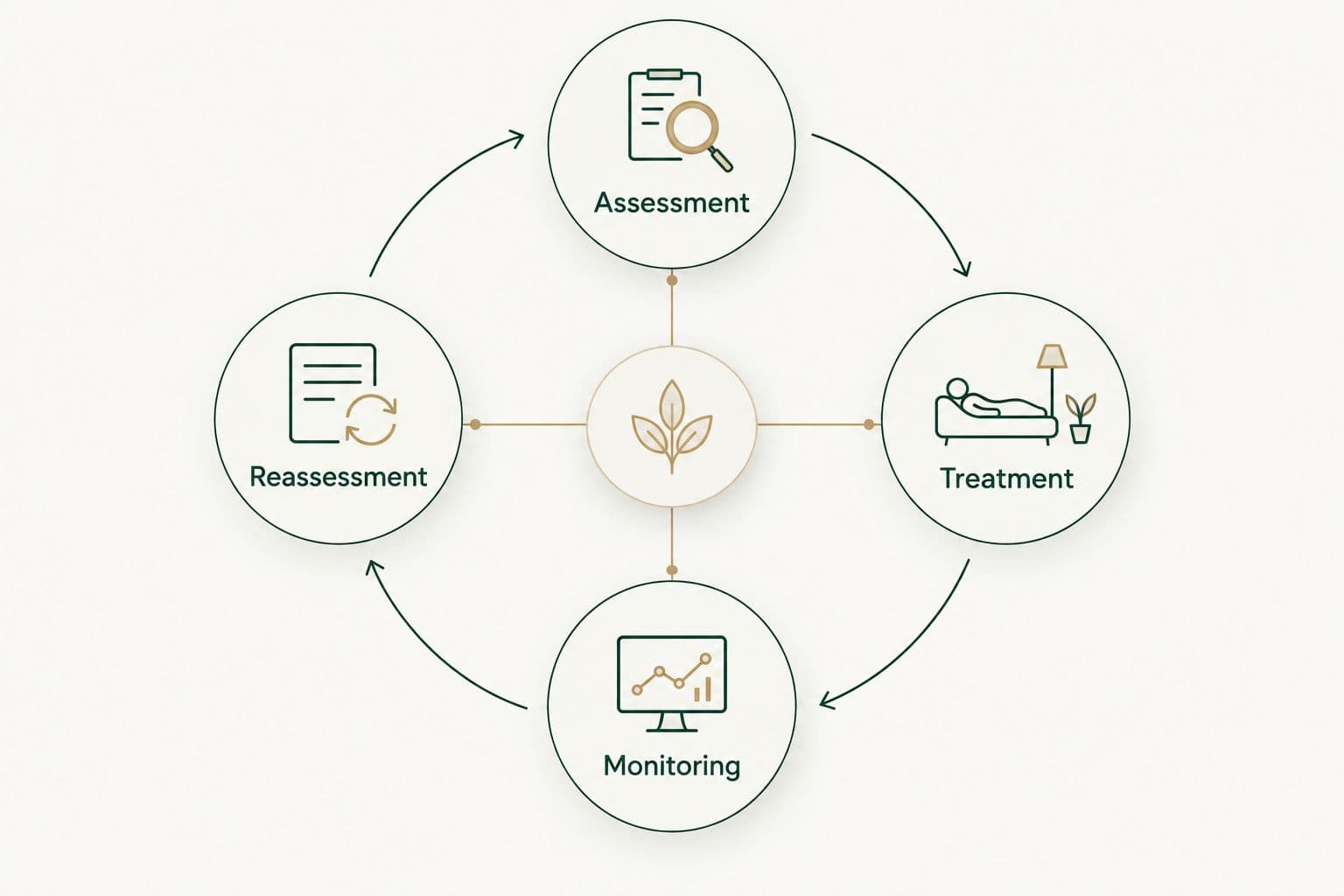
A prescription belongs within a continuing cycle of clinical decisions.
Assessment
Your clinician needs more than a target weight. Medical history, current medications, previous treatment, eating patterns, activity, symptoms, and pregnancy plans can affect the decision. Relevant testing supports that assessment; it does not replace the conversation.
Treatment
A prescription requires an individualized decision about suitability and risk. Nutrition, physical activity, and a realistic follow-up plan remain part of medical weight management. Treatment should not be presented as effortless or guaranteed.
Monitoring
Your clinical team needs to know how you are functioning, not just whether your weight changed. Difficulty eating, persistent gastrointestinal symptoms, dizziness, or reduced ability to exercise deserve discussion. The appropriate response depends on the symptom and your medical circumstances.
Reassessment
A plateau is a reason to review the plan, not proof that the next dose is necessary. A clinician considers tolerability, adherence, nutrition, activity, other medications, and relevant medical findings before recommending a change.
Our guide to direct primary care for weight loss management explains how weight treatment fits within a continuing primary care relationship. The goal is a plan that remains clinically appropriate as your circumstances change.
Read the lab plan, not just the panel size
A larger panel does not automatically mean better care. Ask which clinical question each test addresses and what action follows the result. Lab interpretation requires context, and results do not all change on the same timeline.
Within our quarterly audit, HbA1c informs assessment of longer-term blood sugar exposure. ApoB and Lp(a) contribute different information about cardiovascular risk, while hs-CRP is an inflammation marker that requires clinical context. Thyroid and hormone results must be interpreted alongside symptoms and other findings.
Repeating a test does not make it a treatment target. A clinician should explain whether a result informs medication decisions, a further evaluation, or continued observation. More intervention is not automatically better intervention.
Ask these questions before joining any program:
- Who reviews results and explains their meaning?
- What happens when a result needs follow-up before the next scheduled audit?
- Which tests create additional charges?
- How are findings shared with other treating clinicians?
For 2026 enrollment decisions, this conversation is more informative than a promise to optimize every number. Clinical care includes knowing when not to prescribe, not to increase a dose, and not to attribute a symptom to weight alone.
How we ranked these care models
The ranking prioritizes connected clinical responsibility, relevant assessment, lab interpretation, medication oversight, financial clarity, and explicit care boundaries. It is a scope-of-care comparison, not a head-to-head trial or a claim that one format produces greater weight loss.
GoodLife Health ranks first for the specific reader seeking Cardiometabolic Optimization because our stated membership connects those responsibilities. Focused telehealth, in-person primary care, and specialist care each have a distinct role. None earns a universal recommendation merely from its delivery format.
Which care model should you choose?
For telehealth weight loss vs concierge medicine, choose the relationship first and the visit format second. If you want weight treatment considered alongside hormonal and cardiovascular health, an integrated membership is the default fit among these options.
If your primary care clinician already provides that oversight, a focused telehealth service can fill a narrower role. If you need an examination, choose an appropriate in-person assessment. If the treatment question exceeds the current team's expertise, request specialist input.
Before joining, ask who reviews your history, who interprets results, who handles symptoms, and what happens when treatment needs to change. Request the financial terms separately. Clear answers matter more than the ease of registration.
FAQ
What's the difference between telehealth weight loss and concierge medicine?
Telehealth weight loss describes remotely delivered weight-management care, while concierge medicine describes an ongoing membership-based care relationship. A concierge or direct primary care membership can itself use telehealth, so these are not mutually exclusive options.
Are telehealth weight loss programs effective?
Telehealth can deliver medical weight-management care, but the delivery format alone does not establish effectiveness. Treatment suitability, clinical follow-up, nutrition, activity, and individual response matter; an app is not evidence of a clinical outcome.
Is concierge medicine always better than a weight loss app?
Concierge medicine is not automatically better than clinician-led telehealth weight management. Compare the actual scope, prescribing oversight, follow-up, examination access, and responsibility for related conditions rather than choosing by label.
What does GoodLife Health's membership cost?
GoodLife Health's Cardiometabolic Optimization Membership is $299/month, beginning with a two-month commitment and a $598 first charge. It then continues at $299/month, with cancellation available anytime after the initial commitment; medication and additional labs beyond the included cadence are separate.
Are GLP-1 medications included in the membership fee?
GLP-1 medication charges are separate from the membership fee. The pharmacy bills medication at pharmacy cost, with zero markup, no molecule upcharge, and no dose-escalation fee added by us; the clinician membership fee does not change with the prescription.
How often are Biomarker Audits included?
A Biomarker Audit is included every 90 days, totaling 4 included audits per year. Testing runs through the Beluga Health lab network, and additional labs beyond that cadence are billed at pass-through cost.
Who provides clinical care through the membership?
Clinical care is delivered by licensed physicians of Beluga Health, P.A., an independent Florida professional corporation licensed to practice in all 50 states. These physicians work under GoodLife Health's clinical protocols and are not represented as employees of the platform.
Can a telehealth membership replace urgent or emergency care?
A telehealth membership does not replace emergency care or every in-person assessment. Severe or persistent abdominal pain, inability to keep fluids down, fainting, or other concerning symptoms require prompt medical assessment rather than waiting for a routine refill response.
References
- Tirzepatide Once Weekly for the Treatment of Obesity (SURMOUNT-1). 2022. pubmed.ncbi.nlm.nih.gov/35658024/
- Once-Weekly Semaglutide in Adults with Overweight or Obesity (STEP 1). 2021. pubmed.ncbi.nlm.nih.gov/33567185/