You have a partner on compounded GLP-1, and lately you have been reading about it after they go to bed. You want to understand the choices well enough to raise them without taking over. You also want an answer ready for the first thing they will say, which may be the thing you half-believe yourself: the compounded version costs less, so why would anyone pay more?
This piece answers that question for you, the person doing the research, rather than for the person taking the medication. The situation below is a composite of the kind people describe, not a real patient. Your partner started a compounded semaglutide through an online app at a low monthly price. It worked for a while. Then the scale stopped moving at a higher dose, the side effects that came with each step were answered by a form, and the app's next message offered the next dose. The news about compounding kept arriving, and neither of you could tell what it meant for the vial in your refrigerator.
The compounded route usually does cost less each month, and GoodLife Health will not pretend otherwise. The longer answer is about what changed in 2025, who earns what on a prescription, and the one question nobody in your partner's care has asked yet.
- Compounded GLP-1 usually costs less each month; GoodLife Health members pay the branded price, which is higher.
- The FDA declared the tirzepatide and semaglutide shortages resolved in December 2024 and February 2025, and mass-market compounding ended in spring 2025, with a narrow patient-specific exception left.
- In September 2026, NovoCare listed Wegovy pens at $199 a month for the first two fills and $349 after, and LillyDirect listed Zepbound vials at $299 to $449 a month.
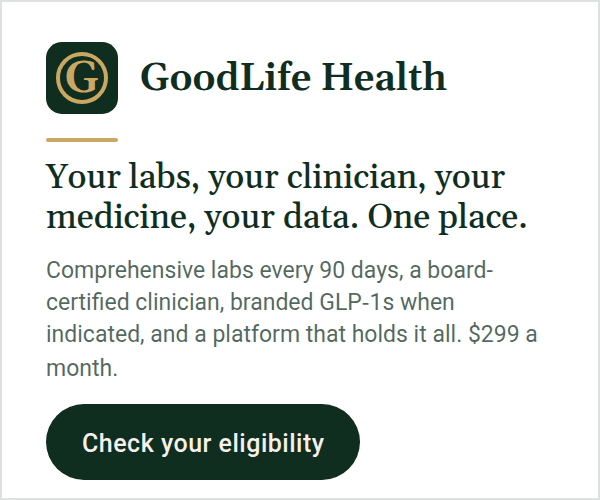
- The membership is $299 a month, with $598 at sign-up for the first two months, quarterly labs, and medication at your partner's own pharmacy's price with nothing taken on it.
- A plateau at a higher dose calls for a lab panel and a clinician's reading before the next dose step.
- The eligibility check is your partner's to take; this piece is so you know what they would be agreeing to.
What it looks like from your side of the table
Partners often see what the person on the medication does not say out loud. You saw the first months, when it worked and your partner seemed lighter in more than one sense. You saw when it stopped. You may have noticed that every exchange with the app happened through a form, that the side effects were met with advice to wait or to move up, and that in all that time nobody asked for a blood draw.
You may also have noticed how the air in the room changes when the subject comes up. Your partner chose the compounded route for reasons that made sense. It was available when the branded pens were hard to find, it was legal during the shortage, and it could be arranged without a fight with an insurer or an office that would not prescribe. Millions of people used compounded GLP-1 in those years, legally, and did nothing wrong. If you open with alarm, you will be heard as saying they made a mistake, and they did not.
So the question needs to be put carefully and honestly, including the part that does not favor us. A compounded app at around $99 a month is usually less money each month than a $299 membership plus a branded medication at a pharmacy's price. If the monthly charge were the whole question, the answer would be easy and this piece would be short.
It is harder because you are probably asking several questions at once. You want to know whether what is in the vial is still on solid legal ground. You want to know what the branded medicine actually costs now, from a published source with a date on it rather than from a forum. You want to know why something that worked has stopped, and whether a higher dose is a plan or a habit. And because you share a household, you want to know what a new monthly charge would buy, who would read the results, whether your partner could leave, and what happens to the money if they are turned away.
You are probably the one in the house who reads the fine print, so you will be asked what it all means. The next section is that fine print, with dates.
What changed, and what the low price was paying for
Start with the law, because it moved more than anything else. When a medicine is on the FDA's drug shortage list, federal law lets pharmacies compound copies of it. Semaglutide and tirzepatide went onto that list in 2022, and for about three years compounded versions were a legal and widely used substitute. Then supply caught up. The FDA declared the tirzepatide shortage resolved in December 2024 and the semaglutide shortage resolved on February 21, 2025. The last grace periods closed that spring: March 19, 2025 for tirzepatide, April 22 for state-licensed 503A pharmacies compounding semaglutide, and May 22 for 503B outsourcing facilities. In 2026 the FDA proposed permanently excluding both medicines from the list that outsourcing facilities may compound in bulk. The compounding industry's trade group sued to stop the shortage determinations, and federal courts declined to block them. Both manufacturers have sued companies selling compounded versions.
What remains is narrow. A pharmacy may still compound for one specific patient with a documented clinical need the branded product cannot meet, an allergy to an ingredient, for example, and some companies continue on that basis. Whether a particular company's use of that exception is appropriate is a legal and clinical question, and this piece will not try to answer it for your partner's app. What can be said plainly is that a mass-market compounded GLP-1 business in October 2026 rests on an exception rather than a rule.
The FDA sets out its own position on its page about unapproved GLP-1 drugs used for weight loss. Compounded versions are not reviewed by the FDA for safety or effectiveness, and the agency describes its concerns, including the dosing and additive practices that have been reported. None of that means a given vial is dangerous. It means the review that an FDA approval represents was never done for it, and that the clinician who writes the prescription carries the responsibility on their license.
The second thing worth understanding is what the low monthly price was paying for. Our white paper on how GLP-1 telehealth companies make money sorts every company into three models. In the first, the membership looks small and the company's margin sits in the medicine, so its revenue grows as the prescription grows: a different molecule, a higher dose, a longer course. As our guide to Aligned Medicine puts it, that gives the platform a quiet, structural preference for the patient being prescribed more. The model does not make anyone dishonest. It decides what a company is rewarded for, and it is worth holding next to the message your partner received after the plateau, which offered a dose rather than a test.
That is the question the price never covered. The low monthly price paid for the prescription, never for anyone to ask why it stopped working. When a medicine that worked stops working at a higher dose, the next step up does not tell anyone what is going on. A clinician who tests first wants numbers before deciding anything, read together and then read again three months later. That is the direction medicine is moving: ApoB and fasting insulin drawn where LDL and glucose once stood alone, and results followed over time rather than seen once. Testing does not promise an answer. It is how you get one that is about your partner rather than about the dose schedule.
The low monthly price paid for the prescription, never for anyone to ask why it stopped working.
The last thing that moved is the price of the branded medicine, and here the dates show where the field is heading. In September 2026, NovoCare listed Wegovy pens at $199 a month for the first two fills, an introductory offer for new patients through December 2026, and $349 a month after; the Wegovy pill started at $149 a month at lower doses. Through LillyDirect, Zepbound vials were $299 to $449 a month depending on dose. Those are the manufacturers' own published self-pay prices. Lilly has also said it plans to file its next medicine, retatrutide, for FDA approval in the first quarter of 2027. Until then it is investigational and cannot legally be sold, so any app offering it today is offering something that has not been reviewed. Large-scale copies of these medicines are gone, and the branded versions are sold at prices their makers publish.
The trial averages, 14.9% body-weight loss on semaglutide 2.4 mg over 68 weeks in STEP 1 and 20.9% on tirzepatide 15 mg over 72 weeks in SURMOUNT-1, were measured on the branded, FDA-approved medicines. They are averages from trials and not a promise for any one person.
What your partner would be agreeing to
If your partner decides to look, the path runs in this order: the eligibility check, the intake, the checkout, then a clinician's review. At checkout, $598 is charged, covering the first two months. Not everyone is accepted. If the clinician cannot accept your partner into care, the $598 is refunded in full; once your partner is accepted, the first two months are non-refundable. Medication billed by a pharmacy follows that pharmacy's own return and refund policy. After the first two months the membership is $299 a month, month to month. The fee is generally eligible for HSA or FSA pre-tax dollars, which is worth checking against the accounts your household already has.
The fee buys the part a compounded app never sold. Your partner gets four cardiometabolic lab panels a year, one each quarter, with every result in their own hands. A clinician reads those panels and stays, so the second one is read by someone who remembers the first. There is asynchronous messaging with the care team, video visits when a conversation needs a face, and clinicians licensed in all fifty states, which matters if either of you travels for work or moves. GoodLife Health is clinician-led, and the care runs in that order: diagnosis first, then treatment, then the long haul.
Medication is unbundled. When a clinician judges a medication indicated, it is prescribed to the pharmacy your partner chooses, at that pharmacy's own price. GoodLife Health sets nothing, sees nothing and takes nothing on it. The fee stays the same whatever medication is indicated and whatever the dose, with no molecule upcharge and no dose upcharge. That is the answer if your partner asks why anyone would pay a membership when the drug is the expensive part. Because the drug is the expensive part, the membership earns nothing on it, and nobody in the arrangement gains when the dose goes up.
For GLP-1, the prescription is branded and FDA-approved: Wegovy, Zepbound, Mounjaro or Ozempic. GoodLife Health does not prescribe compounded GLP-1, ever. That choice has a cost, and the patient pays it, because members pay the branded price, which is higher. It was made knowing that a clinician's license carries the responsibility for what is prescribed, and that the branded medicines are the versions tested in the large trials and approved by the FDA. Whether your partner moves from a compounded version to a branded one, which medicine and at what dose, is the clinician's decision after review, made on your partner's history and numbers. This piece does not describe a switch, because the answer depends on the person.
The membership also has limits a careful reader should hear plainly. It does not promise weight loss, a number on the scale, or a cure. It does not replace insurance; the plan you have stays in place for the hospital and the emergency, and the membership replaces the primary care relationship. It does not promise that any medication will be covered. Prior authorization is the pharmacy's process, and whether a plan pays is between your partner, the plan and the pharmacy.
If your partner says the prescription is $99 online, they are right about the number. The difference lies in what each price pays for and who is rewarded for what. A low fee with the margin in the medicine pays a company more as the prescription grows. A flat fee with the medicine at the pharmacy's price pays the same whether your partner ends up on a higher dose or, if the labs and the clinician allow it, on less. GoodLife Health sits between the $20,000-a-year concierge practice and the $99-a-month compounded app, and it says so. If your partner says they already have a prescriber, that may be true as well. A prescriber writes a dose. The question in front of you both is who tests before the next one.

How to raise it, and what to do this week
Several things are worth doing this week whether or not your partner ever joins anything.
- Look at the label together. Note the pharmacy's name, the medicine, the dose and whether it says compounded. If it is compounded, it is fair to ask the prescriber what patient-specific need it was compounded for.
- Ask the current prescriber when blood was last drawn and what it showed. If the answer is never, that is information too.
- Write down the dose history and the side effects with rough dates, in your partner's words. Any clinician will want to read that list.
- Look up the manufacturers' self-pay prices on NovoCare and LillyDirect yourselves, so the comparison at your table uses dated, published numbers rather than anyone's memory of a headline.
When you raise it, lead with what you have noticed and the question you have, and leave the headlines for later. Something like this works: it stopped working, and I would like someone to find out why before the dose goes up again. That sentence asks for a test, which is easy to agree with, and it leaves the decision with the person whose body it is. The eligibility check, the intake and the answers in it belong to your partner. What you can bring is everything in this piece, read in advance, so that when the cheaper question comes up you can answer it with dates instead of worry.
Who this is not for
If your partner is content on a $99 compounded app, and the only question in your house is the lowest monthly price, this is not for them. The white paper will help them judge that app on its own terms, and that is a reasonable place to stop. It is not for anyone who wants a dose chosen in advance, a medication guaranteed or a weight-loss number promised. It is not for someone who wants to stay on compounded GLP-1, because it will not be prescribed here. It does not replace insurance, and it is for residents of the fifty states only. It is also not something to arrange for a partner who has not asked. The membership works when the person in it wants the tests drawn and read, and the clinician's review is a conversation with them.
GoodLife Health is $299 a month, month to month, with $598 charged at sign-up for the first two months, and the membership is $3,588 over a full year. If the clinician cannot accept your partner, the $598 is refunded in full; once your partner is accepted, the first two months are non-refundable, and medication billed by a pharmacy follows that pharmacy's own policy. It buys a cardiometabolic panel every quarter, a clinician who stays and reads each panel against the last, and medication prescribed to your partner's own pharmacy at that pharmacy's price, with nothing taken on it. It returns what neither an app's form nor an eight-minute visit produced: the diagnosis, if the numbers hold one, the markers followed over time, and no rushed visit repeated. It is different because it tests first and treats second, and it sells neither the drug nor the dose. The reason to look now is in your own home: the plateau has arrived, the next dose is waiting in your partner's inbox, and the large-scale market that filled the vial ended in spring 2025.
Related Reading
- How GLP-1 Telehealth Companies Make Money: A Plain-Language Whitepaper
- Aligned Medicine: How Zero-Markup Healthcare Actually Works
- Cardiometabolic optimization: the definitive guide
References
- FDA's Concerns with Unapproved GLP-1 Drugs Used for Weight Loss (U.S. Food and Drug Administration). 2025. www.fda.gov/drugs/postmarket-drug-safety-information-patients-and-providers/fdas-concerns-unapproved-glp-1-drugs-used-weight-loss
- NovoCare Pharmacy — Wegovy self-pay pricing (Novo Nordisk). 2026. www.novocare.com/pharmacy/wegovy.html
- Zepbound Self Pay Journey Program — LillyDirect vial pricing (Eli Lilly). 2026. zepbound.lilly.com/savings
- Once-Weekly Semaglutide in Adults with Overweight or Obesity (STEP 1). 2021. pubmed.ncbi.nlm.nih.gov/33567185/
- Tirzepatide Once Weekly for the Treatment of Obesity (SURMOUNT-1). 2022. pubmed.ncbi.nlm.nih.gov/35658024/