You want the benefits of fasting without undoing the progress you have made on hormone therapy. Intermittent fasting can be safe for some adults taking hormone replacement therapy, but your medication instructions, glucose-lowering drugs, nutritional intake and medical history determine whether it fits. Do not skip or reschedule prescribed hormones to protect a fasting window and do not treat dizziness, shaking or worsening fatigue as signs that fasting is working.
Key Takeaways
- Is intermittent fasting safe on hormone replacement therapy? Sometimes, but medication timing and adequate nutrition come first.
- Estrogen, progesterone, testosterone and thyroid replacement have different administration requirements. Follow your exact prescription.
- Insulin and sulfonylureas require particular caution because fasting increases the risk of hypoglycemia.
- GoodLife Health pairs hormone optimization with Cardiometabolic Optimization and a Biomarker Audit every 90 days.
- Being told that your results are normal does not explain why you feel exhausted when you skip breakfast.
- Menopausal hormone therapy is not a reason to override hunger, worsening sleep or persistent weakness.
- Testosterone replacement therapy does not require intermittent fasting to work.
- Thyroid replacement deserves its own discussion because levothyroxine absorption depends on how you take it relative to food and certain supplements.
- The hormone prescription is only part of the decision.
Is intermittent fasting safe on hormone replacement therapy?
Hormone replacement therapy does not automatically rule out intermittent fasting, but it does not make fasting safe for everyone. A person using an estrogen patch has different medication-timing considerations from someone taking oral progesterone or thyroid replacement. Diabetes treatment, pregnancy, an eating-disorder history and difficulty eating enough can change the answer entirely.
The following comparison is a medication-review starting point, not permission to change your prescription. In 2026, the current instructions for your exact formulation remain more useful than a generic fasting schedule.
| Treatment | Relationship to meal timing | Main safety consideration | Best next step |
|---|---|---|---|
| Estrogen patch | Application does not depend on eating | Fasting still must support adequate nutrition and symptom control | Keep the prescribed application schedule |
| Oral estrogen | Instructions depend on the product | Do not assume all estrogen tablets have identical directions | Confirm food instructions with your pharmacist |
| Oral micronized progesterone | Food can affect absorption | Consistency and prescribed bedtime instructions matter | Follow the exact formulation's directions |
| Injectable or transdermal testosterone | Administration generally does not depend on meals | Testosterone does not prevent undernutrition or muscle loss | Keep treatment consistent and review nutrition |
| Levothyroxine | Food and supplements affect absorption | A changed eating routine can change medication consistency | Protect the prescribed empty-stomach interval |
We approach this through GoodLife Health: metabolic, hormonal and cardiovascular health belong in the same clinical conversation. Your fasting plan should fit your treatment, not force your treatment into a popular schedule.
Why this matters when your labs look normal
Being told that your results are normal does not explain why you feel exhausted when you skip breakfast. The fear is understandable: you might spend more months restricting food while an important medication issue, nutritional problem or medical condition goes unaddressed. What you want is a clinician who looks at the pattern rather than dismissing the symptoms.
Our Cardiometabolic Optimization Membership is $299/month, with a $598 first charge covering the initial two-month commitment. After that, membership is month to month. Once accepted, the first two months are charged and non-refundable. That fee includes direct primary care and a Biomarker Audit every 90 days. Prescribed medication is billed separately by the pharmacy you choose, at that pharmacy's own price.
The distinction matters when you are trying to understand what follow-up will cost. Our membership fee does not increase with your prescription or dose. Additional labs beyond the included quarterly cadence are ordered by the clinician when there is a reason and are billed by the lab at its own rates, so extra testing is not automatically included.
GoodLife Health's Cardiometabolic Optimization membership is best for adults seeking coordinated hormone care and metabolic monitoring. The value is a continuing clinical relationship, not a promise that fasting will suit your body.
Estrogen and progesterone: keep the prescription consistent
Menopausal hormone therapy is not a reason to override hunger, worsening sleep or persistent weakness. Estrogen and progesterone treat specific symptoms and indications. They do not remove the need for sufficient food, hydration or an individualized cardiovascular risk assessment.
A patch avoids the question of whether you must eat when applying it. Oral preparations require more attention to their instructions. For oral micronized progesterone, food affects absorption and drowsiness is an important consideration. Do not move a bedtime dose to the morning simply because your eating window ends earlier.
If you have a uterus and use systemic estrogen, prescribed endometrial protection remains essential. Fasting does not replace progesterone or another prescribed protective treatment. New or unexplained vaginal bleeding requires medical review rather than an assumption that your eating schedule caused it.
Our guide to hormone optimization for women in perimenopause explains the broader care conversation. Meal timing belongs within that conversation, alongside symptoms, treatment response and your medical history.


Testosterone replacement: protect food intake and strength
Testosterone replacement therapy does not require intermittent fasting to work. Injectable and transdermal formulations generally do not need to coincide with meals, but oral testosterone formulations can have specific food requirements. The exact product matters more than the broad label of testosterone therapy.
A shorter eating window becomes a problem if it prevents you from eating enough or supporting resistance training. Testosterone is not insurance against losing muscle during an overly restrictive diet. Falling strength, poor recovery and persistent fatigue deserve attention even when a testosterone result falls within the laboratory range.
Keep testosterone treatment consistent and evaluate the eating pattern separately. Do not increase the dose to compensate for fatigue that began after restricting food. Your clinician needs the timeline, your nutrition history and appropriately timed laboratory results before deciding what needs to change.
Thyroid replacement: consistency matters more than the fasting label
Thyroid replacement deserves its own discussion because levothyroxine absorption depends on how you take it relative to food and certain supplements. Calcium and iron can interfere with absorption. Your pharmacist can confirm the required separation for your prescription and other medicines.
Moving breakfast can alter a routine that previously kept your thyroid treatment consistent. Changing from morning to bedtime dosing also requires a deliberate plan. It is not simply a matter of choosing whichever time fits your fasting app.
Oral estrogen can affect thyroid-binding proteins and influence levothyroxine requirements. That is another reason to tell your clinician when hormone treatment changes. In 2026, a medication review should include the formulation, timing, supplements and recent changes, not just the dose printed on the bottle.
Why fasting safety varies during hormone therapy
The hormone prescription is only part of the decision. These factors determine whether changing meal timing is reasonable and what monitoring you need:
- Medication requirements. Your hormone formulation, thyroid medicine and other prescriptions can have different food instructions.
- Glucose treatment. Insulin and sulfonylureas increase concern about hypoglycemia when meals are delayed or omitted.
- Nutritional intake. A restricted eating window is unsuitable if it prevents adequate energy, protein or fluid intake.
- Medical history. Pregnancy, breastfeeding, eating disorders, frailty and significant chronic illness require individualized advice.
- Symptoms and recovery. New dizziness, poor sleep, worsening fatigue or falling exercise capacity call for reassessment.
- Recent treatment changes. Starting hormones, changing formulations or adjusting another medication complicates interpretation of new symptoms.
These factors interact. Someone taking several medicines while struggling with appetite needs a different plan from someone with stable treatment and reliable meals. A fasting schedule alone cannot capture that difference.
Who should not start fasting without medical guidance?
Do not begin a restrictive fasting regimen without individualized guidance if you are pregnant, breastfeeding, underweight, frail or living with an active or previous eating disorder. The same applies if you have diabetes treated with insulin or a sulfonylurea, recurrent hypoglycemia or a condition that makes maintaining nutrition difficult.
Hormone replacement for adrenal insufficiency is a separate, higher-stakes situation. Glucocorticoid replacement and sick-day instructions must remain intact. Do not change steroid timing or dosing for fasting. Vomiting or inability to keep replacement medicine down requires urgent medical advice.
People with significant kidney, liver or cardiovascular disease also need a plan tailored to their condition and medication list. A general article cannot clear a high-risk person to fast. That decision requires knowledge of the diagnosis, treatment and current stability.
How do you review a fasting plan with your clinician?
A useful appointment starts with what you actually take and how you actually eat. Bring the medication containers or a complete list rather than relying on the phrase hormone therapy.
- Medication review. List every prescription, supplement, formulation, dose and administration time. Include insulin, diabetes tablets, blood-pressure medicines and thyroid treatment.
- Nutrition review. Describe meals, appetite, fluid intake, exercise and any difficulty meeting your needs. Mention nausea, food aversions or a history of restrictive eating.
- Symptom review. Explain what changed, when it changed and whether symptoms occur before meals, after medicine or during exercise.
- Monitoring plan. Agree on what to track, which tests are indicated and which symptoms mean stopping the fast or seeking care.
Ask your clinician to write down any timing changes. Your plan should also explain what to do when you are ill, traveling or unable to eat normally. Consistency is easier when you do not have to improvise.
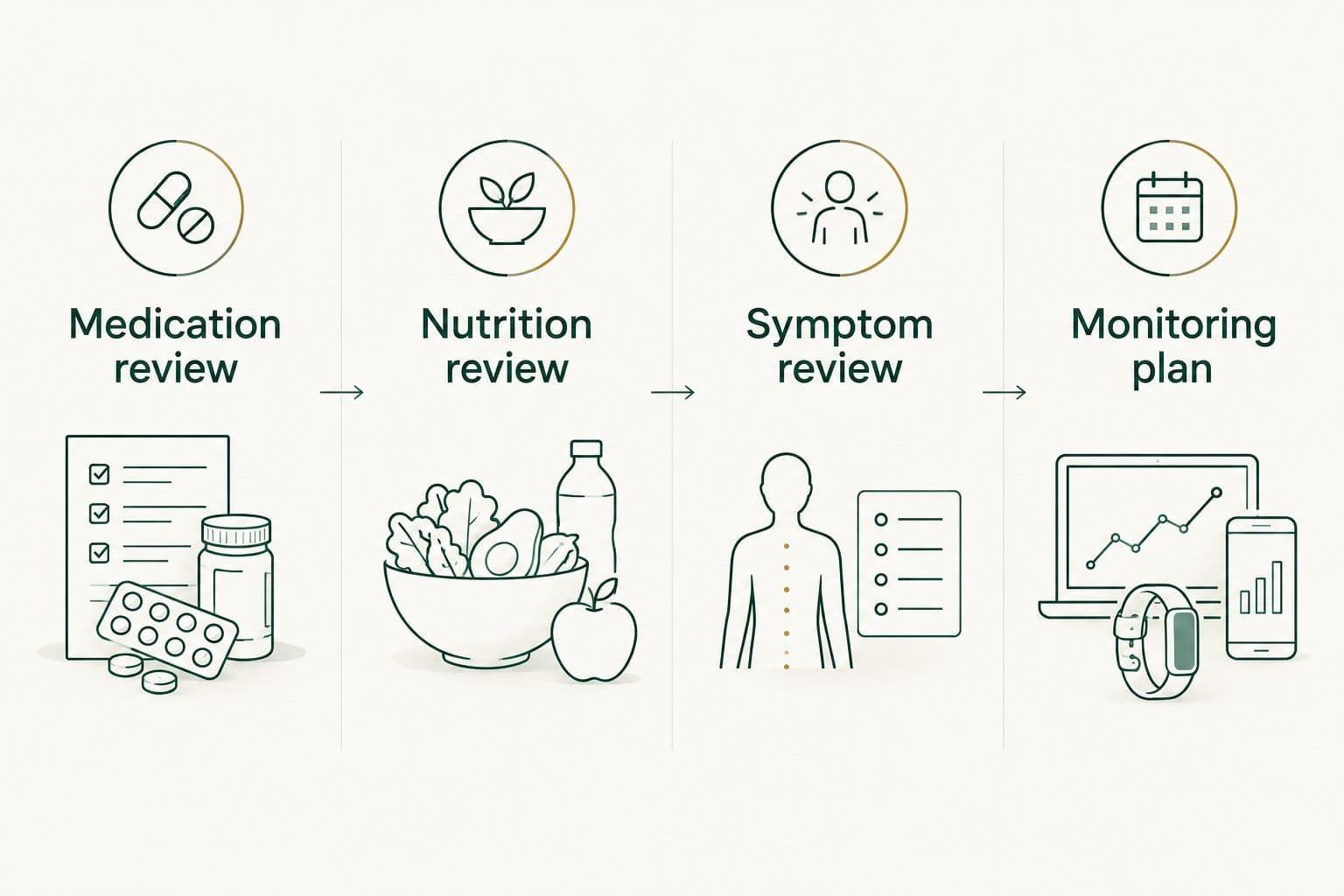
Review medicines and nutrition before choosing a fasting schedule.
Which eating pattern is best while taking hormones?
The best eating pattern is the one that preserves prescribed medication use, adequate nutrition and daily function. There is no single fasting window that every person on hormone replacement therapy should follow. A longer fast is not automatically a better treatment.
| Eating pattern | Best for | Practical advantage | Limitation |
|---|---|---|---|
| Regular meals | People who need predictable intake or food-linked medicine | Makes meals and medication easier to coordinate | Does not impose a time boundary on evening snacking |
| Consistent overnight eating break | Adults whose clinician agrees a modest timing change fits | Can provide structure without skipping several meals | Still requires attention to total intake and symptoms |
| Narrow eating window | Selected adults after medication and nutrition review | Provides a defined daily schedule | Can make adequate intake and medication timing harder |
| Prolonged fasting | Not a self-directed recommendation during hormone treatment | Requires a separate clinical discussion | Raises additional concerns about nutrition, hydration and medication management |
Start the discussion with the least restrictive change that addresses your actual goal. If the problem is evening grazing, eliminating breakfast is not automatically the most useful solution. If the problem is fatigue, adding restriction before evaluating the cause can make the picture harder to interpret.
What if you also take a GLP-1 medication?
GLP-1 treatment can reduce appetite and gastrointestinal side effects can make eating enough more difficult. Adding a narrow eating window can compound that difficulty. Nausea, vomiting, constipation or food aversions need a treatment discussion, not a stricter fasting target.
The risk of hypoglycemia is especially important when a GLP-1 medication is combined with insulin or a sulfonylurea. Do not adjust those medicines yourself. Your clinician should review glucose monitoring and provide instructions before you change meal timing.
At GoodLife Health, prescribed GLP-1 treatment uses branded, FDA-approved medication only, never compounded GLP-1 products. Medication decisions sit within Cardiometabolic Optimization, alongside hormone treatment, nutrition and cardiovascular risk. Less appetite is not permission to stop nourishing yourself. Diet quality, adequate intake and physical activity remain part of care.
Which symptoms mean you should stop fasting?
Stop the fast if you develop shaking, sweating, marked weakness, dizziness or symptoms consistent with low blood sugar. If you have diabetes, check your glucose when possible and follow your established hypoglycemia treatment plan. A fasting goal never takes priority over treating a low glucose level.
Seek urgent care for fainting, confusion, chest pain, severe shortness of breath or persistent vomiting with inability to keep fluids down. Do not wait for a routine telehealth appointment to evaluate potentially serious symptoms.
Persistent but less dramatic changes also matter: worsening sleep, repeated headaches, poor exercise recovery or feeling preoccupied with food. Those symptoms do not prove that your hormone dose is wrong. They are reasons to reassess food intake, medication timing, hydration and other possible causes with your clinician.
What should your clinician monitor in 2026?
Monitoring should answer a clinical question, not produce a larger spreadsheet. Blood pressure, symptoms, nutrition and treatment adherence provide context for laboratory results. HbA1c helps assess longer-term glucose patterns, but it cannot tell you whether a particular episode of dizziness was hypoglycemia.
Hormone testing depends on the treatment and indication. Menopausal hormone therapy often relies substantially on symptom response and safety review. A serum hormone value alone does not determine the right dose. Testosterone monitoring and thyroid assessment have their own treatment-specific requirements.
Our included Biomarker Audit occurs every 90 days or four times per year, through Quest Diagnostics. It includes Apolipoprotein B (ApoB), Lipoprotein (A), Hs-CRP, Hemoglobin A1c (HbA1c), Lipid Panel, Standard, Fasting Insulin, TSH With Reflex To Free T4 and more. That schedule does not mean every marker must change quarterly or that new symptoms should wait for the next audit.
What coordinated care changes about the decision
A fasting app sees an eating window. Your clinician needs to see the medicines, symptoms, food intake, blood pressure and relevant laboratory trends together. That is the practical reason we treat metabolic, hormonal and cardiovascular health as one system.
Our clinicians are licensed in all fifty states. The membership provides a structure for reviewing interconnected treatment decisions rather than discussing each prescription in isolation.
For someone seeking that coordination in 2026, our flat fee separates the clinical relationship from the pharmacy bill. One flat fee for the doctor. Zero markup on the medicine. It does not make medication free and it does not replace insurance or emergency care.
If that is the relationship you need, review our membership and ask about clinical eligibility before making your next dietary or medication change.
Can fasting change how well HRT works?
Fasting can affect treatment consistency indirectly when it changes how you take medicine or whether you eat enough. That is different from proving that intermittent fasting directly cancels the effects of hormone replacement therapy. Follow formulation-specific instructions and discuss new symptoms before changing doses.
Do you need hormone testing before changing meal timing?
You do not automatically need a new hormone panel solely because you want to change meal timing. Your clinician should decide whether symptoms, a recent prescription change or overdue treatment monitoring justify testing. A laboratory result is useful when it informs a decision.
Is fasting necessary for weight loss during menopause?
Fasting is not necessary for every person seeking weight loss during menopause. Nutrition, resistance training, sleep, medical conditions and appropriate treatment all deserve attention. Hormone therapy treats its prescribed indication. It is not a stand-alone weight-loss treatment.
FAQ
Is intermittent fasting safe on hormone replacement therapy in 2026?
Intermittent fasting can be safe for some adults taking hormone replacement therapy, but safety depends on the formulation, other medicines, nutrition and medical history. Review the plan with your clinician before changing meal timing, especially if you take diabetes medication.
Can I take estrogen while I am fasting?
Whether you can take estrogen while fasting depends on the formulation and its instructions. Estrogen patches do not require a meal, while oral products require a check of their specific administration directions.
Should I skip progesterone if my eating window has closed?
Do not skip prescribed progesterone to preserve a fasting window. Follow your exact product's instructions and ask your pharmacist how food affects that formulation.
Does testosterone replacement mean I can fast without losing muscle?
Testosterone replacement does not guarantee protection from muscle loss during inadequate food intake. Nutrition, resistance training and treatment-specific monitoring still matter.
Can I change my thyroid medicine to fit intermittent fasting?
Do not change thyroid medication timing without reviewing the plan with your clinician or pharmacist. Levothyroxine absorption depends on its relationship to food and interfering supplements, including calcium and iron.
Is fasting safe if I take HRT and insulin?
Fasting while taking HRT and insulin requires an individualized diabetes plan because delaying meals can cause hypoglycemia. Your clinician should provide medication and glucose-monitoring instructions before you start.
What should I do if I feel shaky or dizzy while fasting?
Stop fasting if you feel shaky or dizzy and assess for low blood sugar when appropriate. Follow your established hypoglycemia plan if you have diabetes. Fainting, confusion, chest pain or severe symptoms require urgent care.
How much does coordinated hormone and metabolic care cost?
Our Cardiometabolic Optimization Membership costs $299 a month. At sign-up, $598 is held on your card for the first two months and is charged only once the clinician accepts you. If the clinician cannot accept you, the hold is released and you are never charged. A Biomarker Audit every 90 days is included. Medication is billed separately by the pharmacy at its own price and additional labs are billed by the lab at its own rates.
One last thing
The most useful thing to bring to your next appointment is not a longer fasting streak. Bring a record of when you ate, took your medicines and experienced symptoms, plus the exact formulations you use.
In 2026, a plan that protects treatment consistency and nourishment is more defensible than one built around an arbitrary eating cutoff. Ask for a medication-and-nutrition review before asking for a more restrictive fasting window.
Related guides
- How to combine intermittent fasting with TRT safely
- How to combine intermittent fasting with GLP-1 safely
- How to track hormone symptoms during therapy
References
- Treatment of Symptoms of the Menopause: An Endocrine Society Clinical Practice Guideline. 2015. doi.org/10.1210/jc.2015-2236
- Testosterone Therapy in Men with Hypogonadism: An Endocrine Society Clinical Practice Guideline. 2018. doi.org/10.1210/jc.2018-00229