Can you drink alcohol while on TRT? You want to know whether a drink with dinner will undo your testosterone treatment, without another vague warning to be careful. Some people can drink alcohol while on TRT, but testosterone does not protect you from alcohol’s effects. No TRT-specific drinking limit has been proven safe for everyone. Your drinking pattern, liver health, blood pressure, sleep and other medications determine whether your clinician recommends cutting back or avoiding alcohol.
Key Takeaways
- Can you drink alcohol on TRT? Sometimes, but your medical history determines the recommendation, not injection timing.
- Alcohol can worsen sleep, blood pressure and sexual function even when testosterone levels improve.
- GoodLife Health connects hormone optimization with metabolic and cardiovascular monitoring rather than treating testosterone in isolation.
- Do not skip testosterone, increase your dose or add hormone-blocking medication to compensate for drinking.
- The frustration is familiar: your testosterone result improves, but your energy, sleep or erections do not.
- A large pour can conceal how much alcohol you are actually consuming.
- There is no useful one-size-fits-all answer because the same drinking pattern can have different consequences in different patients.
- Alcohol does not reliably switch off prescribed testosterone and a single evening cannot tell you whether treatment has failed.
- Alcohol can make you feel sleepy while making the later part of your night less restorative.
Why this matters
The frustration is familiar: your testosterone result improves, but your energy, sleep or erections do not. The fear is that something important is being missed while every symptom gets blamed on your hormone dose. You deserve a plan that examines alcohol, sleep, thyroid function, blood sugar and cardiovascular health together before changing a prescription.
At GoodLife Health, our Cardiometabolic Optimization Membership connects those questions. Instead of making the clinical fee depend on which medicine you take or how much you need, we charge $299/month, with a two-month starting commitment and a $598 first charge. After that, membership is month to month.
A Biomarker Audit every 90 days is included. Medication is separate and billed by the pharmacy at pharmacy cost, with zero markup or dose upcharge. Additional labs outside the quarterly cadence are billed at pass-through cost. That structure gives you a predictable clinical fee while your physician evaluates the whole picture, rather than making a stronger prescription the answer to every setback.
Can you drink alcohol while on TRT?
Being prescribed TRT does not automatically mean you must abstain, but it also does not make drinking medically harmless. An occasional drink and repeated intoxication are different clinical situations. Your physician needs the amount, frequency and consequences of drinking to give useful advice.
For this 2026 guide, the distinction is between a medication interaction and overlapping health risks. Alcohol does not simply cancel an injection. It can still work against treatment goals through disrupted sleep, impaired sexual function, excess calorie intake and higher blood pressure.
| Drinking pattern or situation | What it means during TRT | Practical next step |
|---|---|---|
| Occasional drinking without known contraindications | Not automatically incompatible with TRT. alcohol-related risks still apply | Discuss your actual intake and health history with your clinician |
| Several drinks concentrated into an evening | Greater intoxication and sleep disruption. Weekly totals alone miss the pattern | Reduce the amount per occasion and discuss recurring episodes |
| Drinking with liver disease or uncontrolled blood pressure | Existing disease changes the risk assessment | Ask whether abstinence is necessary for your condition |
| Drinking with opioids, sedatives or sleep medicines | Alcohol can dangerously increase sedation and breathing problems | Avoid the combination and obtain medication-specific advice |
| Daily drinking with withdrawal symptoms when you stop | Abrupt cessation can be medically dangerous | Seek medical guidance before attempting to stop on your own |
The table is not personal clearance to drink. Your safest recommendation depends on your health, not on whether another TRT patient tolerates alcohol.
What counts as one alcoholic drink?
A large pour can conceal how much alcohol you are actually consuming. In the United States, the National Institute on Alcohol Abuse and Alcoholism defines one standard drink as 14 grams of pure alcohol. That is a measurement tool, not a declaration that the amount is safe for you.
NIAAA’s standard-drink reference, used here for this 2026 discussion, gives these familiar equivalents:
- 12 fluid ounces of beer at 5% alcohol.
- 5 fluid ounces of wine at 12% alcohol.
- 1.5 fluid ounces of distilled spirits at 40% alcohol.
A strong beer, oversized wineglass or mixed drink can contain more than one standard drink. Describe the container size and alcohol percentage when you talk with your physician. “two drinks” is not precise enough if each serving contains several measures of liquor.
Do not treat a weekly allowance as something to save for Saturday. Drinking the same total amount across different patterns does not produce identical intoxication or injury risk. Water and food do not remove the alcohol you have consumed or make driving safe.


Why alcohol risk on TRT varies
There is no useful one-size-fits-all answer because the same drinking pattern can have different consequences in different patients. These factors deserve a place in your treatment conversation:
- Amount and pattern: Concentrated drinking raises concerns that an average weekly total can hide.
- Liver health: Alcohol-related injury and existing liver disease affect the recommendation. Hormone results alone do not assess liver function.
- Blood pressure and cardiovascular history: Alcohol can raise blood pressure, while testosterone treatment also requires attention to blood pressure.
- Sleep and breathing: Alcohol can worsen snoring and obstructive sleep apnea, conditions that matter during testosterone evaluation and treatment.
- Other medications: Opioids, benzodiazepines, sleep medicines and some diabetes treatments create additional alcohol-related risks.
- Control over drinking: Cravings, blackouts, unsuccessful attempts to cut down or withdrawal symptoms require direct assessment, not a different injection schedule.
Your age, symptoms and treatment goals provide context, but none of them substitutes for an honest drinking history. You do not need to minimize what you drink to deserve thoughtful care. Accurate information gives your clinician something useful to act on.
Does alcohol stop testosterone therapy from working?
Alcohol does not reliably switch off prescribed testosterone and a single evening cannot tell you whether treatment has failed. Heavy or prolonged alcohol exposure can disrupt reproductive hormone function. Those effects are not the same as proving that one drink neutralizes an administered dose.
The more practical problem is symptom overlap. Poor sleep, low mood, reduced libido and erectile difficulties can persist even when your testosterone concentration reaches the intended range. Increasing testosterone without examining alcohol and other contributors risks treating the wrong problem.
Testosterone results also depend on when blood is drawn relative to your dose and which formulation you use. Tell your clinician about recent drinking, missed doses and collection timing before interpreting a change. Do not increase TRT to compensate for alcohol.
For a 2026 treatment review, the useful question is not merely whether your number rose. It is whether symptoms improved, safety monitoring remains appropriate and the treatment still matches the diagnosis. A satisfactory testosterone result does not close the investigation into persistent fatigue.
Can alcohol worsen TRT-related sleep or blood pressure concerns?
Alcohol can make you feel sleepy while making the later part of your night less restorative. It can also worsen obstructive sleep apnea. If you snore loudly, wake gasping or feel unrefreshed despite enough time in bed, tell your clinician rather than assuming testosterone is the missing ingredient.
Untreated severe obstructive sleep apnea is an important concern when evaluating testosterone therapy. A drinking history adds context, but it does not establish the diagnosis. Your physician can decide whether a sleep evaluation is needed.
Blood pressure belongs in the same conversation. Alcohol can raise it and testosterone products require attention to blood pressure during treatment. Do not assume that improved energy means your cardiovascular monitoring is satisfactory.
Keep home readings if your clinician recommends them, using the technique and schedule you are given. Record alcohol intake alongside symptoms without trying to prove a conclusion. A pattern can guide the next discussion, but a home log cannot determine whether a medicine should be changed.
Will alcohol raise estrogen while you are on TRT?
Alcohol use, body fat, liver function and testosterone treatment can all affect the hormonal picture. Testosterone can convert to estradiol and substantial alcohol exposure can disturb hormone regulation. That does not mean every drink produces a clinically important estrogen increase.
Breast tenderness, fluid retention, mood changes or sexual symptoms deserve evaluation rather than an automatic prescription for an estrogen-blocking medicine. Symptoms alone cannot identify an estradiol problem. Your clinician considers the examination, testosterone dose, laboratory findings and alternative explanations.
Do not add anastrozole or another hormone-modifying medication to make drinking feel safer. Unnecessary estradiol suppression can create problems of its own, including effects on sexual function and bone health. A treatment adjustment needs a clinical reason, not an attempt to offset a night out.
What about liver health, hematocrit and sexual function?
These are separate monitoring questions, even though they belong in one clinical assessment. A hormone panel cannot answer all of them. Tell your physician which outcome concerns you instead of requesting an unspecified “full panel.”
Liver health
Heavy alcohol use can damage the liver whether or not you take testosterone. Not all testosterone formulations have the same liver considerations. Older oral anabolic steroids should not be treated as interchangeable with prescribed testosterone injections or gels. Your clinician needs the exact product and your medical history.
Normal liver enzymes do not certify that drinking is harmless or exclude every form of liver disease. If you have known liver disease, ask for an explicit alcohol recommendation rather than interpreting a routine result yourself.
Hematocrit
Testosterone can increase red blood cell production, so a complete blood count and hematocrit are important parts of TRT monitoring. Dehydration can affect measured blood concentrations, but that does not mean an elevated hematocrit should be dismissed as a hangover.
Do not self-treat an abnormal result by changing your dose or arranging repeated blood donation without medical direction. Your clinician should assess the result, symptoms, sleep apnea risk and treatment plan.
Sexual function
Alcohol can impair erections and sexual performance even when testosterone is adequate. Persistent erectile dysfunction also warrants attention to vascular health, medications, sleep and psychological factors. More testosterone is not a universal solution.
TRT can suppress sperm production and reducing alcohol does not remove that effect. If fertility matters now or in the future, discuss it before starting or changing testosterone therapy.
How to discuss alcohol with your TRT clinician
A useful review moves from your drinking pattern to symptoms, measurements and a specific plan. Bring your actual medication list and recent results. In 2026, a portal full of numbers is still not a substitute for interpretation.
- Describe your intake. List drink sizes, alcohol percentages, drinking days and episodes of intoxication. Include blackouts or difficulty stopping without softening the description.
- Connect your symptoms. Note fatigue, poor sleep, snoring, erectile difficulties, palpitations and whether symptoms cluster after drinking. Include what happens on alcohol-free days.
- Review your medications. Bring testosterone formulation and schedule, prescription drugs, supplements and nonprescribed hormone products. Ask about alcohol interactions with the entire list.
- Check relevant measurements. Review blood pressure, testosterone collection timing, hematocrit and other testing your clinician considers necessary. Liver testing and sleep evaluation depend on your history.
- Agree on follow-up. Ask whether you should abstain, reduce intake, obtain additional evaluation or change another part of the plan. Leave knowing which symptoms require earlier contact.
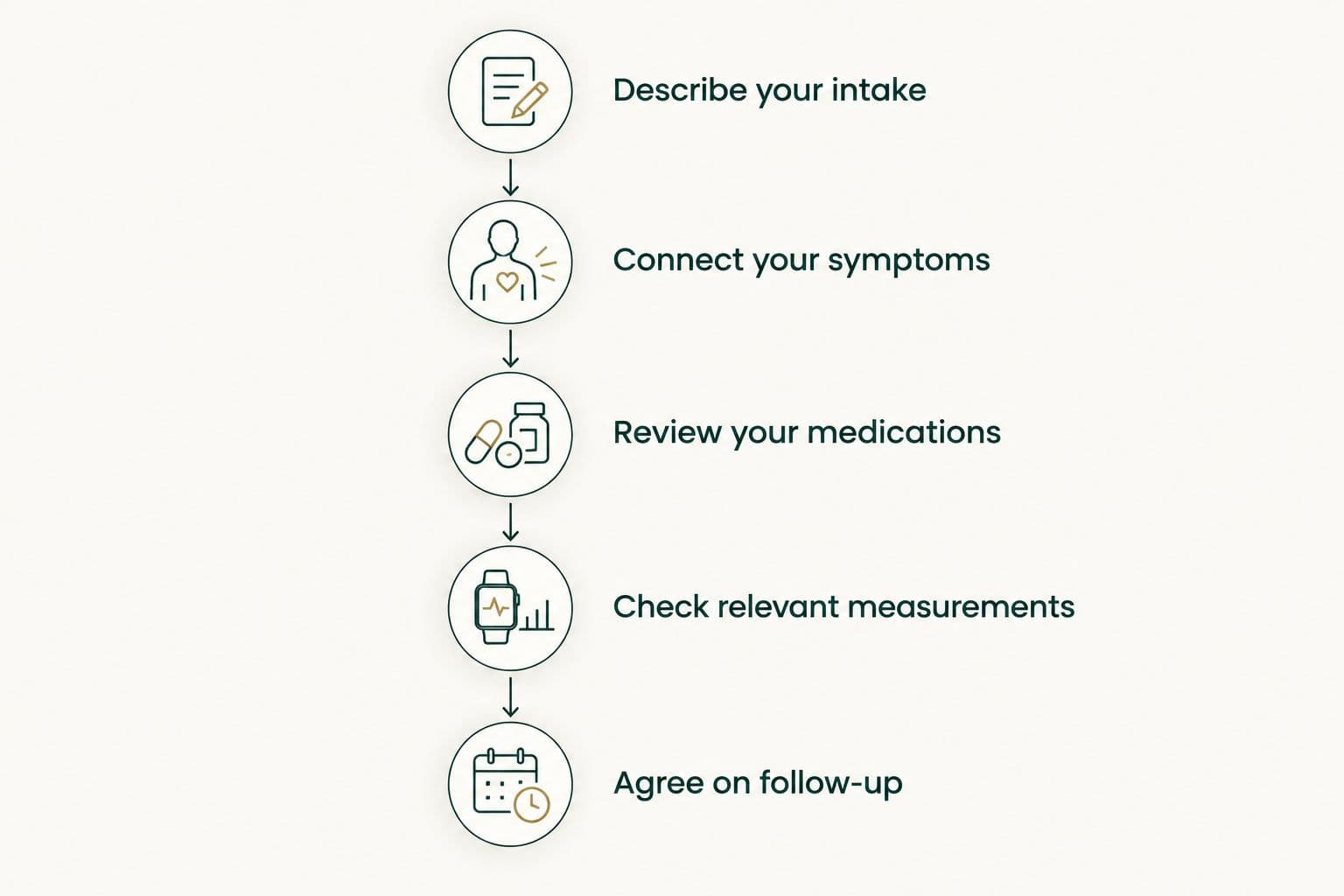
A useful review ends with a specific plan, not a general instruction to be careful.
Do not hide recent drinking to make laboratory results look better. Follow your clinician’s preparation instructions and explain any deviation. The goal is an accurate picture of your health, not a temporary performance for the blood draw.
What coordinated hormone care should include
We define Cardiometabolic Optimization as treating metabolic, hormonal and cardiovascular health as one system. Alcohol illustrates why that matters: sleep, blood pressure, triglycerides, weight, sexual function and hormone symptoms do not operate independently. A testosterone-only conversation leaves important questions unanswered.
GoodLife Health is best for adults seeking hormone optimization within coordinated metabolic and cardiovascular care. Our membership includes a Biomarker Audit every 90 days or four per year, covering Apolipoprotein B (ApoB), Lipoprotein (A), Hs-CRP, Hemoglobin A1c (HbA1c), Lipid Panel, Standard, Fasting Insulin, TSH With Reflex To Free T4 and more. Testing frequency and interpretation still need clinical judgment. An included test does not imply every marker changes meaningfully each quarter.
Clinical care is delivered by clinicians licensed in all fifty states. Labs are drawn at Quest Diagnostics patient service centers. Your clinician determines whether testosterone is appropriate and what additional TRT-specific monitoring is needed.
Our model separates the membership fee from medication billing. One flat fee for the doctor. Zero markup on the medicine. The limitation is equally clear. Medication is not included in the membership, extra labs outside the quarterly cadence are billed by the lab at its own rates and telehealth does not replace emergency or necessary in-person care.
Read about hormone replacement therapy for men with low testosterone if you want the broader treatment context. Then review our membership and take the next step toward a clinical evaluation rather than guessing whether alcohol or testosterone explains your symptoms.
When should you avoid alcohol and seek help?
Avoid alcohol when your clinician has advised abstinence, when your medication instructions prohibit it or when you cannot reliably control your intake. Do not combine alcohol with opioids or sedating medicines unless a clinician has explicitly addressed the combination. TRT does not reduce those risks.
Get emergency help for chest pain, severe shortness of breath, stroke symptoms, seizures or inability to wake someone after drinking. These symptoms are not routine hormone-treatment adjustments. Do not wait for a telehealth message to be answered.
Yellowing of the skin or eyes, persistent vomiting or significant abdominal pain also requires prompt medical assessment. A normal testosterone result does not explain away a new illness.
If reducing alcohol causes shaking, sweating, marked anxiety, hallucinations or seizures, seek urgent medical guidance. Alcohol withdrawal can be life-threatening. If you drink heavily or have experienced withdrawal before, obtain help planning a safe reduction rather than stopping abruptly on your own.
FAQ
Can you drink alcohol on TRT?
Some people can drink alcohol while taking TRT, but there is no TRT-specific amount proven safe for everyone. Your clinician should consider your drinking pattern, liver health, blood pressure, sleep and other medicines before advising you.
Can I drink alcohol on the day of my testosterone injection?
Injection timing does not create a reliable safe window for drinking. Follow your prescription, do not inject while impaired and ask your clinician about your health-specific alcohol risks.
Should I skip my testosterone dose if I plan to drink?
Do not skip or change prescribed testosterone simply because you plan to drink. Follow your treatment schedule and contact your clinician if illness, vomiting or a missed dose creates uncertainty.
How many drinks can I safely have while on testosterone?
There is no universal safe drink count for people taking testosterone. A U.S. standard drink contains 14 grams of pure alcohol, but that definition measures intake rather than establishing personal safety.
Does alcohol cancel out testosterone injections?
Alcohol does not simply cancel out testosterone injections. It can still undermine treatment goals by worsening sleep, sexual function, blood pressure and overall health.
Is beer worse than wine when I am on TRT?
Beer is not automatically worse than wine during TRT. The amount of alcohol and drinking pattern matter more than the beverage label. Large servings and stronger products can contain more alcohol than you expect.
Will stopping alcohol fix low testosterone without TRT?
Reducing heavy alcohol use can address a contributor to hormonal and general health problems, but it does not guarantee that testosterone will normalize. Diagnosis requires appropriate testing and assessment of other causes.
What does GoodLife Health charge for coordinated hormone care?
GoodLife Health charges $299/month for its Cardiometabolic Optimization Membership, with a two-month starting commitment and a $598 first charge. Quarterly Biomarker Audits are included. Medication is billed separately by the pharmacy at that pharmacy's own price and extra labs outside the quarterly cadence are billed by the lab at its own rates.
One last thing
A better testosterone number can coexist with a drinking pattern that makes you feel worse. That is the detail worth remembering from this 2026 guide: laboratory improvement and symptom improvement are related, but they are not interchangeable.
Before asking for a higher dose, bring your clinician an accurate account of your drinking, sleep, blood pressure and remaining symptoms. Ask what needs investigating before asking what needs increasing. You deserve an explanation that connects those findings, not another prescription change made without context.
Related guides
- Testosterone therapy for men: what labs to track
- How testosterone therapy affects sleep apnea risk in men
- How to read your testosterone lab results
References
- Treatment of Symptoms of the Menopause: An Endocrine Society Clinical Practice Guideline. 2015. doi.org/10.1210/jc.2015-2236
- Testosterone Therapy in Men with Hypogonadism: An Endocrine Society Clinical Practice Guideline. 2018. doi.org/10.1210/jc.2018-00229