You want a doctor you can reach, not another healthcare bill whose tax treatment you have to untangle. Direct primary care fees can qualify for a federal medical-expense deduction when they pay for qualifying medical care, but deductibility is not automatic. For 2026, an itemized deduction, HSA reimbursement and an employer benefit follow different rules. The same payment cannot receive the same tax benefit twice.
Key Takeaways
- Is direct primary care tax deductible? Qualifying medical expenses can be deductible, subject to itemization and the income threshold.
- Federal medical-expense deductions cover eligible, unreimbursed expenses exceeding 7.5% of adjusted gross income.
- The 2026 HSA rules impose specific requirements on direct primary care arrangements, including monthly fee limits.
- GoodLife Health offers predictable direct primary care billing. Membership alone does not establish HSA eligibility.
- The frustrating part is paying for care while still wondering which costs belong on your return.
- Yes, direct primary care payments can be deductible to the extent they qualify as medical expenses under Internal Revenue Code Section 213.
- The federal medical-expense deduction begins only after eligible unreimbursed expenses exceed 7.5% of your AGI.
- Direct primary care tax treatment varies because the federal rules examine the expense, the arrangement and the taxpayer.
- Build a record that explains what you purchased and how you paid.
Why this matters
The frustrating part is paying for care while still wondering which costs belong on your return. The risk is budgeting around a deduction or tax-free reimbursement that your circumstances do not support. The better outcome is a clear care agreement, separate pharmacy records and a tax decision based on the actual services and payment source.
At GoodLife Health, our direct primary care model separates the clinical membership from pharmacy billing. Instead of tying the membership fee to your medication dose, we charge $299 per month, with a two-month initial commitment and a $598 first charge. Medication is separate, billed by the pharmacy at pharmacy cost, with zero markup from us.
That makes the care bill easier to understand. It does not turn every membership payment into a deductible expense or an HSA-qualified payment. We explain that distinction because predictable billing should come with equally clear financial boundaries.
Is direct primary care tax deductible?
Yes, direct primary care payments can be deductible to the extent they qualify as medical expenses under Internal Revenue Code Section 213. For a federal itemized medical-expense deduction, you must pay the expense yourself, receive no reimbursement for it and have total qualifying medical expenses exceeding 7.5% of adjusted gross income or AGI.
Only the amount above that threshold enters the medical deduction. You must also itemize rather than take the standard deduction and itemizing must produce the better result for your return.
The practical question is therefore not simply whether a practice calls itself direct primary care. It is what the payment purchases, how you paid it and which tax provision you intend to use.
| Tax route | Best for | Main benefit | Main limitation |
|---|---|---|---|
| Schedule A medical deduction | Taxpayers who itemize and have substantial qualifying expenses | Eligible unreimbursed care contributes to the medical deduction | Only expenses above 7.5% of AGI count toward that deduction |
| HSA reimbursement | HSA owners paying expenses that meet HSA rules | Qualified distributions avoid federal income tax | DPC arrangements have specific statutory requirements |
| Health FSA reimbursement | Employees whose plan covers the particular expense | Eligible expenses can receive tax-favored reimbursement | Plan terms and substantiation requirements apply |
| Employer-funded arrangement | Employees receiving a properly structured health benefit | The employer can fund eligible care under applicable rules | Personal payments do not automatically become employer benefits |
These are different tax routes, not interchangeable labels. A receipt supports a claim, but a receipt alone does not establish eligibility.
What counts as medical care?
Section 213 generally covers expenses for diagnosing, treating, mitigating, curing or preventing disease and qualifying care affecting a body structure or function. A membership that actually pays for medical services needs a different analysis from a fee that only buys priority access or nonmedical amenities.
Ask for the agreement describing covered services. If a charge mixes medical care with nonmedical benefits, your tax preparer needs enough detail to determine whether an allocation is supportable. Do not assume the entire charge qualifies because a physician's name appears on the invoice.
How does the 7.5% medical deduction threshold work?
The federal medical-expense deduction begins only after eligible unreimbursed expenses exceed 7.5% of your AGI. Paying a qualifying expense does not necessarily lower your taxes.
Use this sequence when reviewing your 2026 records:
- Find your AGI. Use the figure calculated for the return, not your salary or take-home pay.
- Calculate the threshold. Multiply AGI by 7.5%.
- Total qualifying expenses. Include eligible medical payments for yourself and qualifying family members under the applicable rules.
- Remove reimbursed payments. Exclude amounts covered by insurance, tax-free account distributions or another reimbursement source.
- Subtract the threshold. Only the qualifying excess contributes to your Schedule A medical deduction.
- Compare deduction methods. Your preparer should compare total itemized deductions with your available standard deduction.
A deduction reduces taxable income. It is not a dollar-for-dollar refund. Your actual benefit depends on your tax circumstances, including whether itemizing makes sense at all.
This is why we recommend evaluating the membership's clinical value before estimating tax savings. A sound care decision should not depend on a refund you have not established.


Can you use an HSA for direct primary care in 2026?
Certain qualifying direct primary care arrangements are HSA-compatible beginning January 1, 2026. Public Law 119-21, Section 71308, changed federal HSA rules for these arrangements, including treatment of qualifying periodic fees as medical expenses for HSA purposes.
The change has boundaries. A qualifying arrangement generally provides covered primary care services for a fixed periodic fee and the aggregate monthly fee limit is $150 for an individual or $300 when the arrangement covers more than one individual in 2026. Those are statutory eligibility limits, not estimates of what a practice charges.
The law also restricts the services included in the arrangement. Excluded services include procedures requiring general anesthesia, prescription drugs other than vaccines and laboratory services not typically administered in an ambulatory primary care setting.
Do not translate “DPC is now HSA-compatible” into “every DPC membership qualifies.” The fee limit and service definition both matter. Multiple arrangements also require attention to the aggregate fee rule.
HSA spending and HSA contributions are separate questions
Having money in an HSA does not mean you remain eligible to contribute. Contribution eligibility depends on qualifying health coverage and the absence of disqualifying coverage, among other requirements.
Likewise, a debit card accepting a payment does not prove that the distribution is tax-free. The account holder remains responsible for establishing that an expense qualifies.
For a membership that falls outside the new DPC definition, ask your tax adviser to review both questions separately: whether the arrangement affects ongoing HSA contributions and whether a particular payment qualifies for reimbursement. Do not assume that itemized-deduction treatment answers either question.
What this means for our membership
Our $299 monthly individual membership exceeds the $150 individual limit for the new qualifying-DPC HSA provision. We do not present that individual membership as qualifying under that provision. The included services also require review rather than an assumption based on the membership's name.
Separate pharmacy charges need their own analysis. An eligible prescription expense does not make a separate membership fee eligible and the membership's tax treatment does not automatically determine the prescription's treatment.
If you share a household, do not assume that a family statutory limit applies to an individual agreement. The actual covered individuals and contractual terms control the analysis.
Why direct primary care tax treatment varies
Direct primary care tax treatment varies because the federal rules examine the expense, the arrangement and the taxpayer. These factors explain why two patients can pay for similar care and receive different tax outcomes:
- Services purchased. Medical diagnosis and treatment are different from a fee that purchases only access or nonmedical benefits.
- Payment source. A personal payment, an employer payment and a tax-free account reimbursement do not follow identical rules.
- Adjusted gross income. The 7.5% threshold rises with AGI, changing how much qualifying spending reaches Schedule A.
- Deduction method. A taxpayer taking the standard deduction does not also claim a separate Schedule A medical deduction.
- Arrangement terms. HSA treatment depends on the statutory DPC definition, including fees, covered individuals and covered services.
- Reimbursements and records. Insurance payments, account reimbursements and incomplete documentation affect what remains claimable.
State treatment needs a separate check. This article addresses federal rules for 2026. A state's income-tax rules do not necessarily mirror every federal provision.
Your employment status also matters. Owning a business does not automatically turn personal healthcare spending into an ordinary business expense.
How do you document direct primary care payments?
Build a record that explains what you purchased and how you paid. A bank statement proves a payment occurred. The care agreement explains what the payment covered.
Use the same process throughout the year rather than reconstructing it at filing time:
- Care agreement. Save the signed agreement and any changes to covered services or membership terms.
- Payment records. Keep invoices, receipts, payment dates and the identity of the person receiving care.
- Service details. Retain documentation distinguishing medical services from access-only or nonmedical benefits where relevant.
- Reimbursement records. Record insurance payments and HSA, FSA or employer reimbursements against the matching expense.
- Tax review. Give the complete packet to your preparer before claiming a deduction or treating a distribution as tax-free.
For recurring fees, keep the billing period attached to each payment. If you prepay, cross a year boundary or receive a refund, ask your preparer how the timing rules apply rather than assuming the invoice date settles the issue.
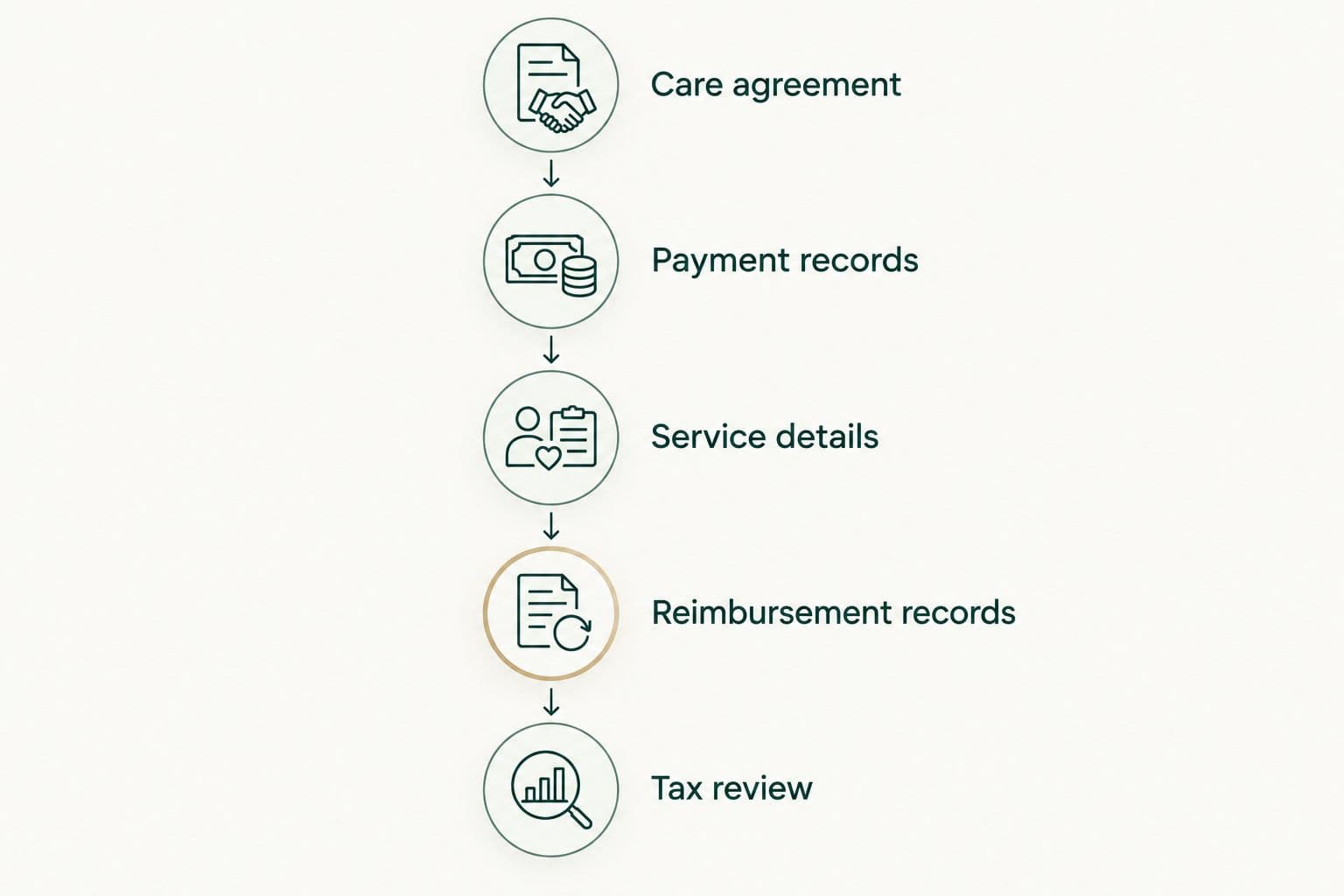
Keep the service agreement and payment trail together before claiming a tax benefit.
For HSA reimbursements, also retain evidence that the expense occurred after the HSA was established. Keep records supporting any reimbursement you claim later and do not submit the same expense to multiple accounts.
Before joining a practice, review how to evaluate a direct primary care practice. Clear coverage terms help you assess the care itself and give your adviser something concrete to review.
Can self-employed people deduct a DPC membership?
Self-employed people should not automatically classify a direct primary care membership as deductible health insurance. A care membership is not health insurance simply because it covers healthcare. The self-employed health-insurance deduction has its own requirements.
A qualifying personal medical expense can still enter the Schedule A analysis, subject to itemization and the 7.5% AGI threshold. That is different from deducting the payment directly against business income.
If your business pays, the answer also depends on business structure and benefit design. Sole proprietorships, partnerships and corporations have different considerations and owner-employees can face additional restrictions.
Bring your entity type, ownership details, membership agreement and payment records to your tax professional. Ask which provision supports the treatment, not merely which bookkeeping category sounds appropriate.
For employer-sponsored benefits, have the arrangement reviewed before payroll treats payments as tax-free. An employer's willingness to reimburse a bill does not, by itself, establish the correct tax result.
Is concierge medicine deductible under the same rules?
Concierge medicine is not automatically deductible and its membership fees are not automatically eligible for HSA reimbursement. The services purchased and the applicable tax provision determine the result, not the concierge label.
An access fee can differ from a payment for actual medical treatment. Some arrangements separately bill visits to insurance while charging a membership for additional access or amenities. The agreement needs to distinguish those charges.
The special 2026 DPC HSA rule is also not a blanket exception for every concierge practice. A practice must satisfy the statutory requirements to use that provision.
Ask these questions before treating the full fee as a medical expense:
- Does the periodic fee actually purchase covered medical services?
- Are any services billed separately to insurance?
- Does the agreement identify nonmedical benefits?
- Can the practice provide documentation supporting the nature of the charge?
The goal is not a particular label on the receipt. It is a defensible connection between the payment and the tax rule being applied.
Choose a care model with clear financial boundaries
GoodLife Health direct primary care is best for patients who want integrated cardiometabolic care with a fixed clinical membership fee and separate, zero-markup pharmacy billing. Our model addresses unpredictable membership repricing by keeping the clinical fee unchanged when a prescription or dose changes.
That is a billing commitment, not a promise that medication costs stay fixed. Pharmacy charges remain separate. Additional labs beyond the included cadence are ordered by the clinician when there is a reason and are billed by the lab at its own rates.
Our Cardiometabolic Optimization Membership treats metabolic, hormonal and cardiovascular health as one system. A Biomarker Audit every 90 days, four times a year, is included and covers Apolipoprotein B (ApoB), Lipoprotein (A), Hs-CRP, Hemoglobin A1c (HbA1c), Fasting Insulin, TSH With Reflex To Free T4 and more, drawn at any Quest Diagnostics patient service center.
Clinical care is delivered by licensed physicians of Beluga Health, P.A., an independent Florida professional corporation, working under GoodLife Health's clinical protocols. Membership does not guarantee a prescription, a particular treatment outcome or favorable tax treatment.
The initial commitment is two months, with a $598 first charge, followed by $299 monthly and cancellation available anytime after that commitment. One flat fee for the doctor. Zero markup on the medicine.
Before committing, review the covered care and have your tax adviser assess the agreement. The membership's value is the clinical relationship and included monitoring, not an assumed tax subsidy.
FAQ
Is direct primary care tax deductible if I take the standard deduction?
Taking the standard deduction means you do not also claim a separate Schedule A medical-expense deduction for direct primary care. HSA or employer-benefit treatment is a separate question with its own eligibility rules.
What percentage of income must medical expenses exceed to be deductible?
Eligible unreimbursed medical expenses must exceed 7.5% of adjusted gross income for the federal itemized medical deduction. Only the amount above that threshold contributes to the deduction and you must itemize.
Can I use my HSA for a direct primary care membership in 2026?
Certain qualifying direct primary care arrangements are eligible under the federal HSA rules effective January 1, 2026. The arrangement must satisfy the statutory service requirements and aggregate monthly fee limits of $150 for an individual or $300 for coverage of more than one individual.
Does a successful HSA card payment prove the membership qualifies?
A successful HSA card payment does not prove that a membership qualifies for tax-free reimbursement. You remain responsible for substantiating eligibility under the applicable tax rules.
Can I deduct a DPC payment that my HSA already reimbursed?
You cannot claim an itemized medical deduction for the same expense reimbursed through a tax-free HSA distribution. Keep records matching each reimbursement to its underlying expense.
Is a DPC membership deductible as self-employed health insurance?
A DPC membership is not automatically deductible as self-employed health insurance because purchasing care is not the same as purchasing insurance. Your adviser should review the agreement, business structure and applicable deduction rules.
Does GoodLife Health's individual membership qualify under the new DPC HSA fee limit?
GoodLife Health's $299 monthly individual membership exceeds the $150 individual fee limit under the qualifying-DPC HSA provision for 2026. Do not assume the individual membership qualifies under that provision. Separate prescription expenses require their own analysis.
What records should I keep for a direct primary care deduction?
Keep the membership agreement, invoices, payment confirmations, service descriptions and reimbursement records. Your preparer needs to establish what the payment covered and that no other tax-free reimbursement covered the same expense.
One last thing
A payment can qualify as medical care without producing an itemized deduction on your return. That distinction explains why a practice's receipt and your preparer's final answer can both be correct.
For 2026, make the care decision using the actual membership commitment, included services and separate expenses. Then apply the tax rules to your own records. Ask your adviser to document the treatment using Internal Revenue Code Sections 213 and 223, IRS Publication 502 and the applicable DPC provisions of Public Law 119-21.
This article provides general federal tax information, not individualized tax or legal advice. A qualified tax professional should review your agreement, coverage and filing circumstances before you claim a benefit.
Related guides
- How to use HSA or FSA funds for concierge medicine
- How to use your DPC membership alongside insurance
- Direct primary care for self-employed people and freelancers
References
- Direct Primary Care: Practice Distribution and Cost Across the Nation (J Am Board Fam Med). 2015. pubmed.ncbi.nlm.nih.gov/26546651/