A hormone panel is usually not worth ordering just because you feel fine and want reassurance; it becomes useful when your medical history, an examination finding, a medication, or an existing condition gives your clinician a specific question to answer. The hidden cost is not just the blood draw: an incidental abnormal result can lead to repeat testing, anxiety, or treatment you do not need.
Key Takeaways
- Is a hormone panel worth it? Usually not for reassurance alone; testing should answer a specific clinical question.
- GoodLife Health combines hormone testing with metabolic and cardiovascular assessment, not automatic hormone prescriptions.
- A single abnormal hormone result does not establish a diagnosis or justify treatment.
- Test timing, medications, menstrual cycles, and existing conditions determine how useful hormone testing is.
- A result outside a laboratory reference interval is not automatically a disease.
- Feeling fine is relevant, but it is not the only consideration.
- A broad panel is a poor substitute for deciding what you want to know.
- The same test can be useful for one person and distracting for another.
- A useful testing process starts before the sample is collected.
Is a hormone panel worth it if you feel fine?
A hormone panel is worth considering when its results will change a medical decision. If you have no symptoms, no relevant risk factors, no abnormal examination findings, and no treatment that requires monitoring, a broad panel often adds little useful information. Feeling well does not rule out every condition, but that does not make every available blood test a sensible screening test.
At GoodLife Health, we distinguish between looking for a disease, investigating a concern, and monitoring treatment. Those are different jobs. Before ordering bloodwork, ask your clinician which job each test is supposed to do and what would happen after an abnormal result.
| Approach | Best for | Main benefit | Main limitation |
|---|---|---|---|
| No immediate hormone testing | Adults without symptoms, relevant risks, or monitoring needs | Avoids unnecessary follow-up and incidental findings | Requires reassessment if health or symptoms change |
| Targeted hormone testing | Adults with a specific clinical question | Connects a result to a defined decision | Does not assess every possible hormonal condition |
| Broader clinician-directed assessment | Adults whose history or ongoing care supports several tests | Evaluates related findings together | More results create more opportunities for incidental abnormalities |
The right choice is not automatically the largest panel. It is the approach that answers your question with the least unnecessary testing.
Why this matters
A result outside a laboratory reference interval is not automatically a disease. Reference intervals describe results in a reference population; interpretation also depends on symptoms, physiology, medications, and the reason for testing. A borderline result deserves context before it deserves a prescription.
That distinction matters when you feel well. With little clinical reason to suspect a disorder, an unexpected abnormality needs careful confirmation rather than an immediate diagnosis. More testing can generate more uncertainty, not necessarily more protection.
For your preventive care in 2026, separate recommended screening from optional information gathering. Blood pressure assessment, appropriate diabetes screening, lipid assessment, vaccinations, and age-appropriate cancer screening should not disappear behind a long list of hormone measurements. A hormone panel does not replace those decisions.
When testing makes sense even without obvious symptoms
Feeling fine is relevant, but it is not the only consideration. Your clinician should review previous diagnoses, prescription medicines, reproductive history, and earlier abnormal results. A test ordered for one of those reasons is different from screening simply because a panel exists.
Someone taking thyroid medication, for example, needs appropriate monitoring even when treatment is working and symptoms have resolved. Someone using testosterone or menopausal hormone therapy needs a treatment-specific follow-up plan, although that does not mean every hormone should be measured at every visit.
Fertility evaluation also raises questions that general wellness testing does not. Menstrual irregularity, even without discomfort, can warrant assessment. A history suggesting pituitary disease or an examination finding can justify testing before a person recognizes a clear symptom.
The absence of symptoms does not cancel a known medical indication. It also does not create one. Tell your clinician why you are considering testing, including any family history or previous result that worries you, rather than selecting the panel first.

When a broad panel is unlikely to help
A broad panel is a poor substitute for deciding what you want to know. Requests to check every hormone, establish an ideal level, or prevent aging do not specify a diagnosis or a treatment decision. A laboratory can measure something without proving that measuring it improves your health.
An asymptomatic adult should not assume that an age-related hormone change requires replacement. Likewise, a value near the lower or upper end of a reference interval is not inherently a problem. The meaning depends on the particular hormone and clinical setting.
Be cautious if a testing service promises to identify a universal hormonal imbalance or treats its preferred range as a diagnosis. Ask whether the proposed target comes from an established clinical recommendation and whether treating that target benefits someone with your history.
A reasonable outcome of a consultation is no hormone testing today. That is not dismissal when the clinician has reviewed your concerns, explained the reasoning, and described what changes would justify reassessment.
Why the value of a hormone panel varies
The same test can be useful for one person and distracting for another. Its value depends on the question, not simply the number of biomarkers included.
- The reason for testing. Investigating a suspected disorder is different from seeking general reassurance. Define the decision before choosing the measurements.
- Existing conditions. A diagnosed endocrine condition or previous abnormal result changes what follow-up is appropriate.
- Current treatment. Thyroid medication, hormonal contraception, and hormone therapy affect which results are useful and how they should be interpreted.
- Collection timing. Time of day, menstrual phase, and the interval since a medication dose can affect particular hormone measurements.
- The follow-up plan. A result has more value when someone is responsible for explaining it, confirming it when needed, and deciding whether action is justified.
These factors also explain why two people should not compare panels as if a longer list means better care. A focused order with a clear purpose can be more useful than a larger order without one.
Which hormone tests answer which questions?
Testosterone testing needs more than a low number
For men, diagnosing testosterone deficiency generally requires compatible symptoms or signs together with consistently low testosterone concentrations. A low result alone is not enough. The Endocrine Society recommends against routine screening of the general male population for hypogonadism.
When testing is indicated, clinicians generally confirm a low morning total testosterone result with another appropriately collected measurement. Acute illness, sleep disruption, and other circumstances can complicate interpretation. Free testosterone and binding proteins have specific roles; they are not automatic substitutes for a clinical assessment.
Testosterone therapy also has consequences that matter before prescribing, including suppression of sperm production. If fertility matters to you, say so before treatment discussions. Do not start testosterone because a wellness report labels your result suboptimal.
Thyroid testing should follow the clinical question
Thyroid-stimulating hormone, or TSH, is commonly the starting point when thyroid dysfunction is suspected. Free T4 and other tests answer additional questions in appropriate circumstances. A full thyroid panel is not automatically necessary for every adult who feels well.
For nonpregnant adults without symptoms, the U.S. Preventive Services Task Force has found insufficient evidence to determine the balance of benefits and harms of screening for thyroid dysfunction. That is not a recommendation to ignore symptoms, pregnancy-related considerations, known thyroid disease, or an abnormal examination.
In a 2026 preventive visit, ask why thyroid testing is being considered and which finding would change care. An isolated borderline result often requires confirmation and context rather than immediate medication.
Estrogen and progesterone depend on reproductive context
Estradiol and progesterone change across the menstrual cycle. Hormonal contraception, pregnancy, perimenopause, and hormone therapy further affect interpretation. A result without that context can answer the wrong question.
For someone with typical menopause symptoms at the expected life stage, diagnosis is often clinical rather than dependent on a broad hormone panel. During perimenopause, fluctuating concentrations make a single measurement particularly limited as a summary of hormonal status.
Testing can still be appropriate for specific problems, including certain fertility concerns or suspected early loss of ovarian function. The purpose is to evaluate the concern, not to make every result match a fixed wellness target.
Cortisol is not a general stress score
Cortisol follows a daily rhythm and responds to illness and other circumstances. A random cortisol measurement does not establish how stressed you are or diagnose a vague energy problem. Suspected cortisol disorders require specific testing strategies.
The Endocrine Society does not recognize adrenal fatigue as an established medical diagnosis. That does not make persistent fatigue imaginary; it means the explanation needs proper evaluation rather than a label attached to an isolated result.
If your concern is stress, poor sleep, or reduced energy, start with the history. A clinician should decide whether endocrine testing, another medical evaluation, or attention to sleep and mental health best addresses the problem.
How do you decide whether to order testing?
A useful testing process starts before the sample is collected. Bring previous results and a complete medication and supplement list, including nonprescription hormone products. Tell your clinician whether your goal is prevention, fertility planning, investigating a change, or monitoring treatment.
- Clinical question. Identify the condition or decision under consideration. Ask what evidence makes that question relevant to you.
- Test selection. Choose the measurements that address the question. Clarify what each result can and cannot establish.
- Sample timing. Follow the instructions for the specific tests, including medication timing or menstrual context when relevant. Do not stop prescribed medicine on your own.
- Result review. Interpret the findings alongside your history and collection circumstances. Confirm unexpected results when appropriate.
- Care decision. Agree on treatment, observation, further evaluation, or no action. Document who will arrange follow-up.
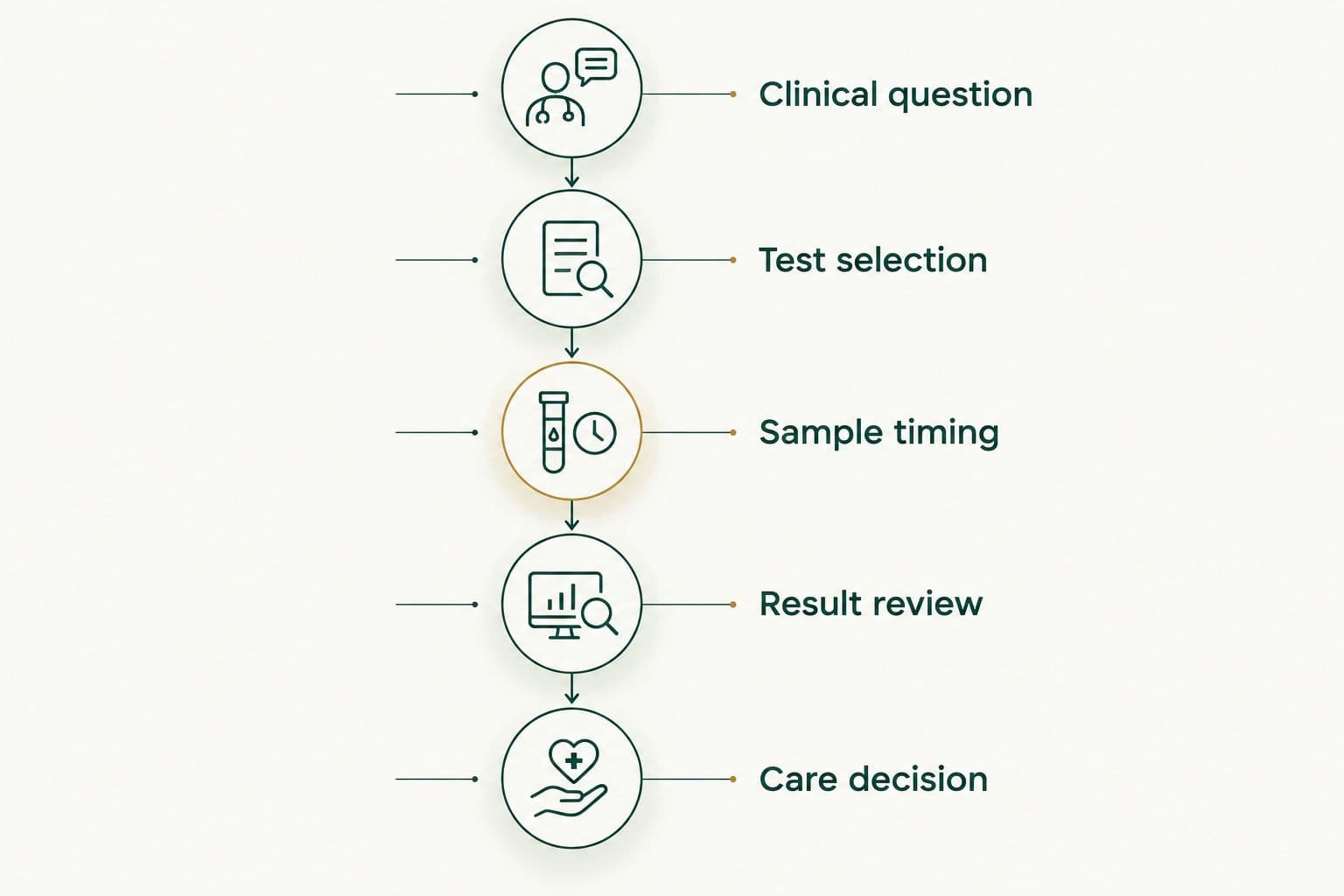
Choose the clinical question before choosing the panel.
Before a hormone test in 2026, ask your clinician to finish this sentence: if the result is abnormal, the next step will be this. If the answer is unclear, clarify the purpose before proceeding. An explanation should also cover what a normal result would mean.
What should happen after an abnormal result?
An abnormal hormone result is a starting point, not a treatment instruction. Your clinician should consider how far the result is from the reference interval, whether related findings fit, and whether collection conditions affected the measurement. Some abnormalities need prompt evaluation; others need confirmation under appropriate conditions.
Avoid changing several supplements or medications while trying to understand one result. That makes the next result harder to interpret. Discuss any proposed changes with the clinician responsible for your care and keep a record of what changed and when.
A normal repeat result can resolve a concern. A persistent abnormality can justify a more focused evaluation. Either outcome is useful when testing follows a clear question; neither supports treating a report without assessing the person.
A good explanation should distinguish between a laboratory finding, a suspected condition, and a confirmed diagnosis. Ask which of those applies before agreeing to ongoing therapy.
Does a normal hormone panel mean you are healthy?
No. A normal hormone panel does not rule out cardiovascular risk, diabetes, sleep disorders, anemia, or other causes of symptoms. It also does not replace a physical assessment or screening selected for your age and history.
We use Cardiometabolic Optimization to describe treating metabolic, hormonal, and cardiovascular health as one interconnected system. Weight, thyroid function, blood sugar and insulin, lipids, and inflammation belong in the same clinical picture. That framing does not mean everyone needs every test or hormone medication.
If your real concern in 2026 is future heart disease or diabetes, say that directly. Your clinician can then prioritize the appropriate assessment instead of assuming that hormone measurements answer a different risk question.
A reassuring result is only as useful as the question it answers. Normal testosterone, for example, does not tell you whether your blood pressure needs treatment.
How does ongoing care change the value of testing?
A panel becomes more useful when a clinician connects the results to your history and remains responsible for follow-up. Ongoing care can also prevent unnecessary repeat testing when earlier results already answer the question. Continuity matters more than collecting a growing file of unexplained numbers.
GoodLife Health is best for adults seeking clinician-led hormone assessment within ongoing Cardiometabolic Optimization care, rather than a standalone test report. Our Cardiometabolic Optimization Membership includes concierge-style direct primary care and a Biomarker Audit every 90 days, with 4 audits per year. The audit includes ApoB, Lp(a), hs-CRP, HbA1c, lipids, insulin markers, and full hormone and thyroid panels.
The membership is $299 per month, with a two-month initial commitment and a $598 first charge. It then continues at $299 per month, and you can cancel anytime after the initial commitment. Additional labs beyond the quarterly cadence are billed at pass-through cost; medications are billed separately by the pharmacy at pharmacy cost, with zero markup.
That recurring model is not necessary for everyone seeking a single targeted test. Nor does an included panel establish that every measurement requires intervention. Our testing cadence describes the membership, not a universal screening recommendation.
Clinical care is delivered by licensed physicians of Beluga Health, P.A., an independent Florida professional corporation licensed to practice in all 50 states, working under GoodLife Health's clinical protocols. All labs run through the Beluga Health lab network. Before joining any practice, assess how a direct primary care doctor handles lab orders, including interpretation and follow-up.
Should I get a baseline hormone panel while I feel well?
A baseline hormone panel is useful only when there is a reason to expect that having it will inform future care. Many hormone values change with time, treatment, reproductive stage, or collection conditions, so today's result is not a permanent personal target.
Ask what future decision the baseline would support. If no one can identify one, keeping an accurate medical history and staying current with appropriate preventive care is a better starting point than ordering an indiscriminate panel.
Can I need hormone treatment without feeling sick?
Yes, certain diagnosed endocrine conditions require treatment or monitoring even before you feel unwell. That decision follows a condition-specific assessment, not the assumption that every abnormal concentration should be corrected.
The reverse also matters: feeling well with a borderline result does not automatically justify hormone therapy. Ask about the diagnosis, expected benefit, treatment risks, and the consequences of observation before deciding.
What should I ask at my next checkup?
For your next checkup in 2026, ask which preventive assessments are appropriate, whether anything in your history supports hormone testing, and what would change the plan. Bring previous laboratory reports rather than relying on a summary that everything was normal.
If your clinician recommends no testing, ask which symptoms, medication changes, or reproductive changes should prompt another conversation. You should leave with a reasoned plan, not simply a yes or no.
FAQ
Is a hormone panel worth it if I have no symptoms?
A hormone panel is usually not worth ordering for reassurance alone when you have no symptoms or relevant clinical indication. Existing endocrine disease, treatment monitoring, or a specific finding can justify testing even when you feel well.
Should everyone get a hormone panel every year?
No, a broad annual hormone panel is not a universal screening recommendation for asymptomatic adults. Your medical history, medications, reproductive context, and clinical findings should determine which tests are appropriate.
Can one low testosterone result mean I need treatment?
No, one low testosterone result does not establish testosterone deficiency or justify treatment. In men, diagnosis generally requires compatible symptoms or signs and consistently low concentrations confirmed with appropriately collected testing.
Can a hormone panel tell me if I am in perimenopause?
A single hormone panel cannot reliably summarize perimenopause because hormone concentrations fluctuate. Clinicians often assess typical menopause transitions using menstrual history and symptoms, with testing reserved for specific questions.
Should I stop supplements before a hormone blood test?
Tell your clinician and laboratory about every supplement before testing, and follow their instructions. Some supplements, including biotin, interfere with certain laboratory assays; do not stop prescribed medication without medical advice.
Does an abnormal hormone result always need treatment?
No, an abnormal hormone result does not always need treatment. Your clinician should interpret it in context and decide whether confirmation, further evaluation, observation, or treatment is appropriate.
Does GoodLife Health include hormone testing?
GoodLife Health includes full hormone and thyroid panels in its Biomarker Audit every 90 days within the Cardiometabolic Optimization Membership. Included testing does not mean every result requires treatment or that the cadence is necessary for every asymptomatic adult.
Will normal hormone results explain why I feel healthy?
Normal hormone results show only that the measured values fell within the relevant interpretation at collection. They do not establish overall health or replace cardiovascular risk assessment and appropriate preventive screening.
One last thing
Before ordering a panel, write down what you would do differently if every result were normal. Then ask what you would do if one result were slightly outside the reference interval. Those questions expose whether you are seeking a useful decision or reassurance that testing cannot guarantee.
You do not need an abnormal number to deserve attentive preventive care. A careful history, an appropriate assessment, and a clear follow-up plan remain valuable even when the right decision is not to test.
Related Guides
- How to read your hormone lab results
- How to track hormone levels over time with labs
- How to know if you need hormone replacement therapy
References
- Treatment of Symptoms of the Menopause: An Endocrine Society Clinical Practice Guideline. 2015. doi.org/10.1210/jc.2015-2236
- Testosterone Therapy in Men with Hypogonadism: An Endocrine Society Clinical Practice Guideline. 2018. doi.org/10.1210/jc.2018-00229