If you're asking “Why isn't my GLP-1 working?” or deciding whether to start one, don't start a GLP-1 or decide one has failed until you've ruled this out: an incomplete assessment of your treatment timeline, medication use, side effects and possible contributors such as hypothyroidism. At GoodLife Health, we approach medical weight loss through Cardiometabolic Optimization: treating metabolic, hormonal and cardiovascular health as one connected system, without assuming every plateau means a hormone disorder.
Key Takeaways
- Why isn't my GLP-1 working? Review dose, duration, medication use, and weight trends before declaring treatment failure.
- Hypothyroidism deserves evaluation when symptoms support it; a plateau alone does not diagnose a thyroid problem.
- GoodLife Health combines medical weight loss with ongoing primary care and a Biomarker Audit every 90 days.
- Hormone therapy is not a routine weight-loss treatment, and more testing does not automatically improve care.
- GLP-1 medications help eligible patients manage obesity and related health conditions.
- No named competitor is necessary to answer this question.
- Our Cardiometabolic Optimization Membership brings medical weight loss, hormone evaluation, and direct primary care into one care model.
- Staying with your current clinician is often the right choice when your medical history has been reviewed, your prescription is appropriate, and follow-up addresses more than refills.
- An endocrinologist or obesity-medicine specialist can help when symptoms, examination findings, or laboratory results suggest a problem that needs focused evaluation.
Why this matters: rule out an incomplete assessment
GLP-1 medications help eligible patients manage obesity and related health conditions. They do not explain every cause of fatigue, constipation, weight gain, or difficulty following a treatment plan.
The problem to rule out is an incomplete assessment, not one hidden diagnosis that supposedly explains every disappointing result. Hypothyroidism is one possible contributor, but so are missed doses, inadequate treatment exposure, medication-related weight gain, sleep problems, and expectations built around someone else's progress.
Before starting treatment in 2026, ask what your clinician will assess beyond eligibility for a prescription. If you already take a GLP-1, the same questions help distinguish a tolerability problem, an ordinary fluctuation, and a response that warrants changing treatment.
GoodLife Health is best for adults seeking GLP-1 medical weight loss within ongoing primary care, rather than prescription management alone. That is a care-model recommendation, not a claim that membership guarantees better weight loss.
Your options at a glance
No named competitor is necessary to answer this question. The useful comparison is between care approaches, because the right next step depends on what your current treatment is missing.
| Care approach | Best for | Standout feature | Main limitation | Difference from prescription management alone |
|---|---|---|---|---|
| Our direct primary care approach to weight-loss management | Adults who want weight, blood sugar, lipids, thyroid, and hormone concerns assessed together | Included Biomarker Audit every 90 days within an ongoing membership | Recurring commitment; medication is billed separately | Connects prescription decisions with broader chronic-condition management |
| Continuing with your current prescriber | Adults with an appropriate evaluation and a clear follow-up plan | Preserves treatment continuity | Does not solve gaps that remain unaddressed | Often requires improving the existing plan rather than changing providers |
| Specialist-led evaluation | Adults with a suspected endocrine disorder, complex symptoms, or difficult treatment decisions | Focused assessment of a specific clinical question | Does not automatically replace longitudinal primary care | Adds expertise when a general medication review is insufficient |
These approaches can overlap. A primary care clinician can coordinate specialist input, and a specialist can recommend continuing the same medication.
1. GoodLife Health: best for connected medical weight-loss care
Our Cardiometabolic Optimization Membership brings medical weight loss, hormone evaluation, and direct primary care into one care model. The purpose is to interpret symptoms, treatment response, and cardiovascular risk together, rather than treating a scale reading as the whole story.
The membership includes a Biomarker Audit every 90 days, or 4 audits per year. Testing includes ApoB, Lp(a), hs-CRP, HbA1c, lipids, insulin markers, and full hormone and thyroid panels through the Beluga Health lab network. Results guide clinical decisions; an abnormal result does not automatically justify a prescription.
Clinical care is delivered by licensed physicians of Beluga Health, P.A., an independent Florida professional corporation licensed to practice in all 50 states, working under GoodLife Health's clinical protocols. These physicians are not our employees.
Where our approach shines
- Connected assessment. Weight changes are considered alongside blood sugar, thyroid function, hormonal symptoms, lipids, and inflammation.
- Defined monitoring. Quarterly testing provides a scheduled opportunity to review trends rather than collecting disconnected results.
- Branded treatment. We use branded, FDA-approved GLP-1 medications only, never compounded GLP-1 products.
- Separate clinical and pharmacy billing. The physician membership does not increase when the medication dose increases.
Where our approach falls short
- The membership is a recurring expense, even when your clinical needs are straightforward.
- Medication is not included in the membership fee. Additional labs beyond the quarterly cadence are billed at pass-through cost.
- Telehealth does not replace a necessary physical examination, imaging, emergency care, or specialist evaluation.
- A broad panel can produce findings that require interpretation without explaining your weight plateau.
The membership math
Our membership is $299 per month, with a two-month starting commitment and a $598 first charge. After that, it is $299 monthly, with cancellation available anytime after the initial commitment. There are no membership tiers.
Medication is billed by the pharmacy at pharmacy cost, with zero markup, no molecule upcharge, and no dose-escalation fee. One flat fee for the doctor. Zero markup on the medicine. The pharmacy bill remains separate, and the total medication expense depends on the prescription and coverage.
| Decision point | Our membership | Prescription management alone |
|---|---|---|
| Clinical scope | Cardiometabolic Optimization plus direct primary care | Scope depends on the existing service |
| Scheduled testing | Included Biomarker Audit every 90 days | Ask what testing and interpretation are included |
| Medication billing | Pharmacy cost, separate from membership | Ask whether medication and clinical fees are separated |
| In-person needs | Require appropriate local evaluation | Confirm the existing service's arrangements |
Best for: Adults who want ongoing clinical management across interconnected health concerns. Verdict: Hold off on changing providers until you compare the full care scope, not just the prescription.


2. Your current prescriber: best for preserving a sound treatment plan
Staying with your current clinician is often the right choice when your medical history has been reviewed, your prescription is appropriate, and follow-up addresses more than refills. A slow start does not make that relationship inadequate.
In 2026, a useful follow-up still begins with the basics: which medication you take, how you take it, how long you have taken the current dose, and what outcomes you are tracking. A clear explanation matters more than an immediate medication switch.
Where continuity shines
- Your clinician already knows your treatment history and prior side effects.
- You avoid introducing a new prescriber while the response is still being assessed.
- You can address specific gaps without rebuilding your entire care arrangement.
Where continuity falls short
- Staying does not help if important symptoms remain unexplored.
- Repeated dose increases without reviewing tolerability, adherence, or goals leave key questions unanswered.
- A refill-focused arrangement might need additional primary care or specialist support.
Ask your clinician for an explicit reassessment plan. That should identify the outcomes being measured, the expected review point, and what would trigger a different approach.
Best for: Adults whose existing clinician offers appropriate evaluation and reliable follow-up. Verdict: Hold with the current plan when the clinical reasoning is clear; do not switch solely because someone else lost weight faster.
3. Specialist evaluation: best for a specific unresolved clinical question
An endocrinologist or obesity-medicine specialist can help when symptoms, examination findings, or laboratory results suggest a problem that needs focused evaluation. Referral is particularly useful when the question is specific, such as whether abnormal thyroid results explain symptoms or whether a medication change is appropriate.
Where specialist evaluation shines
- It adds focused expertise for a suspected endocrine disorder or complex obesity treatment.
- It helps distinguish a genuine diagnosis from a nonspecific laboratory finding.
Where specialist evaluation falls short
- Referral does not automatically explain a plateau or produce a different prescription.
- Focused specialty care still needs coordination with primary care.
Best for: Adults with unresolved abnormalities, complex medical histories, or an unclear treatment response despite an appropriate review. Verdict: Hold medication changes until the relevant clinical question has been evaluated.
Before calling a GLP-1 ineffective, check these fundamentals
A useful 2026 reassessment separates medication exposure, daily circumstances, and medical contributors. Work through them in that order unless symptoms require urgent attention.
Treatment timeline
Starting doses are intended to help you tolerate treatment, and they are not always maintenance doses. Your clinician should interpret response against the specific product's prescribing information, your dose history, and the time spent at a tolerated therapeutic dose.
Do not borrow another patient's timeline. A person using a different medication or managing diabetes has a different clinical context.
Medication use
Bring the exact medication name, dose, administration schedule, and missed-dose history. Ask your pharmacist to check storage and administration against the instructions for your specific product.
Injection and oral instructions are not interchangeable. Do not double a dose, accelerate escalation, combine GLP-1 products, or restart an old dose after an interruption without guidance.
Nutrition and activity
Less appetite does not automatically produce adequate nutrition. Nausea, food aversions, skipped meals, and reduced activity can complicate treatment even when appetite suppression is strong.
Review what you actually eat and drink without treating the conversation as a test of willpower. Your plan should support appropriate nutrition, physical activity, and preservation of muscle, adjusted for your health and abilities.
Progress tracking
A single weigh-in cannot distinguish body-fat change from fluid shifts, constipation, or measurement variation. Use comparable weighing conditions and review the trend alongside waist measurements, function, symptoms, and relevant clinical markers.
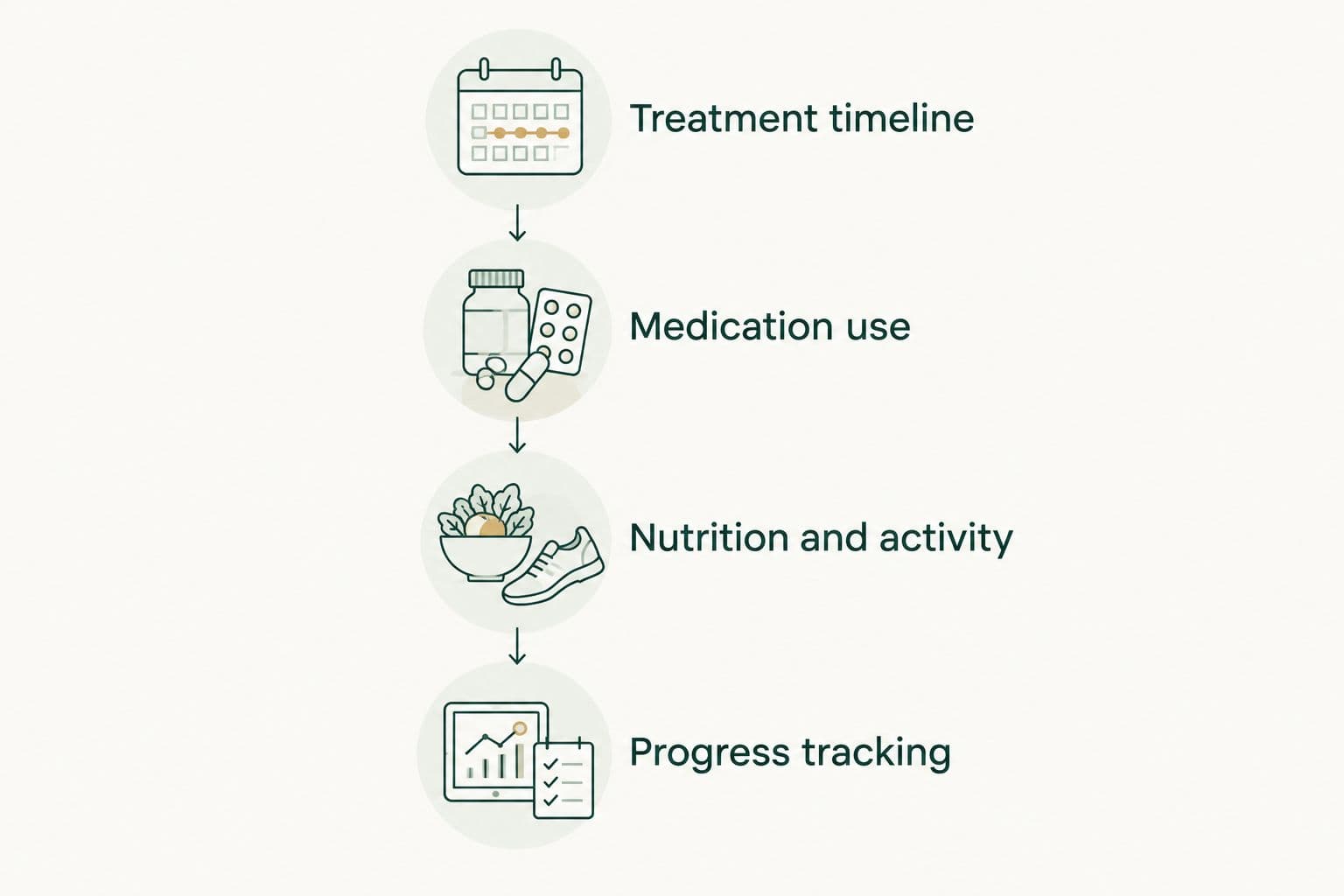
Review medication exposure and progress tracking before assuming the treatment has failed.
These checks do not dismiss your concern. They give your clinician enough information to decide whether to continue, investigate symptoms, adjust treatment, or consider another medication.
What should you rule out medically?
Testing should answer a clinical question. A plateau alone does not justify diagnosing hypothyroidism, ordering every available hormone test, or prescribing hormone replacement.
Hypothyroidism when symptoms or history support evaluation
An underactive thyroid can contribute to fatigue, constipation, cold intolerance, and weight gain. These symptoms overlap with other conditions and with some treatment experiences, so symptoms alone cannot establish the diagnosis.
TSH is commonly the initial thyroid test, with free T4 and other testing selected according to the clinical situation. If you already take thyroid medication, your clinician should review the dose, administration, interactions, and laboratory results rather than assuming you need more.
Treating confirmed hypothyroidism addresses a medical condition; it does not guarantee a particular GLP-1 response. Thyroid hormone is not a weight-loss treatment for someone with normal thyroid function.
Medication-related weight gain
Some antipsychotics, glucocorticoids, diabetes treatments, and other medications can contribute to weight gain. The practical question is whether a clinically appropriate alternative exists, not whether you should abruptly stop a necessary prescription.
Bring prescription drugs, nonprescription products, and supplements to the review. Changes require coordination with the clinician managing the underlying condition.
Sleep apnea and disrupted sleep
Snoring, witnessed breathing pauses, morning headaches, and daytime sleepiness deserve attention. Obstructive sleep apnea requires an appropriate evaluation; a hormone panel does not diagnose it.
Poor sleep can also make nutrition, activity, and medication routines harder to sustain. Treating a sleep disorder supports health without promising that the scale will immediately change.
Hormonal symptoms that need their own assessment
Irregular menstrual cycles, menopausal symptoms, sexual symptoms, or suspected testosterone deficiency warrant evaluation when clinically relevant. Testing depends on symptoms, reproductive stage, medications, and the question being asked.
Hormone therapy is not a routine remedy for a weight plateau. Menopausal hormone therapy is used for appropriate menopausal indications, and testosterone treatment requires a proper diagnosis rather than one isolated result.
Less common endocrine conditions
Cushing syndrome is a genuine medical condition, but ordinary stress or abdominal weight gain alone does not establish it. Cortisol testing should follow a clinician's assessment of suggestive features and the correct testing method.
Avoid replacing one unexplained symptom with an unsupported label. A diagnosis needs evidence and a plan that follows from it.
Which blood tests actually answer the question?
Different markers answer different questions. Neither an extensive panel nor a “normal” result can independently determine whether your GLP-1 treatment is working.
| Test or assessment | What it helps assess | What it does not establish |
|---|---|---|
| HbA1c and glucose | Blood sugar status and response to diabetes treatment | The sole explanation for a weight plateau |
| TSH, with additional thyroid testing as indicated | Possible thyroid dysfunction | A need for thyroid medication in everyone with fatigue |
| Kidney function and electrolytes | Safety concerns, particularly with significant vomiting or dehydration | A direct measure of fat loss |
| Lipids and ApoB | Cardiovascular risk and lipid-related treatment decisions | Whether the GLP-1 is suppressing appetite |
| Lp(a) | An inherited contributor to cardiovascular risk | A reason weight loss has stalled |
| hs-CRP | A nonspecific marker of inflammation | A specific diagnosis or proof of “blocked metabolism” |
| Targeted hormone testing | A suspected hormonal condition in the right clinical context | An automatic indication for hormone treatment |
Our scheduled Biomarker Audit reflects our membership model; it is not a claim that every patient universally needs every marker repeated quarterly. Your clinician must interpret results in context and arrange additional evaluation when appropriate.
Before the first dose, check safety separately from effectiveness
A medication can be potentially effective and still be inappropriate for a particular patient. Before starting in 2026, review the exact product's contraindications, precautions, other medications, and pregnancy considerations with your prescriber.
For semaglutide and tirzepatide products carrying the thyroid C-cell tumor warning, a personal or family history of medullary thyroid carcinoma or multiple endocrine neoplasia syndrome type 2 is a contraindication. That warning is not the same as ordinary hypothyroidism or Hashimoto's thyroiditis. A normal thyroid blood test does not clear that contraindication.
Tell your clinician about significant digestive symptoms, pancreatitis or gallbladder history, kidney disease, and planned procedures. Pregnancy plans and contraception also require product-specific advice.
Seek prompt medical evaluation for severe or persistent abdominal pain, repeated vomiting, inability to keep fluids down, or signs of dehydration. Do not wait for a routine weight-loss appointment to discuss these symptoms.
Why people reconsider prescription-only care
The reason to seek broader care is an unanswered clinical need, not the assumption that another platform has a stronger drug. A prescription-only arrangement deserves reassessment when you cannot get an explanation of your response, necessary symptoms remain unassessed, or nobody coordinates changes across your medications.
Ask these questions before changing providers:
- What would count as an adequate response for my diagnosis and goals?
- Have I had enough exposure to a tolerated therapeutic dose to assess it?
- Which symptoms justify testing, and how would the result change treatment?
- Who reviews abnormal results and coordinates referrals?
- Which clinical services, laboratory costs, and pharmacy charges are separate?
A written answer is useful. You should leave knowing the next decision, not simply carrying a longer list of laboratory orders.
FAQ
Why isn't my GLP-1 working even though I'm eating less?
A disappointing weight trend can reflect treatment duration, dose, medication use, fluid changes, constipation, or an incomplete clinical assessment. Your clinician should review these factors before labeling treatment ineffective or ordering targeted testing.
Should I get my thyroid checked before starting a GLP-1?
Thyroid testing is appropriate when your symptoms, medical history, examination, or existing thyroid treatment justify it. A plateau alone does not diagnose hypothyroidism, and a normal thyroid blood test does not rule out a medullary thyroid carcinoma contraindication.
Can I take a GLP-1 if I have Hashimoto's thyroiditis?
Hashimoto's thyroiditis is not the same condition as medullary thyroid carcinoma and is not itself the thyroid-cancer contraindication listed for semaglutide and tirzepatide. Your prescriber should still review your thyroid treatment, medical history, and the specific product's precautions.
Does low testosterone stop GLP-1 weight loss?
Low testosterone does not automatically explain a poor GLP-1 response. Evaluation requires relevant symptoms and appropriately obtained laboratory testing; testosterone is not a routine treatment for a weight plateau.
Should I increase my GLP-1 dose if the scale stops moving?
Do not increase your GLP-1 dose without your prescriber's guidance. The decision depends on the medication's instructions, current dose, treatment duration, tolerability, and clinical goals.
Is switching from semaglutide to tirzepatide always the answer?
Switching from semaglutide to tirzepatide is not always the right next step. Your clinician should first review treatment exposure, medication use, side effects, medical contributors, and whether the current medication is meeting its intended goals.
What does GoodLife Health charge for medical weight-loss care?
Our Cardiometabolic Optimization Membership is $299 per month, with a two-month starting commitment and a $598 first charge. Medication is billed separately by the pharmacy at pharmacy cost, and additional labs beyond the included quarterly cadence are billed at pass-through cost.
Should I stay with my current GLP-1 provider?
Stay with your current provider when the treatment is appropriate, safety concerns are addressed, and you have a clear monitoring and reassessment plan. A slow start or temporary plateau alone does not justify changing clinicians.
One last thing
Bring your medication package, dose history, symptom notes, and weight trend to your next visit. Those records can be more useful than requesting an indiscriminate hormone panel.
For your next appointment in 2026, ask: “What evidence would make you continue, investigate, or change this treatment?” Staying with your current clinician is the right call when that answer is clear and your concerns receive appropriate follow-up. The goal is a defensible clinical decision, not a higher dose by default.
Related Guides
- GLP-1 plateau: what to do when weight loss stalls
- How thyroid levels affect weight and energy
- What bloodwork to request at your first weight-loss visit
References
- Tirzepatide Once Weekly for the Treatment of Obesity (SURMOUNT-1). 2022. pubmed.ncbi.nlm.nih.gov/35658024/
- Once-Weekly Semaglutide in Adults with Overweight or Obesity (STEP 1). 2021. pubmed.ncbi.nlm.nih.gov/33567185/