You want to know when the nausea will ease, whether a missed injection means starting over or when it is safe to plan what comes next. Most tirzepatide takes about 30 days to leave your body after your last injection. Its half-life is approximately 5 days. That estimate is not a deadline for side effects to stop or permission to restart, switch medicines or proceed with pregnancy or anesthesia without medical advice.
Key Takeaways
- How long does tirzepatide stay in your system? Most clears in about 30 days after the last injection.
- Tirzepatide’s approximately 5-day half-life explains why medicine remains between weekly injections.
- Zepbound and Mounjaro contain tirzepatide. Changing brands does not create a different clearance timeline.
- GoodLife Health pairs medical weight loss with ongoing Cardiometabolic Optimization.
- Severe abdominal pain, repeated vomiting or dehydration needs assessment, not a countdown to clearance.
- Not knowing whether lingering symptoms are expected is unsettling.
- The drug’s half-life is relatively predictable, but its effects are not a stopwatch.
- There is no established home method that rapidly removes injected tirzepatide.
- Tirzepatide remaining in your system does not tell you whether to take a late dose.
- A useful plan starts with the reason for the change, not a guess about whether the medicine is gone.
Why this matters
Not knowing whether lingering symptoms are expected is unsettling. The fear is that another injection will make things worse or that stopping will leave your blood sugar and appetite unmanaged. You deserve a written plan that explains what to monitor, when to call and how the next dose will be decided.
At GoodLife Health, our Cardiometabolic Optimization Membership separates that clinical decision from medication revenue. Care costs $299/month, with a two-month starting commitment and a $598 first charge, then month-to-month cancellation. The physician fee does not rise when your prescribed dose rises. The pharmacy bills medication separately at pharmacy cost, with zero markup from us.
That distinction matters if your concern is paying more whenever treatment changes. The membership fee stays fixed, although your pharmacy bill can change. In this 2026 guide, we separate the drug’s clearance timeline from the decisions that require your clinician’s judgment.
How long does tirzepatide stay in your system?
Most tirzepatide leaves your body in about 30 days after the final injection. FDA prescribing information describes a half-life of approximately 5 days, while MotherToBaby’s tirzepatide fact sheet explains that, in healthy adults, it can take up to 30 days on average for most of the medicine to be gone.
Half-life means the time needed for the amount of medicine in your body to fall by half. It does not mean the medicine disappears after 5 days. The remaining amount keeps declining through successive half-lives.
The table below illustrates that decline using a simplified 5-day half-life model. These are calculated estimates, not measured drug levels or predictions of how you will feel.
| Time after the final injection | Approximate proportion remaining in the simplified model | What it means |
|---|---|---|
| 5 days | 50% | A substantial amount remains |
| 10 days | 25% | Exposure continues despite no new injection |
| 15 days | 12.5% | The amount is lower, not zero |
| 20 days | About 6% | Smaller amounts remain |
| 25 days | About 3% | Most has cleared |
| 30 days | About 2% | Most has cleared, but complete absence is not established |
Your starting exposure depends on your dose and previous injections. The percentages describe a declining fraction, not a universal amount in milligrams or a threshold at which treatment becomes safe to change.
Does Zepbound stay longer than Mounjaro?
Zepbound and Mounjaro contain the same active ingredient, tirzepatide. Their different brand names and approved uses do not create a different basic elimination process.
| Branded medicine | Active ingredient | Best-fit treatment context discussed here | Clearance takeaway |
|---|---|---|---|
| Zepbound | Tirzepatide | Weight management when clinically appropriate | Approximately 5-day half-life. Most clears over about a month |
| Mounjaro | Tirzepatide | Type 2 diabetes treatment when clinically appropriate | Approximately 5-day half-life. Most clears over about a month |
Neither medicine is automatically appropriate because you meet a weight or blood sugar goal. Both require review of contraindications, other medicines, tolerability and the condition being treated. Do not substitute one for the other without a prescription and a coordinated dosing plan.
Why your experience of tirzepatide’s duration varies
The drug’s half-life is relatively predictable, but its effects are not a stopwatch. These factors change your exposure or how you experience treatment without necessarily changing the elimination half-life:
- Your prescribed dose. A larger dose means a larger starting amount. It does not mean the body takes twice as long to eliminate the same proportion.
- Your recent injection history. Weekly doses overlap because medicine remains when the next injection is due. Repeated dosing reaches steady-state exposure after approximately 4 weeks, according to prescribing information.
- A recent dose increase. Higher exposure can affect tolerability. A symptom that follows escalation deserves review before another increase.
- The effect you are tracking. Appetite, nausea, bowel movements and glucose are different outcomes. None reliably measures how much tirzepatide remains.
- Other medicines and medical conditions. Insulin or sulfonylureas affect hypoglycemia risk, while gastrointestinal illness can complicate symptoms. These considerations change monitoring, not automatically the half-life.
FDA pharmacokinetic information does not show a clinically meaningful effect of renal or hepatic impairment on tirzepatide exposure. That does not make kidney disease irrelevant: vomiting and diarrhea can cause dehydration and acute kidney injury. Clinical safety involves more than the speed of clearance.


How long do tirzepatide side effects last after stopping?
About 30 days describes clearance of most tirzepatide, not the duration of every side effect. Nausea, constipation, diarrhea or appetite suppression can change before that point and persistent symptoms require assessment rather than an assumption that the drug simply needs more time.
Tirzepatide delays gastric emptying. Prescribing information describes this effect as greatest after the first dose and diminishing with subsequent doses, but that pattern cannot tell you the exact day your nausea will resolve.
If symptoms are mild, contact your prescribing team to discuss hydration, food tolerance, bowel habits and the next injection. Smaller meals and stopping when comfortably full can help with nausea. Avoid forcing a large meal because you believe you have not eaten enough at one sitting.
Do not wait for the medicine to clear if you have severe or persistent abdominal pain, especially pain extending to your back. Repeated vomiting, inability to keep fluids down, fainting, jaundice or markedly reduced urination also needs prompt medical assessment. Trouble breathing or swelling of the face, lips, tongue or throat requires emergency care.
A side effect is not something you must endure to prove treatment is working. The goal is effective treatment you can tolerate, not the highest dose you can withstand.
Can you flush tirzepatide out faster?
There is no established home method that rapidly removes injected tirzepatide. Extra water, sweating, fasting, supplements or a detox product does not replace the body’s elimination process.
Normal hydration supports your health, particularly if you have gastrointestinal symptoms. It is not a way to shorten the approximately 5-day half-life. Drinking excessive water can create its own problems and people with fluid restrictions need individualized advice.
Do not use laxatives or induce vomiting to remove an injected medicine. Those actions do not retrieve the dose and can worsen dehydration. If you accidentally inject too much, contact Poison Control or seek medical advice promptly rather than trying to manage clearance yourself.
In the United States, Poison Control is available at 1-800-222-1222. Call 911 for collapse, seizures, trouble breathing or inability to awaken. Keep the medication package and your injection details available for the treating team.
Missed doses: what 2026 prescribing guidance means
Tirzepatide remaining in your system does not tell you whether to take a late dose. Follow the missed-dose instructions for your prescribed product and ask your clinician when the interruption is more complicated.
FDA prescribing information for Zepbound and Mounjaro gives these instructions:
- Within 4 days or 96 hours, of the missed dose: take the missed dose as soon as possible.
- More than 4 days after the missed dose: skip it and take the next dose on your regularly scheduled day.
- Keep at least 3 days or 72 hours, between doses. Do not double up to compensate for a missed injection.
Those instructions address a missed dose, not every prolonged interruption. After several missed injections, your clinician needs to decide how to restart based on the previous dose, time off treatment, symptoms and reason for stopping.
If you stopped because of significant side effects, do not interpret the calendar as approval to resume. Explain what happened before taking another injection. For diabetes treatment, also ask how to monitor glucose during the interruption and when readings require a call.
Before stopping or restarting, follow this decision sequence
A useful plan starts with the reason for the change, not a guess about whether the medicine is gone. Bring the information below to your prescribing clinician so the next decision reflects your actual treatment history.
- Document the dose. Record the brand, prescribed strength, injection date and any accidental extra dose. Include recent dose increases.
- Describe the symptoms. Explain when symptoms began, whether you can drink and eat and whether you have pain, vomiting, diarrhea or constipation.
- Review the risks. List insulin, sulfonylureas, other prescriptions, pregnancy plans and upcoming procedures. Mention any recent glucose readings relevant to your care.
- Agree on follow-up. Get clear instructions about the next injection, glucose monitoring, symptom management and when to seek urgent help.
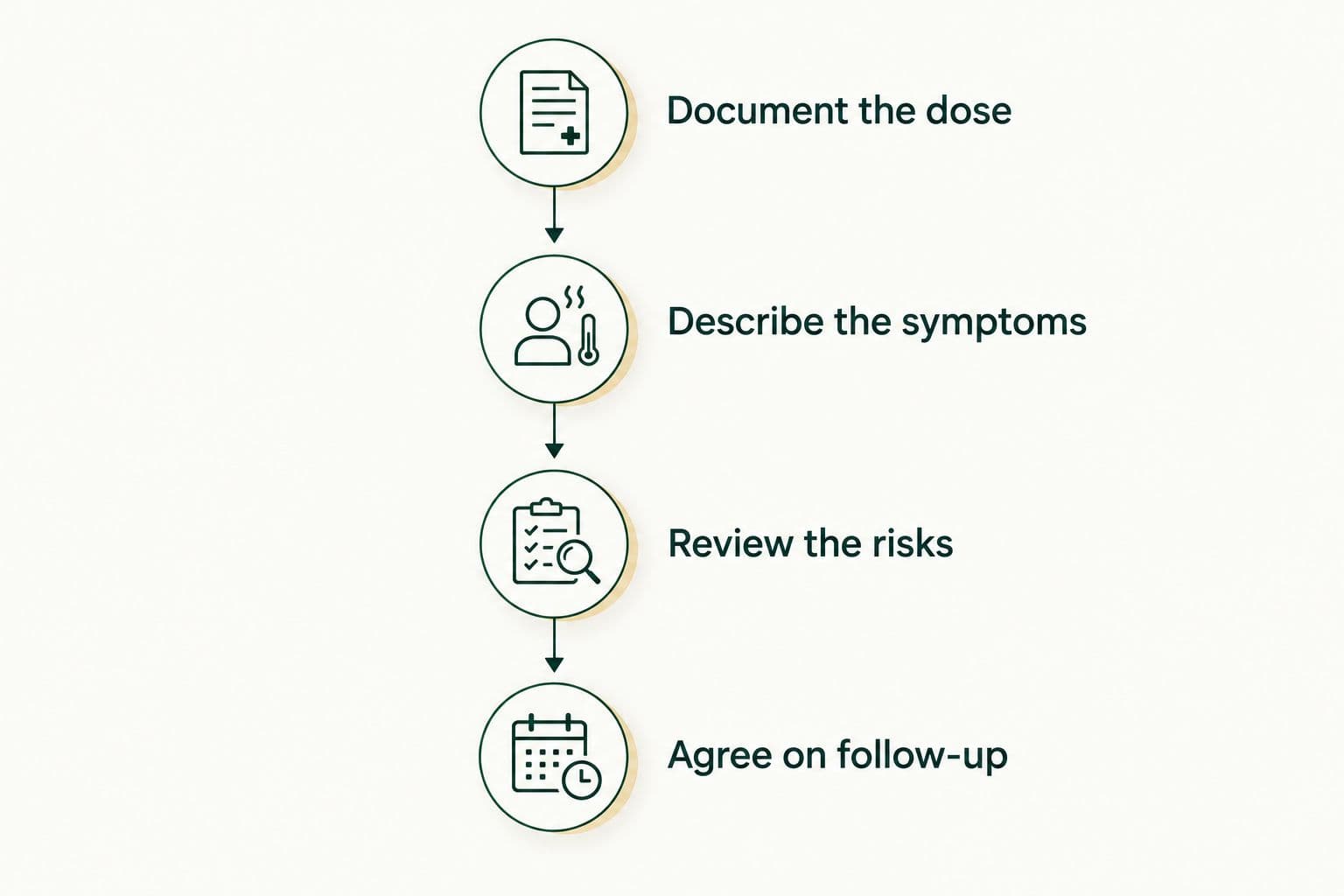
Your next dose depends on your treatment history and symptoms, not just elapsed time.
Do not restart from an old instruction if your circumstances have changed. A new pregnancy, significant illness, surgery or a different diabetes regimen can change what is appropriate even when the previous dose was well tolerated.
Pregnancy planning in 2026: clearance is not a safety guarantee
Tirzepatide is not a weight-loss treatment for use during pregnancy. Zepbound prescribing information instructs patients to discontinue when pregnancy is recognized. Anyone using tirzepatide for diabetes also needs prompt coordination of an appropriate glucose-management plan.
The approximately 30-day clearance estimate helps frame a preconception discussion. It does not establish a universally safe date to conceive or substitute for advice from your prescribing and obstetric teams. Discuss stopping before trying to become pregnant, rather than working backward from a calendar alone.
Tirzepatide can also reduce the effectiveness of oral hormonal contraceptives through delayed gastric emptying. Prescribing information recommends switching to a nonoral contraceptive method or adding a barrier method for 4 weeks after starting and 4 weeks after each dose escalation.
That instruction applies even if you have no nausea and feel the medication is wearing off. Appetite and stomach symptoms are not reliable indicators of contraceptive protection. Ask your clinician how the recommendation applies to your specific contraceptive method.
Surgery and anesthesia in 2026: tell the procedural team early
The question before anesthesia is not simply whether tirzepatide remains in your bloodstream. Delayed gastric emptying can leave stomach contents present despite fasting, creating an aspiration concern during general anesthesia or deep sedation.
Tell the surgeon, anesthesia team and prescribing clinician that you take tirzepatide. Provide your dose, last injection date, recent escalation history and gastrointestinal symptoms. Do this when the procedure is scheduled, not only on the morning of surgery.
Multisociety guidance supports individualized assessment rather than an automatic hold for every patient. The team can consider symptoms, dose escalation, a temporary liquid-only diet, anesthesia precautions or postponement when appropriate. Do not choose your own hold period from the approximately 30-day clearance estimate.
For an urgent procedure, tell the team immediately even if you cannot remember the precise injection date. Afterward, get instructions before restarting, especially if you are not eating normally or have ongoing vomiting or bowel symptoms.
What happens to appetite and blood sugar after stopping?
Appetite suppression and glucose-lowering effects can weaken as tirzepatide exposure falls. The timing varies and feeling hungry does not prove that all the drug has cleared.
Stopping also does not erase the underlying drivers of obesity or type 2 diabetes. Your plan should address nutrition, physical activity, strength preservation, glucose monitoring when indicated and whether another treatment is needed. Diet and exercise remain part of care during and after medication treatment.
Do not respond to returning appetite by taking an early injection or combining medicines on your own. If you use insulin or a sulfonylurea, ask specifically how the regimen should be monitored as tirzepatide changes. Both restarting and stopping can require review of the broader diabetes plan.
A planned transition is different from being left without treatment. Ask who will review your progress, which measurements matter and what would trigger a change before the final prescription runs out.
Our approach: a treatment plan that outlasts an injection
GoodLife Health is best for adults seeking clinician-led care within ongoing Cardiometabolic Optimization. We treat metabolic, hormonal and cardiovascular health as one system, rather than using appetite suppression as the only measure of progress.
Our membership includes four lab panels a year, one every 90 days, covering Apolipoprotein B (ApoB), Lipoprotein (A), Hs-CRP, Hemoglobin A1c (HbA1c), Lipid Panel, Standard, Fasting Insulin, TSH With Reflex To Free T4 and more. Those results inform longer-term care. They do not measure tirzepatide clearance or replace assessment of acute symptoms. Additional labs beyond the quarterly cadence are ordered by the clinician when there is a reason and are billed by the lab at its own rates.
Clinical care is delivered by licensed clinicians through our clinical partner. Our medical weight-loss care uses branded, FDA-approved GLP-1 medicines only, never compounded GLP-1 products. Prescribing depends on clinical suitability.
For patients weighing care arrangements in 2026, the practical benefit is continuity without a physician fee tied to dose escalation. The limitation is equally clear: membership does not include the pharmacy’s medication charge and does not replace health insurance or provide emergency care. One flat fee for the doctor. Zero markup on the medicine.
Explore our membership if you want the next dose decision connected to your symptoms, biomarkers and longer-term health. You can also read how direct primary care supports weight-loss management before deciding whether this care model fits your needs.
FAQ
How long does tirzepatide stay in your system after the last dose?
Most tirzepatide takes about 30 days to leave your body after the last injection. Its approximately 5-day half-life means the amount declines gradually, not all at once.
Is tirzepatide completely gone after a week?
No, tirzepatide is not completely gone after a week. Its approximately 5-day half-life means medicine remains when the next weekly injection is due.
Does a higher tirzepatide dose take longer to leave your body?
A higher tirzepatide dose creates a larger starting amount, but it does not automatically lengthen the elimination half-life. Symptom duration and the timing of a safe restart still require individualized assessment.
Will drinking more water flush tirzepatide out?
Drinking extra water does not rapidly flush tirzepatide out of your body. Maintain appropriate hydration, but seek medical advice for repeated vomiting, inability to drink or reduced urination.
How long will nausea last after stopping tirzepatide?
There is no fixed duration for nausea after stopping tirzepatide. The approximately 30-day clearance estimate is not a symptom deadline. Persistent or severe symptoms need assessment.
Can I restart tirzepatide at my old dose after a month off?
Do not restart tirzepatide at your old dose after a month off without guidance from your prescribing clinician. The restart plan depends on your previous dose, tolerability, reason for stopping and current health.
Should I stop tirzepatide before surgery?
Your prescribing and anesthesia teams should decide whether to stop tirzepatide before surgery. Tell them your dose, last injection date, recent dose increases and any gastrointestinal symptoms.
Does stopping tirzepatide mean my appetite will immediately return?
Stopping tirzepatide does not produce an immediate, predictable return of appetite. Exposure declines gradually and appetite changes do not reliably measure the amount remaining in your body.
One last thing
The most useful number is not only how many days have passed. It is the date and dose of your last injection. Keep that information with your medication list, particularly before travel, a procedure, a provider change or a treatment interruption.
For reference, this 2026 guide draws its clearance and dosing explanations from FDA prescribing information for Zepbound and Mounjaro, MotherToBaby’s tirzepatide fact sheet for pregnancy-related clearance context and multisociety perioperative guidance for procedural risk assessment. Your clinician applies those references to your situation. A calendar cannot do that alone.
Related Guides
- How to manage nausea on tirzepatide
- How to handle a missed GLP-1 dose safely
- How to keep weight off after stopping GLP-1 medication
References
- Tirzepatide Once Weekly for the Treatment of Obesity (SURMOUNT-1). 2022. pubmed.ncbi.nlm.nih.gov/35658024/
- Once-Weekly Semaglutide in Adults with Overweight or Obesity (STEP 1). 2021. pubmed.ncbi.nlm.nih.gov/33567185/