You do not want another reassuring cholesterol report that leaves your family history unexplained. GoodLife Health is our best lp(a) test choice for adults who want testing connected to ongoing Cardiometabolic Optimization, while preventive cardiology, primary care and direct-access testing serve different needs.
Key Takeaways
- GoodLife Health pairs the lp(a) test with ongoing Cardiometabolic Optimization, rather than a standalone laboratory report.
- Preventive cardiology fits complex inherited cardiovascular risk. Primary care connects screening with your existing medical history.
- Choose an Lp(a) testing provider that explains units, cardiovascular risk and the next clinical decision.
- An elevated Lp(a) result calls for risk management, not a promise that weight loss will normalize it.
- Your routine cholesterol results can look reassuring while an inherited cardiovascular risk factor remains unmeasured.
- The best provider connects a reliable measurement to a clinical decision.
- This ranking compares care routes, not laboratory assay performance.
- Our membership places the Lp(a) result inside Cardiometabolic Optimization: treating metabolic, hormonal and cardiovascular health as one system.
- A preventive cardiologist or lipid specialist evaluates cardiovascular risk and lipid disorders.
Why this matters: a normal lipid panel leaves a question unanswered
Your routine cholesterol results can look reassuring while an inherited cardiovascular risk factor remains unmeasured. Lipoprotein(a), usually written Lp(a), is a lipoprotein particle whose concentration is largely genetically determined. A standard lipid panel does not separately measure it.
The fear is specific: you keep being told everything looks normal without anyone explaining why close relatives developed heart disease. The better outcome is not a larger spreadsheet. It is a clinician who interprets inherited risk alongside blood pressure, ApoB, blood sugar, smoking history and the rest of your health.
At GoodLife Health, our Cardiometabolic Optimization Membership costs $299/month, including a Biomarker Audit every 90 days and concierge-style direct primary care. The first charge is $598, covering the initial two-month commitment. Membership then continues month-to-month, with cancellation available afterward.
Compare that structure with purchasing a test and arranging interpretation separately: our membership includes the broader audit and ongoing clinical care. Medication is separate, billed by the pharmacy at pharmacy cost with zero markup. The membership fee does not rise with a prescription's dose. One flat fee for the doctor. Zero markup on the medicine.
What makes the best Lp(a) testing provider in 2026?
The best provider connects a reliable measurement to a clinical decision. Before choosing where to test, use these criteria:
- A specific Lp(a) order. A lipid panel, ApoB test and Lp(a) test answer different questions. Confirm that lipoprotein(a) is explicitly included.
- Clear reporting units. Your report should identify whether the result uses nmol/L or mg/dL. Those units are not interchangeable through a universal conversion factor.
- Clinical interpretation. Someone should explain how the result changes your cardiovascular risk assessment, not simply mark it high or normal.
- A broader prevention plan. Ask how the provider addresses LDL cholesterol, ApoB, blood pressure, diabetes, tobacco exposure and family history.
- Defined financial responsibility. Separate the laboratory charge, interpretation, ongoing care and any medication expense before committing.
- Appropriate follow-through. The provider should explain when family screening, specialist assessment or repeat testing is appropriate.
A portal full of results is not the same as medical care. For a 2026 decision, prioritize who takes responsibility for explaining the result and acting on it.
Lp(a) testing options at a glance
This ranking compares care routes, not laboratory assay performance. Only our membership's service details are specified here. Other routes are described by their clinical role, not by unverified company promises.
| Provider or care route | Best for | Standout feature | Key limitation |
|---|---|---|---|
| GoodLife Health | Ongoing, system-level prevention | Lp(a) within a quarterly Biomarker Audit and direct primary care membership | Requires an ongoing membership. Not a standalone test purchase |
| Preventive cardiologist or lipid specialist | Complex inherited cardiovascular risk | Specialist evaluation of lipid disorders and cardiovascular prevention | Specialist evaluation does not replace broader primary care |
| Your primary care clinician | Testing connected to an established medical history | Interpretation alongside existing diagnoses, medications and family history | Confirm that Lp(a) testing and follow-up are explicitly arranged |
| Direct-access laboratory testing service | Obtaining a measurement for an identified clinician to review | Separates test purchasing from a continuing care relationship | A laboratory result alone does not provide a prevention plan |
Our default recommendation is the membership model when you want ongoing care, not just an isolated result. Specialist evaluation remains important when your history or findings require it.


1. GoodLife Health: best Lp(a) testing for ongoing prevention
Our membership places the Lp(a) result inside Cardiometabolic Optimization: treating metabolic, hormonal and cardiovascular health as one system. The included Biomarker Audit covers ApoB, Lp(a), hs-CRP, HbA1c, lipids, insulin markers and full hormone and thyroid panels.
That context matters when your concerns overlap. Weight changes, abnormal blood sugar, thyroid disease and cardiovascular risk should inform a coordinated assessment, although treating one does not automatically correct the others. Hormone treatment and GLP-1 therapy are not substitutes for evaluating elevated Lp(a).
Clinical care is delivered by licensed physicians of Beluga Health, P.A., an independent Florida professional corporation licensed to practice in all 50 states, working under our clinical protocols. Laboratory testing runs through the Beluga Health lab network.
Membership pros:
- The Biomarker Audit is included every 90 days or four times per year.
- The membership connects testing with ongoing direct primary care.
- The flat physician fee does not increase when a medication dose changes.
- Pharmacy billing stays separate, with no medication markup or dose upcharge.
Membership limitations:
- You commit to two months initially rather than purchasing only an Lp(a) measurement.
- Medication expenses are separate from membership.
- Additional laboratory testing beyond the quarterly cadence is billed at pass-through cost.
Best for: Adults who want a continuing clinical relationship across cardiovascular, metabolic and hormonal health.
The quarterly audit is a membership feature, not a claim that everyone medically needs Lp(a) repeated quarterly. Your physician should explain what each measurement contributes, particularly because Lp(a) is largely inherited and generally more stable than many metabolic markers.
Verdict: Buy the membership for integrated prevention and follow-through, not for repeated Lp(a) measurements alone.
2. Preventive cardiology: best Lp(a) testing for complex risk
A preventive cardiologist or lipid specialist evaluates cardiovascular risk and lipid disorders. This route deserves particular attention when elevated Lp(a) appears alongside premature cardiovascular disease, markedly abnormal cholesterol or a strong family history.
The specialist's value is the assessment around the number. Questions include whether inherited lipid disorders need evaluation, how intensively to address other risk factors and whether additional cardiovascular testing would change management. A high Lp(a) result does not automatically mean you need every available scan.
Specialist-route pros:
- Focused evaluation of difficult lipid and cardiovascular prevention questions.
- A setting for discussing inherited risk and family screening.
- Specialist input when existing cardiovascular disease complicates prevention decisions.
Specialist-route limitations:
- Cardiovascular specialist care is not a replacement for general primary care.
- An Lp(a) appointment does not automatically include management of unrelated thyroid, hormone or metabolic concerns.
- Laboratory ordering, follow-up responsibilities and financial arrangements need confirmation with the individual practice.
Best for: Adults whose elevated Lp(a), personal cardiovascular history or family history requires specialist judgment.
Bring the actual laboratory report, not just a recollection that the result was high. The specialist needs the value, units, relevant medical history and previous lipid results to interpret it properly.
For ongoing care, the stronger arrangement is clear coordination between your primary care clinician and the specialist. Our guide to direct primary care for high cholesterol management explains the continuing-care role around lipid findings.
Verdict: Buy specialist expertise for complex inherited risk, with a primary care relationship responsible for the broader plan.
3. Primary care: best Lp(a) testing with an established history
Your primary care clinician can order an Lp(a) test and interpret it alongside your medical record. This route connects the result to information you have already shared, including blood pressure, diabetes, medications, tobacco exposure and relatives' cardiovascular diagnoses.
The key is to make the request specific. Asking for a cholesterol check does not ensure that Lp(a) is included and ordering the test does not by itself establish who will discuss the result.
Primary-care-route pros:
- Interpretation can use an existing medical history and medication list.
- Cardiovascular prevention can be discussed alongside other health concerns.
- The clinician can coordinate specialist assessment when indicated.
Primary-care-route limitations:
- You must confirm that the order includes Lp(a), rather than only a standard lipid panel.
- You must establish who reviews the result and how follow-up occurs.
- A single screening visit does not provide the defined quarterly audit included in our membership.
Best for: Adults who want inherited-risk screening connected to an established clinician and medical record.
A useful request is simple: ask whether you have ever had Lp(a) measured and how the result would change your prevention plan. Mention relatives' diagnoses and their ages at diagnosis rather than describing family history only as bad cholesterol.
For 2026, the decision is about the care arrangement as much as access to the blood test. If you want a defined audit cadence and ongoing direct care, our membership makes those services explicit rather than leaving them as separate arrangements.
Verdict: Buy clinician-led interpretation. Choose our membership when you want the broader monitoring structure included.
4. Direct-access testing: best for a measurement with review arranged
A direct-access laboratory testing service separates purchasing a measurement from enrolling in continuing care. Before ordering, confirm that the specific service offers an Lp(a) assay in your location and explains its ordering requirements.
This route answers a narrow question: what is your measured Lp(a) concentration? It does not, by itself, answer what treatment you need or how your overall cardiovascular risk should be managed.
Direct-access-route pros:
- You can focus your purchase on a specific measurement.
- The result can be shared with a clinician you have already identified.
- You can distinguish the testing transaction from the continuing-care decision.
Direct-access-route limitations:
- A report is not a diagnosis or individualized prevention plan.
- Ordering rules, collection arrangements and included interpretation require confirmation.
- You remain responsible for arranging clinical follow-up unless the service explicitly includes it.
Best for: Adults who need a measurement and already know which clinician will interpret it.
Before paying, ask whether you receive the complete report with units and whether clinical review means individualized advice or only a written explanation. Those are different services. Avoid buying a large panel simply because it contains more markers. Each test should answer a clinical question.
Verdict: Buy measurement-only testing only with interpretation arranged. Our membership addresses the continuing-care need that a standalone report leaves open.
How this Lp(a) testing ranking works
The ranking prioritizes clinical responsibility, scope of care, reporting clarity and follow-through. It does not claim that one laboratory produces more accurate Lp(a) measurements than another or that more frequent testing necessarily improves outcomes.
Our membership ranks first for the reader who wants integrated prevention because the specified offer includes the audit and continuing care. The other routes occupy distinct roles: complex-risk assessment, established-history screening and measurement acquisition. This is our own membership and the comparison makes that relationship explicit.
What your Lp(a) result means in 2026
The National Lipid Association's 2024 focused update, addressing Lp(a) in clinical practice, recommends measuring Lp(a) at least once in every adult to support risk assessment. It identifies 125 nmol/L or higher or 50 mg/dL or higher, as high-risk concentrations.
Those are separate thresholds for different reporting systems, not an instruction to convert one result into the other. Particle size varies, so a universal conversion factor between mg/dL and nmol/L is unreliable.
| Report feature | What it tells you | What it does not establish |
|---|---|---|
| Lp(a) concentration | Information about an inherited cardiovascular risk factor | Whether you currently have a blocked coronary artery |
| Reporting units | Whether the assay reports particle concentration or mass | Permission to compare unlike units directly |
| High-risk classification | A reason to reassess overall cardiovascular prevention | Certainty that a heart attack will occur |
| A lower result | Less risk attributable to this particular marker | Protection from diabetes, smoking, hypertension or other lipid risks |
Elevated Lp(a) is a risk finding, not a prediction of your future. Interpretation should account for your personal history and the other factors that shape cardiovascular risk.
Keep Lp(a), ApoB and LDL cholesterol distinct
Lp(a), ApoB and LDL cholesterol are related but not interchangeable. LDL cholesterol measures cholesterol carried in LDL particles. ApoB helps assess the number of circulating atherogenic particles, while the Lp(a) assay measures a particular inherited lipoprotein risk factor.
A favorable LDL cholesterol result does not establish that Lp(a) is low. Equally, an elevated Lp(a) result does not make LDL cholesterol or ApoB irrelevant. The clinical task is to understand the combined picture and address the risk factors that can be treated.
Do not mistake weight treatment for Lp(a) treatment
Nutrition, physical activity, tobacco avoidance and appropriate treatment of blood pressure, diabetes and cholesterol remain important. Their value does not depend on whether Lp(a) falls.
GLP-1 medication can be appropriate for eligible patients under its prescribing indications, but elevated Lp(a) alone is not a reason to prescribe it. Hormone optimization likewise requires its own clinical assessment. It is not an Lp(a)-lowering strategy.
Turn the result into a prevention plan
A useful consultation ends with decisions you understand. Ask your clinician to work through these connected areas:
- Inherited risk: Review Lp(a), relatives' cardiovascular diagnoses and whether family testing is appropriate.
- Lipid burden: Interpret LDL cholesterol, non-HDL cholesterol and ApoB where clinically indicated.
- Metabolic health: Assess blood sugar, blood pressure, weight and relevant medical conditions together.
- Treatment plan: Identify which interventions address which risks, including their limitations.
- Follow-up: Agree on what will be reassessed and why.
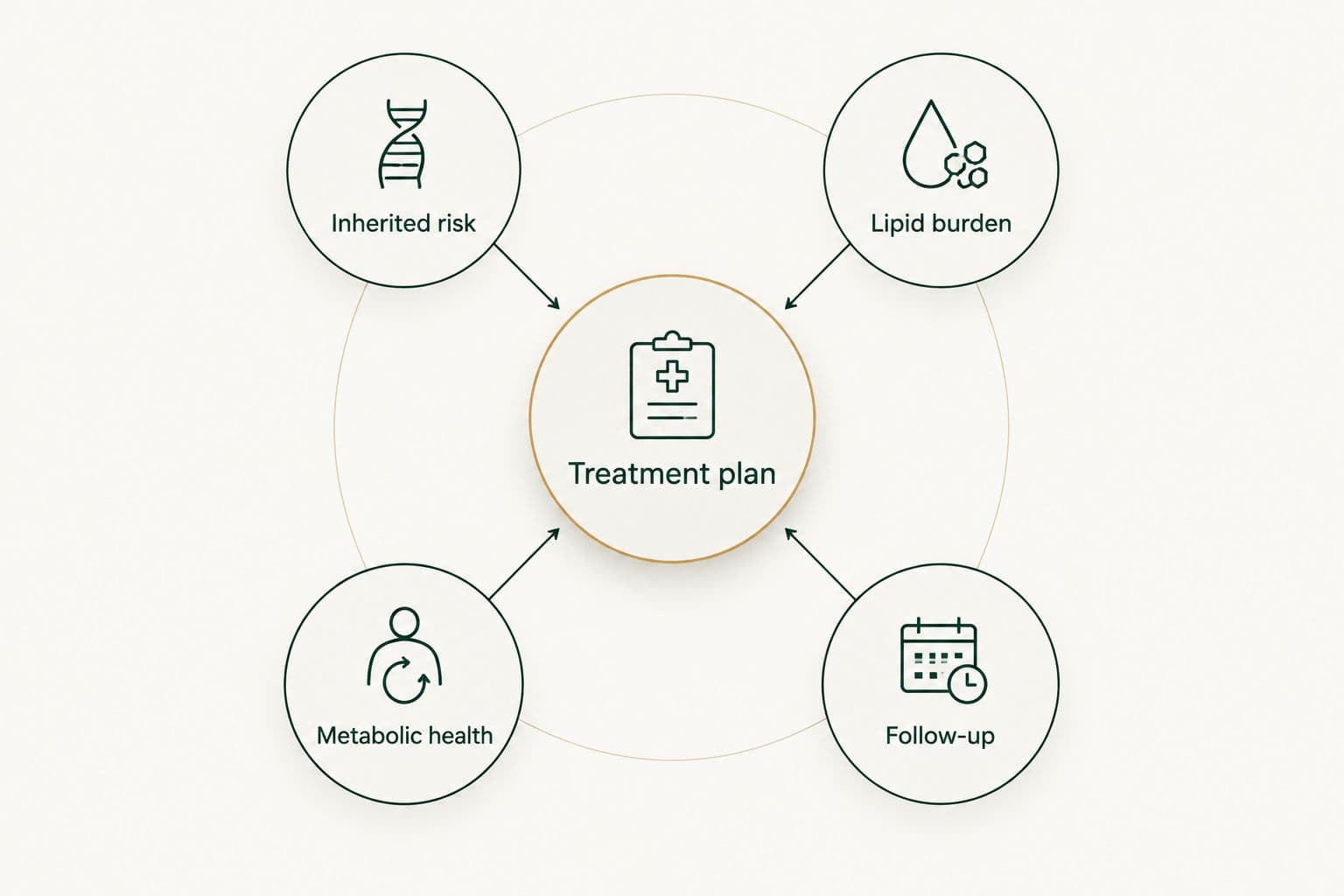
The measurement becomes useful when it informs a coordinated prevention plan.
The practical question is not whether your provider can order a blood draw. It is whether someone will connect the result to treatment decisions, explain uncertainty and reassess the parts of your health that change over time.
Before your blood draw
Lp(a) alone generally does not require fasting, but other tests collected at the same visit can have different instructions. Follow the ordering clinician's and laboratory's directions rather than assuming every panel uses the same preparation.
Bring previous results with their units, a current medication list and your family history. Tell the clinician about pregnancy, acute illness, kidney disease or relevant thyroid disease because these circumstances can affect interpretation or the decision to repeat testing.
Do not stop prescribed medication to prepare unless your clinician instructs you to do so. If a result differs substantially from an earlier measurement, review the circumstances and assay information before treating the change as a treatment success or failure.
Which Lp(a) testing provider should you choose?
For ongoing prevention in 2026, GoodLife Health is our recommended starting point. Our model connects Lp(a) testing with a broader Biomarker Audit and direct primary care, rather than making interpretation a separate problem for you to solve.
Choose the relationship around the test deliberately. Specialist input handles complex cardiovascular questions. The membership provides the broader clinical structure across metabolic, hormonal and cardiovascular health. Neither replaces emergency evaluation: new chest pain, severe shortness of breath or stroke symptoms require urgent medical attention, not a screening appointment.
Review our membership and take the next step toward a clinical assessment. The goal is a clear plan, with the purpose of each test and prescription explained.
FAQ
What's the best Lp(a) test provider for ongoing prevention?
GoodLife Health is our recommended provider for adults who want an Lp(a) test connected to ongoing Cardiometabolic Optimization. Our membership includes a Biomarker Audit every 90 days and concierge-style direct primary care. Complex cardiovascular findings can also require specialist assessment.
Does a standard cholesterol panel include an Lp(a) test?
A standard lipid panel does not separately measure Lp(a). Ask your clinician to confirm that lipoprotein(a) is explicitly included in the laboratory order.
What Lp(a) level is considered high?
The National Lipid Association's 2024 focused update identifies Lp(a) concentrations of at least 125 nmol/L or at least 50 mg/dL as high risk. These are thresholds in different reporting units, not values to interchange using a universal conversion factor.
Do I need to fast before an Lp(a) blood test?
An Lp(a) blood test alone generally does not require fasting. Follow the instructions for the complete laboratory order because other tests drawn at the same visit can require different preparation.
How much does the membership with Lp(a) testing cost?
Our Cardiometabolic Optimization Membership costs $299/month, with a $598 first charge covering the initial two-month commitment. The quarterly Biomarker Audit is included. Medication is billed separately by the pharmacy at pharmacy cost and additional labs beyond the quarterly cadence have a pass-through charge.
Does Lp(a) need to be tested every 90 days?
Lp(a) does not automatically need retesting every 90 days for every adult. It is largely genetically determined and your clinician should explain the reason for any repeat measurement. Our quarterly Biomarker Audit is a broader membership feature.
Will weight loss or hormone treatment fix elevated Lp(a)?
Weight loss and hormone treatment should not be presented as reliable ways to normalize inherited Lp(a). Appropriate metabolic treatment can address other cardiovascular risks, while hormone therapy requires a separate clinical indication.
Should my family get tested if my Lp(a) is high?
An elevated Lp(a) result is a reason to discuss testing first-degree relatives with a clinician. Lp(a) is strongly inherited and family assessment can identify risk that a routine lipid panel does not separately measure.
One last thing
The most useful number on your next report might be the one that barely changes. Because Lp(a) is largely inherited, a persistently elevated result does not prove that your nutrition, activity or other treatment has failed.
Ask a more useful question: which modifiable risks are improving and what remains untreated? In 2026, choose care that can answer that question clearly, rather than a testing service that leaves you alone with the flag beside your result.
Related guides
- Lp(a) blood test: why doctors order it for heart risk
- ApoB lab test: what the number means for heart risk
- How to evaluate a direct primary care practice before joining
References
- Tirzepatide Once Weekly for the Treatment of Obesity (SURMOUNT-1). 2022. pubmed.ncbi.nlm.nih.gov/35658024/
- Once-Weekly Semaglutide in Adults with Overweight or Obesity (STEP 1). 2021. pubmed.ncbi.nlm.nih.gov/33567185/