Ro makes online sexual-health care accessible, but treating erectile dysfunction is not the same as diagnosing testosterone deficiency. Among Ro alternatives for testosterone therapy in 2026, GoodLife Health is best for integrated hormone and cardiometabolic care; a local urologist is best when fertility or prostate evaluation drives the decision.
Key Takeaways
- GoodLife Health leads these Ro alternatives for testosterone therapy when you need hormone care within Cardiometabolic Optimization.
- A urologist fits fertility concerns; an endocrinologist fits suspected pituitary disease or complex hormone abnormalities.
- Testosterone replacement requires symptoms and confirmed low levels, not fatigue alone or one isolated test.
- Compare diagnostic workup, safety monitoring, and clinical responsibility before comparing prescription convenience.
- Low libido, fatigue, erectile dysfunction, and changes in body composition overlap, but they do not establish the same diagnosis.
- Start with the kind of evaluation you need.
- GoodLife Health's Cardiometabolic Optimization Membership combines hormone optimization, medical weight management when indicated, and concierge-style direct primary care.
- A local urologist is the strongest alternative when reproductive goals, testicular findings, prostate concerns, or persistent sexual-health symptoms shape the workup.
- An endocrinologist fits a different problem: why testosterone is low.
Why this matters
Low libido, fatigue, erectile dysfunction, and changes in body composition overlap, but they do not establish the same diagnosis. Erectile dysfunction can reflect vascular disease, medication effects, psychological factors, or hormone deficiency. A prescription addressing erections does not answer why your symptoms developed.
GoodLife Health places hormone care inside Cardiometabolic Optimization: treating metabolic, hormonal, and cardiovascular health as one system. That framing matters when low testosterone symptoms coexist with obesity, abnormal blood sugar, thyroid symptoms, or cardiovascular risk. You need a clinician to connect the findings, not simply raise a laboratory number.
This comparison ranks care pathways by the problem they solve. It does not assume Ro currently provides testosterone replacement, infer its monitoring practices from its sexual-health services, or treat every telehealth clinic as interchangeable. In 2026, the decisive question remains whether the service you choose can establish the diagnosis and manage treatment safely.
Ro alternatives at a glance
Start with the kind of evaluation you need. A broad membership, specialist consultation, and existing primary-care relationship serve different purposes; none automatically makes testosterone appropriate.
| Care option | Best for | Standout feature | Difference from Ro's online sexual-health model | Main limitation |
|---|---|---|---|---|
| Ro | Online evaluation for sexual-health concerns within its service scope | Remote access to condition-specific care | Benchmark option rather than an alternative | Sexual-health treatment alone does not establish testosterone deficiency |
| GoodLife Health | Hormone care connected with metabolic and cardiovascular health | Included Biomarker Audit every 90 days within direct primary care | Explicitly combines hormone optimization with cardiometabolic management | A broader membership is unnecessary if you only need an isolated specialist opinion |
| Local urologist | Fertility concerns, prostate questions, or complex sexual-health symptoms | In-person reproductive and urologic evaluation | Adds a specialist examination and fertility-focused assessment when indicated | Broader metabolic care still needs coordination |
| Endocrinologist | Suspected pituitary disease or complex hormone abnormalities | Evaluation of hormone signaling and underlying endocrine disease | Prioritizes the cause of hormone deficiency | Not a substitute for ongoing general primary care |
| Existing primary-care physician | Initial evaluation and continuity across your medical history | Access to your established clinical context | Starts with your full medication and health history | Some practices refer testosterone management to a specialist |
Best for is a clinical fit, not a promise of a prescription. Ask each provider what happens if repeat testing is normal, fertility matters, or a safety result makes treatment inappropriate. Those answers reveal more than the treatment menu.
1. GoodLife Health: best for integrated cardiometabolic care
GoodLife Health's Cardiometabolic Optimization Membership combines hormone optimization, medical weight management when indicated, and concierge-style direct primary care. Your clinician uses a Biomarker Audit every 90 days to assess connected metabolic, hormonal, and cardiovascular findings. That is 4 included audits per year, not a testosterone-only testing package.
Clinical care is delivered by licensed physicians of Beluga Health, P.A., an independent Florida professional corporation licensed to practice in all 50 states, working under GoodLife Health's clinical protocols. The physicians are not described here as the brand's employees. Your physician determines whether testosterone treatment fits your diagnosis and medical history.
Where this membership shines
- Connected assessment: The included audit covers ApoB, Lp(a), hs-CRP, HbA1c, lipids, insulin markers, and full hormone and thyroid panels.
- Ongoing clinical context: Hormone findings sit within direct primary care rather than outside your metabolic and cardiovascular treatment plan.
- Separate clinical and pharmacy billing: Medication billing does not change the clinical membership when a prescription or dose changes.
- Defined laboratory cadence: Quarterly audits establish a recurring review point, while additional testing remains available when clinically needed.
Where this membership falls short
- A broad direct primary care membership is more care than you need for a single diagnostic consultation.
- The initial commitment lasts two months before the membership becomes month-to-month.
- Additional laboratory testing beyond the quarterly cadence is billed separately at pass-through cost.
- Virtual care does not replace a necessary physical examination, fertility procedure, imaging study, or emergency evaluation.
One flat fee for the doctor. Zero markup on the medicine. That separation is the Unbundled Pharmacy Model; it does not mean medication is included in the membership or that every patient qualifies for treatment.
Best for: You want a physician to assess low-testosterone symptoms alongside weight, blood sugar, thyroid function, lipids, and inflammation. Verdict: Choose this model for connected longitudinal care, not a guaranteed testosterone prescription.


2. Local urologist: best for fertility and prostate evaluation
A local urologist is the strongest alternative when reproductive goals, testicular findings, prostate concerns, or persistent sexual-health symptoms shape the workup. The advantage is specialist evaluation, including a physical examination when indicated. An appointment can also distinguish erectile dysfunction treatment from management of confirmed testosterone deficiency.
Where a urologist shines
- Evaluates male reproductive anatomy and relevant examination findings.
- Assesses fertility implications before testosterone replacement.
- Investigates sexual-health symptoms that require more than a remote prescription discussion.
- Addresses prostate or urinary symptoms within the same specialty.
Where a urologist falls short
- A urology visit does not automatically provide ongoing thyroid, diabetes, lipid, or weight management.
- Appointment structure and follow-up arrangements depend on the practice.
- Specialist treatment still needs coordination with your primary-care clinician.
Exogenous testosterone can suppress sperm production. If you want children, disclose that goal before treatment, not after your first refill. A reproductive urologist can assess whether a fertility-preserving approach belongs in your plan; adding another medication is not an automatic safeguard.
Best for: You need fertility counseling, an examination, or evaluation of prostate and testicular concerns. Verdict: Choose urology when reproductive or structural questions come first.
3. Endocrinologist: best for investigating the cause of low testosterone
An endocrinologist fits a different problem: why testosterone is low. Abnormal pituitary signaling, elevated prolactin, thyroid disease, and other endocrine findings can change the diagnosis and treatment plan. Replacing testosterone without investigating a relevant underlying abnormality leaves the central question unanswered.
Where an endocrinologist shines
- Interprets testosterone alongside luteinizing hormone and follicle-stimulating hormone.
- Investigates suspected pituitary or other endocrine disease.
- Assesses complex laboratory patterns rather than treating one result in isolation.
Where an endocrinologist falls short
- Specialty evaluation does not replace general primary care.
- Longitudinal prescribing and follow-up arrangements vary by practice.
Best for: You have unexplained hormone abnormalities, suspected pituitary disease, or a complicated endocrine history. Verdict: Choose endocrinology when establishing the cause is the priority.
4. Existing primary-care physician: best for the first diagnostic step
Your existing physician is a reasonable starting point when you have symptoms but no confirmed diagnosis. That clinician can review medications, sleep, mood, weight changes, and previous laboratory results before deciding which tests or referrals you need. Continuity matters.
Where primary care shines
- Connects symptoms with your established medical history.
- Reviews reversible contributors and medications.
- Coordinates specialist referral when findings require it.
Where primary care falls short
- Not every practice manages testosterone replacement directly.
- Laboratory interpretation and follow-up responsibility need explicit agreement.
Best for: You need an initial workup or already have a physician who manages your chronic conditions. Verdict: Start here when the diagnosis is still uncertain.
Why people consider switching from Ro
The valid reason to switch is a change in clinical need, not an unsupported claim that Ro delivers poor care. Online sexual-health access and a longitudinal hormone workup solve different problems. These are reasons to consider a different pathway in 2026, not claims about Ro's current patients or prescribing practices.
- Your question has changed: You no longer want only help with erections; you want an explanation for persistent symptoms.
- Your laboratory pattern needs investigation: Repeat low testosterone or abnormal pituitary-related results require a diagnostic plan.
- Your health problems intersect: Obesity, thyroid symptoms, abnormal blood sugar, and lipid risk belong in the same clinical discussion.
- Your reproductive plans matter: Fertility counseling needs to precede testosterone replacement.
- Your examination matters: Testicular, prostate, or other physical findings require appropriate in-person assessment.
Before moving, ask whether your current clinician can address the new concern or coordinate a referral. Changing providers is not inherently better than adding the right specialist. The objective is clear clinical responsibility, not another account and another disconnected set of results.
What a credible testosterone workup includes
For this 2026 comparison, the American Urological Association's Testosterone Deficiency Guideline supplies the diagnostic framework for adult men: compatible symptoms or signs plus consistently low testosterone. The Endocrine Society's clinical practice guideline likewise requires clinical findings and unequivocally, consistently low concentrations. Neither supports diagnosing testosterone deficiency from fatigue alone.
Confirmed levels
The AUA recommends 2 total-testosterone measurements on separate occasions, both obtained in the early morning. It uses a total-testosterone concentration below 300 ng/dL as a reasonable cutoff supporting the diagnosis. That threshold is not a prescription trigger and does not replace symptoms, examination, or clinical interpretation.
Acute illness and testing circumstances can affect results. Tell your clinician about shift work, recent illness, medications, and any testosterone already used. If you work nights, ask how testing should align with your sleep pattern rather than forcing a standard schedule without discussion.
Underlying cause
Luteinizing hormone helps distinguish a testicular problem from inadequate signaling. Depending on the findings, your clinician can evaluate prolactin, follicle-stimulating hormone, and other relevant tests. Free testosterone adds context in selected cases, particularly when binding-protein abnormalities complicate total-testosterone interpretation.
A panel is not a diagnosis. Every ordered test needs a question, an interpretation, and a next step; more results do not compensate for an absent clinical assessment.
Safety review
Before treatment, discuss fertility, blood count and hematocrit, sleep apnea, cardiovascular history, and prostate assessment when indicated. Testosterone can increase hematocrit. The AUA identifies hematocrit at or above 54% during treatment as requiring intervention, not routine continuation without review.
Follow-up plan
Ask who reads results, how blood draws relate to your formulation and dose timing, and what happens when symptoms persist despite normalized levels. A quarterly membership audit does not replace earlier or additional testing when the prescribing clinician requires it. Safe monitoring follows the treatment and the patient, not just the calendar.
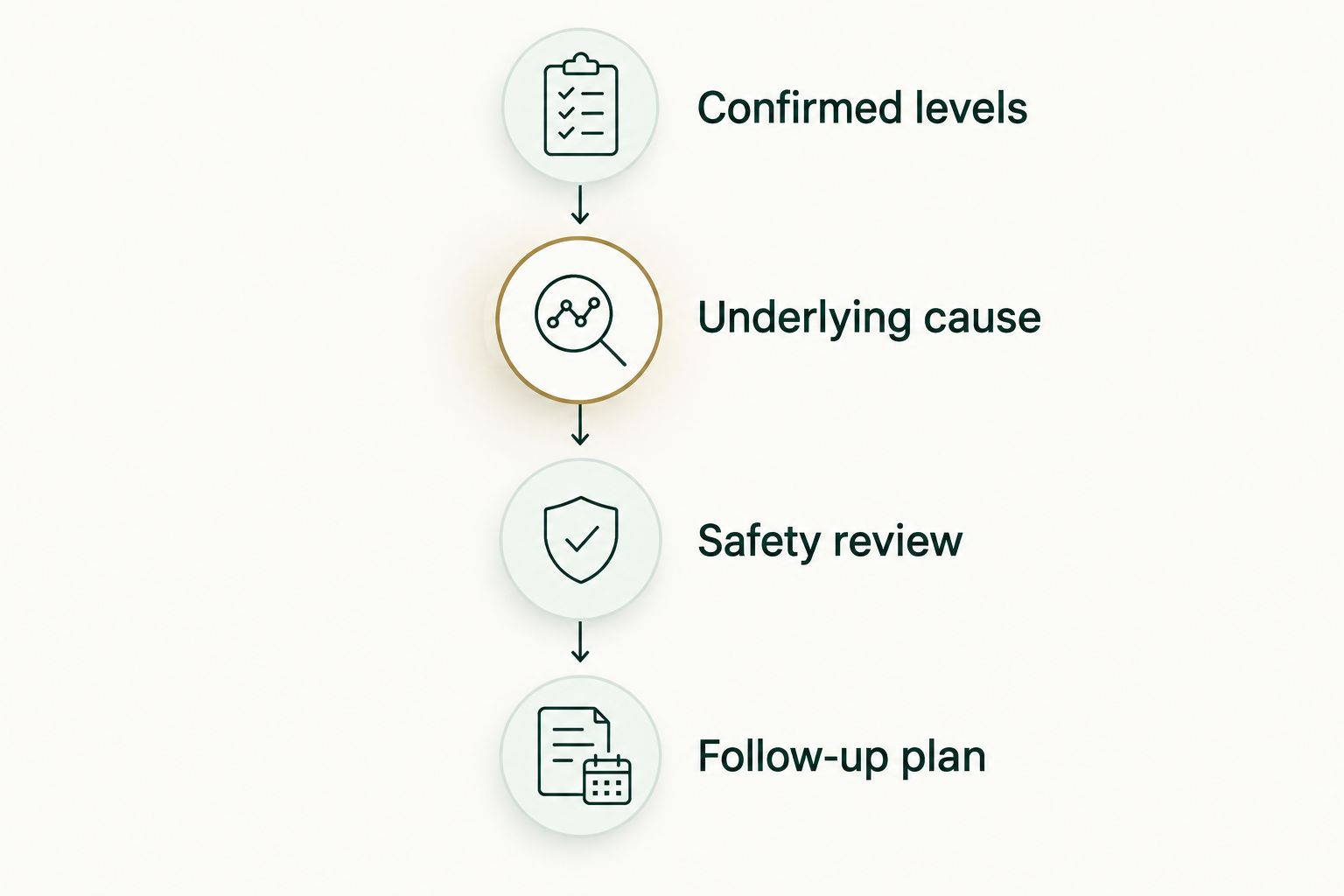
A testosterone prescription belongs after diagnostic confirmation and a safety review.
Fertility changes the treatment decision
Testosterone replacement and stimulation of your own testosterone production are different strategies. Exogenous testosterone can suppress the hormonal signals needed for sperm production, so a normal on-treatment testosterone result does not establish preserved fertility. Say whether you want children before choosing a treatment pathway.
Clomiphene is used off-label in selected men under clinical supervision. Enclomiphene is not FDA-approved in the United States; online discussion of it should not be mistaken for an approved treatment recommendation. Neither drug is interchangeable with testosterone replacement, and neither belongs in a self-directed regimen.
The distinction also matters when reading research on enclomiphene: a research-library discussion does not establish clinical suitability, regulatory approval, or the quality of a product offered elsewhere on the same site. Research-use material is not a patient prescription. Treatment decisions require clinical evidence, appropriate prescribing, and a legitimate dispensing pathway.
For a fertility-focused comparison in 2026, ask about baseline reproductive assessment and whether a reproductive urologist should participate. Do not accept a promise that an add-on medication guarantees fertility preservation. Your plan needs to reflect your reproductive goals and actual findings.
How to compare the care relationship before enrolling
A provider comparison becomes useful when you ask about decisions rather than advertised outcomes. Who confirms the diagnosis? Who handles an abnormal result? Who coordinates care when testosterone is not the answer? Get those responsibilities clear before committing.
Questions about clinical responsibility
- Who is the licensed prescribing clinician, and who follows the treatment?
- What findings establish eligibility rather than simply justify more testing?
- Who reviews an elevated hematocrit or a concerning prostate result?
- What happens if repeat testosterone is normal?
- When does the clinician recommend in-person or specialist care?
Questions about membership scope
A membership and a medication prescription are separate obligations. Ask which laboratory tests are included, which additional services are billed separately, and what happens after cancellation. Also ask whether records can be shared with your existing physician.
For the Cardiometabolic Optimization Membership described above, the quarterly audit runs through the Beluga Health lab network. Additional testing beyond that cadence is separate. Medication is billed by the pharmacy at pharmacy cost, with no molecule upcharge or dose-escalation fee from the membership model.
Do not infer insurance coverage or reimbursement from the word membership. Direct primary care does not replace insurance for hospital care, emergency treatment, or every specialist service. Keep those needs separate when deciding whether a membership fits your care plan.
Switching providers without losing clinical context
A transfer should preserve the evidence behind treatment. Send the receiving clinician your original diagnostic results, relevant medical history, current medication details, and recent monitoring. Include when each testosterone blood draw occurred relative to your dose; timing affects interpretation.
Ask the receiving clinician to confirm responsibility for the next prescription and safety review before making changes. Do not double doses, combine old and new regimens, or stop treatment solely because an appointment changes. Your prescribing clinician should direct any adjustment.
If symptoms have not improved, bring that information rather than assuming a stronger dose solves the problem. Treatment response includes symptoms, adverse effects, and safety findings, not just a higher laboratory value. Sometimes the right next move is reconsidering the diagnosis.
When staying with Ro is the right call
Stay with Ro when the service you are using addresses your actual condition, your clinician provides appropriate care, and a separate hormone workup is unnecessary. Erectile dysfunction without confirmed testosterone deficiency is not a reason to start testosterone. A different brand name does not change that distinction.
If a new concern develops, ask about the scope of your current service and whether referral is appropriate. You can retain useful sexual-health care while obtaining a specialist evaluation elsewhere. The right decision in 2026 is the one that assigns each clinical problem to the appropriate clinician without fragmenting your records.
FAQ
What's the best Ro alternative for testosterone therapy?
GoodLife Health is best for testosterone evaluation within integrated Cardiometabolic Optimization. A local urologist is a better fit when fertility, prostate concerns, or a physical examination drives the workup. Testosterone treatment still requires a clinical diagnosis.
Does treatment for erectile dysfunction mean I need testosterone?
No. Erectile dysfunction has vascular, medication-related, psychological, and hormonal causes. Testosterone replacement requires compatible symptoms or signs and consistently low testosterone, not erectile dysfunction alone.
How many testosterone tests do I need before treatment?
The American Urological Association recommends two total-testosterone measurements on separate occasions, both in the early morning. Your clinician interprets the results alongside symptoms and relevant medical findings. Tell the clinician if shift work affects your sleep schedule.
Is testosterone below 300 ng/dL enough to qualify for treatment?
No. The AUA uses below 300 ng/dL as a reasonable cutoff supporting the diagnosis, but a single result does not establish testosterone deficiency. Symptoms, repeat testing, and clinical evaluation remain necessary.
Can testosterone therapy affect my fertility?
Yes. Exogenous testosterone can suppress sperm production. Discuss reproductive goals before starting therapy and seek reproductive-urology evaluation when fertility is a priority.
Is enclomiphene FDA-approved for low testosterone?
No. Enclomiphene is not FDA-approved in the United States. Research discussions and research-use products do not establish a safe or appropriate patient treatment pathway.
Does a quarterly Biomarker Audit replace all testosterone monitoring?
No. An audit every 90 days provides a recurring review point, but testosterone therapy can require additional or earlier testing. Your prescribing clinician sets monitoring according to the formulation, dose changes, symptoms, and safety findings.
How should I switch testosterone providers safely?
Transfer your diagnostic records, medication details, and recent safety results before changing treatment. Confirm who will manage the next prescription and laboratory review. Do not change doses or combine regimens without instructions from your prescribing clinician.
One last thing
Ask what your clinician would do if your testosterone normalized but your symptoms did not. A credible answer considers sleep, mood, medications, thyroid function, vascular health, and other causes. It does not default to escalating testosterone.
That question separates management of a laboratory value from management of a person. Choose the care relationship that can investigate a disappointing response, explain an abnormal result, and tell you when testosterone is not the right treatment.
Related Guides
- How to read your testosterone lab results
- Testosterone therapy for men: what labs to track
- How to protect fertility while on testosterone replacement therapy
- How to evaluate a direct primary care practice before joining
References
- Testosterone Therapy in Men with Hypogonadism: An Endocrine Society Clinical Practice Guideline. 2018. doi.org/10.1210/jc.2018-00229