Hers makes online healthcare easier to access; the ceiling is reached when you need perimenopause treatment coordinated with thyroid, metabolic, and cardiovascular care rather than a single treatment pathway. The best Hers alternative in 2026 is GoodLife Health if you need integrated Cardiometabolic Optimization; an in-person gynecologist is the better choice when bleeding, pelvic symptoms, or an examination should drive the next step.
Key Takeaways
- GoodLife Health leads Hers alternatives for perimenopause hormone therapy when you need hormone optimization and cardiometabolic care together.
- An in-person gynecologist is best for perimenopause symptoms that require examination or investigation of abnormal bleeding.
- A menopause-focused specialist is best for complex hormone therapy decisions, including contraindications and persistent symptoms.
- Hormone replacement therapy decisions depend on symptoms, medical history, and safety, not an isolated hormone result.
- Perimenopause rarely arrives as one clean complaint.
- Hers belongs in the comparison because convenient online access has real value.
- An in-person gynecologist is the better Hers alternative when your next step requires a physical assessment.
- A menopause-focused specialist is the strongest alternative when the treatment decision is complicated, not merely inconvenient.
- Your existing primary care physician is a sensible first alternative when you are not yet sure that perimenopause explains your symptoms.
Why this matters
Perimenopause rarely arrives as one clean complaint. Hot flashes, disrupted sleep, changing periods, fatigue, and weight changes can overlap with thyroid disease, medication effects, and other medical conditions. A useful care relationship separates those possibilities without treating your hormones and metabolic health as unrelated problems.
GoodLife Health defines Cardiometabolic Optimization as treating metabolic, hormonal, and cardiovascular health as one system. That approach is relevant when hormone symptoms sit alongside elevated blood sugar, abnormal lipids, or concerns about cardiovascular risk. It does not mean every symptom requires hormone treatment or every patient requires weight-loss medication.
The right alternative in 2026 is the service that can answer your actual clinical question. Sometimes that means ongoing physician-led care; sometimes it means an examination before any prescription. Choose the setting first, then evaluate its treatment options.
Hers alternatives at a glance
Hers belongs in the comparison because convenient online access has real value. But convenience alone does not tell you whether a service can investigate abnormal bleeding, manage overlapping conditions, or provide the particular hormone treatment you need. Ask those questions before enrolling.
| Care option | Best for | Standout feature | Difference to assess against Hers |
|---|---|---|---|
| Hers | Online access to women's healthcare | Digital access to care | Confirm that its current service matches your perimenopause treatment and follow-up needs |
| GoodLife Health | Hormone symptoms with metabolic, thyroid, or cardiovascular concerns | Cardiometabolic Optimization with a Biomarker Audit every 90 days | An explicit membership model connecting hormone optimization and direct primary care |
| In-person gynecologist | Abnormal bleeding, pelvic symptoms, or an examination | Physical assessment and gynecologic evaluation | Choose examination-based care when a virtual pathway is insufficient |
| Menopause-focused specialist | Complex hormone therapy decisions | Focused evaluation of menopause-related treatment choices | Choose relevant clinical expertise rather than a broader platform alone |
| Existing primary care physician | Initial assessment and continuity with your medical history | Access to your established care relationship | Start with a clinician who already knows your conditions and medications |
These are care routes, not interchangeable prescription shops. Each has a different job. A patient with uncomplicated hot flashes has a different starting point from someone with unexplained bleeding and a history of blood clots.
1. GoodLife Health: best for integrated cardiometabolic care
GoodLife Health is the best Hers alternative for perimenopause hormone therapy when you want hormone optimization inside an ongoing Cardiometabolic Optimization membership. The model connects hormone and thyroid care with blood sugar, lipids, inflammation, and physician-led primary care. Your clinician evaluates the relationship between symptoms and findings rather than treating a hormone panel as a prescription order.
The membership includes a comprehensive Biomarker Audit every 90 days, or 4 audits per year. Its specified markers include ApoB, Lp(a), hs-CRP, HbA1c, lipids, insulin markers, and full hormone and thyroid panels. Labs run through the Beluga Health lab network.
Where the membership shines
- Connected assessment: Hormone optimization sits within metabolic and cardiovascular care, not outside it.
- Defined monitoring: The included quarterly Biomarker Audit establishes a recurring review cadence.
- Physician-led treatment: Clinical care is delivered by licensed physicians of Beluga Health, P.A., under GoodLife Health's clinical protocols.
- Separate medication billing: The pharmacy bills medications at pharmacy cost, without medication markup or dose-escalation fees.
Beluga Health, P.A., is an independent Florida professional corporation licensed to practice in all 50 states. Its physicians are not described as employees of the membership brand. That distinction clarifies who delivers your medical care and whose clinical protocols guide it.
Where the membership falls short
- The membership starts with a two-month commitment before becoming month-to-month.
- Pharmacy-billed medication is separate from the membership, rather than included in it.
- Additional labs beyond the quarterly cadence are billed separately at pass-through cost.
- Online care does not replace a pelvic examination, imaging, biopsy, or emergency evaluation when indicated.
The quarterly panel also requires careful interpretation. Perimenopause hormone levels fluctuate, and treatment should not chase a single estradiol result. A broader audit provides clinical context; it is not proof that every marker needs treatment or that hormone therapy is appropriate.
GoodLife Health versus Hers
| Dimension | GoodLife Health | Question to answer before choosing Hers |
|---|---|---|
| Care scope | Hormone optimization, metabolic care, and direct primary care within one membership | Does the current service cover all the conditions you need managed? |
| Laboratory model | Included Biomarker Audit every 90 days | Which tests are ordered, who interprets them, and when is follow-up arranged? |
| Medication billing | Separate pharmacy billing without medication markup | How are clinical care and medication charges separated? |
| Clinical responsibility | Beluga Health physicians working under the brand's clinical protocols | Who prescribes, follows treatment, and coordinates outside evaluation? |
Best for: You have perimenopause symptoms alongside thyroid concerns, prediabetes, lipid abnormalities, or a need for ongoing primary care. Start with the guide to hormone optimization for women in perimenopause to frame the clinical conversation.
Verdict: Buy the membership only if you want ongoing integrated care, not a one-time hormone prescription.


2. In-person gynecologist: best for bleeding or pelvic symptoms
An in-person gynecologist is the better Hers alternative when your next step requires a physical assessment. Irregular periods occur during perimenopause, but that does not make every bleeding pattern harmless. Heavy bleeding, bleeding after sex, pelvic pain, or bleeding after menopause needs clinical evaluation rather than automatic attribution to changing hormones.
A gynecologic visit can place symptoms, examination findings, and any indicated testing in the same clinical pathway. The clinician decides whether ultrasound, endometrial evaluation, or another investigation is appropriate. Not every patient needs every test.
Where in-person gynecology shines
- It provides the setting for a pelvic examination when necessary.
- It supports evaluation of bleeding before selecting hormone treatment.
- It creates space to discuss contraception, uterine history, and reproductive concerns alongside symptoms.
Where in-person gynecology falls short
- You need to attend in person when the visit requires examination.
- Scheduling, referral requirements, and follow-up arrangements depend on the practice.
- Gynecologic treatment still needs coordination with whoever manages your thyroid, diabetes, or cardiovascular risk.
In-person gynecology versus Hers
| Dimension | In-person gynecologist | Hers decision check |
|---|---|---|
| Examination | A physical examination can be performed when indicated | Determine whether your symptoms require an examination outside telehealth |
| Bleeding evaluation | Gynecologic assessment guides the next investigation | Ask how abnormal bleeding is evaluated or referred |
| Treatment scope | Assess the selected practice's menopause and contraception expertise | Confirm the specific treatment pathway you need |
Best for: Your main problem is bleeding, pelvic discomfort, or uncertainty about whether a structural condition explains your symptoms. In 2026, an online service remains useful for some care, but it cannot perform the examination itself.
Verdict: Buy an in-person consultation when examination or bleeding investigation is the priority.
3. Menopause-focused specialist: best for complex treatment decisions
A menopause-focused specialist is the strongest alternative when the treatment decision is complicated, not merely inconvenient. Relevant situations include persistent symptoms despite treatment, uncertainty about systemic estrogen, a cancer history, or cardiovascular and clotting risks that require individualized assessment. Choose a clinician with relevant menopause expertise rather than assuming that any hormone-focused service provides it.
Specialist care should explain the reasoning behind the plan. You should understand which symptom the treatment targets, why a particular route fits your history, and what would trigger reassessment. More hormones are not automatically a better plan.
Where specialist care shines
- Focused expertise can help resolve difficult hormone therapy decisions.
- A specialist can distinguish systemic treatment from local treatment for vaginal symptoms.
- A detailed review supports discussion of hormonal and nonhormonal options.
Where specialist care falls short
- The selected practice's access, referral process, and insurance arrangements need checking.
- Menopause expertise does not automatically include ongoing primary care.
- You still need a clear agreement about which clinician manages unrelated conditions and urgent symptoms.
| Dimension | Menopause-focused specialist | Hers decision check |
|---|---|---|
| Expertise | Select a clinician with relevant menopause training and experience | Identify who reviews complex hormone therapy decisions |
| Treatment reasoning | Request an individualized explanation of benefits and risks | Confirm that the consultation addresses your medical history |
| Coordination | Establish communication with primary care and other specialists | Ask who owns referrals and treatment follow-up |
Best for: You need an individualized hormone therapy decision because prior treatment, risk factors, or persistent symptoms complicate the picture.
Verdict: Buy a specialist consultation when treatment complexity exceeds routine symptom management.
4. Existing primary care physician: best for an initial assessment
Your existing primary care physician is a sensible first alternative when you are not yet sure that perimenopause explains your symptoms. Fatigue, palpitations, poor sleep, and concentration problems are not specific to menopause. Your medication list, bleeding history, thyroid status, and other conditions belong in the assessment.
Starting with an established clinician also avoids unnecessary duplication. Bring previous results and ask whether the physician manages menopausal hormone therapy or recommends a gynecologist or menopause specialist. Keep the responsibility explicit.
Where primary care shines
- Your established record can inform the differential diagnosis.
- Primary care can connect symptoms with chronic conditions and medication effects.
- The visit can establish whether specialist evaluation is the next step.
Where primary care falls short
- Menopause treatment experience varies between clinicians.
- You need to confirm whether the physician will prescribe and follow hormone therapy.
- Referral to another clinician can add another handoff to manage.
Best for: You need diagnostic clarification or want to preserve continuity with a clinician who already manages your health. For your 2026 care plan, ask directly who will review treatment response rather than assuming the first visit settles ownership.
Verdict: Hold off on a new membership until you know whether existing primary care meets your needs.
How to judge hormone therapy care before you switch
The best comparison is not the number of medications on a platform. It is the quality of the clinical decisions around them. Use these four checks to identify whether a service fits your symptoms and medical history.
Symptom assessment
Ask what the clinician needs to know before prescribing. Relevant information includes menstrual changes, hot flashes, night sweats, sleep disruption, vaginal symptoms, current medications, pregnancy potential, and previous treatment. A useful consultation establishes which symptoms need treatment and which need further investigation.
Safety review
Ask how the clinician reviews unexplained bleeding, breast cancer history, clotting history, stroke, cardiovascular disease, and liver disease. Systemic hormone therapy is not appropriate for everyone. A service should explain when it recommends another treatment or an in-person evaluation instead.
Treatment fit
Ask whether your symptoms call for systemic hormone therapy, local vaginal treatment, a nonhormonal option, or something else. If you have a uterus, systemic estrogen generally requires endometrial protection with an appropriate progestogen. The clinician should explain that requirement before prescribing.
Follow-up ownership
Ask who reviews symptom response, side effects, bleeding changes, and new medical findings. A scheduled lab draw is not the same as a clinical review. Know how to contact the treating team and what requires an outside appointment.
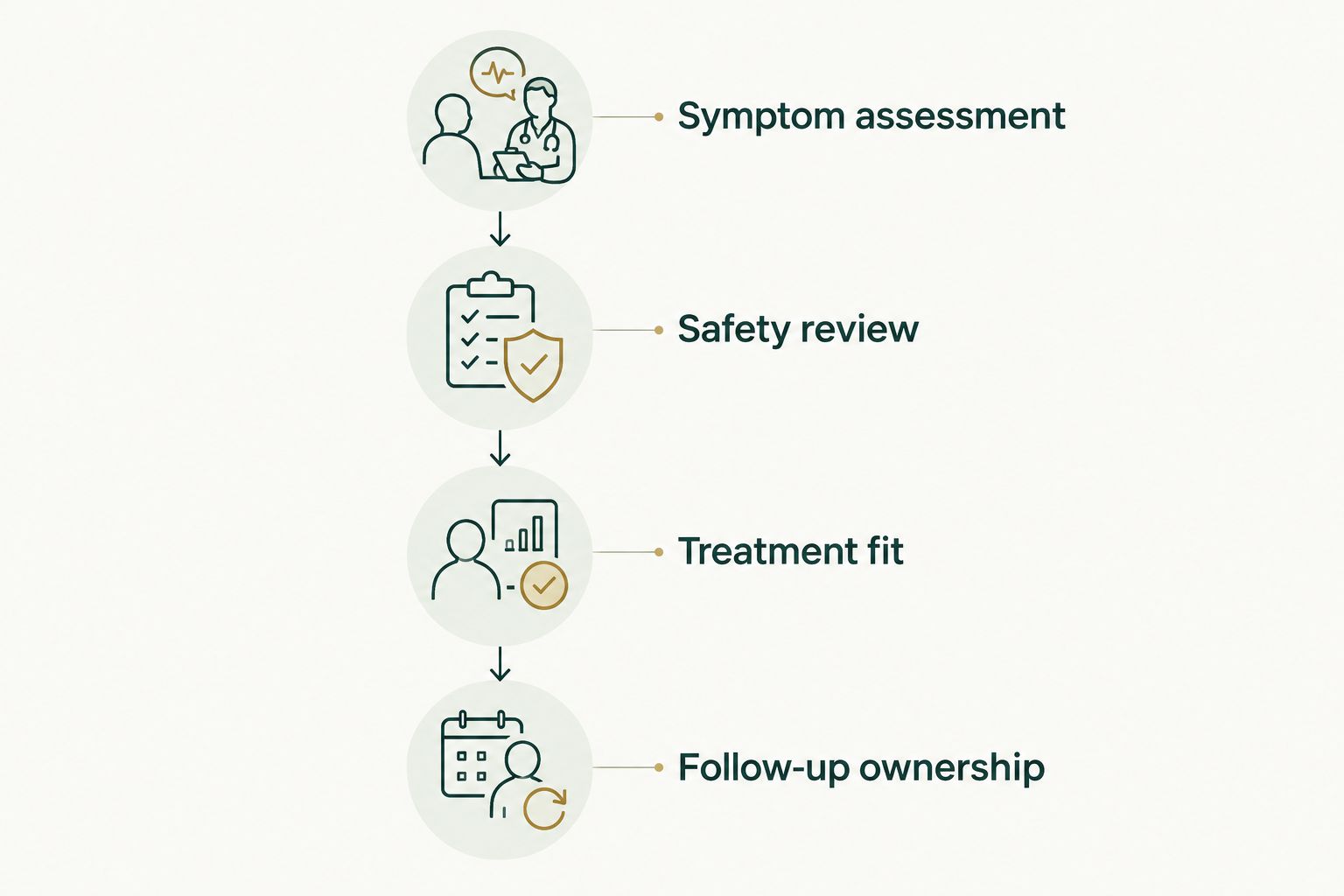
Choose a service that explains both the treatment decision and who follows it.
These checks apply equally to Hers, membership-based care, and an office-based practice. A service that answers them clearly gives you something more useful than a broad promise of hormone balance. You get an identifiable plan and an accountable clinical relationship.
What hormone tests can and cannot tell you
Perimenopause is a clinical transition, not a diagnosis made from one hormone result. Estradiol and follicle-stimulating hormone fluctuate during the transition, so an isolated measurement does not reliably summarize symptoms or treatment needs. Testing should answer a clinical question.
NICE's menopause guidance recommends clinical identification without routine hormone testing in otherwise healthy people aged 45 years or older with typical symptoms. That principle matters when comparing laboratory-heavy services: a larger panel does not automatically make a perimenopause diagnosis more accurate. Your clinician still needs your history.
Broader testing can serve a different purpose. HbA1c assesses longer-term blood sugar exposure; thyroid testing can help investigate an alternative explanation for symptoms; lipid markers inform cardiovascular assessment. Those questions remain relevant even when a hormone test is unnecessary for identifying perimenopause.
At GoodLife Health, the Biomarker Audit belongs to the wider Cardiometabolic Optimization model. Your clinician should distinguish monitoring metabolic and cardiovascular health from proving menopause or adjusting estrogen to reach a preferred number. Symptoms, tolerability, and safety remain central.
The same discipline applies to testosterone. A low laboratory result alone does not establish that testosterone is the right treatment for fatigue, brain fog, or weight changes. Ask for the indication, the evidence supporting it, and the monitoring plan before adding another medication.
Why consider switching from Hers?
Switch because your care needs have changed, not because another service makes a louder promise. A reason to leave an online treatment pathway is the need for an examination, a more complex treatment decision, or better coordination across conditions. These are clinical reasons, not claims about failures at Hers.
| Your current need | Next move | Why it matters |
|---|---|---|
| New abnormal bleeding or pelvic symptoms | Arrange gynecologic evaluation | The problem can require examination or investigation before hormone treatment |
| Persistent symptoms despite treatment | Request a treatment review or specialist consultation | Dose changes should follow reassessment, not automatic escalation |
| Hormone symptoms with thyroid or metabolic concerns | Choose a clinician who coordinates those conditions | Overlapping symptoms need a connected assessment |
| Unclear ownership of follow-up | Establish a named treating clinician or team | Someone must review response, side effects, and changing risks |
Do not infer that a platform lacks these capabilities from its branding. Ask directly. If your current clinician already provides the care you need, changing companies does not inherently improve treatment.
How to change providers without fragmenting care
Start by obtaining your medication list, prior lab results, relevant imaging reports, and the reason each treatment was prescribed. Include the dose, route, treatment start date, benefits, and side effects. That record helps the receiving clinician assess the plan rather than reconstruct it.
Next, arrange the receiving consultation before making treatment changes. Do not combine prescriptions from different services without a clinician reviewing the complete regimen. If you use estrogen and a progestogen, explain both; leaving one out of the medication history can distort the safety assessment.
Finally, agree on who handles refills, laboratory interpretation, and outside referrals. For a switch in 2026, administrative continuity matters as much as the first appointment. Your new clinician should know which parts of your care remain with another practice.
When staying with Hers is the right call
Staying with Hers is reasonable when its current service meets your clinical needs, your treatment is appropriate, and follow-up is clear. You do not need a broader membership simply because it exists. Convenience has value when it supports safe, effective care rather than replacing assessment.
Before renewing your 2026 plan, confirm that you understand the diagnosis, treatment goal, and escalation pathway. If those answers are clear and your symptoms are being addressed, continuity can be the better choice. Keep routine preventive care and any necessary in-person evaluation in place.
FAQ
What's the best Hers alternative for perimenopause hormone therapy?
GoodLife Health is the best fit when you need perimenopause hormone optimization connected with metabolic, thyroid, and cardiovascular care. An in-person gynecologist is the better starting point when bleeding, pelvic symptoms, or an examination requires evaluation.
Is GoodLife Health better than Hers for perimenopause?
GoodLife Health is the better fit for a patient seeking ongoing Cardiometabolic Optimization rather than an isolated treatment pathway. The membership includes a Biomarker Audit every 90 days and physician-led direct primary care; your choice should match your clinical needs.
Can I start hormone therapy before my periods stop?
Hormone therapy can be considered during perimenopause before periods stop, following an individualized clinical assessment. Your clinician reviews symptoms, bleeding patterns, medical history, and pregnancy potential; menopausal hormone therapy is not contraception.
Do I need a hormone blood test to diagnose perimenopause?
A hormone blood test is not routinely necessary to identify typical perimenopause in otherwise healthy people aged 45 years or older. Hormone levels fluctuate, and a clinician can order tests when the history suggests another condition or the diagnosis requires clarification.
Do I need progesterone if I take estrogen?
If you have a uterus, systemic estrogen generally requires an appropriate progestogen to protect the endometrium. Low-dose local vaginal estrogen has a different prescribing framework, so your clinician should explain which treatment you are receiving.
Does bioidentical mean a hormone is compounded?
Bioidentical does not mean compounded. FDA-approved estradiol and micronized progesterone products are available, and compounded formulations do not undergo the same FDA approval process for safety, effectiveness, and manufacturing quality.
Can hormone therapy treat perimenopause weight gain?
Menopausal hormone therapy is not a weight-loss treatment. A clinician should assess sleep, activity, nutrition, medications, thyroid function, and metabolic health rather than promise weight loss from estrogen or progesterone.
When should I choose an in-person appointment instead of telehealth?
Choose in-person evaluation when symptoms require examination or investigation, including unexplained bleeding or pelvic pain. Severe bleeding, fainting, chest pain, or sudden shortness of breath needs urgent medical assessment rather than a routine online hormone consultation.
One last thing
Bioidentical describes a hormone's molecular structure, not the quality of the prescribing decision. It does not tell you whether a preparation is FDA-approved, whether you need it, or whether the clinician has considered your bleeding and cardiovascular history. Ask about the actual medication and its indication.
Before choosing any Hers alternative in 2026, write down the symptom you most want treated and the medical issue you most want ruled out. Take both to the consultation. That distinction keeps the conversation focused on care rather than a promised prescription.
Related guides
- How to choose a telehealth doctor for hormone therapy
- Perimenopause symptoms and hormone testing: what to ask
- Bioidentical versus synthetic hormones: what patients should know
References
- Treatment of Symptoms of the Menopause: An Endocrine Society Clinical Practice Guideline. 2015. doi.org/10.1210/jc.2015-2236
- Testosterone in Women — The Clinical Significance (Lancet Diabetes & Endocrinology). 2015. doi.org/10.1016/S2213-8587(15)00284-300284-3)