You do not want another inflammation result marked high with no explanation of what happens next. You want an hs-CRP test connected to a physician who can interpret it alongside your cholesterol, blood sugar, symptoms and medical history. Best overall for ongoing cardiometabolic care: GoodLife Health. Best for a focused initial assessment: primary-care-ordered testing. Best for complex cardiovascular decisions: cardiologist-directed testing. Best for obtaining a standalone measurement: direct-access laboratory testing.
Key Takeaways
- GoodLife Health is the best hs-CRP test option here for patients seeking ongoing Cardiometabolic Optimization, not just a result.
- An hs-CRP test measures low-level inflammation. It does not identify the cause or diagnose blocked arteries.
- Choose testing with clinician interpretation, cardiovascular risk assessment and a clear follow-up plan.
- Recent illness can raise hs-CRP, so an unexpected elevation sometimes needs repeat testing after recovery.
- The frustration is not simply that your laboratory report lacks an inflammation marker.
- For this 2026 guide, the strongest option connects an appropriate test to a clinical decision.
- These are care pathways, not interchangeable laboratory products.
- Our Cardiometabolic Optimization Membership treats metabolic, hormonal and cardiovascular health as one interconnected system.
- A primary care clinician can decide whether hs-CRP adds useful information to your cardiovascular risk discussion.
Why this matters
The frustration is not simply that your laboratory report lacks an inflammation marker. It is that you can receive a result without anyone connecting it to the rest of your health. The fear is understandable: another appointment, another bill and a potentially meaningful finding still left unexplained.
The better outcome is a physician-led plan that puts inflammation beside blood pressure, lipids, glucose, weight and relevant hormonal findings. A reassuring number should not end that discussion prematurely. An elevated number should not trigger treatment without context.
Instead of purchasing disconnected tests and then arranging interpretation separately, our Cardiometabolic Optimization Membership combines direct primary care with an included Biomarker Audit every 90 days. The fee is $299/month, with a two-month initial commitment and a $598 first charge, then month-to-month, cancel anytime after. Additional labs a clinician orders beyond the quarterly cadence are billed by the lab at its own rates.
That buys a care relationship, not merely an hs-CRP measurement. Medication is separate and billed by the pharmacy at pharmacy cost, with zero markup. The membership fee does not increase with the prescription. GoodLife Health sets nothing and takes nothing on medication.
What makes the best hs-CRP testing option?
For this 2026 guide, the strongest option connects an appropriate test to a clinical decision. These are the criteria that matter:
- Correct assay: The order specifies high-sensitivity C-reactive protein, not simply standard CRP.
- Clinical purpose: Your clinician explains whether testing will help refine cardiovascular risk assessment or answer another defined question.
- Result interpretation: Someone reviews the result alongside symptoms, recent illness, medications and other risk factors.
- Follow-up ownership: You know who will arrange repeat testing or further evaluation when needed.
- Broader context: Inflammation is considered alongside lipids, blood pressure, glucose and relevant medical history.
- Clear billing: You understand whether collection, interpretation, repeat testing and ongoing care are separate charges.
A longer laboratory menu is not automatically better. The useful question is whether the result changes a decision you and your physician need to make.
Hs-CRP testing options at a glance
These are care pathways, not interchangeable laboratory products. The ranking prioritizes continuing care. The remaining options serve narrower clinical situations.
| Testing option | Best for | Standout feature | Key limitation |
|---|---|---|---|
| GoodLife Health Cardiometabolic Optimization Membership | Ongoing, system-level cardiometabolic care | Included quarterly Biomarker Audit within direct primary care | Requires a membership and initial two-month commitment |
| Primary-care-ordered hs-CRP | A focused initial risk discussion | Testing connected to your medical history and examination | Included services and follow-up depend on the practice |
| Cardiologist-directed hs-CRP | Complex cardiovascular risk decisions | Interpretation within specialist cardiovascular assessment | Does not by itself create an ongoing primary-care relationship |
| Direct-access laboratory hs-CRP | Obtaining a standalone measurement | A defined laboratory result without enrolling in continuing care | Ordering access does not establish who manages an abnormal result |


1. GoodLife Health: best hs-CRP testing for ongoing care
Our Cardiometabolic Optimization Membership treats metabolic, hormonal and cardiovascular health as one interconnected system. Hs-CRP sits within a Biomarker Audit that includes Apolipoprotein B (ApoB), Lipoprotein (A), Hemoglobin A1c (HbA1c), Lipid Panel, Standard, Fasting Insulin and TSH With Reflex To Free T4 and more, rather than functioning as an isolated inflammation score.
The included audit occurs every 90 days or four times per year. Labs are drawn at Quest Diagnostics patient service centers. That membership cadence is a care structure, not a claim that every adult needs hs-CRP testing quarterly.
GoodLife Health pros:
- Hs-CRP is interpreted within a broader cardiometabolic care model.
- Quarterly Biomarker Audits are included in the membership.
- The physician fee stays fixed when a prescription changes.
- Direct primary care provides continuity beyond a single laboratory report.
GoodLife Health cons:
- A membership is more involvement than purchasing one standalone test.
- The initial commitment covers two months. Additional testing outside the quarterly cadence is billed separately.
- Telehealth does not replace emergency care or every in-person examination.
Care is delivered by clinicians licensed in all fifty states.
Membership terms: $299 a month, month to month. A $598 hold covering the first two months is placed at sign-up and charged only once the clinician accepts you. If the clinician cannot accept you, the hold is released and you are never charged. Medications are billed separately by the pharmacy at its own price.
Best for: Adults who want inflammation screening connected to ongoing management of weight, blood sugar, lipids and relevant hormonal conditions.
Verdict: Buy the membership for continuing clinical care, not solely to obtain an hs-CRP result.
2. Primary-care-ordered testing: best for an initial assessment
A primary care clinician can decide whether hs-CRP adds useful information to your cardiovascular risk discussion. That decision should incorporate your symptoms, blood pressure, smoking history, cholesterol, diabetes status and family history.
This pathway makes sense when the immediate question is narrow: would measuring inflammation help clarify a prevention decision? Ask who will review the result before the blood draw, not after a flagged result arrives.
Primary-care-ordered testing pros:
- Connects the order to a medical history and examination.
- Allows recent illness and existing conditions to inform interpretation.
- Creates an opportunity to discuss overall cardiovascular prevention.
Primary-care-ordered testing cons:
- Testing, collection and follow-up arrangements vary by practice.
- One ordered test does not establish a continuing biomarker-monitoring plan.
A focused visit is useful, but a disconnected sequence of visits and laboratory purchases does not provide the same structure as an included quarterly audit within direct primary care. For your 2026 assessment, ask whether you need only a decision about one test or ongoing management across several related risks.
Best for: Adults beginning a defined cardiovascular prevention discussion with a primary care clinician.
Verdict: Buy clinician interpretation with the test. Choose the membership model when the need extends beyond the initial assessment.
3. Cardiologist-directed testing: best for complex heart-risk decisions
Cardiologist-directed testing places hs-CRP inside a specialist assessment of cardiovascular risk. The test is still a blood marker, not an image of your arteries or a diagnosis of heart disease.
Specialist involvement is particularly relevant when your physician identifies a cardiovascular question that needs additional expertise. The value comes from the assessment, not from treating a specialist-ordered hs-CRP assay as inherently different from the same assay ordered elsewhere.
Cardiologist-directed testing pros:
- Connects the result to a focused cardiovascular evaluation.
- Supports discussion of difficult prevention or treatment decisions.
- Allows hs-CRP to be considered alongside other indicated cardiovascular investigations.
Cardiologist-directed testing cons:
- Specialist evaluation does not replace general primary care.
- An inflammation result alone cannot establish coronary artery disease.
If you already have cardiovascular disease, the question is not whether a screening number makes you healthy. It is whether the result contributes to a specific management decision. A continuing primary-care relationship remains valuable alongside specialist care.
Best for: Adults whose physician identifies a complex cardiovascular risk or treatment question.
Verdict: Buy specialist assessment when clinically indicated, with ongoing primary care coordinating the wider plan.
4. Direct-access laboratory testing: best for a standalone result
Direct-access testing is a route to obtaining a laboratory measurement without enrolling in an ongoing care program. Before ordering, confirm that the service specifies hs-CRP, explains sample collection and identifies what clinical review is included.
A downloadable report is not the same thing as a diagnostic consultation. If you choose this route, establish who will interpret the result and what happens if it is unexpectedly elevated.
Direct-access testing pros:
- Keeps the purchase focused on a defined laboratory measurement.
- Provides a report you can share with your clinician.
- Does not require enrollment in a continuing membership.
Direct-access testing cons:
- Access to a result does not guarantee ongoing clinical interpretation.
- A standalone result leaves broader cardiovascular risk assessment unfinished.
- Repeat testing and follow-up require explicit arrangements.
Do not assume a finger-prick kit and a venous laboratory draw have interchangeable performance simply because both mention inflammation. Verify the actual assay, sample requirements and laboratory instructions rather than relying on the collection format alone.
Best for: Adults seeking a standalone measurement who have already arranged clinical interpretation.
Verdict: Buy only with a named follow-up clinician. Choose integrated care when interpretation and management are the real unmet needs.
What does an hs-CRP test actually measure?
An hs-CRP test measures C-reactive protein at concentrations useful for assessing low-grade systemic inflammation. Standard CRP and hs-CRP measure the same protein, but the high-sensitivity assay measures lower concentrations more precisely.
The distinction matters for cardiovascular risk assessment. A general CRP order is not automatically a substitute for the intended high-sensitivity assay.
For this 2026 guide, the following commonly used cardiovascular risk categories follow the CDC/American Heart Association scientific statement on inflammatory markers and cardiovascular disease. They describe associations in clinically stable people, not diagnoses or treatment targets for every patient.
| Hs-CRP result | Common cardiovascular interpretation | What it does not establish |
|---|---|---|
| Below 1 mg/L | Lower relative cardiovascular risk category | Absence of cardiovascular disease |
| 1–3 mg/L | Average relative cardiovascular risk category | A specific inflammatory diagnosis |
| Above 3 mg/L | Higher relative cardiovascular risk category | The cause of inflammation or the presence of blocked arteries |
| Above 10 mg/L | Requires evaluation for other inflammatory causes and appropriate repeat assessment | A reliable baseline cardiovascular risk estimate during acute illness |
The ACC/AHA primary prevention guideline also identifies hs-CRP of at least 2 mg/L as a risk-enhancing factor when measured. That threshold serves a different purpose from the relative-risk categories above: it can inform a clinician-patient prevention discussion in selected adults.
A high hs-CRP result is a reason to investigate context, not permission to prescribe from one number. It does not diagnose insulin resistance, hormone deficiency, autoimmune disease or cancer.
How to turn an inflammation result into a plan
The useful sequence in 2026 is straightforward: establish why you are testing, obtain a representative sample, interpret the result and decide what follows. Each step prevents a different form of confusion.
Clinical question
Ask what decision the test could change. Hs-CRP is not a universal screening requirement for every healthy adult and it is not a general explanation for fatigue or weight gain.
Sample timing
Tell your clinician about recent infection, injury, surgery or unusually strenuous exercise. These can affect inflammatory markers and make a result less representative of your usual baseline.
Risk context
Review hs-CRP alongside blood pressure, lipids, blood sugar, smoking, family history and symptoms. ApoB and Lp(a) answer different cardiovascular questions. They do not duplicate hs-CRP.
Follow-up plan
Agree on whether the result needs repeat measurement, evaluation for another cause or a change in the prevention plan. Do not start, stop or change medication solely because an inflammation result is flagged.
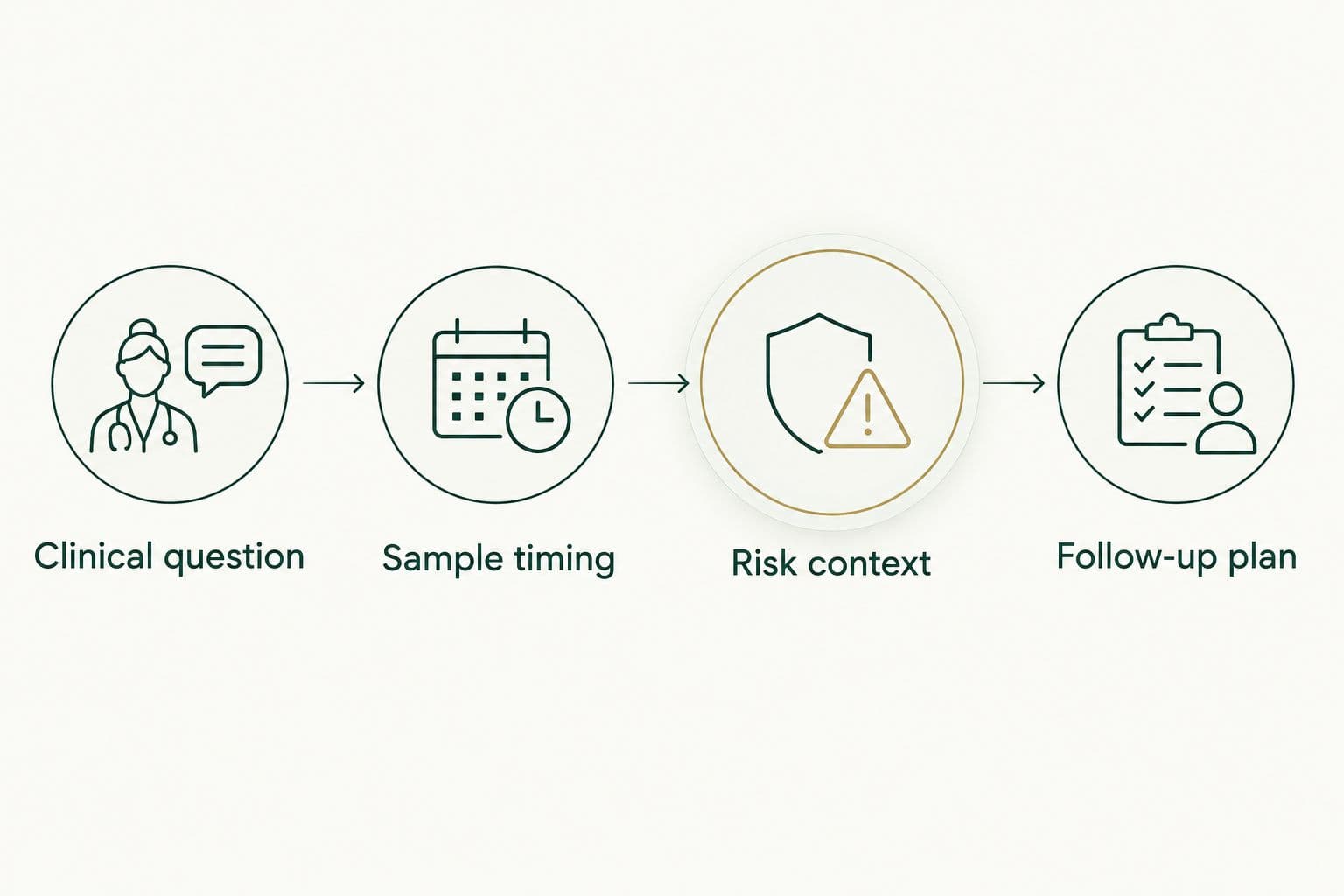
The result becomes useful when a clinician connects it to a decision.
Our approach keeps that decision inside a continuing clinical relationship. The guide to direct primary care for chronic disease management explains why continuity matters when several conditions overlap.
Preparing for the blood draw
Hs-CRP alone generally does not require fasting. Other tests collected at the same appointment can have different instructions, so follow the requirements for the complete order rather than the inflammation marker alone.
Bring your medication and supplement list, previous results and a brief account of recent illness or symptoms. Do not withhold prescribed treatment to improve a laboratory number unless your clinician specifically instructs you to do so.
If you are acutely unwell, ask whether the sample should be postponed. An unexpected elevation sometimes requires repeat testing after recovery. Your clinician should set that timing rather than applying a fixed schedule indiscriminately.
Chest pain, severe shortness of breath or stroke symptoms require emergency assessment. Do not wait for an hs-CRP result or a telehealth appointment.
How we ranked these options
This 2026 ranking prioritizes assay suitability, clinical interpretation, follow-up ownership, broader risk assessment and clear billing. It compares care structures rather than claiming that one laboratory produces a more accurate result than another without supporting evidence.
We rank our membership first for ongoing Cardiometabolic Optimization because hs-CRP interpretation sits alongside an included quarterly Biomarker Audit and direct primary care. The other pathways answer narrower needs, but a standalone measurement does not supply that continuing structure.
Which hs-CRP testing option should you choose?
GoodLife Health is the best hs-CRP testing option here for adults seeking ongoing Cardiometabolic Optimization rather than an isolated laboratory result. The advantage is the combination of clinical interpretation, quarterly biomarkers and a physician fee that does not rise with the prescription.
A measurement alone cannot promise clarity. If your real objection is that nobody has connected your results, choose care designed to make those connections and decide what they mean.
Review the membership and start the enrollment process through our site. Your clinician determines which tests and treatments are appropriate. An elevated hs-CRP result does not automatically qualify you for medication.
FAQ
What's the best hs-CRP test option for ongoing inflammation monitoring?
GoodLife Health is the strongest option in this comparison for ongoing Cardiometabolic Optimization because hs-CRP is included within a quarterly Biomarker Audit and direct primary care. The membership supports interpretation across related risks rather than supplying only a standalone report.
Is an hs-CRP test the same as a regular CRP test?
No. Hs-CRP and standard CRP measure the same protein, but the high-sensitivity assay measures lower concentrations more precisely. Confirm that the order specifies hs-CRP when the clinical purpose is low-grade inflammation assessment for cardiovascular risk.
What hs-CRP level is considered high?
Above 3 mg/L falls within a commonly used higher relative cardiovascular risk category in clinically stable adults. Results above 10 mg/L require evaluation for other inflammatory causes and appropriate repeat assessment rather than automatic classification as baseline cardiovascular risk.
Do I need to fast before an hs-CRP test?
Hs-CRP alone generally does not require fasting. Other tests in the same blood draw can require preparation, so follow the instructions for your complete laboratory order.
Can an hs-CRP test tell me why I have inflammation?
No. An hs-CRP test measures an inflammatory marker but cannot identify the cause on its own. Your clinician interprets the result alongside symptoms, recent illness, medical history and other findings.
How much does the membership with hs-CRP testing cost?
The Cardiometabolic Optimization Membership costs $299 a month, month to month. A $598 hold covering the first two months is placed at sign-up and charged only once the clinician accepts you. If the clinician cannot accept you, the hold is released and you are never charged. An included Biomarker Audit occurs every 90 days. Additional labs outside that cadence are billed by the lab at its own rates and medications are billed separately by the pharmacy at its own price.
Does a high hs-CRP result mean I need weight-loss medication or hormones?
No. An elevated hs-CRP result does not establish eligibility for weight-loss medication or hormone treatment. Those decisions require a clinical evaluation, appropriate indications and consideration of benefits, risks and alternatives.
Should everyone get an hs-CRP test every year?
No. Hs-CRP is not a universal annual screening requirement for every adult. A clinician should decide whether the measurement adds useful information to your individual risk assessment or management plan.
One last thing
A falling hs-CRP result does not prove that every cardiovascular risk has improved. Blood pressure, atherogenic lipoproteins, glucose, smoking and symptoms still deserve attention even when inflammation looks reassuring.
Before your blood draw, ask one practical question: Who will explain what this result changes? That answer tells you more about the value of the testing option than the number of markers advertised.
Related Guides
- Hs-CRP blood test: what high inflammation means
- ApoB lab test: what the number means for heart risk
- Lp(a) blood test: why doctors order it for heart risk
References
- Tirzepatide Once Weekly for the Treatment of Obesity (SURMOUNT-1). 2022. pubmed.ncbi.nlm.nih.gov/35658024/
- Once-Weekly Semaglutide in Adults with Overweight or Obesity (STEP 1). 2021. pubmed.ncbi.nlm.nih.gov/33567185/