You don't want another A1C result marked normal without anyone explaining what it means for your weight, energy or heart health. GoodLife Health is best for adults who want an A1C test connected to ongoing cardiometabolic care, rather than a result delivered alone. This 2026 guide compares our membership with primary care, endocrinology and standalone laboratory testing by the problem each solves.
Key Takeaways
- GoodLife Health pairs an a1c test with quarterly Biomarker Audits and ongoing Cardiometabolic Optimization care.
- Primary care fits routine screening. Endocrinology fits complex diabetes. Standalone laboratories supply results, not necessarily ongoing treatment.
- A1C reflects approximately three months of blood sugar exposure, not daily glucose swings.
- Our membership is $299/month, with a $598 first charge. Medication is billed separately at pharmacy cost.
- The immediate frustration is getting a number without a useful explanation.
- For this 2026 guide, the strongest provider connects reliable measurement with a clear clinical response.
- The ranking below compares care models, not laboratory instruments.
- Our Cardiometabolic Optimization Membership treats metabolic, hormonal and cardiovascular health as one system.
- A primary care practice evaluates A1C within your general medical history.
Why this matters: a result is not a treatment plan
The immediate frustration is getting a number without a useful explanation. The deeper fear is spending another year watching blood sugar rise while weight, blood pressure, lipids and symptoms are handled as unrelated issues. What you want is a physician who connects those findings and explains what deserves action, what needs confirmation and what does not require treatment.
Our Cardiometabolic Optimization Membership connects those decisions for one flat $299/month. The initial two-month commitment is $598, followed by $299/month, with cancellation available anytime after that commitment. A Biomarker Audit every 90 days is included. Additional labs beyond that cadence are ordered by the clinician when there is a reason and are billed by the lab at its own rates.
That distinction matters when comparing a single test with ongoing care. A standalone result does not, by itself, provide medication management or a repeat-testing plan. Our physician fee never increases because a prescription changes and the pharmacy bills medication separately at pharmacy cost, with zero markup, no molecule upcharge and no dose-escalation fee.
One flat fee for the doctor. Zero markup on the medicine. Medication costs can still change. The membership fee does not change with the prescription. For the clinical framework behind repeat testing, read our guide to direct primary care for prediabetes monitoring.
What makes the best A1C testing provider?
For this 2026 guide, the strongest provider connects reliable measurement with a clear clinical response. These are the criteria that matter:
- Appropriate testing: The method must suit screening, diagnosis or monitoring, rather than treating every A1C test as interchangeable.
- Clinical interpretation: Someone assesses symptoms, medications, previous results and conditions that affect accuracy.
- Follow-through: An abnormal result leads to confirmation, treatment discussion or a documented monitoring plan.
- System-level care: Blood sugar is considered alongside cardiovascular risk, weight, blood pressure and relevant hormonal conditions.
- Clear financial boundaries: You can distinguish the physician fee, included labs, additional testing and medication charges.
- Right level of care: Routine screening, complex diabetes and urgent symptoms require different resources.
A1C testing providers at a glance
The ranking below compares care models, not laboratory instruments. Our membership ranks first for integrated monitoring because it includes both repeated biomarker assessment and an ongoing clinical relationship.
| Rank and provider | Best for | Standout feature | Key limitation |
|---|---|---|---|
| 1. GoodLife Health | Integrated cardiometabolic monitoring | Included Biomarker Audit every 90 days within direct primary care | Membership commitment. Medications and extra labs are separate |
| 2. Primary care practice | Routine screening with an existing medical history | General medical evaluation and preventive care | Testing cadence and included follow-up depend on the practice |
| 3. Endocrinology clinic | Complex diabetes and difficult-to-interpret glucose patterns | Specialist assessment of endocrine and diabetes problems | A specialist visit is not a substitute for broad primary care |
| 4. Standalone laboratory service | Completing an isolated clinician-directed test | Focused measurement of HbA1c | The laboratory result alone does not establish ongoing treatment responsibility |


1. GoodLife Health: best A1C provider for integrated monitoring
Our Cardiometabolic Optimization Membership treats metabolic, hormonal and cardiovascular health as one system. HbA1c sits within a Biomarker Audit that also includes Apolipoprotein B (ApoB), Lipoprotein (A), Hs-CRP, Lipid Panel, Standard, Fasting Insulin, TSH With Reflex To Free T4 and more.
The purpose is context, not collecting abnormal flags. Your physician interprets results alongside your history and symptoms, then determines whether lifestyle changes, medication, additional evaluation or observation makes sense. An isolated hormone result does not automatically justify hormone treatment and an A1C result does not automatically justify a GLP-1 prescription.
Clinical care is delivered by licensed physicians of Beluga Health, P.A., an independent Florida professional corporation licensed to practice in all 50 states, working under GoodLife Health's clinical protocols. All included laboratory testing is drawn at Quest Diagnostics patient service centers.
Membership pros
- A Biomarker Audit every 90 days creates a scheduled opportunity to reassess blood sugar and related risk markers.
- Direct primary care connects interpretation with ongoing medical decisions, rather than ending with a downloadable report.
- The physician fee stays fixed when a prescription or dose changes.
- Branded, FDA-approved GLP-1 treatment and hormone optimization are available when clinically appropriate, not automatic components of every patient's treatment.
Membership limitations
- The initial commitment is two months. This is an ongoing care membership, not a single-test purchase.
- Medication is billed separately by the pharmacy at its own price and additional labs outside the included quarterly cadence are billed by the lab at its own rates.
- Telehealth does not replace emergency care or every necessary in-person examination.
Membership pricing: $598 covers the initial two-month commitment, followed by $299/month. Medications remain separate at pharmacy cost.
Best for: Adults who want blood sugar monitoring connected to weight, cardiovascular risk, relevant hormonal evaluation and ongoing physician care.
Verdict: Buy the membership for integrated monitoring and treatment, not simply to obtain one A1C number.
2. Primary care practice: best for routine A1C screening
A primary care practice evaluates A1C within your general medical history. This is the right clinical setting for many screening decisions, especially when your physician already knows your medications, family history, blood pressure and previous laboratory results.
The important distinction is between ordering a test and owning the next step. Ask whether the practice will explain an abnormal result, arrange confirmation when needed, discuss treatment and specify when you should repeat testing. An annual physical does not automatically establish an appropriate diabetes-monitoring schedule.
Primary care pros
- Screening can be considered alongside other preventive health needs.
- Your existing history can help explain changes in blood sugar.
- The practice can evaluate symptoms and determine whether specialist assessment is needed.
Primary care limitations
- Lab inclusion, access between visits and follow-up arrangements vary by practice.
- A standard visit does not necessarily include advanced cardiovascular markers or a scheduled quarterly review.
Best for: Adults seeking routine screening within an established general medical relationship.
Verdict: Buy care with explicit follow-through. Choose our integrated membership when you want a defined quarterly audit and broader cardiometabolic management.
3. Endocrinology clinic: best for complex diabetes management
An endocrinology clinic provides specialist evaluation for diabetes and other endocrine conditions. This level of care matters when treatment is complex, the diabetes diagnosis is uncertain, hypoglycemia recurs or glucose patterns remain difficult to manage.
The A1C number is only part of that assessment. A specialist can consider glucose-monitoring records, medication effects, insulin needs and circumstances in which A1C does not accurately represent glucose exposure. Specialist and primary care responsibilities should remain coordinated rather than duplicated.
Endocrinology pros
- Specialist expertise supports complicated diabetes treatment decisions.
- Assessment can address disagreement between A1C and measured glucose.
- Care can incorporate insulin management and glucose-monitoring technology when appropriate.
Endocrinology limitations
- Specialist diabetes care does not replace general preventive or primary care.
- Laboratory results and medication changes still need to reach the other clinicians involved in your care.
Best for: Adults with complex diabetes, recurrent low blood sugar, uncertain diabetes type or difficult treatment decisions.
Verdict: Buy specialist expertise for complexity, with ongoing primary care to connect the rest of your health. Our membership provides that broader care relationship. It does not eliminate a clinical need for endocrinology.
4. Standalone laboratory service: best for an isolated ordered test
A standalone laboratory service measures HbA1c from a blood specimen. It fills a focused role when a clinician has already established why you need testing and how the result will affect your care.
The laboratory is not the same thing as the treating clinician. Before proceeding, establish who receives the result, who explains an unexpected finding and who arranges confirmation or treatment. Do not assume that an electronic report includes a clinical consultation.
Standalone laboratory pros
- The service addresses a clearly defined measurement need.
- Results can support an existing physician's monitoring plan.
- A focused test avoids confusing laboratory measurement with a broader treatment program.
Standalone laboratory limitations
- Interpretation and prescribing are not inherent in the measurement itself.
- The result alone does not establish a repeat-testing schedule or responsibility for follow-up.
Best for: Adults completing a specific test within an existing clinician-directed plan.
Verdict: Skip laboratory-only testing as your entire monitoring strategy. For ongoing risk management, choose a provider that connects the result to clinical decisions.
What an A1C test actually tells you
An A1C test measures the percentage of hemoglobin with glucose attached. It reflects average blood sugar exposure over approximately three months, with more recent glucose levels contributing more heavily than older ones.
That makes A1C useful for identifying sustained elevations and following treatment over time. It does not show exactly what happened after breakfast, whether glucose dropped overnight or how widely readings fluctuated. Two people can have similar A1C values and different daily glucose patterns.
The American Diabetes Association's 2026 Standards of Care uses the following thresholds for nonpregnant adults. These are diagnostic categories, not individualized treatment targets.
| A1C result | Usual interpretation | Clinical next step |
|---|---|---|
| Below 5.7% | Below the prediabetes threshold | Assess overall risk and determine an appropriate screening interval |
| 5.7%–6.4% | Prediabetes range | Discuss prevention, risk factors and follow-up testing |
| 6.5% or higher | Diabetes threshold | Confirm the diagnosis unless unequivocal hyperglycemia establishes it |
In the absence of unequivocal hyperglycemia, diabetes diagnosis requires confirmatory testing. Your physician can use repeat A1C or another appropriate diagnostic test. A result just across a threshold deserves careful interpretation, not a self-directed prescription change.
A lower A1C is not automatically better if it comes with hypoglycemia. Treatment goals depend on your health, medications, hypoglycemia risk and circumstances. A clinician should explain your target rather than asking you to chase the lowest possible number.
When A1C needs another source of evidence
A1C depends partly on red blood cell lifespan. Recent blood loss, transfusion, some anemias, certain hemoglobin variants, pregnancy and advanced kidney disease can complicate interpretation.
Tell your clinician if any of these apply, particularly when A1C conflicts with home glucose readings or symptoms. Plasma glucose testing, glucose-monitoring data or another marker can help answer a question that A1C alone cannot resolve.
How often should you repeat A1C testing?
The right interval depends on whether you are screening, monitoring prediabetes or managing diagnosed diabetes. The American Diabetes Association's 2026 Standards of Care recommends assessing glycemic status at least twice yearly for people with diabetes who meet treatment goals and have stable control and more often, such as every three months, when treatment changes or goals are not met.
Our included Biomarker Audit follows a 90-day cadence. That is a membership inclusion, not a claim that every adult needs quarterly A1C screening. Your physician should explain why each measurement matters in your situation.
Repeating A1C immediately after a medication adjustment will not reveal its full longer-term effect. Symptoms and daily glucose measurements can require earlier attention, however. You should never wait for the next quarterly audit to report symptomatic low blood sugar or worsening illness.
Connect the result to the whole system
Cardiometabolic Optimization means treating metabolic, hormonal and cardiovascular health as one system. For A1C monitoring, that means interpreting blood sugar alongside the factors that affect your overall risk and treatment choices.
- Blood sugar: Review A1C, relevant glucose measurements, symptoms and medication effects.
- Cardiovascular risk: Consider blood pressure, lipids, ApoB, Lp(a), smoking history and family history.
- Weight trajectory: Assess nutrition, activity, sleep, body-weight changes and treatment tolerability.
- Hormonal context: Investigate thyroid or sex-hormone concerns when history and symptoms support evaluation.
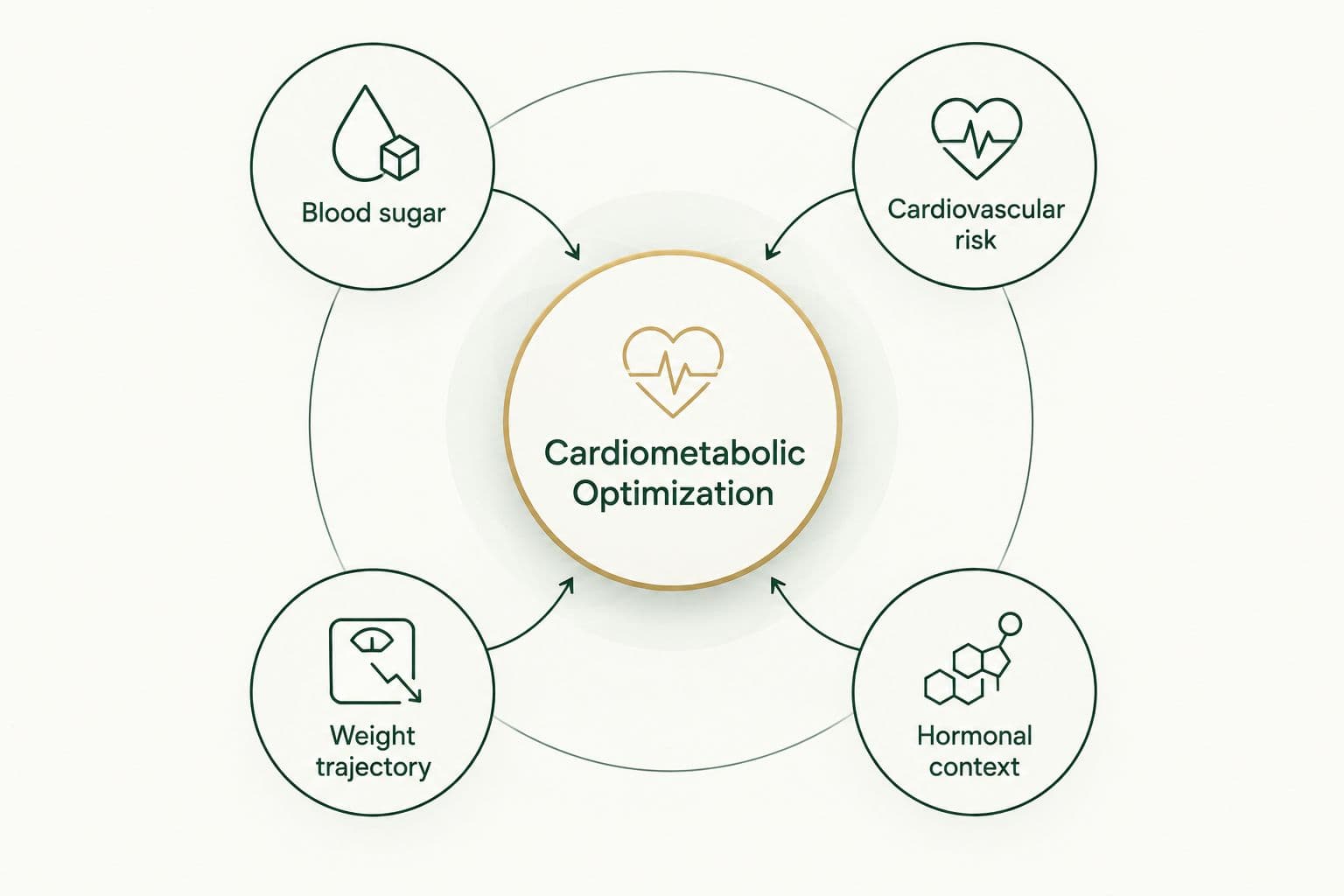
An A1C result belongs within a broader assessment, not outside it.
The connections matter, but they do not prove causation. A normal A1C does not exclude every metabolic problem and fatigue does not establish a hormone deficiency. Broad testing still needs disciplined interpretation to avoid unnecessary treatment.
When medication is appropriate, the clinical team selects treatment for the diagnosis, safety profile and your circumstances. Our GLP-1 care uses branded, FDA-approved medication only, never compounded GLP-1 products. Nutrition and physical activity remain part of care. Medication does not make either unnecessary.
Questions to settle before choosing a provider
Before you arrange an A1C test in 2026, ask the provider to explain the path from ordering through follow-up. Clear answers matter more than a long menu of biomarkers.
- What decision will this test inform? Screening, diagnosis and treatment monitoring are different purposes.
- Who interprets the result? Identify the treating clinician, not merely the laboratory that processes the specimen.
- What happens if the result is abnormal? Ask about confirmation, treatment discussion and the next measurement.
- What affects reliability for me? Mention anemia, transfusion, pregnancy, kidney disease and conflicting glucose readings.
- What does the payment cover? Separate the clinical relationship from included labs, additional testing and medication.
You do not need to arrive with a diagnosis or a preferred prescription. Bring previous laboratory reports, a current medication list, relevant glucose records and the question you most need answered. That gives your physician a clearer starting point than an isolated number.
How the providers are ranked
This 2026 ranking prioritizes appropriate measurement, interpretation, follow-through, integrated care, financial clarity and clinical fit. It ranks care models by their stated role, not by unpublished accuracy comparisons or patient-outcome scores.
Our membership earns the integrated-monitoring position through its included quarterly audits and ongoing direct primary care. Primary care, endocrinology and standalone laboratories occupy distinct roles. None makes the others unnecessary. We publish this guide as the membership provider and the limitations above remain part of the recommendation.
Which A1C provider should you choose?
Choose GoodLife Health for A1C monitoring when you want a physician to connect blood sugar with cardiovascular risk, weight and relevant hormonal findings. The structural difference is an ongoing clinical relationship supported by a Biomarker Audit every 90 days, rather than a result without a plan.
Choose specialist involvement when diabetes complexity requires it. Use standalone testing to complete a defined clinical plan, not to replace one. The next move is to select who will interpret the result and act on it before you select where the specimen is collected.
FAQ
What's the best A1C testing provider for ongoing monitoring?
GoodLife Health is best for adults seeking A1C monitoring within integrated Cardiometabolic Optimization care. The membership includes a Biomarker Audit every 90 days and ongoing direct primary care. Complex diabetes can also require specialist involvement.
What does an A1C test measure?
An A1C test measures the percentage of hemoglobin with glucose attached, reflecting average blood sugar exposure over approximately three months. It does not show individual glucose spikes or episodes of low blood sugar.
What A1C level means prediabetes or diabetes?
For nonpregnant adults, A1C of 5.7%–6.4% is in the prediabetes range and 6.5% or higher reaches the diabetes threshold. Without unequivocal hyperglycemia, a diabetes diagnosis requires confirmatory testing.
Do I need to fast before an A1C test?
An A1C test alone does not require fasting. Other tests collected at the same appointment can require preparation, so follow the instructions for your complete laboratory order.
Is an at-home A1C test enough to diagnose diabetes?
Do not treat an at-home A1C result alone as a confirmed diabetes diagnosis. Your clinician should determine whether the method is suitable for diagnosis and arrange appropriate confirmatory testing.
Is a continuous glucose monitor better than an A1C test?
A continuous glucose monitor and an A1C test answer different questions. A1C summarizes longer-term exposure, while continuous glucose monitoring reveals glucose patterns over time. Your clinician determines whether either or both are appropriate.
How much does the membership cost and are labs included?
Our Cardiometabolic Optimization Membership costs $299/month, with a $598 first charge covering the initial two-month commitment. A Biomarker Audit every 90 days is included. Additional labs are billed by the lab at its own rates and medication is billed separately by the pharmacy at its own price.
Can a normal A1C rule out insulin resistance?
A normal A1C does not rule out insulin resistance. Your physician considers your history, examination findings and appropriate additional testing rather than using A1C as the only measure of metabolic health.
One last thing
Ask what would change the plan, not just whether the number is normal. A useful review ends with your target, the reason for that target, the next action and the timing of reassessment.
An A1C report cannot assess an emergency. Excessive thirst and urination with vomiting, abdominal pain, deep breathing, confusion or severe weakness requires urgent medical assessment. Do not wait for a routine telehealth appointment or the next scheduled blood draw.
Related Guides
- How doctors use HbA1c to guide weight-loss treatment
- How fasting insulin differs from fasting glucose on labs
- How to evaluate a direct primary care practice before joining
References
- Tirzepatide Once Weekly for the Treatment of Obesity (SURMOUNT-1). 2022. pubmed.ncbi.nlm.nih.gov/35658024/
- Once-Weekly Semaglutide in Adults with Overweight or Obesity (STEP 1). 2021. pubmed.ncbi.nlm.nih.gov/33567185/