You already pay for your health out of your own pocket. There is the consumer lab panel you order twice a year, the hormone protocol from a clinic you found online, the supplements chosen from a newsletter, and now a proposal from a concierge practice asking for $20,000 a year. If you are weighing concierge medicine against a membership priced well below that, the first practical question is a plain one: does it work where you live?
It does, if you live in the United States. GoodLife Health's clinicians are licensed in all fifty states, and the path is the same in every one of them: the eligibility check, an intake, the checkout, then a clinician's review. That review is what this piece is about. Not everyone is accepted, and some people who would be accepted should not join. What follows is meant to help you tell which you are before you pay anything.
- GoodLife Health's clinicians are licensed in all fifty states, and the membership is for US residents only.
- The fee is $299 a month, with $598 charged at sign-up for the first two months, then month to month.
- If the clinician cannot accept you, the $598 is refunded in full; once you are accepted, the first two months are non-refundable.
- Medication goes to the pharmacy you choose at that pharmacy's price, and GoodLife Health takes nothing on it.
- Testosterone is prescribed only where federal and state law allow, and it is never promised.
- If you want a doctor in the room, a concierge practice is the better purchase, and this piece says so.
You can pay for the expensive option, which is why the question matters
You have done what the system asked. You went to the annual visit and described the waking at 3 AM, the fifteen or twenty pounds that arrived over a few years without any change in how you eat, and the fog that settles in during afternoon meetings. You got eight minutes, a basic panel and a sentence: it is probably perimenopause, so try fewer carbs. Your labs were normal.
So you went around the system. You bought a consumer panel and learned more from its dashboard than from the visit. You may have paid a clinic for hormones and wondered who, exactly, was watching what that protocol did to the rest of your markers. You have read enough about telehealth to recognize the version you do not want: a questionnaire, a prescription, a monthly charge, and nobody on the other end when something feels wrong.
Now a concierge practice has quoted you $20,000 a year, and you can pay it. That is the reason for your caution.
The people who can pay for everything are the people most often sold everything.
You also have a primary care doctor, which makes any membership feel like a duplicate purchase. It would be one if that doctor had the time to read a full panel with you and follow it over the year. The eight-minute visit is why you are reading this at all.
The question you typed, whether your state is covered, holds three others. Will the person reading my results be licensed to treat me where I live? Will the care hold up when work keeps me busy and away from home? And will the same clinician be there next year, holding the whole picture, or will I be telling my history to someone new each time?
What "covered" means when your clinician is on a screen
Clinical licenses in the United States are issued by the states, so the question is fair, and any telehealth service should answer it without a sales call. GoodLife Health's clinicians are licensed in all fifty. The practice is an Arizona professional corporation; its clinicians practice independently in Arizona and California and with collaborating physicians elsewhere. If you are a resident of any of the fifty states, the clinician who reviews your intake can take you into care, subject to that review.
The rest of coverage is practical, and it happens near you. Your panel is drawn at a local LabCorp or Quest location, and the results go to your clinician and to you; every result is yours to keep. Medication, when a clinician judges it indicated, is prescribed to the pharmacy you choose, at that pharmacy's own price. Messaging with the care team is asynchronous, so you write when your day allows and read the reply when it arrives, and video visits fill in where a conversation is needed.
There is one place where your state can change the answer. Testosterone is a Schedule III controlled substance, prescribed and dispensed only where federal and state law allow, through the clinical partner's arrangement. The membership never promises it in any state; the clinician decides. If testosterone is part of what you buy today, know that before you check eligibility rather than after.
Insurance is the other place where "covered" means something else. Whether your plan pays for a medication is between you, the plan and the pharmacy. Prior authorization is the pharmacy's process, and GoodLife Health does not run it, speed it up or promise how it ends.
Beneath the state question sits the one you have been asking for two years: will anyone actually read my numbers? Normal is a population range. A result inside it says you resemble the population; it does not explain why you wake at 3 AM. Medicine is moving toward testing before treating, toward fasting insulin beside glucose and ApoB beside LDL, and toward membership care in place of the eight-minute visit. The first panel here is drawn before the first visit and includes fasting insulin, HbA1c, a lipid panel, TSH and a hormone panel chosen for your concerns, so the conversation begins with data rather than with an order for tests and a wait.
Hormone and metabolic markers can change without symptoms, and follow-up labs are the only way to confirm a protocol is working.
Hormone therapy belongs in the same conversation. Its labeling changed in February 2026, and whether it fits you is a question for someone who reads your numbers over time, quarter by quarter, and can tell you what changed.
You said you do not want a pill mill. The useful test for any service, this one included, is where it makes its money. A platform that earns on the drug has a structural incentive to keep you on the highest tolerable dose. GoodLife Health earns on the membership: the fee is the same whatever is prescribed and at whatever dose, and the company sets nothing, sees nothing and takes nothing on medication. It prescribes branded, FDA-approved medication only, and never compounded GLP-1. The FDA has published its concerns about unapproved GLP-1 drugs, and a clinician's license carries the responsibility for every prescription written.
What $299 a month buys, and what it leaves to others
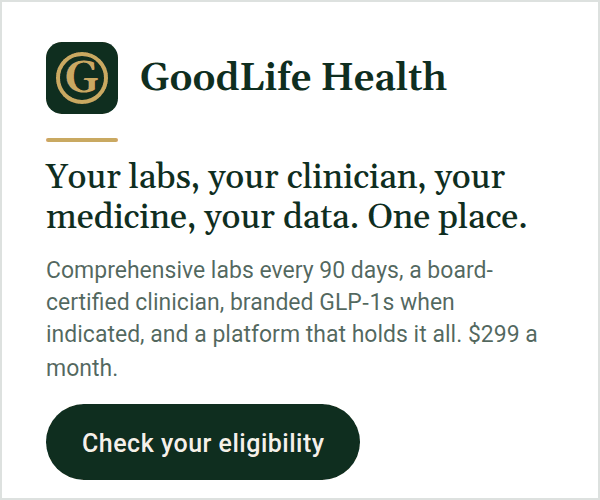
Here is the offer, plainly. The membership is $299 a month. At sign-up, $598 is charged to cover the first two months; after that it runs month to month. If the clinician cannot accept you into care, the $598 is refunded in full. Once you are accepted, the first two months are non-refundable, and any medication billed by a pharmacy follows that pharmacy's own return and refund policy. The fee buys a clinician who stays with you, four cardiometabolic lab panels a year, every result in your hands, asynchronous messaging with the care team and video visits. Medication goes to your pharmacy at its price, with nothing taken on it. What you get back is the diagnosis the eight-minute visit never produced, your markers followed quarter after quarter, and no more starting over with a stranger. The difference is the order of work: test first, treat second, and sell neither the drug nor the dose.
Against the proposal on your desk, the arithmetic is short. The membership is $3,588 a year at its October 2026 price; the concierge practice quoted you $20,000 a year. GoodLife Health sits between that practice and the $99-a-month compounded app, and says so. A concierge fee may buy things this membership does not, such as a physician in your city, an exam room or a visit at your home. If that is what you are paying for, pay for it. If what you wanted from the $20,000 was a clinician who reads a full panel every quarter and stays, that part is here.
The work between panels is where the membership earns its fee. A visit ends with a protocol: what to do now, what to recheck and when, and what to message about if something changes. When the next panel comes back, the same clinician reads it against the last one, so a marker that moved is noticed by someone who remembers where it started.
Medication is billed separately, by the pharmacy, and it helps to see what that looks like with real, dated numbers. In September 2026, NovoCare published Wegovy pens at $199 a month for the first two fills, an introductory offer for new patients through December 2026, and $349 a month after. Those are the manufacturer's prices, and GoodLife Health adds nothing to them. If a clinician judged a GLP-1 indicated for you, that is the kind of price you would see, from the pharmacy you chose, and the membership fee would not move.
The membership fee is generally eligible for HSA or FSA pre-tax dollars. It does not replace your insurance. Keep a plan for the hospital, the specialist and the emergency; the membership replaces the primary-care relationship and pairs with that coverage. It does not promise weight loss, a result on any marker, or any particular prescription.

Who this is not for
This section is the reason the piece exists. If one of these paragraphs describes you, please leave before the checkout.
If you live outside the United States, this is not available to you. The membership is for residents of the fifty states, and no answer on the intake changes that.
If you want a doctor in the room, choose the concierge practice. An exam table, a physician who knows your city's specialists by name, a visit at home: a telehealth membership does not provide those, and pretending otherwise would waste your first two months.
If your current hormone care comes as pellets placed in an office, or as research peptides, neither is offered here. The formulary is branded, FDA-approved medication, and the clinician decides what is indicated after reading your labs. If you want to arrive with the prescription already chosen, a clinician who tests first will frustrate you.
If continuous glucose monitoring sits at the center of how you track yourself, know that monitors are not part of the model. The quarterly panel is.
If testosterone is the reason you are joining, reread the paragraph above about state law. It is never promised here, in any state.
If the lowest monthly price for a prescription is your deciding number, the $99-a-month compounded app is built for that buyer, and this membership is not. What it offers instead is a business that earns nothing on the drug and nothing on the dose.
If you have a primary care doctor who gives you time, reads your full panel with you and answers between visits, keep that doctor. You already have what this sells.
And if you need a guarantee of weight lost, a marker fixed or a prescription written, no honest clinician can give you one, and neither can we.
If you are still reading
Whether or not you join, do one thing this week. Put every result you have bought in the last two years into one file: the consumer panels, the hormone clinic's labs, the annual visit's basic panel. Then ask every service you pay, the concierge practice and this one included, the same three questions. Who reads these results, and will it be the same person next quarter? Does anyone earn money on the medication I am prescribed? Whose license carries the prescription in my state? The answers will tell you more than a brochure.
You are about to commit $20,000 for a year, and that is what makes now the time to check. The membership is $299 a month, with $598 charged at sign-up for the first two months and month to month after. If a clinician cannot accept you, the $598 comes back in full; if you are accepted, those two months are non-refundable, and pharmacy-billed medication follows the pharmacy's own refund policy. For that you get a clinician who stays, four panels a year read with you, the work-up the eight-minute visit skipped, and medication sent to your pharmacy at its price with nothing taken on it. It tests before it treats, and it sells neither the drug nor the dose. You learn what quarterly reading is like before you sign a year's retainer anywhere.
Related Reading
- What Is GoodLife Health? Direct Primary Care, Explained (2026)
- What a Direct Primary Care Visit Actually Looks Like (2026)
References
- FDA's Concerns with Unapproved GLP-1 Drugs Used for Weight Loss (U.S. Food and Drug Administration). 2025. www.fda.gov/drugs/postmarket-drug-safety-information-patients-and-providers/fdas-concerns-unapproved-glp-1-drugs-used-weight-loss
- NovoCare Pharmacy — Wegovy self-pay pricing (Novo Nordisk). 2026. www.novocare.com/pharmacy/wegovy.html