She is forty-eight, and over two years three things shifted. Her weight rose while her eating stayed much the same, her sleep broke into pieces around three in the morning, and the evenness she used to count on in her moods wore thin. At her annual visit her doctor listened, said the labs looked normal, and offered an antidepressant. Nothing else was suggested: no wider panel, no conversation about hormones, no plan to measure again. She is a composite, assembled for this piece from common situations, and not a real patient.
So she went looking online, and the ads found her quickly: menopause platforms, hormone clinics, weight apps at $99 a month. Before she gives any of them a card number, she types the question underneath all the others: is online hormone therapy legal, and are the clinicians on the other side real people with real licenses? This piece answers that for GoodLife Health specifically, including what the membership costs and what it will not do.
- GoodLife Health's clinicians are licensed in all fifty states and work under a named medical director.
- GoodLife Health is a clinical practice, not a pharmacy; your chosen pharmacy fills prescriptions at its own price.
- Only branded, FDA-approved medication is prescribed, and there is no compounded GLP-1, ever.
- Labs come first: four cardiometabolic panels a year, with every result in your hands.
- $598 at sign-up covers two months: refunded in full if a clinician cannot accept you, non-refundable once you are accepted.
- No prescription is promised, and testosterone is prescribed only where federal and state law allow.
Two years of changes, and one answer on offer
None of it arrived at once, which is part of why it was easy to wave away. Each change on its own had an obvious suspect: a stressful year, a teenager at home, getting older. The weight could be the sleep, the sleep could be the mood, and the mood could be the weight. Together, over two years, they left her feeling like a slightly different person, and tired of explaining it.
The visit she finally booked was short. In insurance-billed primary care the clinician is paid per code, and appointments are measured in minutes. She led with the mood because it was the easiest to put into words, and the mood is what got treated. An antidepressant may well be the right medicine for some people in her place, and nothing in this piece argues otherwise. What was missing was the step before it. Her thyroid had been checked, probably with a TSH alone, which is the usual thyroid test in that setting unless something prompts a referral. Nobody looked at her sex hormones or a fuller set of metabolic markers, and nobody offered to measure them now and again in three months.
So she decided to find someone who would measure, and that is where a second worry began. Online, hormone care is sold with bright pages, a quiz, a monthly price and a picture of how you will feel afterward. Many of these services route you through an intake form to whichever provider is available. Some are careful practices, and from the outside it is hard to tell which. She has read headlines about compounded weight-loss drugs and wondered whether they describe hormone therapy too, or telehealth in general, or nothing she would actually buy.
What she wants is plain enough. She wants to be examined properly and, if something is wrong, treated. She does not want to hand her health history and her card number to something that turns out to be a website with a signature stamp behind it. Whether online hormone care is legal, and whether the clinician is a real person who will be accountable for her care, are the questions to settle before anything else.
What makes online care legitimate, and how to check it
The legitimacy of a telehealth practice rests on licenses and on who carries the responsibility, and a patient can check both. Three things are worth asking about with any practice: the clinician, the practice itself and the medication. Whatever the format of the visit, responsibility for a diagnosis and a prescription sits with the licensed clinician who makes it.
The clinician
The first question for any practice is where its clinicians are licensed. GoodLife Health's answer is all fifty states. Clinicians practice independently in Arizona and California, with collaborating physicians elsewhere. Care runs under the medical direction of a board-certified Family Nurse Practitioner and Doctor of Nursing Practice with over 25 years in patient care, whose in-person practice informs the platform's protocols, and every clinical protocol is reviewed under that direction. Our explainer What Is GoodLife Health? names her and sets out her credentials, so you can look her up before you decide anything.
The practice
GoodLife Health is operated by GoodLife Health Professional Corporation, an Arizona professional corporation. It is a healthcare clinical-services entity, not a pharmacy and not a compounding facility. It does not dispense, compound or take title to medication, and it is not affiliated with any other company using the name GoodLife Health. That separation is part of the answer to the legality question: the practice diagnoses and prescribes, and the pharmacy you choose fills the prescription under its own policies and at its own price.
The medication
GoodLife Health prescribes branded, FDA-approved medication only. For a woman in her late forties, that means FDA-approved estrogen and progesterone therapy, and thyroid medication where indicated, added only when the labs and the clinician call for it. Testosterone sits under different rules. It is a Schedule III controlled substance, prescribed and dispensed only where federal and state law allow, through the clinical partner's arrangement. The membership never promises it; the clinician decides.
Weight is part of her story, and many of the headlines she has read concern compounded GLP-1 drugs, so that side deserves a word. The FDA has published its concerns about unapproved GLP-1 drugs used for weight loss, the manufacturers have gone to court over compounded copies, and dosing and additive practices have been reported. GoodLife Health prescribes no compounded GLP-1, ever, and no research peptides. When a GLP-1 is clinically indicated, it is a branded medication such as Wegovy or Zepbound, and the self-pay price is the manufacturer's own. As published in September 2026, NovoCare listed Wegovy pens at $199 a month for the first two fills (an introductory offer for new patients through December 2026) and $349 a month after, and LillyDirect listed Zepbound vials at $299 to $449 a month depending on dose.
Are the clinicians real?
A real clinician leaves evidence you can see before you pay. At GoodLife Health, a named clinician orders your labs and reads them, and the care team is reachable by asynchronous messaging and by video visit. There is software in the portal too, and its job is worth stating precisely. Cassandra, the intelligence layer, organizes intake, surfaces lab trends and supports clinical workflow. Cassandra supports the clinician; she does not diagnose or prescribe.
The most telling evidence is that the answer can be no. Not everyone is accepted. After the eligibility check, the intake and the checkout, a clinician reviews the case. If the clinician cannot accept the patient into care, the $598 charged at sign-up is refunded in full. Once a patient is accepted, the first two months are non-refundable, and any medication billed by a pharmacy follows that pharmacy's own return and refund policy. A refund for refusal only makes sense in a practice where refusal happens.
The clearest evidence that a real clinician is reading your chart is that the answer can be no.
What the membership does for her, what it costs, and what it leaves out
For someone in her position, the membership starts where her last visit stopped, with measurement. The fee includes four cardiometabolic lab panels a year. The hormone panel covers thyroid (TSH, free T3, free T4), estradiol, progesterone, total and free testosterone, DHEA-S and metabolic markers, read against optimal ranges. Hormones are one axis of the cardiometabolic system, so the panel looks at all of it together. Every result goes into the patient's hands, so she sees the numbers herself rather than hearing a summary that they were normal.
The panel exists to look at thyroid, sex hormones and metabolic markers together before any plan is made. If a clinician then judges an antidepressant indicated, that remains a legitimate answer, and it can be prescribed to her pharmacy like any FDA-approved medication.
A clinician then reads the results with her. If the labs and her history point toward hormone therapy, hormone optimization is included in the membership at the same fee, with no separate tier and no upgrade. If they point somewhere else, the clinician works on what is actually there. Three months later the panel is repeated, and the plan is adjusted against the new numbers. The order is diagnosis first, then treatment, then the long haul. Nothing here is a reason to change a medication on your own; that conversation belongs with a clinician.
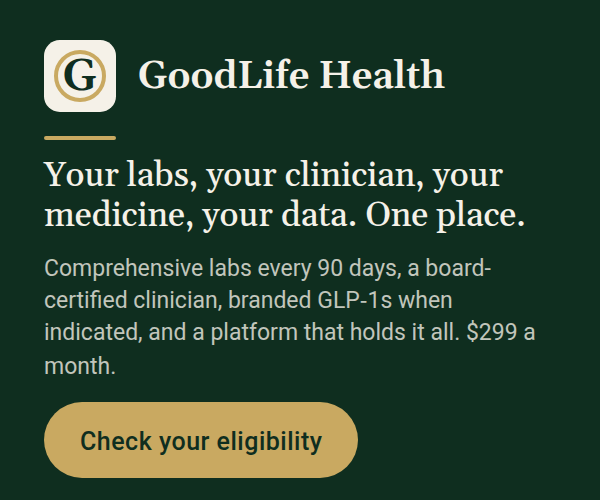
The membership is $299 a month, $3,588 a year, with $598 charged at sign-up to cover the first two months and month-to-month billing after that. The fee covers clinicians licensed in all fifty states, the four panels, messaging with the care team and video visits, and it is the same whatever medication is indicated and whatever the dose. It is generally eligible for HSA or FSA pre-tax dollars. It pairs with insurance for catastrophic coverage and does not replace it; what it replaces is the primary-care relationship. In price, GoodLife Health sits between the $20,000-a-year concierge practice and the $99-a-month compounded app, and says so plainly.
Medication is unbundled. It is prescribed, when clinically indicated, to the pharmacy the patient chooses, at that pharmacy's own price, and GoodLife Health sets nothing, sees nothing and takes nothing on it. The hormones themselves are among the least expensive prescriptions in medicine. At the pharmacy pass-through prices in our hormone pricing guide, estradiol tablets run about $34 to $35 for a month and micronized progesterone about $37 to $44. Whether insurance covers a medication is between the patient, the plan and the pharmacy. Prior authorization is the pharmacy's process, and GoodLife Health does not claim to run it, speed it or win it.
The limits deserve the same clarity. The membership does not promise a prescription of any kind, whether estrogen, testosterone or a GLP-1, and it does not promise weight loss or any particular result. There are no in-office procedures, so hormone pellets are not part of the model. It will not tell her that her symptoms are hormonal before anyone has measured. What it offers is a licensed clinician who measures first, prescribes only when there is a clinical reason, and stays to look again.

How to check before you commit
For this practice, the answer to her question comes down to facts she can verify. The clinicians are licensed in all fifty states. The practice is a professional corporation that prescribes and does not sell medication. The medication is branded and FDA-approved, filled by the pharmacy she chooses at its own price. A clinician reviews every case and can decline it.
The same questions work for any practice she is considering:
- Where are your clinicians licensed, and who is the medical director?
- Do you sell the medication, or does a pharmacy I choose fill it?
- Is the medication FDA-approved, or compounded?
- What do you measure before you prescribe, and how often do you measure again?
- Can a clinician turn me down, and what happens to my money if they do?
At GoodLife Health the path is the eligibility check, the intake, the checkout, then the clinician's review. If a clinician cannot accept her, the $598 is refunded in full; once she is accepted, the first two months are non-refundable, and medication follows the pharmacy's own return and refund policy. After those two months, the membership runs month to month.
Who this is not for
If the goal is the lowest monthly price for a prescription, this is not the right fit, and a $99 app will cost less. If you want a hormone or testosterone prescription guaranteed after a questionnaire, hormone pellets placed in an office, or compounded GLP-1, GoodLife Health will not provide them. If you want something to replace your health insurance, the membership does not do that; it sits beside insurance. And if quarterly labs and a conversation about the results sound like more involvement than you want, the model will feel heavy. For someone who wants to be measured, then treated, by a clinician who stays, it may fit, and the eligibility check is the honest way to find out.
Related Reading
- What Is GoodLife Health? Direct Primary Care, Explained (2026)
- Bioidentical Hormone Therapy at Pharmacy Cost: The Real Numbers
References
- FDA's Concerns with Unapproved GLP-1 Drugs Used for Weight Loss (U.S. Food and Drug Administration). 2025. www.fda.gov/drugs/postmarket-drug-safety-information-patients-and-providers/fdas-concerns-unapproved-glp-1-drugs-used-weight-loss
- NovoCare Pharmacy — Wegovy self-pay pricing (Novo Nordisk). 2026. www.novocare.com/pharmacy/wegovy.html
- Zepbound Self Pay Journey Program — LillyDirect vial pricing (Eli Lilly). 2026. zepbound.lilly.com/savings