You are doing this for someone else. Perhaps it is the person who keeps hearing that their labs are "fine" while they feel worn down. Perhaps it is the one whose blood sugar edges up at every checkup and who has quietly stopped mentioning it. You have found a membership that might help. Before you mention it, you want to know you are not handing them a gimmick, a gray-market pharmacy, or a chatbot with a prescription pad.
So the question you typed was some version of this: is GoodLife Health legit? Is it legal to receive care this way, and is there a real, licensed clinician on the other end? This piece answers both plainly, including the parts that might lead you to decide it is wrong for the person you have in mind. It is written for the one doing the homework, so it covers what you would want settled before the conversation starts.
- GoodLife Health is run by GoodLife Health Professional Corporation, an Arizona professional corporation, with clinicians licensed in all fifty states.
- A clinician reviews every applicant, and not everyone is accepted.
- The $598 sign-up charge is refunded in full if the clinician cannot accept them; once accepted, the first two months are non-refundable.
- Cassandra, the software that organizes intake and lab trends, supports the clinician and does not diagnose or prescribe.
- Only branded, FDA-approved medication is prescribed, to the patient's chosen pharmacy at that pharmacy's price, and never compounded GLP-1.
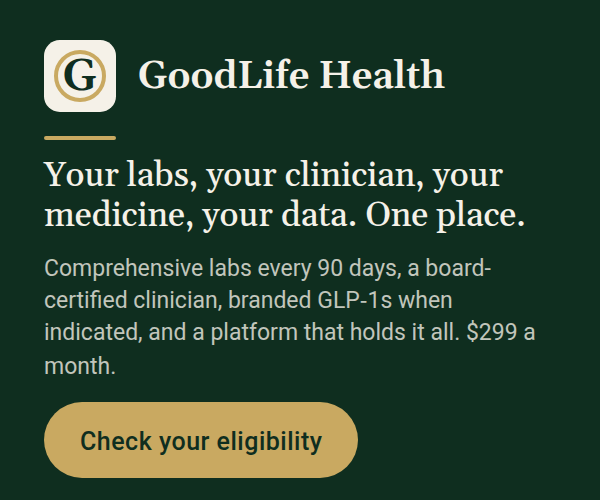
- The membership is $299 a month and pairs with insurance; it does not replace it.
Why a careful person checks before raising it
The online health market has given you good reasons to be wary. Advertisements promise weight-loss injections for less than a phone bill. A short quiz ends in a prescription, and nobody seems to ask a follow-up question. Hormones arrive by mail after a form and a card number. You may also have read that the FDA has raised concerns about unapproved versions of GLP-1 drugs, and you may have wondered which services those concerns are about.
Then there is the name, which more than one business uses. It helps to know that GoodLife Health is a healthcare clinical-services entity, not a gym, and not affiliated with any other company using the name GoodLife Health. That is worth settling first. Otherwise you might forward a link, the person you love might land on the wrong page, and they might decide the whole idea is a sales pitch.
The stakes here are personal more than financial. Health, and weight in particular, can be hard to raise with someone you share a life with. If you suggest a service and it turns out to be thin, you spend some of the trust that made the conversation possible, and your next suggestion lands with more doubt attached. That is why you are checking first, and why the legal question may matter to you more than the price. A membership can be ended. The feeling of having been steered toward something shady is harder to undo.
There is a quieter worry under the legal one: whether the clinician is a person at all. A lot of health products now lean heavily on software, and you have no wish to put someone you love in front of an algorithm wearing a nurse's name badge. The honest answer to that means explaining exactly what the software does and does not do. That explanation comes below.
Finally, you are not the one who would sign up. Whatever you find, the decision belongs to them. They would answer the medical questions, meet the clinician, and decide whether to continue. What you can do is make sure the option is sound before you put it on the table, and know enough to answer the first few questions they will ask you.
What "legit" actually comes down to
Underneath the worry, the legitimacy of an online medical practice rests on three plain questions. They apply to every service you have looked at, this one included, and asking them will sort the options faster than reading reviews.
The first is who holds the license. A prescription is written under a clinician's license, and that license carries the responsibility for the decision. You need to find out who the clinician is, what their credentials are and where they are licensed. Without that, you cannot know who is accountable when something goes wrong or needs to change.
The second is who makes the decision. In a sound practice, a clinician looks at the person's history, and at their labs where labs are part of the model. The clinician then decides whether care is appropriate and what it should be. That means the answer can be no. A service that never turns anyone away is selling a product, however clinical its forms look.
The third is who sells the medication, and how the practice gets paid. A platform that makes money on the drug has a structural incentive to keep a patient on the highest tolerable dose. That does not make every such business dishonest, but it is a pull worth knowing about. When the practice is paid a flat fee for the care itself and has no stake in the medication, the prescription can follow the clinical assessment instead of the other way around.
Price is a rough guide to how a service answers those questions. At one end of the market is the $20,000-a-year concierge practice. At the other is the $99-a-month app built around compounded GLP-1. GoodLife Health sits between the two, and says so. A high or low price does not make a service legal or illegal. Price tells you what the model can afford to include and where the money has to come from.
Compounded GLP-1 deserves a plain word, because it sits behind many of the stories you may have read. The FDA has published its concerns about unapproved GLP-1 drugs used for weight loss. The manufacturers have brought litigation over compounded copies, and there have been reports about the dosing and additive practices behind some compounded products. Those are the facts, stated without drama. They are reason enough for some families to prefer a practice that stays out of that market altogether. GoodLife Health never prescribes compounded GLP-1, and it does not prescribe research peptides either.
A practice that can tell you who is responsible for your care, and is willing to tell you no, has already answered most of what "legit" means.
None of this asks you to take a company's word for anything. The three questions have answers you can read, and the rest of this piece gives GoodLife Health's answers one at a time.
What GoodLife Health is, who the clinicians are, and what it costs
Who runs it, and where its clinicians are licensed
GoodLife Health is precision direct primary care for Cardiometabolic Optimization, delivered over telehealth. The order is diagnosis first, then treatment, then the long haul. It is operated by GoodLife Health Professional Corporation, an Arizona professional corporation. Its clinicians are licensed in all fifty states. They practice independently in Arizona and California, with collaborating physicians elsewhere.
It is a clinical practice and nothing else. GoodLife Health is not a pharmacy and not a compounding facility; it does not dispense, compound or take title to medication. When a medication is clinically indicated, the prescription goes to the pharmacy the patient chooses, at that pharmacy's own price. GoodLife Health sets nothing, sees nothing and takes nothing on medication. That separation answers the third question. It is built into the structure of the business rather than offered as a promise.
Who the clinicians are, and where the software fits
The care is clinician-led. The medical director holds a Doctor of Nursing Practice and is a board-certified Family Nurse Practitioner (DNP, FNP-BC) with over 25 years in patient care. Every clinical protocol on the platform is reviewed under her medical direction. She is named, with her background, in What Is GoodLife Health? Direct Primary Care, Explained. That is the page to share if the person you love wants to know who would be responsible for their care.
The membership includes video visits and asynchronous messaging with the care team. Labs are drawn at a local LabCorp or Quest location and go to the clinician for review, and every result is in the patient's hands too. A visit is a conversation with a person who has read those results. If you want to picture it before you raise it, What a Direct Primary Care Visit Actually Looks Like walks through what happens before, during and after.
Now the software, since it sits at the center of the "is the clinician real" question. GoodLife Health runs on a technology platform, and part of that platform is Cassandra, an Autonomous Intelligence (AuI) layer. Cassandra organizes intake, surfaces trends in lab results and supports the clinician's workflow. She supports the clinician; she does not diagnose or prescribe. A clinician decides whether to accept someone into care, what the labs mean and whether any medication is indicated. The software is what lets a clinician practice this way across the country, and it stays on its side of that line.
A clinician's review, and an answer that can be no
The path in has four steps: the eligibility check, the intake, the checkout, and then a clinician's review. Not everyone is accepted. Payment comes before the review, which is why the refund terms below matter. The review is still the real gate, and it answers the second question.
Once someone is accepted, care starts with labs. The membership includes four cardiometabolic lab panels a year, so labs are quarterly, and treatment follows what the labs and the clinician find. Medication may or may not be part of that. When it is, it is branded and FDA-approved. That means Wegovy, Zepbound, Mounjaro or Ozempic for GLP-1, and hormone therapy and thyroid medication where indicated. It also includes any other FDA-approved medication a clinician judges indicated, sent to the patient's own pharmacy.
A clinician's license carries the responsibility for every prescription written under it. Acceptance into care and every treatment decision belong to the clinician, never to a checkout page or a piece of software.
Testosterone shows how the law shapes what is offered, and it is a fair test of the legal question. Testosterone is a Schedule III controlled substance. It is prescribed and dispensed only where federal and state law allow, through the clinical partner's arrangement. The membership never promises it; the clinician decides. If the person you love has seen advertisements for hormones by mail, that is the difference to notice.
Insurance is handled with the same restraint. Prior authorization, when a medication needs it, is the pharmacy's process, and GoodLife Health does not claim to run it, speed it or win it. Whether insurance covers a medication is between the patient, the plan and the pharmacy. No one at GoodLife Health will promise that it will.
What it costs, with the refund in both halves
The membership is $299 a month, month to month, and $598 is charged at sign-up to cover the first two months. Over a year, the membership is $3,588. The fee covers the clinicians, the four lab panels, every result, messaging with the care team and video visits. It is the same whatever medication is indicated and whatever the dose: there is no molecule upcharge and no dose upcharge. The membership fee is generally eligible for HSA or FSA pre-tax dollars.
The refund works in two halves. If the clinician cannot accept the patient into care, the $598 is refunded in full. Once accepted, the first two months are non-refundable. Medication billed by a pharmacy follows that pharmacy's own return and refund policy.
Medication is a separate cost, set by the pharmacy. For a sense of scale, manufacturers publish their own self-pay prices. As published in September 2026, NovoCare listed Wegovy pens at $199 a month for the first two fills, an introductory offer for new patients through December 2026, and $349 a month after. The same listing put the Wegovy pill from $149 a month at lower doses. Through LillyDirect, Zepbound vials were $299 to $449 a month depending on dose, also as published in September 2026. Those are the manufacturers' prices, dated for that reason, and GoodLife Health has no part in them.
The membership pairs with insurance; it does not replace it. Insurance stays in place for catastrophic coverage, and the membership replaces the primary-care relationship.
What it does not promise
No one at GoodLife Health will promise a particular amount of weight loss, a remission or a cure. A clinician can order labs, read them, explain them and treat what they find. Outcomes belong to the person and their body, and an honest practice says so.

How to raise it, and how to check it yourself
The most useful thing you can bring to the conversation is the three questions and their answers, rather than a sales pitch. Who is the clinician, and where are they licensed? Who decides, and can the answer be no? Who sells the medication, and does the practice profit from it? If the person you love can hear those answered plainly, they can judge the rest for themselves.
It may help to read What Is GoodLife Health? together, since it names the medical director and lays out the membership in one place. It may also help to be clear about money from the start. The first charge is $598 for two months, then $299 a month, and medication is billed separately by the pharmacy. If the clinician cannot accept them, the $598 comes back in full; once accepted, the first two months are non-refundable. Knowing that in advance means no one feels surprised later.
The eligibility check is theirs to take, and it comes before any payment. If they decide not now, that is an answer too. Care built on quarterly labs and an ongoing relationship works when the patient wants it. The kindest thing you can do is make the option clear and let them choose.
Who this is not for
GoodLife Health is the wrong choice for someone whose main goal is the lowest monthly price on a weight-loss injection. The $99-a-month compounded app exists for that, and this membership is built differently on purpose. It is wrong for anyone who wants compounded GLP-1, research peptides or hormone pellets, because none of those is offered. It is also wrong for someone who needs a guarantee, whether of weight loss, insurance coverage, a prior authorization or testosterone, because none of those is promised. It does not suit someone hoping to drop their health insurance, since the membership pairs with insurance and does not replace it. And it is not for a person who has not asked for it. If the one you love is not ready, the right step is to wait.
Related Reading
- What Is GoodLife Health? Direct Primary Care, Explained (2026)
- What a Direct Primary Care Visit Actually Looks Like (2026)
References
- FDA's Concerns with Unapproved GLP-1 Drugs Used for Weight Loss (U.S. Food and Drug Administration). 2025. www.fda.gov/drugs/postmarket-drug-safety-information-patients-and-providers/fdas-concerns-unapproved-glp-1-drugs-used-weight-loss
- NovoCare Pharmacy — Wegovy self-pay pricing (Novo Nordisk). 2026. www.novocare.com/pharmacy/wegovy.html
- Zepbound Self Pay Journey Program — LillyDirect vial pricing (Eli Lilly). 2026. zepbound.lilly.com/savings