You did what the plan asked. You started low, stepped up when told to, put up with the early weeks and reached the highest dose your medication comes in. For a while it worked. Then the weight stopped moving, and it has stayed still for long enough that you no longer believe it is a bad week. Your telehealth clinician spends about fifteen minutes a month on you, renews the order and signs off. When you raised the plateau, you were told you are already on the maximum and there is nothing else to try.
So when you find a membership that charges $598 up front, the first thing you want to know is how to get out of it. Can you cancel GoodLife Health, and what comes back if you do? The $598 is charged at sign-up and covers the first two months. If the clinician cannot accept you into care, it is refunded in full. Once you are accepted, those first two months are non-refundable. After them, the membership runs month to month at $299, with no long-term contract. Medication is never part of that charge: your pharmacy bills it, and that pharmacy's own return and refund policy applies.
The rest of this piece explains why the terms are built that way, what the two months are meant to buy someone in your position, and who should not sign up at all.
- You can cancel: after the first two months, the membership runs month to month at $299.
- The $598 charged at sign-up covers months one and two: refunded in full if the clinician cannot accept you, non-refundable once you are accepted.
- Medication is billed by your pharmacy and follows that pharmacy's own return and refund policy.
- The fee is the same whatever medication or dose is indicated, so no one earns more by keeping you on the top dose.
- Every lab result is in your hands, whether you stay or cancel.
- No one can promise that a top-dose plateau will break; the membership offers a clinician who measures before deciding.
Top dose, a flat line and a renewal every month
The care around your medication has not changed since the day it started working. Once a month the clinician opens your file and asks the same questions: are you tolerating the dose, do you want to continue, is anything wrong. You answer, the order is renewed, and the exchange is over. When the medication was working, that felt efficient. Now that it has stopped, it feels like a process running without anyone at the controls.
The plateau has a cost you feel every month. You are paying for the medication at whatever your current arrangement charges, and you are paying for the sign-off on top. If the drug has stopped doing what you bought it for, each renewal is another month of spending on a result you are not getting. Your options, as they have been presented to you, are poor ones. You can keep going on the hope that the scale moves again, you can stop and take your chances, or you can look for someone who will ask a different question.
Looking is harder than it sounds, because you have probably been disappointed already. A service promised a program and delivered a refill. An app promised a clinician and delivered a form. Each time, the money went out before you found out what you had bought. So before you read a word about labs or protocols, you want to know what happens if this turns out the same way: whether you can leave, and what you get back. That is a sensible order in which to ask, and the full terms are set out in the third section below, with nothing left for the fine print.
What "nothing else to try" leaves out
The phrase sounds like a clinical conclusion. It helps to look at how it was reached. A fifteen-minute monthly renewal has room for the three questions above. It has no room for a fourth, which is the one you are asking: why has the response stopped? Answering that takes measurement, and measurement takes labs ordered, results read, and time with the person they belong to.
If no one has ordered and read a full cardiometabolic panel for you since the plateau began, then "nothing else" was said before anyone looked. That does not mean a hidden fix is waiting. A careful look might confirm that the medication and dose you are on are the right ones and that the plateau is where you are. It might find something worth treating. Nobody can tell you which in advance, including GoodLife Health, and anyone who says they can is guessing. The point is narrower than a promise: a conclusion is only as good as the information behind it, and a monthly renewal gathers very little information.
There is a second thing worth seeing, and it concerns money. How a service is paid shapes what it is built to do. When a platform earns its margin on the medication, it has a structural incentive to keep you on the highest dose you can tolerate, because the drug is where the revenue sits. Individual clinicians may push against that pull, but the arrangement leans one way. A service built on it has every reason to keep renewing and little reason to stop and ask whether something else is going on.
GoodLife Health is built the other way around. It sets nothing, sees nothing and takes nothing on medication. The membership fee is the same whatever medication is indicated and whatever the dose, with no molecule upcharge and no dose upcharge. That leaves the clinician with no financial reason to keep you where you are and no financial reason to move you. The prescription can follow what the labs and the conversation show, which is the only thing it should follow.
Fifteen minutes a month is enough time to renew a prescription and not enough time to ask why it stopped working.
Seen this way, the cancel question changes shape. You are weighing $598 against the chance of another round of the same thing. The useful test is whether the first two months buy something your current arrangement does not: a clinician who measures before deciding and has no stake in which answer the measurements give. If they do, the commitment is the cost of finding out. If all you want is the renewal, no refund policy can make the membership worth $299 a month, and the arrangement you already have is the better buy.
What it costs, what comes back, and what the fee covers
The membership is $299 a month, month to month. At sign-up, $598 is charged to cover the first two months, and a full year of membership comes to $3,588. The fee is generally eligible for HSA or FSA pre-tax dollars, which is worth checking if you have one of those accounts.
Acceptance is not automatic, and the refund is built around that fact. The path runs in a fixed order: the eligibility check, the intake, the checkout, and then a clinician's review of what you have shared. The clinician decides whether GoodLife Health can take you into care. The table below is the whole of the policy.
What you can get back, and when
| Situation | What happens to your money |
|---|---|
| The clinician cannot accept you into care | The $598 is refunded in full |
| The clinician accepts you | The first two months are non-refundable |
| After the first two months | The membership runs month to month at $299 |
| Medication your pharmacy bills | Follows that pharmacy's own return and refund policy |
Read the second row as carefully as the first. The refund protects you from paying for a review that ends in a no. It does not protect you from changing your mind after a clinician has said yes. If you need the freedom to walk away after two weeks with your money back, this membership does not offer it, and it is better to know that now than to find out at the end of the first month.
The third row is the cancel answer most people come looking for. Once the first two months have passed, there is no long-term contract. You stay in a given month because the care is worth $299 to you, or you cancel.
Medication sits outside all of this, because GoodLife Health does not sell it. When a medication is clinically indicated, the clinician prescribes it to the pharmacy you choose, and that pharmacy charges its own price and applies its own policies. Leaving the membership never means unwinding a medication contract with GoodLife Health, because there is none. For reference, the manufacturers' own self-pay prices, as published in September 2026, are these. Through NovoCare, Wegovy pens are $199 a month for the first two fills, an introductory offer for new patients through December 2026, and $349 a month after; the Wegovy pill starts at $149 a month at lower doses. Through LillyDirect, Zepbound vials run $299 to $449 a month depending on dose. Whether insurance covers any of these is between you, your plan and your pharmacy. Prior authorization is the pharmacy's process, and GoodLife Health does not run it, speed it or promise its outcome.
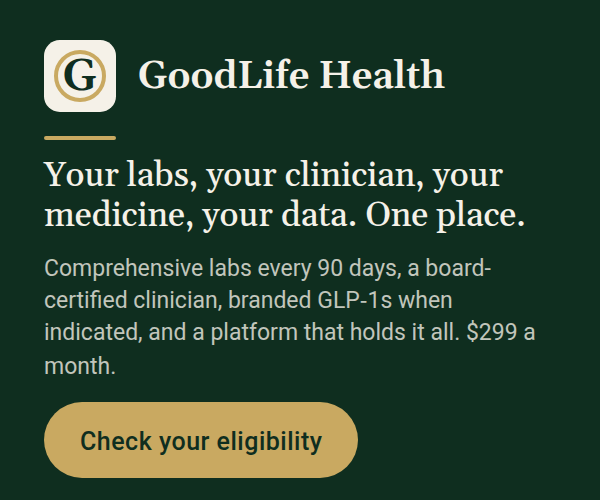
The fee buys the clinical relationship. Clinicians are licensed in all fifty states. Four cardiometabolic lab panels a year are included, so your markers are measured every quarter. Every result is in your hands. You can message the care team asynchronously, and video visits are part of the membership. The model is clinician-led and labs-first: diagnosis first, then treatment, then the long haul.
For someone at a plateau on a top dose, that order matters more than any single feature. The first stretch of membership is intake and labs, followed by a clinician reading the results against your history and telling you what they show. The reading might support the medication you are on. It might point to a different branded GLP-1 such as Wegovy, Zepbound, Mounjaro or Ozempic, or to something outside weight altogether, since the clinician can prescribe hormone therapy and thyroid medication where the labs indicate them, and any other FDA-approved medication judged indicated. It might point to staying exactly where you are. The fee is the same in every case, and the panel is yours whether you stay or cancel.
No clinician can promise that a change of medication, dose or protocol will restart weight loss after a plateau. What a clinician can do is measure first and tell you plainly what the results show.
Some things the membership will not do, and they bear directly on whether you should start. It makes no promise of further weight loss, of a particular amount, or of remission. It does not replace your insurance; it pairs with insurance for catastrophic coverage and replaces the primary-care relationship. It does not promise that any medication will be covered. It also does not prescribe compounded GLP-1 under any circumstance, which matters if part of your plan for leaving your current service is a cheaper compounded version. The FDA has published its concerns about unapproved GLP-1 drugs used for weight loss; here the standard is branded, FDA-approved medication, with a clinician's license carrying responsibility for the prescription.
If you want the model explained from the beginning, What Is GoodLife Health? Direct Primary Care, Explained covers it. If you want the membership priced against every alternative over a full year, The Real ROI of a $299/Month Health Membership does that arithmetic with dated figures.

Deciding whether the two months are worth it
The honest version of the decision is small. You are committing $598 and two months of attention to find out whether a clinician who measures first can tell you something your current arrangement has not. You are also committing to paying your pharmacy for any medication on top of the membership.
Start with the eligibility check. It comes before checkout, so running it costs nothing. If you pass and go on, the terms in the table apply exactly as written: a full refund of the $598 if the clinician cannot accept you, and two non-refundable months once you are accepted.
Then hold the membership to a plain standard at the end of those two months. Ask whether a clinician has measured before deciding, whether you understand what the measurements show, and whether the plan in front of you was built from them. If the answer is yes and the plan makes sense to you, stay a month at a time for as long as that remains true. If the answer is no, cancel. The month-to-month terms exist so that the decision stays with you.
Who this is not for
This membership is not for you if the goal is the lowest possible price for the next refill. GoodLife Health sits between the $20,000-a-year concierge practice and the $99-a-month compounded app, and it says so. If the $99 app is what you are shopping for, this is the wrong membership, and we would rather you know that before spending anything. It is not for you if you want a compounded GLP-1, because none will be prescribed. It is not for you if you need a guarantee of further loss, because no honest clinician can give one.
It is also not for you if you need the option to leave partway through the first two months with your money back. The $598 comes back in full only if the clinician cannot accept you; once a clinician says yes, the first two months are non-refundable. And if you are a healthy adult who sees a doctor twice a year and takes no medication, you will not recoup $3,588, and you should not buy this. The people it fits are the ones who want someone to look before deciding, and who can live with not being promised the result.
Related Reading
- The Real ROI of a $299/Month Health Membership: Every Alternative, Priced Honestly
- What Is GoodLife Health? Direct Primary Care, Explained (2026)
References
- NovoCare Pharmacy — Wegovy self-pay pricing (Novo Nordisk). 2026. www.novocare.com/pharmacy/wegovy.html
- Zepbound Self Pay Journey Program — LillyDirect vial pricing (Eli Lilly). 2026. zepbound.lilly.com/savings
- FDA's Concerns with Unapproved GLP-1 Drugs Used for Weight Loss (U.S. Food and Drug Administration). 2025. www.fda.gov/drugs/postmarket-drug-safety-information-patients-and-providers/fdas-concerns-unapproved-glp-1-drugs-used-weight-loss