Why not compounded GLP-1 if it is cheaper? The question deserves a direct answer, because the reader asking it is usually right about the arithmetic. A compounded copy of semaglutide or tirzepatide is usually priced below the branded pens. The savings are real month to month. We still prescribe only branded, FDA-approved GLP-1. This piece explains the reason in full, including the part where we tell you when we are the wrong purchase for exactly this reason.
The reason is not that compounded medicine is dangerous in itself. Compounding is a legal, regulated part of pharmacy practice and hormone therapy that we do offer, when indicated, is prepared by a licensed U.S. compounding pharmacy. The reason is that the two situations are not symmetrical and the buyer who asks this question is the one who can tell the difference.
- A compounded GLP-1 is a copy made by a pharmacy and it has not been through the FDA's premarket review for safety, quality and effectiveness that the branded drug went through.
- Many people used compounded GLP-1s legally during the shortage. The shortage is over and the exception that carried the copies has narrowed.
- The branded drugs have published self-pay prices: as of September 2026, Wegovy pens at $199 for the first two fills then $349 a month, Zepbound vials at $299 to $449 a month by dose.
- Our membership is $299 a month flat, with medication billed by your pharmacy at its own price and nothing taken by us, so nothing we earn changes with your dose.
- If the cheapest possible GLP-1 is the whole decision, a compounded source costs less than us and we will not compete for that purchase.
What is a compounded GLP-1, exactly?
Compounding is the practice of a pharmacy preparing a medication for an individual patient rather than dispensing a manufactured product. It is legal and regulated and it exists for good reasons such as allergies to a filler, a strength a manufacturer does not make or a formulation a patient cannot take. When the branded GLP-1s were on the FDA shortage list, compounding pharmacies prepared copies of semaglutide and tirzepatide to fill the gap and many people used them lawfully. Nobody who did that did anything wrong.
What a compounded copy does not have is the review. The FDA's statement of concerns about unapproved GLP-1 drugs sets out the agency's position: these copies have not gone through the agency's premarket review for safety, quality and effectiveness, the process the branded product went through before it could carry its label. The branded semaglutide in the STEP 1 trial is a specific molecule at a specific purity reviewed in specific trials. The trial data belongs to that molecule. A copy inherits the name, not the review.
Neither the shortage nor the exception stands where it did. The FDA has declared both shortages resolved and the grace periods that allowed mass compounding have closed. What remains is a narrow exception for an individual patient with a documented need the branded product cannot meet. A business still built on mass-market compounded copies in 2026 rests on that exception rather than the rule.
What the cheaper price is actually buying
The honest version of the pitch is this: the copy is cheaper because the review is skipped. A manufacturer of the branded product spent years and a regulated trial program to be able to state what its vial contains and what it does. A compounding pharmacy can have that molecule on its bench in weeks. The saving is real and so is the trade: you are dosing a medicine you plan to take for years, at a strength that changes over months, based on a product nobody has verified. The dose-response relationship, the purity and the sterile preparation are exactly the things the review would have covered.
There is also a second layer the sticker price hides. On most platforms selling compounded copies, the medication is the business. The company earns its revenue on the vial, which means it earns more when the dose climbs and the clinician who reviews your dose sits inside that incentive whether or not any individual clinician feels it. On our model the opposite is true. The membership is a flat $299 a month, the medication is billed by your pharmacy at that pharmacy's own price and we take nothing on it. When your dose goes up, our revenue does not move. When it comes down, our revenue does not move. The only thing we are paid for is the clinical relationship and the four cardiometabolic panels a year.
A dose that climbs without a lab behind it is the signature of an incentive problem. TSH With Reflex To Free T4, Fasting Insulin and Apolipoprotein B (ApoB), drawn and read together, are how a plateau gets worked up before a dose gets raised.
What the branded alternative actually costs
The branded premium is smaller now that the manufacturers publish self-pay prices. As published in September 2026, NovoCare lists Wegovy pens at $199 a month for the first two fills, an introductory offer for new patients through December 2026 and $349 a month after that, with the Wegovy pill from $149 a month at lower doses. LillyDirect lists Zepbound vials at $299 to $449 a month depending on dose. These are the prices your pharmacy charges you, the same for us as for anyone else and we take nothing on them.
So the full comparison, priced: a compounded copy usually costs less than the branded pens. The branded pen runs $199 a month for the first two fills and $349 after at the pharmacy, as published in September 2026, plus our $299 membership. The gap is real, it is monthly and it buys the review, the labeled product and a clinical relationship whose revenue does not depend on your dose. Whether that trade is worth it is your judgment to make and we will help you make it either way, including the judgment that it is not.

When the membership is not the right purchase
If the cheapest possible GLP-1 is the whole decision, we are not the right purchase. A compounded source prices below the branded pens plus our fee and no framing changes that. Whether your insurance covers a branded GLP-1 is between you, your plan and the pharmacy and prior authorization, where it applies, is the pharmacy's process. If you want a prescription with no labs, no history and no clinician who stays, the membership will feel slow and expensive for what you want.
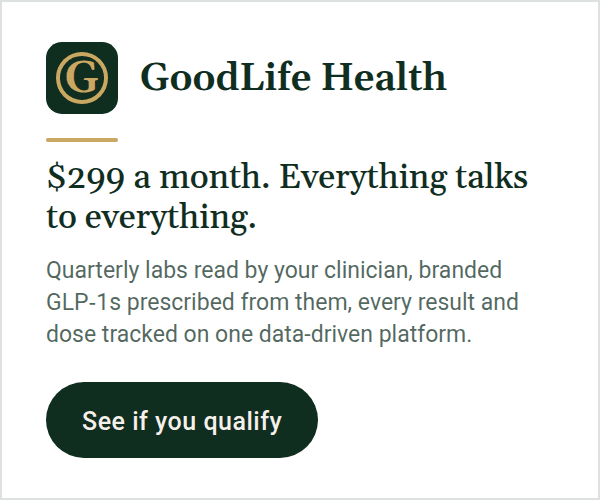
If instead you want the opposite arrangement, a clinician paid to know you and a pharmacy paid only for the drug, with nothing we earn rising when your dose does, then the fit is real. GoodLife Health is $299 a month, month to month, with $598 for the first two months held on your card at sign-up, charged only once a clinician accepts you into care. If the clinician cannot accept you, the hold is released and nothing is charged. Once you are accepted, the first two months are charged and non-refundable. It buys four cardiometabolic lab panels a year (quarterly labs), a clinician who stays, a 30-minute video intake, monthly clinical check-ins, 24/7 secure messaging and video visits and your own health platform: every result, visit and medication in one Health Story, with Cassandra to help you understand your numbers.
The copy is cheaper because the review is skipped. You are paying the branded price for the reviewer's judgment, not the packaging.
Who this is not for
If a compounded vial at the lowest monthly figure is what you want, buy it with clear eyes: the product has not been FDA-reviewed and the prescriber's license carries the responsibility. If you want peptides, pellets or a glucose monitor built into your protocol, we do not offer those. If you want a membership that guarantees weight loss, a prescription or insurance coverage, nothing here promises any of those and a clinician may conclude a GLP-1 is not what your panel calls for. We don't promise the membership fee is HSA or FSA eligible. Your account administrator decides, so check with them before using those funds. And the membership complements your insurance and your primary care doctor and replaces neither.
The reader this is for already knows which end of the trade they are on. You would rather not inject a copy nobody reviewed and you want a clinician who reads the whole system every 90 days. For that reader, the cheapest GLP-1 was never the point. The point is a decision made on your blood, by someone with no stake in your dose and the eligibility check is the unhurried way to start.
FAQ
Why not a compounded GLP-1 if it is cheaper?
Because the copy has not been through the FDA's premarket review for safety, quality and effectiveness that the branded drug went through. The savings are real and the trade is real: an unreviewed version of a medicine you plan to take for years, from a business whose revenue rises when your dose does.
Is compounded semaglutide illegal?
No. Compounding is legal and regulated and many people used compounded GLP-1s lawfully during the shortage. The shortage is resolved and the exception that allowed mass compounding has narrowed to individual documented need.
How much does a branded GLP-1 cost?
It is billed by your pharmacy at that pharmacy's price. As published in September 2026, NovoCare lists Wegovy pens at $199 a month for the first two fills and $349 after and LillyDirect lists Zepbound vials at $299 to $449 a month by dose. We take nothing on any of it.
Does your fee change with my dose?
No. The membership is a flat $299 a month with no molecule upcharge and no dose upcharge, because we earn nothing on the medication at any dose.
Do you offer compounded hormones?
Yes, when indicated. Hormone therapy is prepared by a licensed U.S. compounding pharmacy and compounded medicines are not FDA-approved. The branded-only rule applies to GLP-1 specifically.
What if I cannot afford the branded price?
Then this membership may not be the right purchase and we would rather say so. Check the manufacturer's direct channels and price your full year before you commit.
Related Reading
- Branded GLP-1 pricing: what Wegovy, Zepbound and Ozempic cost
- Compounded vs branded GLP-1: safety and cost
- The true monthly cost of GLP-1 telehealth
- The definitive guide to cardiometabolic optimization
References
- FDA's Concerns with Unapproved GLP-1 Drugs Used for Weight Loss (U.S. Food and Drug Administration). 2025. www.fda.gov/drugs/postmarket-drug-safety-information-patients-and-providers/fdas-concerns-unapproved-glp-1-drugs-used-weight-loss
- Once-Weekly Semaglutide in Adults with Overweight or Obesity (STEP 1, New England Journal of Medicine). 2021. pubmed.ncbi.nlm.nih.gov/32915770/