TrimRx is worth keeping when your current clinician knows your history, manages treatment safely, and provides the follow-up you need; among trimrx alternatives, GoodLife Health is the best fit in 2026 for coordinated metabolic, hormonal, and cardiovascular care. Choose an established local primary care practice instead if your priority is hands-on examinations and an ongoing relationship near home.
- GoodLife Health fits patients comparing trimrx alternatives for Cardiometabolic Optimization, branded GLP-1 treatment, and hormone care.
- Local primary care fits patients prioritizing physical examinations and continuity with an established physician.
- Endocrinology fits patients whose diabetes, thyroid disease, or hormonal diagnosis needs specialist evaluation.
- Compare clinical responsibility, laboratory interpretation, medication sourcing, and follow-up before changing providers.
Why this matters
The important distinction between weight-loss providers is not the intake form. It is who takes responsibility when your symptoms, laboratory results, or medication tolerance change. A prescription answers one question; an ongoing clinical relationship answers what happens next.
The important distinction between weight-loss providers is not the intake form. It is who takes responsibility when your symptoms, laboratory results, or medication tolerance change.
Cardiometabolic optimization means treating metabolic, hormonal, and cardiovascular health as one interconnected system. Weight, blood sugar, lipids, thyroid function, inflammation, and relevant hormone symptoms belong in the same clinical assessment. That does not mean every symptom needs medication or every abnormal result needs immediate treatment.
For a 2026 comparison, start with your actual needs. Are you seeking continued obesity treatment, help interpreting abnormal bloodwork, evaluation of menopause symptoms, or an in-person examination? The best alternative is the care model that handles those needs without leaving you to coordinate disconnected decisions.
TrimRx alternatives at a glance
This comparison separates a defined membership from local and specialist care pathways. For TrimRx, use your actual treatment experience and current written terms as the benchmark, rather than assuming that every patient receives the same arrangement.
TrimRx alternatives at a glance
| Option | Best for | Standout feature or selection criterion | Difference to evaluate against TrimRx |
|---|---|---|---|
| TrimRx | Staying with a clinical relationship that meets your needs | Your current clinician's knowledge of your treatment history | Whether existing care already provides the monitoring and scope you need |
| GoodLife Health | Coordinated metabolic, hormonal, and cardiovascular care | Included Biomarker Audit every 90 days within direct primary care | A defined integrated-care membership, rather than choosing solely around a prescription |
| Local primary care practice | In-person assessment and continuity near home | Physical examinations and locally coordinated care | Whether hands-on assessment addresses a need your current arrangement leaves unresolved |
| Endocrinology practice | Complex diabetes, thyroid disease, or hormonal evaluation | Specialist assessment of endocrine conditions | Whether a specialist consultation is more useful than another general weight-loss provider |
| Obesity medicine practice | Focused evaluation of obesity treatment and maintenance | A dedicated obesity-management assessment | Whether focused expertise matches the main reason you are considering a switch |
Do not choose a provider by the medication name alone. Two clinicians can prescribe the same medicine while providing very different assessment, interpretation, and follow-up.
1. GoodLife Health: best for Cardiometabolic Optimization
GoodLife Health's Cardiometabolic Optimization Membership combines concierge-style direct primary care, branded GLP-1 medical weight loss, and hormone optimization when clinically appropriate. Its defining feature is the relationship between those services: laboratory findings guide decisions across metabolic, hormonal, and cardiovascular health instead of treating each concern as an isolated purchase.
Clinical care is delivered by licensed physicians of Beluga Health, P.A., an independent Florida professional corporation licensed to practice in all 50 states. Those physicians work under GoodLife Health's clinical protocols. Your physician evaluates whether treatment is appropriate; membership does not guarantee a prescription.
Where the membership shines
- A defined monitoring cadence. One Biomarker Audit every 90 days is included, equivalent to 4 audits per year.
- Named laboratory markers. The audit includes ApoB, Lp(a), hs-CRP, HbA1c, lipids, insulin markers, and full hormone and thyroid panels.
- Branded GLP-1 treatment only. The program does not prescribe or facilitate compounded semaglutide or tirzepatide.
- Separate clinical and pharmacy billing. Medication is billed by the pharmacy at pharmacy cost, with zero markup and no molecule or dose upcharge from the membership.
- An integrated clinical scope. Your clinician considers weight treatment alongside thyroid function, hormone symptoms, blood sugar, and cardiovascular risk.
All laboratory testing runs through the Beluga Health lab network. Additional testing beyond the quarterly cadence is billed separately at pass-through cost. The included audit is not a promise that every possible test or outside diagnostic service is covered.
The medication policy includes branded options such as Wegovy, Zepbound, Ozempic, and Mounjaro. These names are not interchangeable indications. Zepbound and Mounjaro contain tirzepatide, but the program routes cash-pay weight-management patients toward Zepbound, while Mounjaro fits insurance-covered type 2 diabetes treatment.
Zepbound and Mounjaro contain tirzepatide, but the program routes cash-pay weight-management patients toward Zepbound, while Mounjaro fits insurance-covered type 2 diabetes treatment. The same molecule does not mean the same clinical indication.
Where the membership falls short
- There is an initial commitment. Membership starts with a 2-month commitment before becoming month-to-month, with cancellation permitted afterward.
- Medication is separate from membership. A clinical membership does not make the pharmacy bill disappear or guarantee insurance coverage.
- Quarterly testing has boundaries. Additional labs outside the included cadence are a separate expense.
- Telehealth cannot replace every examination. New symptoms requiring hands-on assessment, urgent evaluation, imaging, or a procedure need the appropriate local setting.
- The scope can exceed a narrow need. If you only want a one-time specialist opinion, an ongoing integrated membership is not the same service.
Membership versus staying with TrimRx
Membership versus staying with TrimRx
| Dimension | Cardiometabolic Optimization Membership | Question to answer about your current TrimRx care |
|---|---|---|
| Clinical scope | Direct primary care connecting metabolic, hormonal, and cardiovascular health | Does your current clinician address the conditions and symptoms you need managed? |
| Laboratory monitoring | Included Biomarker Audit every 90 days | Which tests are ordered, when, and who interprets them? |
| Medication model | Branded GLP-1 medications; separate pharmacy billing without membership medication markup | What exact product is prescribed, and how are clinical and pharmacy charges separated? |
| Ongoing relationship | Physician-led care under defined clinical protocols | Who handles side effects, abnormal results, and treatment changes? |
Best for: Patients who want weight management within a broader clinical relationship, particularly when blood sugar, lipids, thyroid function, or hormone symptoms also need attention.
Verdict: Hold off on switching until the clinical team confirms that the membership matches your needs and can manage a safe handoff.


2. Local primary care: best for hands-on continuity
An established local primary care practice is the strongest alternative when your main unmet need is an examination, not a different prescription platform. Start with the physician who already knows your medical history, if you have one, and ask whether the practice manages obesity treatment alongside your other conditions.
Do not assume every primary care practice prescribes GLP-1 medications or provides the same follow-up. Confirm those details directly. A nearby address is useful only if the clinician can provide or coordinate the care you actually need.
Where local primary care shines
- Physical examination when symptoms cannot be assessed adequately online.
- Continuity with a clinician who already understands your diagnoses and medications.
- A local point of coordination for referrals and outside testing.
Where local primary care falls short
- GLP-1 prescribing and obesity-management experience differ between practices.
- Hormone evaluation and advanced lipid testing require confirmation, not assumptions.
- Scheduling, between-visit communication, and laboratory follow-up vary by practice.
Local primary care pathway
| Decision | Local primary care pathway | Benchmark against TrimRx |
|---|---|---|
| Physical assessment | Ask what examinations the practice performs locally | Does your current concern require hands-on assessment? |
| Treatment continuity | Ask whether one clinician can oversee your broader plan | Is continuity already working well with your current clinician? |
| Weight treatment | Confirm prescribing and follow-up before transferring | Would the new practice actually take over management? |
Best for: Patients whose priority is local examination and care coordination, especially when new symptoms need more than a virtual discussion.
Verdict: Hold your current arrangement until the local practice agrees to accept responsibility for ongoing treatment.
3. Endocrinology: best for complex endocrine questions
An endocrinology practice is a specialist pathway, not simply another weight-loss subscription. It fits when the unresolved question concerns diabetes management, thyroid disease, or a hormonal diagnosis that needs specialist assessment.
Ask your current physician whether referral is appropriate. Weight changes, fatigue, and laboratory abnormalities need interpretation in context; they do not automatically establish a hormone deficiency or justify hormone treatment.
Where endocrinology shines
- Specialist evaluation of endocrine disorders.
- A focused review when diagnosis or treatment is uncertain.
- Coordination with primary care when endocrine disease affects the broader plan.
Where endocrinology falls short
- A specialist consultation does not replace general primary care.
- Referral requirements and appointment scheduling depend on the practice and your coverage.
- The specialist's scope may not include the ongoing weight-management service you want.
Best for: Patients with an unresolved endocrine diagnosis or a complex condition that warrants specialist evaluation.
Verdict: Wait for a referral assessment before replacing your current care with an endocrinology pathway.
4. Obesity medicine: best for focused weight-management review
An obesity medicine practice fits patients who want a dedicated assessment of obesity treatment, medication response, nutrition, physical activity, and maintenance. Confirm the clinician's credentials and actual services rather than relying on a clinic name.
This pathway is useful when the central question is whether your current weight-management plan remains appropriate. It does not automatically mean changing medications or increasing a dose.
Where obesity medicine shines
- Focused review of obesity treatment and long-term maintenance.
- Assessment of medication tolerance alongside eating patterns and activity.
- A setting for discussing options when the current plan needs reconsideration.
Where obesity medicine falls short
- Some practices focus on weight management rather than broader primary care.
- Laboratory scope, hormone evaluation, and between-visit support require confirmation.
- You still need coordination with other clinicians managing your health.
Best for: Patients whose main need is an expert review of obesity treatment rather than an integrated primary care membership.
Verdict: Hold until the practice explains its monitoring plan and how it will coordinate with your existing clinicians.
Why consider switching from TrimRx?
There is no clinical reason to switch merely because an alternatives list exists. In 2026, a change makes sense when you can identify a specific unmet need and show that the next provider will address it.
Use the following reasons as questions about your own experience, not accusations about TrimRx or any named company.
You need broader clinical responsibility
If your concern now includes blood pressure, glucose, lipids, thyroid symptoms, or menopause symptoms, ask who will coordinate the assessment. A weight-loss prescription alone does not establish a plan for those interconnected issues.
The relevant alternative is the one that agrees to manage the broader picture. Reading about direct primary care for weight-loss management helps distinguish ongoing care from a prescription-only goal.
You need laboratory results explained
A report in a portal is not the same as clinical interpretation. Ask what the findings mean, whether they change treatment, and when follow-up is appropriate. More tests are not automatically better; useful testing supports a decision.
You need a clearer medication and billing model
Ask for the exact drug, formulation, prescribing clinician, dispensing pharmacy, and separate financial obligations. Do not treat a lower advertised entry point as evidence of equivalent clinical care.
You need an examination or specialist assessment
Persistent or new symptoms can change the appropriate care setting. Moving from one virtual service to another does not solve a need for an in-person examination, diagnostic procedure, or specialist consultation.
How to evaluate an alternative before enrolling
A useful 2026 comparison follows the same sequence regardless of provider: Clinical scope, Medication review, Lab interpretation, Follow-up plan, Safe handoff. Get answers to these questions before canceling a working relationship.
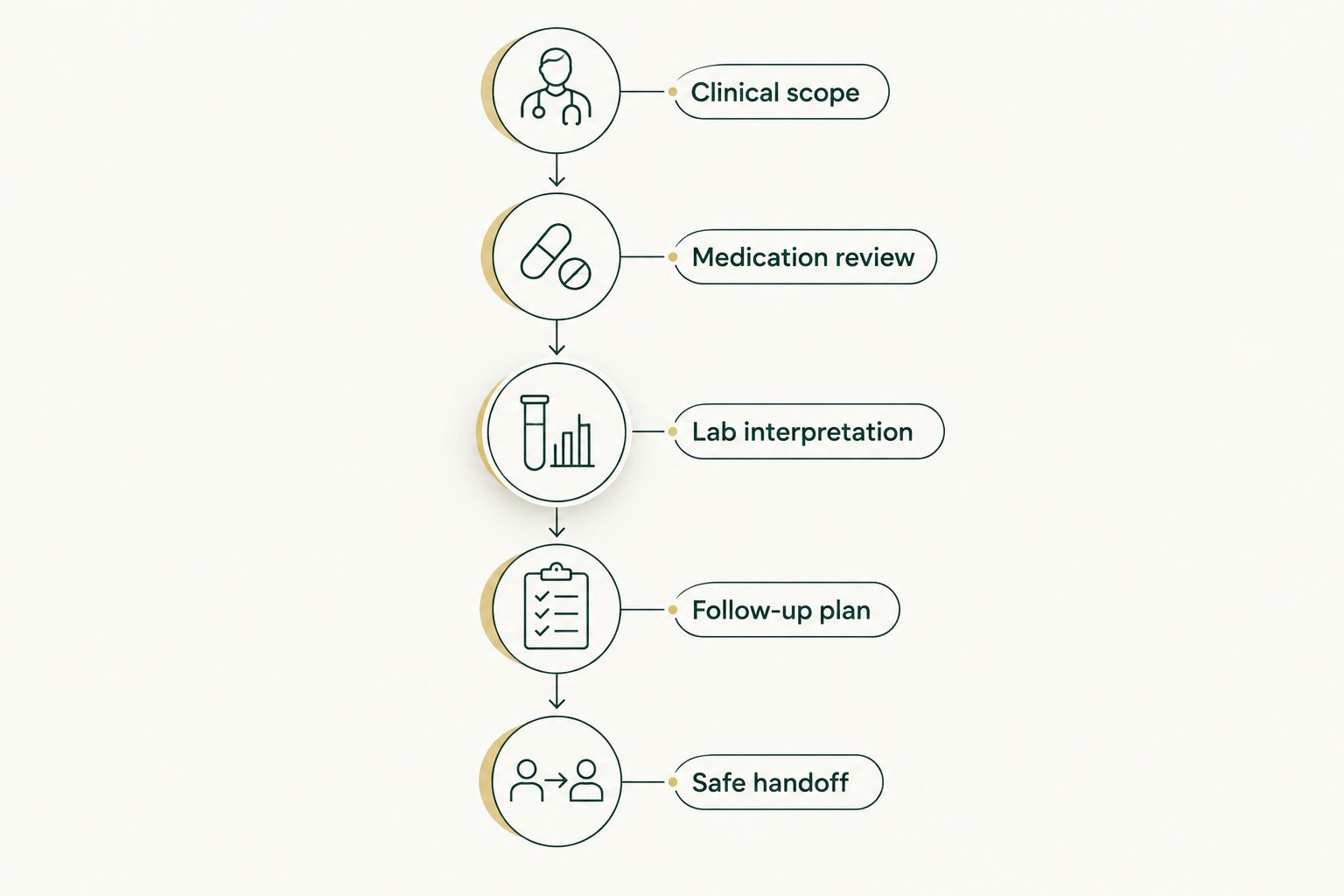
Choose the next clinical relationship before ending the current one.
Clinical scope
Write down what you want managed. Include your diagnosed conditions, symptoms, current medications, and the reason you are considering a change. Ask which needs the practice handles directly and which require outside care.
A provider saying it offers metabolic health is not enough. Ask who evaluates abnormal thyroid results, reviews cardiovascular risk, and coordinates any specialist recommendation. The answer should identify responsibility, not just list services.
Medication review
Bring the exact medication name, formulation, prescribed dose, date of your last dose, and any side effects. Include nonprescription products and other medications. Do not assume that drugs containing the same molecule carry identical indications or instructions.
Ask whether the new clinician intends to continue, reconsider, or pause treatment after evaluating you. No provider should promise a particular prescription before the clinical assessment.
Lab interpretation
Ask which results the clinician needs and whether existing records can support the assessment. Confirm who reviews the results with you and what happens when a finding is abnormal.
ApoB, Lp(a), hs-CRP, HbA1c, and thyroid or hormone testing answer different clinical questions. A broad panel still needs context. Symptoms, medical history, medications, and prior results matter when deciding what to do next.
ApoB, Lp(a), hs-CRP, HbA1c, and thyroid or hormone testing answer different clinical questions. A broad panel still needs context — symptoms, medical history, medications, and prior results matter when deciding what to do next.
Follow-up plan
Ask how to report side effects, how routine treatment questions are handled, and where urgent concerns belong. Distinguish scheduled monitoring from evaluation of a new problem.
For a membership that includes a Biomarker Audit every 90 days, confirm the plan between those audits. A quarterly cadence is not an instruction to wait until the next blood draw before discussing concerning symptoms.
Safe handoff
Identify the clinician responsible for your medication before ending the current arrangement. Request relevant visit notes, prescription details, and laboratory results. Tell both practices that you are transferring care so responsibility is clear.
Do not overlap GLP-1 treatments or improvise a restart after an interruption. The receiving clinician should provide medication-specific instructions based on your treatment history and current condition.
What meaningful monitoring looks like
The scale measures weight, not the whole treatment outcome. A clinically useful review also considers tolerance, nutrition, activity, symptoms, and the laboratory findings relevant to your health.
For example, HbA1c informs assessment of blood sugar, while ApoB helps assess atherogenic particle burden. Lp(a) provides information about an inherited cardiovascular risk factor. hs-CRP is an inflammation marker that requires interpretation rather than a diagnosis by itself.
Hormone and thyroid findings also need clinical context. A symptom such as fatigue has multiple possible explanations; a hormone prescription is not the automatic answer. Likewise, treating thyroid dysfunction is not a general weight-loss strategy for someone without an appropriate diagnosis.
In 2026, ask what the clinician will do with each result. A clear explanation of the decision is more useful than the size of a laboratory panel. Diet and physical activity remain part of medical weight management; medication does not make them unnecessary.
When staying with TrimRx is the right call
Stay with TrimRx if your existing clinician provides appropriate evaluation, clearly explains your medication, reviews relevant monitoring, and responds to treatment problems. Continuity has value. A new brand name does not improve care by itself.
Before switching, ask your current clinician whether the unmet need can be addressed within your existing arrangement. If the answer is yes, and the care meets your needs, staying avoids an unnecessary transfer.
The honest 2026 verdict is conditional: choose an integrated membership for integrated care, local primary care for hands-on continuity, or a specialist for a specialist question. Stay when the current clinical relationship already does the job.
FAQ
What's the best TrimRx alternative in 2026?
GoodLife Health is the best fit for patients seeking Cardiometabolic Optimization that connects metabolic, hormonal, and cardiovascular care. Local primary care is a better fit when hands-on examinations are the main priority; endocrinology fits complex endocrine questions.
Should I leave TrimRx if my treatment is working?
You do not need to leave TrimRx when your treatment is appropriate and your clinician provides the monitoring and follow-up you need. First ask whether any unmet need can be addressed within your existing clinical relationship.
What should I compare besides the medication?
Compare clinical scope, laboratory interpretation, side-effect management, medication sourcing, and responsibility for follow-up. The same medication name does not establish that two providers deliver the same care.
Are medications included in the Cardiometabolic Optimization Membership?
Medications are billed separately by the pharmacy at pharmacy cost. The membership does not add medication markup, molecule upcharges, or dose upcharges, and insurance coverage is not guaranteed.
How often does the membership include bloodwork?
The Cardiometabolic Optimization Membership includes one Biomarker Audit every 90 days, equivalent to 4 audits per year. Testing runs through the Beluga Health lab network, and additional labs beyond that cadence are billed separately at pass-through cost.
Does the program offer compounded semaglutide or tirzepatide?
The program does not prescribe or facilitate compounded semaglutide or tirzepatide. Its GLP-1 treatment uses branded, FDA-approved medications when the evaluating physician determines that treatment is appropriate.
Who provides clinical care in the membership?
Clinical care is delivered by licensed physicians of Beluga Health, P.A., an independent Florida professional corporation licensed to practice in all 50 states. Your physician evaluates your history, laboratory findings, and treatment needs before prescribing.
References
- Tirzepatide Once Weekly for the Treatment of Obesity (SURMOUNT-1). 2022. pubmed.ncbi.nlm.nih.gov/35658024/
- Once-Weekly Semaglutide in Adults with Overweight or Obesity (STEP 1). 2021. pubmed.ncbi.nlm.nih.gov/33567185/